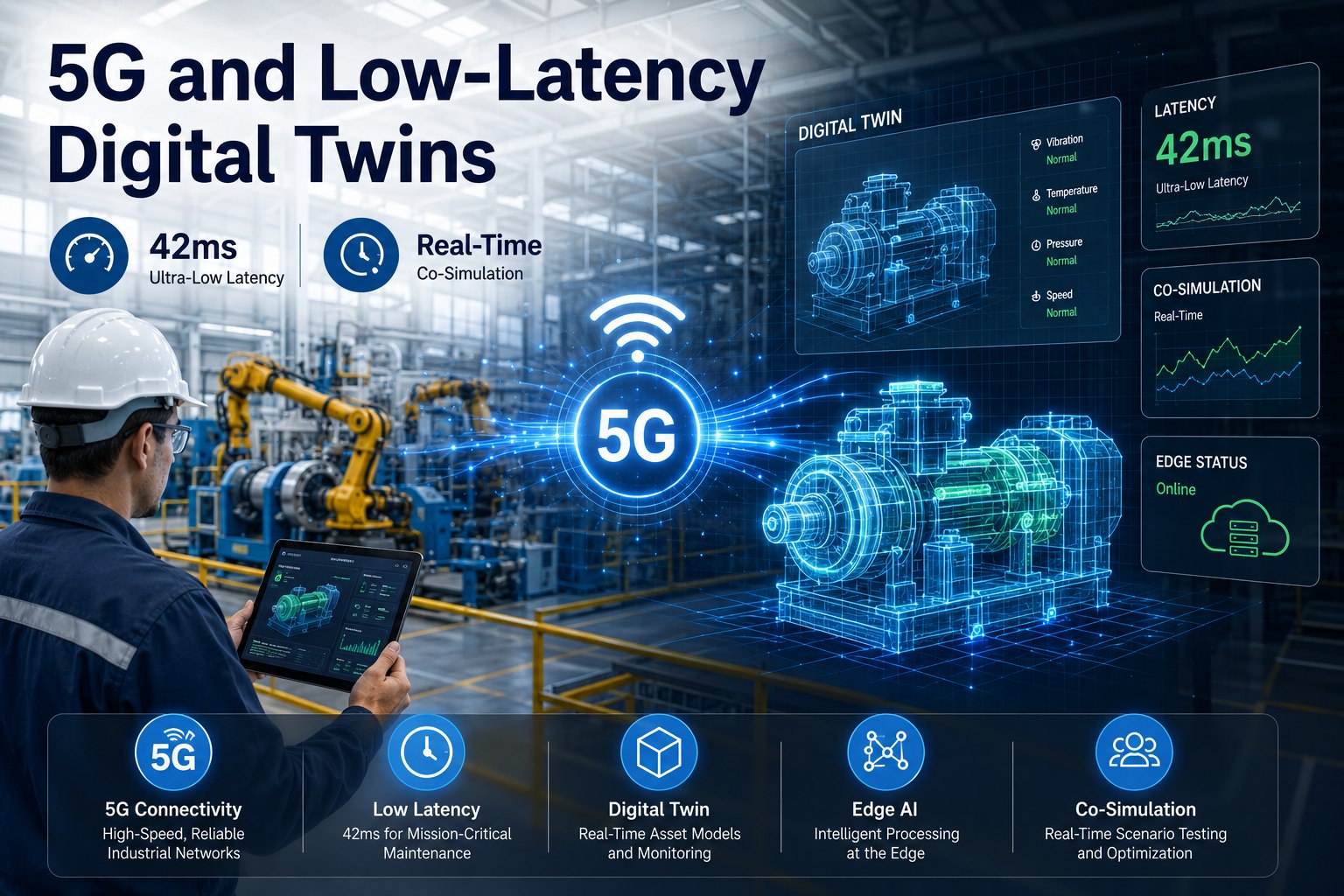
A digital twin is only as useful as the freshness of its data. If the twin is 100 milliseconds behind the physical asset it represents, you can use it to plan and analyze. If it's 1 millisecond behind, you can use it to control. The gap between those two numbers is the difference between a digital twin that monitors and one that closes the loop. 4G LTE puts you firmly in the first camp at typical 50-100ms latencies. 5G's Ultra-Reliable Low-Latency Communications (URLLC) profile drops the floor to sub-millisecond round-trip — fast enough to coordinate AGVs, sync co-bots in human-robot collaboration, run real-time motion control over wireless, and run digital twin co-simulation at the speed the physical asset actually moves. The OxMaint edge stack on private 5G delivers 42ms end-to-end including AI inference — well inside the budget for mission-critical maintenance applications. This guide walks through what 5G URLLC means for digital twin maintenance, how the latency budget breaks down by application, and how the OxMaint deployment integrates 5G connectivity, edge AI, and the digital twin co-simulation engine into one stack that ships pre-trained in 6–12 weeks. Sign up free to see 5G-enabled digital twin co-simulation running on your asset data.
MAY 12, 2026 5:30 PM EST , Orlando
Upcoming OxMaint AI Live Webinar — 5G and Low-Latency Digital Twins
Live session for OT engineers, smart factory architects, plant network leads, and reliability programs evaluating 5G URLLC for digital twin maintenance. We'll walk through the latency cascade from 4G LTE to URLLC, demonstrate the OxMaint 42ms end-to-end edge stack on private 5G, show real-time co-simulation between a physical asset and its digital twin, and walk through the OxMaint deployment that ships pre-configured for 5G integration in 6–12 weeks.
Every digital twin application has a latency budget. If your network can't meet it, the twin becomes a nice visualization rather than a control surface. The race below shows how four wireless network types compare on round-trip latency to a physical asset — the time between the asset moving and the digital twin reflecting that motion. The gold tape at 50ms marks the boundary for condition monitoring. The red tape at 1ms is where motion control lives. Where each network finishes determines what you can actually do with it.
0ms
1ms
10ms
42ms
50ms
80ms
5G URLLC Private network
<1ms
Motion control · Co-bots
OxMaint Edge Stack Private 5G + edge AI
42ms
DT co-sim · AI inference
5G eMBB Public 5G
~15ms
Condition monitoring
4G LTE Public cellular
~80ms
Analytics only
0–1ms · Motion control
1–10ms · Real-time control
10–50ms · Co-simulation & monitoring
50ms+ · Analytics & planning
The Bidirectional Twin — Physical and Digital, Synchronized
A digital twin maintenance system isn't just a 3D model that looks like the asset. It's a continuously running simulation that ingests sensor data, runs physics-based or ML-based predictions, and pushes commands or alerts back to the physical system — all in real time. The diagram below shows the two-way data flow that makes co-simulation possible: physical asset state flows up to the twin every cycle; predicted issues, control adjustments, and alert thresholds flow back down. The latency of that round trip is what determines whether your twin can actually close the loop. Book a demo to see the bidirectional twin sync running on your equipment.
PHYSICAL
Production Asset
Sensors capturing vibration, temperature, current, position at full sample rate. Wireless triaxial accelerometers + IR cameras + PLC tags.
▶
UPSTREAM Sensor state · 5G URLLC
42ms
Round-trip
◀
DOWNSTREAM Predictions · Alerts · Setpoints
DIGITAL
Digital Twin
Physics-based + ML simulation running on RTX PRO 6000 Blackwell. Mirrors physical state continuously. Runs failure scenarios at 100× real time.
Latency Budgets — Mapping Applications to Network Tier
Different maintenance applications need different latencies. Predictive analytics that aggregates sensor data over hours doesn't need URLLC — it works fine over 4G. Motion control of a co-bot operating next to a human worker needs sub-millisecond latency or it's unsafe. Most maintenance applications sit in between. The mapping below shows which applications fit in which latency bucket, and which networks can deliver each. Sign up free to map your maintenance applications to the right latency tier.
1ms
Motion Control
Co-bot safety zones
High-speed servo loops
Force feedback teleoperation
5G URLLC only
5–10ms
Real-Time Control
AGV coordination
Remote operation
Augmented-reality overlays
5G URLLC
42ms
DT Co-Simulation
Bidirectional twin sync
AI inference + alert push
Operator HMI updates
OxMaint edge stack
50–100ms
Condition Monitoring
Vibration trending
Thermal anomaly detection
Health-score updates
5G eMBB · Wi-Fi 6
100ms+
Analytics & Planning
Predictive maintenance
Parts forecasting
Reliability reporting
4G · Wi-Fi · Wired
Network Slicing — Why It Matters for Industrial 5G
Network slicing is exclusive to 5G, and it's what makes private industrial 5G fundamentally different from sharing public bandwidth. A slice is a dedicated logical network running on the same physical 5G infrastructure, but with reserved bandwidth, latency guarantees, and isolation from other traffic. Your factory's URLLC slice sits next to a public eMBB slice (consumer phones), an mMTC slice (low-power IoT), and other tenants — but they cannot interfere with your motion-control packets. The diagram below shows how the same 5G infrastructure can carry all four traffic classes simultaneously without compromise. Sign up free to map your maintenance traffic to the right URLLC slice configuration.
URLLC SLICE
Industrial Mission-Critical
<1ms · 99.9999% reliable · Reserved
eMBB SLICE
Enhanced Mobile Broadband
~15ms · Best-effort · High bandwidth
mMTC SLICE
Massive IoT Sensors
~100ms · Low power · 1M devices/km²
PUBLIC SLICE
Consumer / Default
Variable · Shared · Best-effort
One physical 5G network · Four isolated logical slices. Your factory's URLLC traffic gets reserved bandwidth and latency guarantees, regardless of what's happening on the other slices.
Owned, Not Rented — The OxMaint 5G + Digital Twin Stack
The OxMaint 5G Digital Twin deployment isn't a SaaS subscription you pay every month forever. It's a pre-configured AI server bundled with the digital twin co-simulation engine, edge AI inference, and 5G integration kit — designed to ride your private 5G network at 42ms end-to-end. Get a quote and order it like the hardware it is — pre-configured, pre-tested, ready to ingest sensor streams within days, and owned outright the day delivery completes.
Perpetual License
No monthly fees, no per-twin metering, no per-device billing. Future costs are entirely optional and at your discretion.
Data Sovereignty
Twin state, sensor history, simulation results all live on your server, behind your firewall. Never uploaded.
Source Access
Source code and modification rights included. Customize twin physics models, add asset types, retrain freely.
AI-Native Core
Predictive maintenance, anomaly detection, NLP work orders — all built into the twin engine, not bolted on.
Pre-Configured · 5G-Ready · Ships in 6–12 Weeks
Order an OxMaint 5G Digital Twin Stack — Pre-Loaded, Owned
A complete on-prem digital twin maintenance deployment for 5G-enabled factories. AGX Orin appliances on the URLLC slice running per-asset twin sync at sub-50ms latency. RTX PRO 6000 Blackwell central server running the physics+ML co-simulation engine, AI inference, and the OxMaint dashboard. Pre-configured for integration with private 5G networks (Ericsson, Nokia, Firecell, Celona). 5G modems, network slicing config, and PROFINET RT/PROFIsafe gateway included. Pre-trained on industrial datasets, ready to fine-tune within days.
The OxMaint 5G Digital Twin Stack uses the standard per-plant architecture: central RTX PRO 6000 Blackwell server plus two AGX Orin edge appliances. Twin engine, 5G integration kit, network slicing config, and CMMS connectors all included in the OxMaint AI Software + Integration line. Book a demo to walk through per-plant pricing for your 5G footprint.
Swipe to see breakdown
Component
Unit Cost
Per Plant
Notes
RTX PRO 6000 Blackwell 96GB Server
$19,000
$19,000
Twin engine + AI inference
NVIDIA AGX Orin #1 (5G Edge)
$4,000
$4,000
Per-asset twin sync at sub-50ms
NVIDIA AGX Orin #2 (URLLC Slice)
$4,000
$4,000
Real-time inference on URLLC
5G Modems + PROFINET Gateway
~$2,500
~$2,500
URLLC modem, RT/safe gateway
Local Electrical / Instrumentation
$8,000–$12,000
~$10,000
Sensor mounting, antenna runs, conduit
OxMaint AI Software + Integration
$35,000–$55,000
$45,000 avg
Twin engine, slicing config, CMMS connectors
Per-Plant Total (excl. 5G network)
$72,500–$94,500
~$84,500 avg
4-month delivery per plant
4-Plant Full Rollout (with Enterprise AI)
~$420,000–$520,000
Total programme
Parallel delivery + DGX Station GB300 Ultra
$84.5K
Avg per plant
42ms
End-to-end
$0
Recurring fees
∞
Perpetual
Perpetual · Owned · Source Access · Data Sovereignty
Stop Watching Your Twin Lag — Sync at 42ms, Owned
Real-time digital twin co-simulation. URLLC-ready edge AI. Bidirectional sensor-to-twin sync at 42ms end-to-end. Network-slicing-aware deployment for private industrial 5G. Your team owns the platform, the twin engine, and the source code outright. The architecture every modern smart factory adopting 5G needs alongside the network itself.
Do I really need 5G URLLC, or will my existing Wi-Fi 6 / wired network work?
It depends on the application latency budget. Wi-Fi 6 typically delivers 5-15ms latency in well-engineered industrial deployments — fine for condition monitoring, health-score updates, and most digital twin co-simulation use cases. Wired Ethernet is even faster (sub-millisecond) but obviously requires cabling. The cases where 5G URLLC is genuinely required: motion control of co-bots operating in the same physical space as humans, AGV coordination across large facilities where Wi-Fi roaming creates latency spikes, mission-critical applications that need 99.9999% reliability over wireless, and any application running PROFINET RT or PROFIsafe over wireless (which 5G URLLC supports natively but Wi-Fi cannot guarantee). For maintenance specifically, the 42ms end-to-end OxMaint edge stack works fine over Wi-Fi 6 in most plants — 5G URLLC becomes important when you're integrating with safety systems, AGVs, or co-bots that need deterministic latency guarantees.
What does the 42ms end-to-end latency actually break down into?
The 42ms includes: ~1-2ms for the URLLC over-the-air radio round trip, ~5-8ms for the 5G core network processing, ~10-15ms for the AGX Orin edge AI inference (running per-asset autoencoders and anomaly scoring), ~10-15ms for the dashboard update and operator HMI refresh, plus ~3-5ms of buffer and protocol overhead. The dominant contributors are AI inference and HMI rendering — not the network itself. This is why edge AI matters for low-latency applications: pushing inference back to the central server adds 50-100ms of WAN round trip and breaks the latency budget. Running inference on the AGX Orin appliance at the edge (3 meters from the asset, on the same URLLC slice) keeps the entire round trip inside the 50ms condition-monitoring budget. For motion control applications that need sub-1ms, the OxMaint stack uses a separate inline path that bypasses the dashboard and runs only the safety-critical inference — but that's a different architecture than the maintenance workflow described in the rest of this page.
Can I deploy this on a public 5G network or do I need a private 5G network?
Both options work, but private 5G is strongly recommended for production maintenance applications. Public 5G eMBB delivers ~10-20ms latency in good conditions and is fine for analytics-tier maintenance applications (predictive trending, parts forecasting, reporting) — these don't need URLLC anyway. However, public 5G doesn't reliably deliver URLLC (network slicing for industrial customers on public infrastructure is still limited), and your traffic shares bandwidth with consumer phones. Private 5G is what gives you the URLLC slice, the network isolation, the deterministic latency guarantees, and the option to run PROFINET RT/PROFIsafe over wireless. Costs vary widely: a turnkey private 5G network like Firecell's Pegasus runs around £10,100 for an indoor lab + £84/1000m²/month covering up to 10,000m². Larger Ericsson or Nokia private 5G deployments run higher, but with more capacity and integration depth. The OxMaint stack is private-5G-ready out of the box and integrates with all major private 5G vendors.
How does the digital twin co-simulation actually work — is it a 3D model?
A maintenance digital twin is not primarily a 3D visualization (though most include one for operator HMI use). The core of the twin is a continuously running simulation that models the physics and degradation behavior of the asset — for a pump, that's flow dynamics, bearing wear models, impeller cavitation, seal degradation; for a motor, it's electromagnetic state, winding insulation health, bearing mechanics. The simulation runs in parallel with the physical asset, ingests real sensor data continuously, and uses that data to update its internal state to match reality. Where the simulation diverges from real measurements, that divergence is itself a signal — it can indicate sensor drift, model inaccuracy, or a real anomaly developing. The "co-simulation" term means both physical asset and digital twin are running simultaneously and synchronized. The twin can also run forward at faster than real time (100× is typical for the OxMaint engine) to predict failure trajectories under different operating conditions, which is what makes it useful for maintenance planning rather than just monitoring.
How long until our team is productive operating 5G + digital twin infrastructure?
Most teams reach basic productivity within 4-6 weeks of deployment and full operational fluency within 4-6 months. The OxMaint 5G Digital Twin deployment includes structured training: weeks 1-2 cover the unified dashboard, twin synchronization basics, mobile app, and asset model navigation; weeks 3-4 cover URLLC slice management, latency-budget monitoring, and AI inference interpretation; weeks 5-12 cover advanced topics including custom physics-model authoring, twin parameter tuning, network-slice prioritization rules, and integration with existing PLC/SCADA infrastructure. Teams already running a CMMS ramp faster on the maintenance workflow side; teams already running OT networks ramp faster on the 5G/slicing side. The OxMaint deployment includes a dedicated engineer for the first 6 weeks who handles twin model authoring for your specific asset types — by month 4, your team is independently operating the platform and authoring new twins for additional asset categories.