Hospitality & Hotel AI: Guest Operations and Asset Care
By Riley Quinn on May 4, 2026
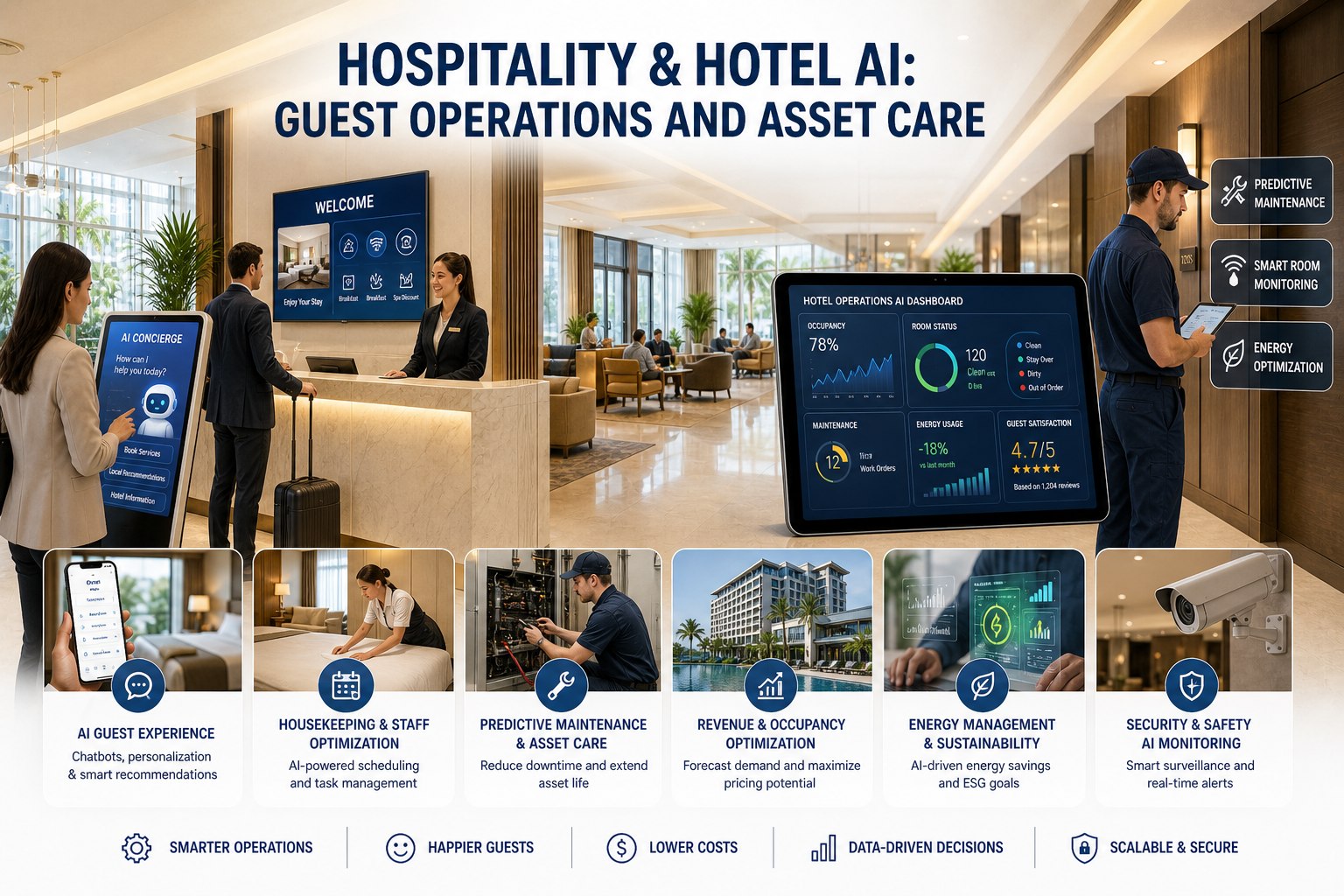
It's 6:14 AM at a 250-room hotel. The night auditor closes the books while the AI quietly preheats Room 412 — the guest's flight lands at 7:30 and check-in moved up. By 6:42, a vibration anomaly flags the chiller serving the east tower. By 11:15, an Allen key drops from a minibar door hinge a model said would fail 9 days from now. At 6 PM, the revenue engine bumps the next-week rate after spotting an event surge. At 11:42 PM, an AI concierge tells a guest where the late-night ramen is. None of these moments looked like AI to anyone — they looked like a hotel that just worked. Sign up free to run the same playbook on your property.
MAY 12, 2026 5:30 PM EST , Orlando
Upcoming OxMaint AI Live Webinar — Hotel AI Operations: From PMS to Plant Room in One Stack
Live session for hotel CIOs, GMs, chief engineers, and revenue directors. We'll architect the complete on-prem AI stack for a 250-room property — PMS integration, predictive maintenance for HVAC and critical assets, energy optimization, guest messaging — and walk through the Marriott-style 25% equipment-failure reduction playbook.
The properties using AI well aren't running it as a feature — they're running it as a continuous backdrop. Here's what an actual operating day looks like when the PMS, the BMS and the asset list are talking to one AI layer that's awake 24/7.
Guest's airline API shows wheels-down at 06:42. AI cross-references PMS arrival, ambient temp, and guest's historical setpoint preference. HVAC starts heating Room 412 at 06:14 — not 06:00 (wastes energy), not 07:30 (cold room).
Energy + Guest Experience
07:42
Chiller-3 vibration anomaly flagged
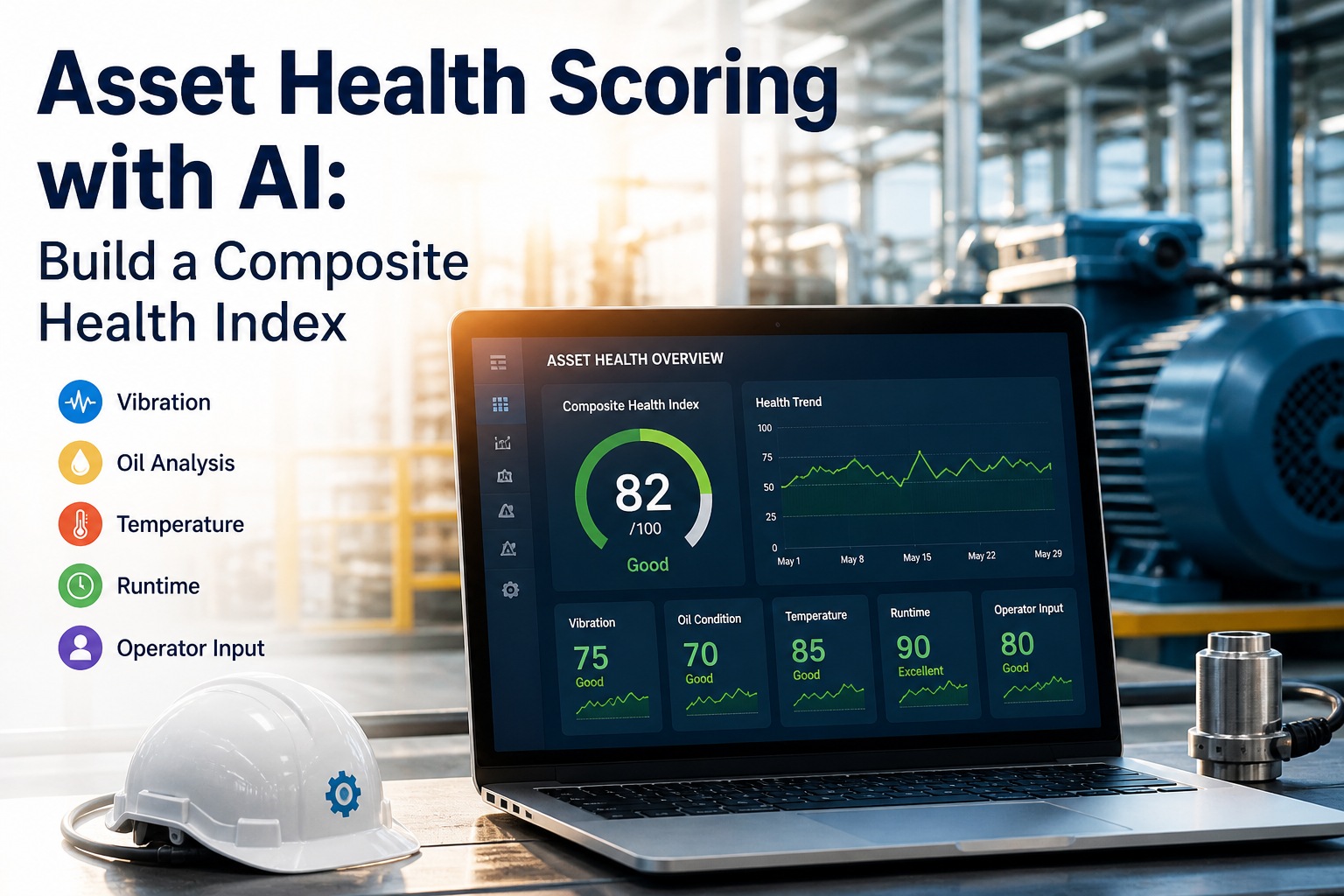
East-tower chiller showing 14% above baseline vibration on bearing assembly. Model predicts failure window 9–14 days out. Auto-creates CMMS work order, schedules service Tuesday 02:00 when load is lowest, parts arrive Friday.
Asset Care
09:33
Housekeeping route re-optimized
Three early checkouts logged in PMS. AI re-routes housekeeping cart sequence — guest in Suite 814 has a 13:00 arrival flagged "engineering background, photographs rooms" so quality-priority routing applies. Engineering also alerted: TV in 814 due for firmware update.
Operations
11:15
Minibar hinge replaced — 9 days early
Engineering tech replaces hinge on Room 1206 minibar before guest arrival. Door close-cycle data showed micro-binding pattern model has seen end in failure 8 of 8 last times. Cost: $11 + 4 minutes. Cost if it had failed mid-stay: $0 minibar + room reassignment + service recovery.
Asset Care
14:08
Guest WhatsApp handled in 11 seconds
"Hi can I get a late checkout till 3?" — AI checks PMS for next reservation in 1709 (none until 17:00), confirms 15:00, logs the loyalty touch, notifies housekeeping to defer. No staff time consumed. Guest replied "thank you so much <3" — measurable satisfaction signal logged.
Guest Experience
16:51
Rate adjustment for Friday — local event surge detected
AI scrapes city event calendar, OTA rate parity, competitor positioning. Detects a 4-night convention 12 mi away, midweek demand softer than usual, weekend peaks. Recommends $34 ADR lift Thu–Sat, $18 cut Sun–Mon. Revenue manager approves with one tap.
Revenue
19:22
Ballroom HVAC ramps down — load shift
Wedding event running late, but kitchen prep zones are cooling. Model reads BMS load, knows ballroom dinner already served, ramps down kitchen cooling 22% over 40 min. Saves 64 kWh — and the GM never even saw the decision get made.
Energy
23:42
Late-night ramen request — and a stay extension
Guest in 904 messages asking for a ramen recommendation. AI suggests three spots open until 02:00, surfaces an in-room dining option as fallback, and notes the guest's stay ends Thursday — quietly offers a Friday extension at preferred-loyalty rate. Booking added before front desk even sees the conversation.
Guest + Revenue
The Three Systems That Already Live in Your Hotel
The reason hotel AI works on-prem so well isn't theoretical — it's that the three systems AI needs to read are already in the building. The PMS server, the BMS controller, and the asset/CMMS database are all on-property already. The AI layer just needs to live where they live. Book a demo to see the integration walkthrough on a real property.
The intersection is where ROI lives
Each system on its own is just data. The PMS knows who's in the room. The BMS knows the temperature. The CMMS knows the chiller history. None of them, alone, can tell you that Room 412's slightly warm air is because the chiller serving that zone has been drifting for 6 days and is 9 days from failure. The AI layer reads all three at once — and that's where the Marriott-style 25% failure reduction comes from. It's not a smarter algorithm; it's the same algorithm with three data sources instead of one.
The on-prem AI server lives in the same building as the data. Latency is the network cable, not the internet.
The 25% Number, Decoded
Marriott's published 25% reduction in equipment failures from AI predictive maintenance is the headline. But the hotel buying AI infrastructure today wants to know what's actually behind that number — what specifically drops, what shifts category, and where the savings show up on the P&L.
25%
Equipment failure reduction (Marriott, published)
↓ what actually drives that number
Emergency repair calls
−38%
Shift from "broken at 2 AM" to "scheduled at 02:00 Tue"
Rooms out-of-order from equipment
−45%
Failures avoided entirely or shifted to vacant windows
Service-recovery comps to guests
−52%
No mid-stay HVAC failures = no comp nights to issue
Avg HVAC asset useful life
+22%
Right-time service extends life vs run-to-failure
Engineering team time on planned vs reactive
+65%
Team works calendar, not pager alerts
Net effect on a 250-room property: roughly $84K–$140K annual P&L impact, before the energy and guest-satisfaction effects compound.
Pre-Configured · PMS-Ready · Ships in 6–12 Weeks
Order the Complete Hotel AI Stack as One SKU
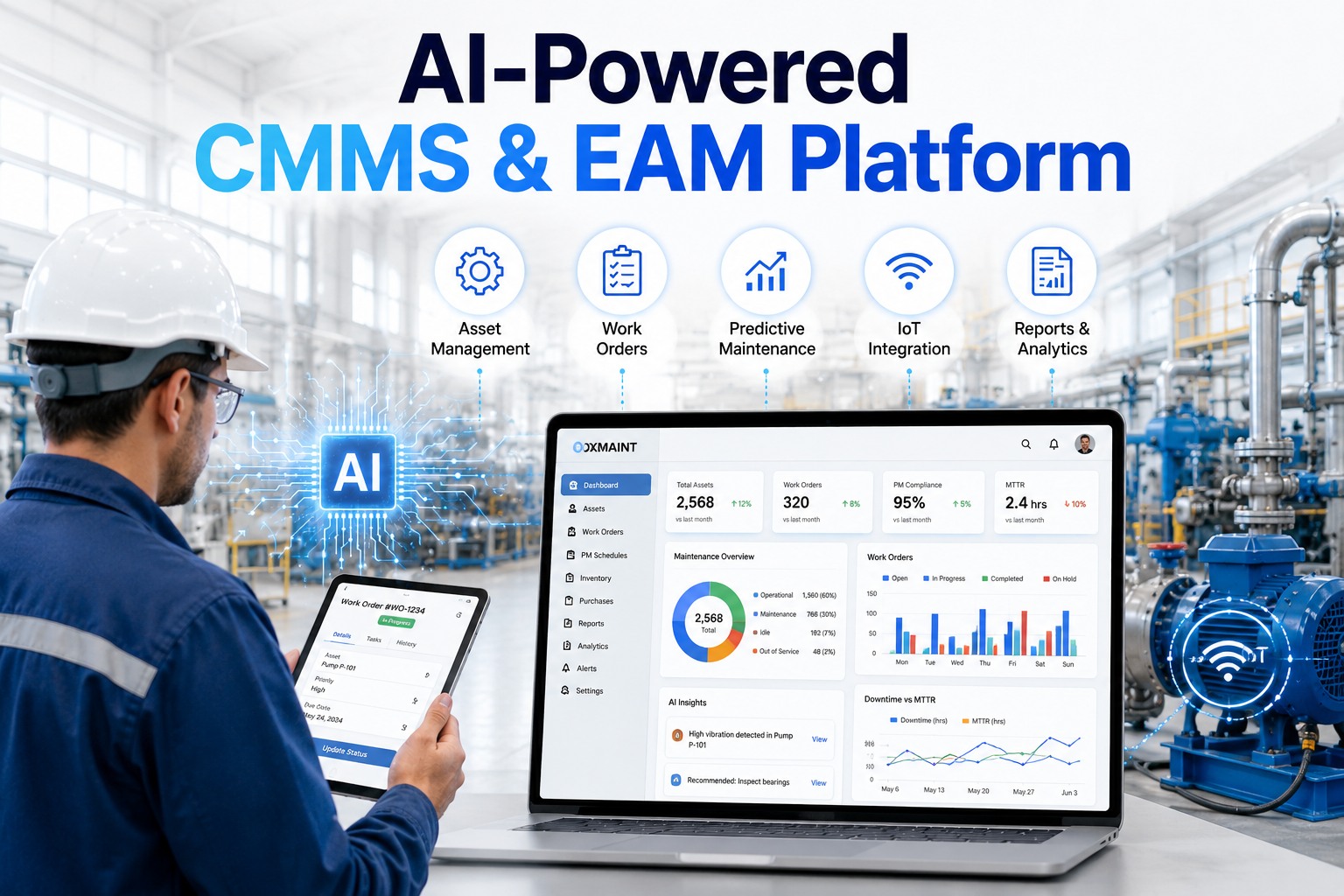
OxMaint's hotel AI server arrives with PMS connectors, predictive maintenance models, BMS bridge, and guest messaging stack pre-installed. Pre-configured, pre-tested, ready to plug into your network and run within days. Perpetual license, full source access, all guest data and asset telemetry stays on your premises.
Hotels are the rare vertical where the on-prem AI argument isn't about compliance theater or vendor lock-in worry — it's about the data already being on-property. The PMS server, the BMS controller, the asset list, the energy meters — all already in the building. Putting the AI layer in the same room is removing a bottleneck, not adding a constraint. The hotels that figure this out early stop paying for round-trip latency between their plant room and a Virginia data center for decisions that have to happen in seconds. Sign up free to map this against your specific PMS and BMS setup.
What Hotel AI Actually Costs in 2026
Hotel AI vendors typically quote a $40K–$400K range and bury recurring SaaS fees, per-seat charges, or per-conversation pricing in the contract. The OxMaint hotel AI server is a one-time capital purchase: hardware, perpetual software license, AI models, and integration with your PMS, BMS, and CMMS. No recurring license fees. Future costs are entirely optional and at your discretion. Sign up free to see the full pricing breakdown for your property type.
Swipe to see breakdown
Component
Unit Cost
Per Hotel (4 mo)
Notes
AI server (GPU + compute)
$19,000
$19,000
Guest messaging LLM + analytics core
Edge inference unit
$4,000
$4,000
BMS / IoT bridge — HVAC, elevators, energy
Network + install
$10,500–$14,500
~$12,500
Hotel VLAN, plant-room cabling, electrical
OxMaint AI software + PMS/CMMS integration
$35,000–$55,000
$45,000 avg
Perpetual license, AI models, Opera/Mews/Protel integration
PMS-embedded AI sees PMS data only. It can't correlate a guest's late-arrival flag with a chiller anomaly with a housekeeping route. The OxMaint server sits above the PMS and reads PMS + BMS + CMMS together. You keep your PMS AI for what it does well; you add the layer that sees across systems.
"Our property is too small to justify $84K."
A 120-key independent hotel running 65% occupancy that prevents 4 mid-stay HVAC failures and 1 chiller emergency in year one has already paid for the server. The math gets harder to argue with at 250+ keys, 80%+ occupancy, or any property with a banquet operation.
"We're a branded property — IT decisions go through the flag."
The on-prem server runs alongside your branded systems, not against them. It connects to the same PMS the brand mandates. Most flag IT teams approve on-prem AI specifically because it doesn't touch the brand cloud — guest data stays property-side.
"What happens when our PMS vendor changes the API?"
You own the source. You modify the connector. No change-order with us, no waiting on a vendor roadmap. Source access and modification rights are part of the perpetual license — that's the whole point of the owned-platform model.
"How long until this thing is actually running?"
6–12 weeks from sign-up to live operation. Server is pre-configured, pre-tested, factory-validated against synthetic hotel data. On-site work is rack the box, plug into your VLAN, run the connect-systems wizard, validate, go live. Most properties cut over during a low-occupancy week.
Perpetual · PMS-Ready · One Hotel or Full Portfolio
Stop Renting Hotel AI by the Conversation
A complete hotel AI platform on enterprise-grade hardware at your property. PMS connectors, predictive maintenance, energy optimization, and guest messaging — all pre-installed, all owned. No SaaS lock-in. Source code and modification rights included. Ready to run within days of arrival.
Which hotel AI workloads should run on-prem and which can stay in the cloud?
Three signals push a workload to on-prem: tight latency requirements (per-room HVAC adjustments, real-time guest messaging, predictive maintenance alerting), high data sensitivity (anything containing guest PII under GDPR/CCPA — including loyalty data, stay history, guest preferences), and continuous 24/7 operation (energy management can't have cloud-API outages). Three signals make cloud workable: latency in hours or days (brand-wide demand forecasting, weekly revenue analytics), aggregated or anonymized data (cross-property benchmarks, market positioning), and bursty compute (one-time model training, ad-hoc analysis). Most hotels in 2026 end up running a hybrid: on-prem AI server for the operational backbone, cloud for brand-wide analytics. The OxMaint hotel AI server is built for that hybrid pattern.
How does this integrate with our existing PMS — Opera, Mews, Protel, or Clock?
The hotel AI server connects to your PMS through standard APIs that all four major systems support. Opera (Oracle Hospitality) uses OPERA Cloud APIs and the legacy OXI/Opera Web Services for on-premise installs. Mews provides REST APIs for guest, reservation, and rate data. Protel offers PROTEL Web Services and the more modern Protel Air APIs. Clock PMS supports both REST and GraphQL endpoints. Integration scaffolding for all four ships pre-configured on the OxMaint server — what's left is providing API credentials, configuring which data fields sync (reservations, room status, guest profiles, rate plans), and validating against your specific PMS instance. Typical PMS connection takes 2–3 days from credentials handover to live data flow. Same pattern applies to BMS and CMMS connections.
Can a single AI server handle a 250-room property, or do we need multiple servers?
A single OxMaint hotel AI server (RTX PRO 6000 Blackwell, 96GB ECC GDDR7) comfortably handles all four operational scenarios for properties up to roughly 400 keys — predictive maintenance on hundreds of assets, energy optimization across all rooms, 24/7 guest messaging, and revenue forecasting. Above 400 keys, or for properties with unusually heavy workloads (large banquet operations, casino floor, attached convention center, high-volume spa), the server can scale by adding GPU capacity in the same chassis or by deploying a second server for workload separation. For multi-property groups, the typical pattern is one server per property plus an optional Enterprise tier for cross-property analytics and brand-wide model fine-tuning.
What's the realistic timeline from purchase to live operation?
Six to twelve weeks from sign-up to live operation is typical. The compressed timeline works because the server is configured, integrated, and pre-tested in the OxMaint factory before shipping — GPU, AI software, PMS connectors, BMS bridge, CMMS integration scaffolding, and guest messaging stack are all installed and validated against synthetic hotel data before the unit leaves the assembly line. On-site work then collapses to: rack and power the server (1 day), connect to your PMS and BMS (2–3 days), validate data flow (1 week), run the AI models in shadow mode against live data while staff get familiar (1–2 weeks), then cut over to live operation. For multi-property rollouts, parallel deployment lands 3–4 hotels simultaneously inside a 4-month window.
How is this different from the AI tools already in our PMS or revenue management system?
Most PMS-embedded AI features are narrow and vendor-locked: a chatbot that only works inside the PMS UI, a forecasting model that only sees reservation data, a guest segmentation tool that can't reach your asset list. They're useful, but they don't solve the operational backbone problem because they can't see across systems. The OxMaint hotel AI server is the layer that sits above your existing systems and watches all of them at once — PMS for guest context, BMS for environmental data, CMMS for asset history, energy meters for consumption. That cross-system visibility is what produces Marriott's 25% failure reduction (which requires correlating BMS sensor data with PMS room status with CMMS service history) and Singapore-style 30% HVAC savings (which requires combining occupancy, weather, and rate data). You keep PMS-embedded AI for what it does well, and you add the OxMaint layer for what no single PMS module can do — see across the whole operation.