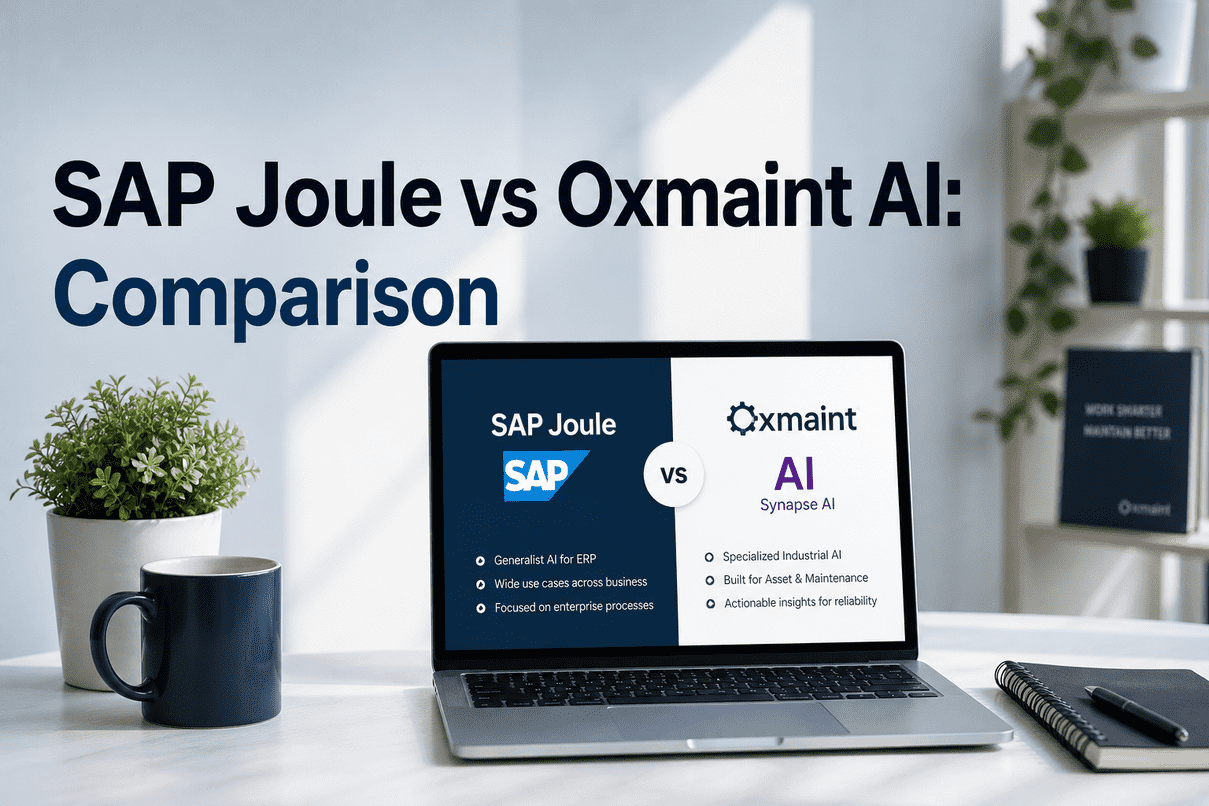
SAP Joule and Oxmaint AI are both labeled "enterprise AI" — but they're solving fundamentally different problems. Joule is a generalist business AI assistant orchestrating 40+ agents and 2,400 skills across finance, HR, procurement, and supply chain. Oxmaint's Synapse AI is a specialist industrial intelligence engine focused on one mission: predicting equipment failure 2–8 weeks before it happens and turning that prediction into a work order before downtime hits the P&L. The DSAG Investment Survey 2026 found that only 3% of SAP customers have moved Joule into production, while 77% of AI-active enterprises are using non-SAP solutions for use cases SAP can't reach fast enough. If your KPI is uptime, OEE, or MTBF — not expense reports and tender analysis — this comparison matters. See Oxmaint's Synapse AI catch a real failure 72 hours before breakdown — register for the live event.
GENERALIST ERP AI
SAP Joule
Embedded across 35+ SAP solutions. Orchestrates agents for finance, HR, procurement, and supply chain. Requires RISE or GROW with SAP contracts.
40+Agents across business functions
2,400Skills across SAP modules
3%Of SAP customers in production
SPECIALIST INDUSTRIAL AI
Oxmaint Synapse AI
Purpose-built for asset reliability. Predicts equipment failure from sensor data, auto-generates work orders, and runs as standalone or alongside any ERP — no migration required.
70%Reduction in unplanned downtime
72hrAverage failure prediction lead time
90%+Failure prediction accuracy
Two Different Bets on Where Enterprise AI Creates Value
SAP and Oxmaint are not competing for the same job. SAP is betting that the highest-value enterprise AI lives in process orchestration across business functions — automating expense reports, reconciling bank statements, generating tender analyses. Oxmaint is betting that the highest-value enterprise AI lives in operational technology — catching the bearing temperature drift that turns a $20K planned repair into a $350K catastrophic gearbox failure. Both bets can be right at the same time. But for asset-intensive operations, the math points clearly in one direction.
SAP's Bet
Cross-functional process AI delivering 30% time savings on expense reports, 80% on bank reconciliation, 27% gains in compliance hardening. Strong in finance, HR, procurement workflows.
Oxmaint's Bet
Industrial AI converting sensor data into prevented failures. 70% downtime reduction on monitored assets, 30% lower OPEX for wind fleets, 80–88% OEE for food plants vs 65–72% baseline.
Side-by-Side: Where Each Platform Actually Wins
Generic feature checklists hide the real differences. The table below compares both platforms on the dimensions that matter when a plant director or reliability engineer is choosing where to deploy AI dollars in 2026. Book a 30-minute Synapse AI walkthrough with an Oxmaint reliability engineer.
Capability
SAP Joule
Oxmaint Synapse AI
Primary Mission
Generalist enterprise AI across 35+ SAP applications — finance, HR, procurement, supply chain
Specialist industrial AI for predictive maintenance and asset reliability
Sensor & IoT Native
Limited Requires custom Joule Studio agents + BTP IoT services
Native OPC UA, MQTT, Modbus TCP, and REST sensor ingestion built in
Failure Prediction Models
Not core Generic ML available via BTP AI Foundation, custom build required
Built-in Asset-specific baselines, 90%+ accuracy, 2–8 week advance warning
Time to First Value
6–18 months Tied to S/4HANA migration, clean-core data, agent build
Days–Weeks First predictions confirmed within 2 weeks of sensor connection
Contract Prerequisites
RISE or GROW Locked to SAP cloud contracts; ECC users excluded
Standalone Runs alongside SAP, Oracle, Dynamics, or no ERP at all
Pricing Model
AI Units Min 100 units at €7 each; overages at 150–200% of contracted rate
Predictable Per-asset / per-user tiers with transparent scaling
Mobile Field Operations
Office-first Designed for back-office and knowledge worker UI
Field-first Offline mobile app, voice-to-text WO entry, QR scanning, GPS
ERP Integration
Native Embedded in S/4HANA; non-SAP via MCP / A2A protocols
Bidirectional Native connectors to SAP, Oracle, Microsoft Dynamics
The Core Architectural Difference — One Picture
SAP Joule reasons over structured business records in S/4HANA. Oxmaint's Synapse AI reasons over real-time sensor streams from the plant floor. That single architectural choice cascades into every difference that matters: deployment speed, ERP independence, ROI timeline, and which job each platform is built to do.
SAP Joule Architecture
04
Joule Assistants & Agents — role-based orchestration
03
BTP AI Foundation — model layer, AI Units billing
02
S/4HANA Cloud — clean-core master data required
01
RISE / GROW Contract — entry prerequisite
Oxmaint Synapse AI Architecture
04
Auto Work Orders — prediction → action in one flow
03
Synapse AI Engine — asset-specific failure models
02
IoT & PLC Layer — OPC UA, MQTT, Modbus native
01
Standalone or ERP-Connected — no migration needed
Don't Wait 18 Months for Your S/4HANA Migration to Reach the Plant Floor
Oxmaint's Synapse AI deploys alongside your existing ERP — SAP, Oracle, Dynamics, or none — and delivers prevented failures inside the first 60 days. No clean-core requirement, no RISE contract, no AI Units to budget. Just real industrial intelligence catching real failures.
5 Decision Scenarios — Which Platform Wins When
The right answer depends entirely on what you're trying to do. These five scenarios cover the realities most enterprise leaders face in 2026, and each one points to a clear best-fit platform — sometimes even both, working together.
01
"We're already on S/4HANA Cloud and want to automate finance and procurement workflows."
→ SAP Joule wins
Native embedding in S/4HANA, role-based assistants, and the cash-management and tender-analysis agents are exactly what Joule is built for.
02
"We need to cut unplanned downtime on a 200-asset plant — fast."
→ Oxmaint Synapse AI wins
First confirmed predictions in under 2 weeks. 70% downtime reduction documented across deployments. No ERP migration required.
03
"We're still on SAP ECC and ECC support ends Dec 2027."
→ Oxmaint Synapse AI wins
Joule is locked behind RISE/GROW contracts and excludes ECC users entirely. Oxmaint runs standalone or alongside ECC today, with zero migration dependency.
04
"We're a multi-site operation running mixed ERPs — SAP at HQ, Oracle and Dynamics at acquired sites."
→ Oxmaint Synapse AI wins
ERP-agnostic by design. Native connectors to all three. Single source of truth for maintenance across heterogeneous systems.
05
"We want both — back-office automation AND plant-floor predictive maintenance."
→ Both, working together
Run Joule for finance, HR, procurement workflows. Run Oxmaint Synapse AI for asset reliability. Oxmaint pushes work orders, parts requisitions, and cost data into SAP via native bidirectional integration.
The 2026 Reality Check — What the Data Actually Shows
3%
of SAP customers run Joule in production according to the DSAG Investment Survey 2026 — most enterprises are still in pilot or evaluation
77%
of AI-active enterprises use non-SAP solutions because they don't require RISE/GROW contracts or clean-core S/4HANA migration
$50B
lost annually by U.S. manufacturers to unplanned downtime — most preventable with sensor-driven predictive maintenance, not ERP automation
40%
of enterprise applications will include task-specific AI agents by end of 2026 (Gartner) — purpose-built specialists, not generalist platforms
Expert Take — Why Generalist AI Hits a Ceiling on the Plant Floor
"The hardest lesson from three years of enterprise AI deployments is that generalist platforms struggle on operational technology problems. Joule is genuinely strong at automating expense reports, generating tender analyses, and reconciling bank statements — these are pattern-rich, document-driven, ERP-bounded tasks. But predicting bearing failure on a cement mill drive at 4:17 AM on a Tuesday requires asset-specific baselines, sensor-level telemetry, and a model that has seen this exact failure mode dozens of times before. That's a different engineering problem, and it's solved by specialists with deep industrial focus, not by horizontal platforms still tied to ERP master data quality."
ERP Migration Is Not a Maintenance Strategy
Asset-intensive operations losing $200K+ per outage cannot wait 18 months for an S/4HANA clean-core migration. Predictive maintenance must deliver prevented failures now — on the assets running today, in the ERP environment that exists today.
Sensor Data Lives Outside the ERP
Vibration, temperature, current, acoustic emission — none of this is in S/4HANA. It lives in PLCs, SCADA historians, and IoT platforms. The AI that predicts failure has to reach into OT, not pull from finance master data.
Specialists Compound; Generalists Spread
Every prevented failure feeds Synapse AI's models with asset-specific outcome data, sharpening predictions over time. Generalist models trained on broad enterprise patterns plateau much sooner on narrow industrial problems.
Recommendation Matrix — Pick the Right Tool for the Job
If your priority is...
Recommendation
Reducing forced outages, MTTR, and OEE losses
Oxmaint Synapse AI
Automating finance, HR, procurement workflows
SAP Joule
Connecting PLCs, SCADA, and IoT sensors to maintenance
Oxmaint Synapse AI
Multi-ERP / multi-site asset visibility under one CMMS
Oxmaint Synapse AI
Process mining and back-office orchestration in SAP
SAP Joule
Both back-office AND plant-floor AI in one program
Both — Oxmaint integrates with Joule via SAP connector
See What Specialist Industrial AI Actually Does — Live
Join Oxmaint's live event to watch Synapse AI catch real failures from real sensor data — predict bearing wear 72 hours ahead, auto-generate the work order, check parts inventory, and schedule the technician. No slides. No theory. Just specialist AI doing the job generalist AI wasn't built for.
Frequently Asked Questions
Is SAP Joule a competitor to Oxmaint Synapse AI, or do they solve different problems?
They solve different problems. SAP Joule is a generalist enterprise AI assistant orchestrating 40+ agents and 2,400 skills across finance, HR, procurement, and supply chain — its strengths are expense report generation, bank reconciliation, tender analysis, and back-office process automation. Oxmaint's Synapse AI is a specialist industrial intelligence engine focused on predicting equipment failure from real-time sensor data and turning predictions into automated work orders. Many asset-intensive enterprises run both: Joule for finance and HR, Oxmaint for plant-floor reliability, with Oxmaint pushing work orders and cost data into SAP via native bidirectional integration. The platforms are complementary far more often than they are competitive.
Can Oxmaint replace SAP Plant Maintenance (PM) module?
Oxmaint can either replace SAP PM entirely or run alongside it as a specialized predictive maintenance layer — both deployment models are common. Enterprises with heavy SAP investment often keep SAP PM for ERP-side cost accounting and procurement integration, while Oxmaint handles the actual reliability workflows: sensor ingestion, failure prediction, work order automation, mobile field execution, and KPI dashboards. Oxmaint's bidirectional connector pushes completed work orders, parts consumption, and labor hours back into SAP for financial close. Other enterprises — particularly those still on ECC, those with multi-ERP environments, or those wanting to avoid the S/4HANA migration dependency — replace SAP PM with Oxmaint outright and gain a faster, more modern reliability platform with no clean-core data prerequisite.
Why do only 3% of SAP customers run Joule in production?
The DSAG Investment Survey 2026 attributes the low production rate to three factors: contract prerequisites (Joule requires RISE with SAP or GROW with SAP — ECC customers are excluded entirely), data readiness (Joule depends on clean-core S/4HANA master data and well-governed authorization design), and pricing complexity (AI Units bill at €7 per unit with overages running 150–200% of contracted rates). Meanwhile, 77% of AI-active enterprises are using non-SAP solutions like Microsoft Copilot, ChatGPT, or specialist platforms because those tools are available without contract or migration prerequisites. For asset-intensive operations, this gap is especially pronounced — the urgency of preventing forced outages doesn't align with multi-year clean-core migration timelines.
How fast can Oxmaint Synapse AI deliver measurable ROI compared to SAP Joule?
Oxmaint's Synapse AI typically confirms its first accurate failure predictions within 2 weeks of sensor data flowing in, and most plants document their first prevented failure inside 60 days — usually recovering the entire program cost in a single event. Across full deployments, customers report 70% reduction in unplanned downtime, 30% lower OPEX in wind fleet examples, and 80–88% OEE in food manufacturing versus the 65–72% industry baseline. SAP Joule's ROI timeline is more variable: SAP-documented metrics show 30% time savings on expense reports and 80% on bank reconciliation, but these gains are gated behind RISE/GROW contracts, S/4HANA readiness, and Joule Studio agent build cycles — typically 6–18 months to first production value for most enterprises.
Does Oxmaint integrate with SAP, and how does that integration actually work?
Yes. Oxmaint provides native bidirectional connectors to SAP S/4HANA, SAP ECC, Oracle, and Microsoft Dynamics. Sensor-triggered work orders generated by Synapse AI flow into SAP for cost accounting, parts requisitions hit MM for procurement, and completed work order data — labor hours, parts consumed, downtime impact — pushes back to SAP for financial close and KPI reporting. The integration is API-driven and does not require RISE/GROW contracts, BTP licensing, or S/4HANA clean-core migration to function. This means SAP customers gain specialist predictive maintenance capability immediately while preserving their existing ERP investment, and non-SAP customers get the same reliability outcomes without any ERP dependency.