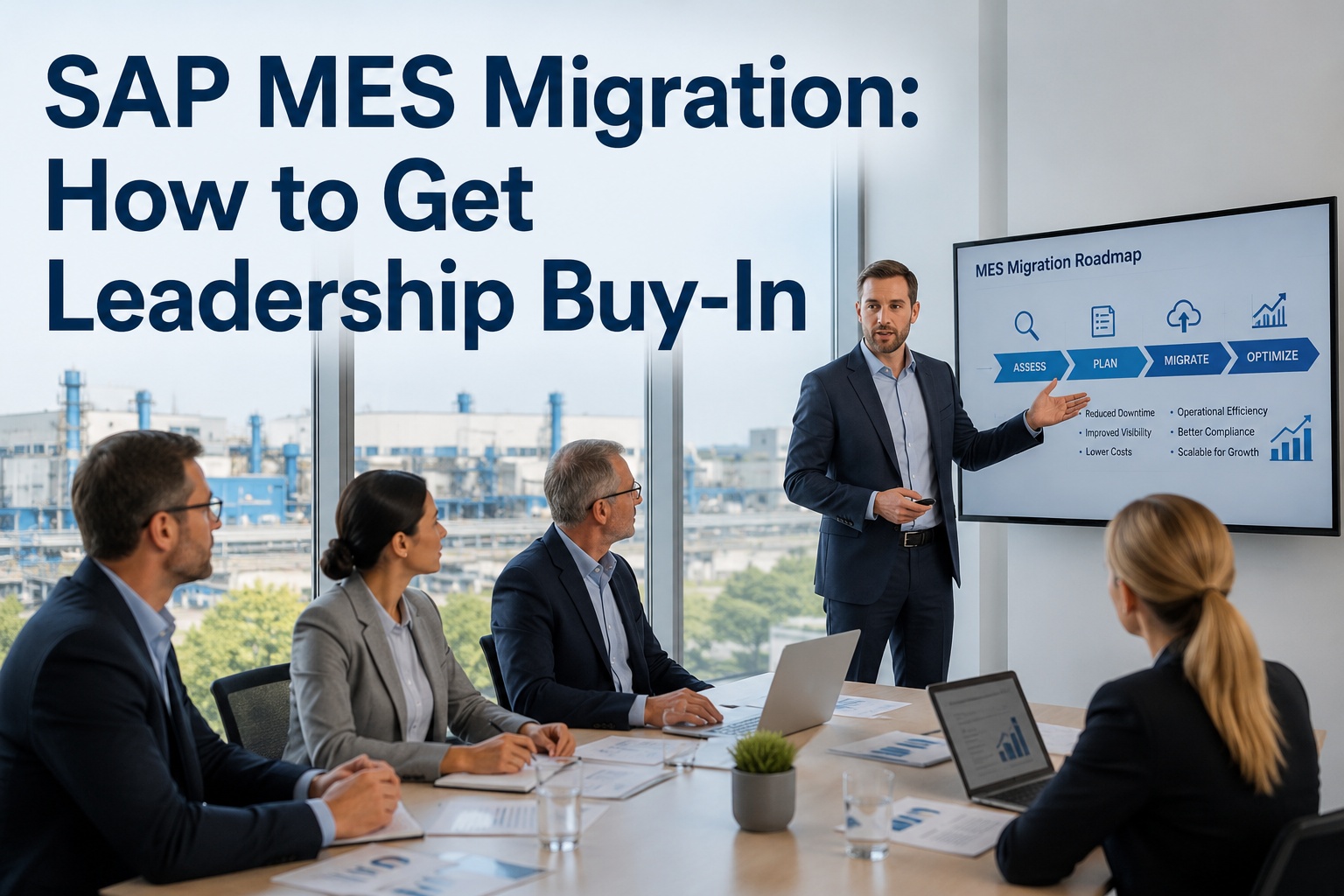
You already know your SAP MES platform is on borrowed time. SAP confirmed mainstream maintenance for SAP ME and SAP MII ends December 31, 2027, with paid extended support running only through 2030. The technical case writes itself. Yet most maintenance and operations leaders we speak to are stuck — not on what to migrate to, but on how to convince the CFO, CIO, and plant directors to fund the move. This page gives you the framework, the numbers, and the language to win that conversation.
The Real Barrier to SAP MES Migration Is Internal, Not Technical
Your engineers are ready. Your vendors are ready. Your roadmap is drafted. What's blocking the budget approval? A business case that speaks to maintenance ROI, downtime cost, and operational risk — in the language CFOs and CIOs actually fund.
Why This Conversation Is Different From Every Other IT Upgrade
Most software migrations are driven by IT. SAP MES migration is different — it sits on the shop floor, it controls production execution, and the business case must connect three audiences who rarely agree: the CFO who funds it, the CIO who owns the platform, and the Plant Director who lives with the operational consequences. Each one needs a different version of the same story, anchored in maintenance reliability, downtime cost, and the cost of doing nothing.
The CFO
Wants: Quantified payback. Hard numbers. Risk-adjusted ROI.
Frame migration as a hedge against rising extended-maintenance fees, unplanned downtime, and compliance penalties — not as a "modernization initiative."
The CIO
Wants: Platform stability. Vendor support. Architectural clarity.
Lead with NetWeaver Java end-of-life, the shrinking consulting talent pool, and the integration debt building inside a frozen platform.
The Plant Director
Wants: No production hits. Maintenance team productivity. Real-time visibility.
Show how the new platform reduces unplanned downtime, integrates work orders with CMMS, and gives shift supervisors live OEE without spreadsheet gymnastics.
The Five-Pillar Business Case Framework
A migration proposal that lists features will get tabled. A proposal that builds five connected financial pillars — each grounded in maintenance and operational reality — gets signed. Use this as the spine of your executive deck.
Cost of Doing Nothing
Quantify the 2–4% annual extended-maintenance surcharge, projected over the 2028–2030 window. Add compliance exposure, security patch risk, and the rising hourly rate of legacy NetWeaver consultants. This is your floor — what migration must beat to break even.
Maintenance & Downtime Recovery
This is where most business cases underperform. Calculate current unplanned downtime hours per line, multiply by contribution margin per hour, and model a conservative 15–25% reduction from tighter CMMS-to-MES integration, predictive work orders, and real-time asset visibility.
Labor & Process Efficiency
Reference benchmarks of 30–60% finance and process cycle-time reductions from comparable SAP migrations. Apply the same logic to maintenance technicians: paper work orders eliminated, manual data entry replaced, technician wrench time recovered.
Risk & Compliance Hedge
Post-2027, security patches and legal change packages stop on standard support. Audit findings, regulatory exposure, and cyber incidents become priced risks on the balance sheet. CFOs respond to risk-adjusted models, not feature lists.
Strategic Capability Unlock
Real-time OEE, AI-driven predictive maintenance, mobile work orders, and cloud-native scalability. These are not features — they are the platform on which the next decade of plant productivity gains will be built. Quantify what each unlocks in your top three pain points.
The Numbers That Move Approvals
Executives do not read business cases line by line. They scan for three things: payback period, total investment, and the size of the downside risk. Anchor your one-page summary in numbers like these — taken from public SAP migration benchmarks and adapted to your plant's operating profile.
| Metric | Industry Benchmark | What to Anchor in Your Proposal |
|---|---|---|
| Payback period | 18 to 36 months | Show a base case at 24 months and a stretched case at 36 months. Avoid optimistic outliers. |
| Breakeven on cumulative benefits | 2 to 3 years post go-live | Build a year-by-year cash flow over five years showing crossover. |
| Extended maintenance premium | 2–4% of annual license fee | Calculate the three-year cost of staying on extended maintenance through 2030. |
| Finance & process cycle time reduction | 30 to 60 percent | Apply a conservative 30% to maintenance work order cycle times specifically. |
| FTE equivalent automation | 1 to 3 FTEs per plant | Frame as redeployed capacity, not headcount reduction. Plant directors will fight headcount cuts. |
| Inventory and working capital impact | 10 to 30 percent reduction | Apply only to MRO inventory and spare parts where MES-CMMS integration is direct. |
The Maintenance Story Most Business Cases Miss
A finance-led business case will model labor savings and license costs. It will rarely model the maintenance impact properly — and that is where the largest hidden value sits for any plant running SAP ME or MII. Walk your leadership through this calculation step by step.
Measure your current unplanned downtime
Pull the last 12 months of unplanned downtime hours per critical asset. Most plants underestimate this by 20–40% because minor stoppages under 15 minutes never get logged. A modern MES-CMMS integration captures all of it automatically.
Convert hours into contribution margin
Multiply downtime hours by your contribution margin per hour of production — not revenue, not gross margin. CFOs trust contribution margin because it isolates the true cost of a stopped line.
Model a 15–25% reduction conservatively
Public case material on connected fieldworker and asset intelligence programs supports this range. Stay conservative in the base case; preserve the higher number for the upside scenario.
Add the technician productivity gain
Maintenance technicians spend 25–35% of their shift on non-wrench-time activities: walking, paperwork, looking for parts, waiting for approvals. A modern MES with native work-order flow recovers a meaningful portion of this.
Layer in MRO inventory reduction
Better visibility into asset condition and predictive triggers reduces emergency spare-part purchases and lets you safely lower minimum stock levels. 10–15% MRO inventory reduction is defensible.
How to Sequence the Conversation
Leadership buy-in rarely happens in one meeting. It happens across a sequenced campaign — each conversation building on the last, each adding one new stakeholder to the coalition. Run this playbook over 8 to 12 weeks before the formal capital request.
Build the internal coalition
Align maintenance manager, plant IT, controls engineering, and one operations VP. No proposal goes to the CFO without these four already nodding.
Quantify your baseline
Pull 12 months of downtime, work order, OEE, and MRO data. This is the "current state" page in your final deck. Without it, every projected benefit is hand-waving.
Run a pre-read with the CIO
Walk through the NetWeaver lifecycle, consulting market constraint, and platform risk. Let the CIO co-author the technical sections. Co-authored proposals get funded.
Validate financials with the FP&A team
Before any CFO sees a number, that number should already be agreed with the analyst who will be asked to defend it. Surprise numbers get killed in committee.
Site visit or reference call
Arrange for the CFO or CIO to speak directly with a peer who has completed the migration. Vendor decks lose to peer-validated outcomes every time.
Formal capital request
By this point the request is a formality, not a debate. Every stakeholder has already seen, edited, and approved the numbers. The meeting takes 20 minutes.
Objections You Will Hear — And How to Answer Them
Every business case faces the same five or six objections. Prepare crisp, evidence-backed answers in advance. Reading them off a slide signals confidence; improvising signals weakness.
"Can we wait until 2030 on extended maintenance?"
Technically yes, at 2–4% premium per year, with no new features, no security innovations, and a consulting market that gets thinner and more expensive every quarter. The wait does not de-risk the migration. It compounds the risk.
"What if we just stay on the legacy system longer?"
After mainstream support ends, security patches and legal change packages stop. For regulated industries that is a compliance event, not a deferral. The auditor's report writes itself.
"How do we know the ROI numbers are real?"
Anchor every number to a public benchmark, a peer reference, or your own historical baseline. Then disclose your assumptions on the same page. CFOs trust transparent assumptions more than precise-sounding forecasts.
"What if the migration disrupts production?"
Phased side-by-side migration over 6–12 months keeps the legacy system live until cutover. Pilot a single line, validate, then scale. Big-bang migrations fail; phased migrations succeed on time and on budget.
"Do we have the internal team to do this?"
Probably not alone. Plan for an internal core team plus a specialist partner. Budget realistic consulting fees up front — under-budgeting partners is the single most common cause of overrun.
"Is this just an IT project, or a transformation?"
A technical lift-and-shift wastes the opportunity. Treat the migration as a process redesign — clean the master data, retire the customizations no one uses, and standardize work order flow. The platform change is the easy part.
The One-Page Executive Summary Template
Boards approve on one page. Build everything else as appendices. Your one-pager should answer five questions in five sentences each — no more.
Where OxMaint Fits in Your Migration Story
An MES platform alone is not enough. The leadership buy-in story gets stronger when the migration is paired with a modern CMMS that integrates work orders, asset health, and technician workflows directly into the new execution layer. OxMaint is purpose-built for this — closing the loop between shop-floor execution and maintenance operations without the integration debt of legacy point solutions. Talk to our team about how plants in your industry are sequencing the MES migration alongside CMMS modernization to maximize the business case.
Ready to Build the Business Case That Gets Funded?
Get a working session with our team to pressure-test your numbers, benchmark against peer migrations, and shape the one-page summary your CFO will sign.