AI-Native On-Prem vs SAP MII for Cement: 2030 Roadmap
By Riley Quinn on May 12, 2026
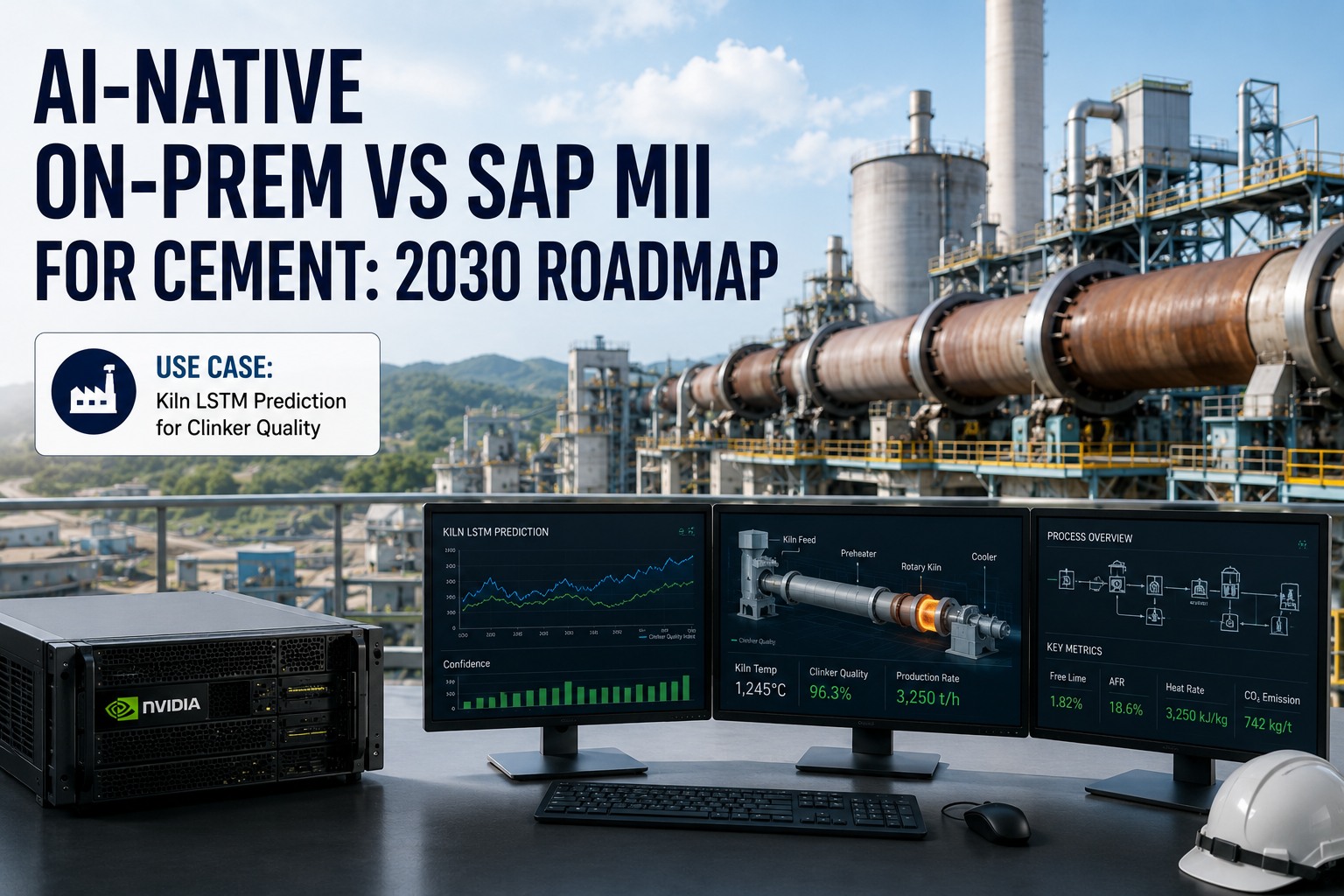
SAP MII was built in 2004 to be a glue layer — pulling sensor readings, running scripts, surfacing dashboards. It works. It's also fundamentally rule-based. Your kiln operator sets a target burning zone temperature, MII triggers an alert when it drifts, the operator nudges the fuel rate. That's not optimization. That's a fancy thermometer. AI-native is a different beast. Instead of rules and alerts, you have a kiln LSTM predicting the next 15 minutes of clinker quality. A free lime soft sensor replacing the 4-hour lab delay with a 30-minute forecast. An AFR optimizer dynamically blending alternative fuels while holding quality. These models don't just monitor — they predict, recommend, and (when you trust them) close the loop. And critically: with NVIDIA on-prem hardware, you get all of this without sending one byte of cement-plant data to the cloud. No SAP BTP subscription. No hyperscaler. Source code yours, forever. Book a free demo of AI-native cement plant software.
AI-NATIVE · NOT SAP-NATIVE
Your Cement Plant Is Burning $1-2M/Year in "Insurance Clinker." MII Cannot Stop It. AI-Native Can.
Most cement plants overburn 30-50 kcal/kg clinker on every shift — a conservative safety margin against the 4-hour lab delay that tells you free lime is too high after the damage is already done. AI-native models close that gap. LSTM neural networks predict clinker quality 15-30 minutes ahead. Free lime soft sensors replace lab delays with live forecasts. AFR optimizers dynamically blend alternative fuels. All running on NVIDIA on-prem hardware behind your firewall — no SAP BTP, no hyperscaler, no monthly fees. Pilot in 6 to 12 weeks. Source code included.
The On-Prem Server Stack — AI-Native Cement Without the Cloud
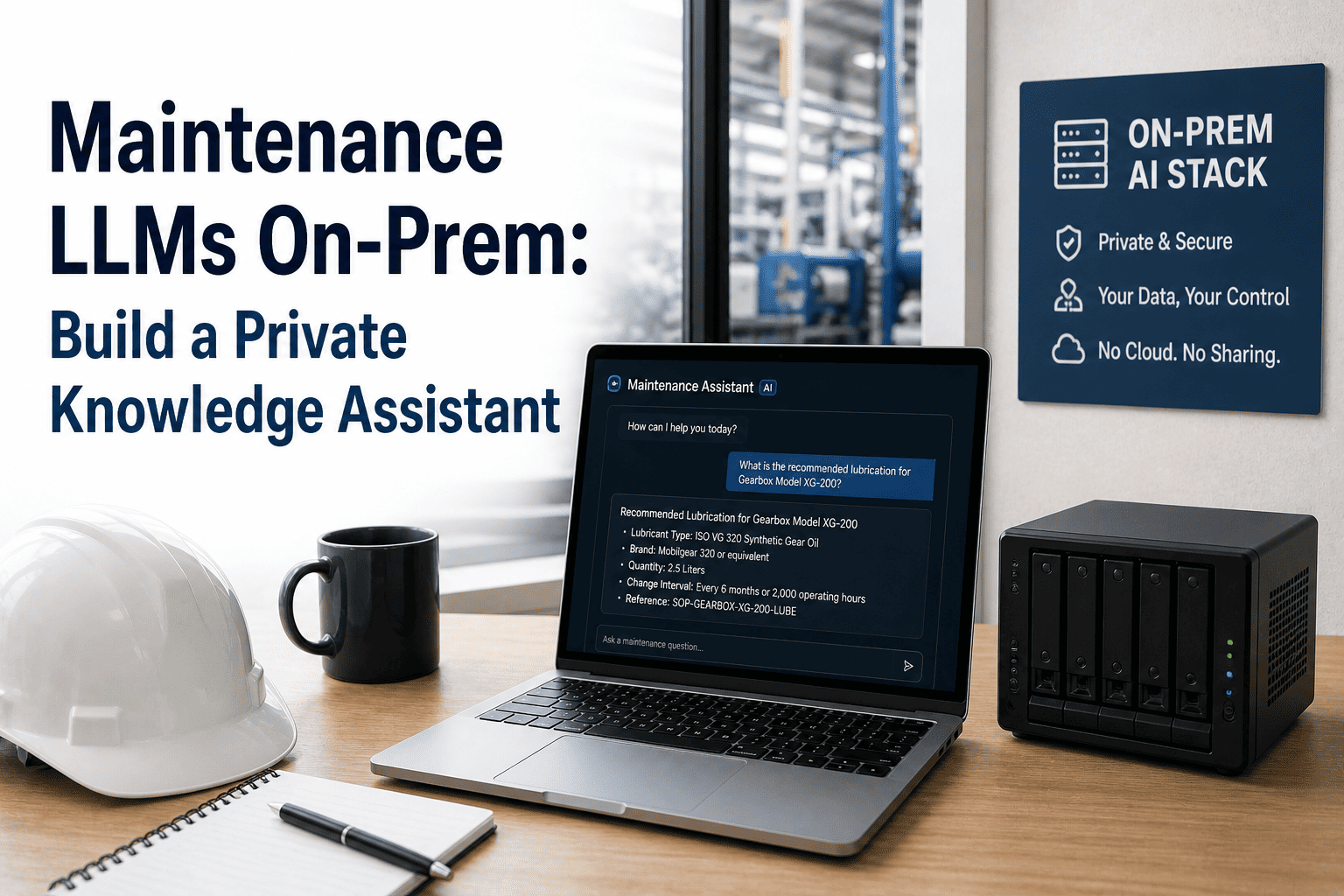
Cement plant data is high-value IP. Raw mix recipes, fuel blend optimization secrets, kiln control logic — the kind of data your competitors and your IT security team both want kept locked down. Three pieces of NVIDIA hardware sit in your control room, never connect to the public internet, and run your full AI-native cement stack. Book a free demo of AI-native cement plant software.
AT THE KILN · SENSOR HUB
NVIDIA Jetson AGX Orin The Kiln Sensor Hub
JobReads kiln, calciner, cooler thermocouples + gas analyzers
SpeedSub-second updates from every sensor
WhereMounts near the kiln control room
FormRuggedized box, fits in switchgear cabinet
What it does: Replaces SAP PCo. Reads burning zone thermocouples, preheater cyclones, NOx/O2/CO analyzers, raw meal feed rate, ID fan draft. Tags every reading with timestamp + asset ID. Local buffering during network outages.
SpeedPredictions every 60 seconds · sub-100ms inference
WhereSits in your control room behind your firewall
FormTower computer, fits under a desk
What it does: Runs all three AI-native models simultaneously. Predicts clinker quality 15-30 minutes ahead. Generates setpoint recommendations for the kiln operator. Pushes confidence scores so operators know when to trust the AI.
3 MODELSCONCURRENT INFERENCE
ENTERPRISE · DIGITAL TWIN
NVIDIA DGX Station GB300 Ultra · The Digital Twin
JobNVIDIA Omniverse digital twin of your kiln
SpeedSimulates fuel mix scenarios in minutes
WhereSits at corporate HQ in a server rack
FormRack-mounted, 24/7 enterprise grade
What it does: Trains your kiln LSTM on years of historical data. Simulates what-if scenarios — new fuel blends, raw material changes, production rate shifts — before you try them on the real kiln. Retrains the model overnight from each shift's data.
OMNIVERSEDIGITAL TWIN · WHAT-IF
100%
Stays inside your plant · never goes online
$0/mo
No BTP · no hyperscaler · buy once, own forever
Offline
Works fully air-gapped if your team requires it
Yours
Source code included · modify it freely
MII Scripts vs AI-Native Models — Side-by-Side Architecture
The fundamental difference is not just speed or accuracy — it's the architectural shift from reactive rules to predictive models. Here's exactly what changes when you swap MII script logic for AI-native models. Sign up free for AI-native cement plant software.
Lab sample every 1-2 hours · 4-hour total delay · operator over-burns "just in case"
4 hr lag
FREE LIME SOFT SENSOR
Neural model uses 25+ signals (gas analyzer, feed rate, fuel mix, temps) to predict free lime live · 15-30 min forecast
Live forecast
KILN CONTROL
PID loops + operator setpoints · one variable at a time · alerts on threshold breaches
1 variable
KILN LSTM
Recurrent neural network learns the entire pyroprocess as one system · coordinates dozens of setpoints simultaneously
30+ vars
ALTERNATIVE FUEL MIX
Manual blend tables · operator adjusts ratios based on experience · conservative caps on AFR%
30-40% AFR
AFR OPTIMIZER
Characterizes each fuel blend's combustion profile real-time · dynamically maximizes AFR% while holding quality in spec
70%+ AFR
DEPLOYMENT MODEL
SAP DM requires SAP BTP cloud subscription · ongoing fees · cement IP leaves the plant
Cloud · $$/mo
ON-PREM NVIDIA
Jetson + RTX + DGX sit in your plant · zero cloud · zero subscription · source code included · air-gap capable
$0/mo
Three Real Cement Scenarios — How AI-Native Beats MII Scripts
Three real cement plant scenarios — each walked through in plain language. Same pattern every time: kiln sensor hub → LSTM engine → operator recommendation, all on-prem. Book a free demo of AI-native cement plant software.
SCENARIO 01
"We over-burn every shift because the lab sample tells us free lime is too high 4 hours later. How does AI fix this?"
THE PROBLEM
Mid-size cement plant. 3,500 TPD kiln. Free lime measured in the lab — sample taken every hour, results 2-4 hours later. Kiln operator can't wait for results, so they over-burn 30-50 kcal/kg clinker "just in case." That's 3-8% excess fuel every shift. On this plant: $1.4M/year in wasted fuel. Plus excess CO2. Plus "insurance clinker" the market never asked for.
HOW THE HARDWARE SOLVES IT
The Kiln Sensor Hub (Jetson)
Reads 25+ signals: burning zone temp, calciner temp, NOx, O2, CO, raw meal feed rate, fuel mix, ID fan draft. Streams to the LSTM engine every second.
The LSTM Engine (RTX)
Free lime soft sensor predicts the next 15-30 minutes of free lime content. Validated against lab samples — accuracy within ±0.05% FCaO. Operator sees forecast on dashboard with 94% confidence score.
Operator Action
Free lime trending high → operator nudges feed rate down 1-2% before it's out of spec. No more over-burning. Quality stays in spec, fuel waste eliminated.
THE RESULT
Fuel consumption down 7.2% in first quarter. $1.4M/yr saved. CO2 down 5.8%. Plant CFO approved blueprint for kiln 2.
SCENARIO 02
"Our AFR cap is 38% because the operator can't keep quality in spec at higher ratios. How do we push past 60%?"
THE PROBLEM
Plant has access to cheap RDF and tire chips — but every time the AFR ratio creeps above 38%, clinker quality drifts. Operators play it safe and cap at 35-38%. Meanwhile every percentage point of AFR replaces 1% of pet coke at one-third the cost. Plant accountants estimate every 5% AFR increase = $600K/year saved. Sitting at 38% means leaving $2-3M/year on the table.
HOW THE HARDWARE SOLVES IT
The Kiln Sensor Hub (Jetson)
Reads fuel weigh feeders, calorific value analyzers, gas chemistry, burning zone temp profile every second. Sees each fuel blend's combustion signature in real time.
The AFR Optimizer (RTX)
Characterizes RDF, tire chips, pet coke, coal combustion profiles. Adjusts burner split, primary air, draft fan to compensate for each blend. Holds clinker quality in spec while pushing AFR aggressively.
Closed-Loop Mode (Optional)
After 4 weeks of operator-supervised mode, plant moves to closed-loop on AFR adjustments. AI runs the AFR dial directly while operator supervises. Quality stays in spec at 65-70% AFR.
THE RESULT
AFR raised from 38% to 67% in 6 months. $3.2M/yr fuel savings. CO2 down 18%. ESG report praised by board.
SCENARIO 03
"Our IT team wants to test a new raw mix before running it on the real kiln. SAP MII has no simulation. What does AI-native offer?"
THE PROBLEM
Cement company expanding to a new limestone quarry. Slightly different chemistry — higher silica, more iron. The process team wants to know how the kiln will respond before committing the raw mix. Today: they have to run a 48-hour trial, eat the cost of off-spec clinker, and adjust. Each trial costs $80-150K in wasted production. Three trials a year = up to $450K in trial costs alone.
HOW THE HARDWARE SOLVES IT
The Digital Twin (DGX + Omniverse)
DGX runs an NVIDIA Omniverse digital twin of the kiln — calibrated on 3 years of historical operating data. Process team enters the new raw mix chemistry, AFR plan, and target output rate.
Simulation Engine
Simulates 48 hours of operation in 12 minutes. Shows expected free lime trajectory, burning zone behavior, fuel consumption, predicted clinker quality. Highlights risk windows where stability could drift.
Pre-Tuned Live Operation
When the real raw mix arrives, kiln operators already have the recommended setpoints. The kiln stabilizes in 4 hours instead of 48. Off-spec clinker production: minimal.
THE RESULT
New raw mix qualified in 4 hours vs 48. $120K saved per trial × 3 trials = $360K/yr. Plant agility transformed.
$5M+
Combined annual savings across the three scenarios at a single 3,500 TPD plant — fuel waste eliminated, AFR maximized, raw mix trials de-risked. Most cement plants see ROI in the first 6 months. The hardware pays for itself before the SAP MII end-of-life clock runs out.
Get Your AI-Native Cement Blueprint · 6-12 Week Pilot
Stop Pouring Fuel Money Down the Kiln. Get the AI-Native Blueprint.
Book a 30-minute call. We walk through your kiln, lab cycle, AFR cap, and raw mix variability. You leave with a kiln-specific AI-native blueprint — which models fit your plant, hardware sizing, and a 6-to-12-week pilot path. No SAP BTP. No monthly fees. Source code included.
What You Get — Everything In One Box, Yours Forever
A pre-configured AI-native cement stack arrives at your control room. Kiln sensor hub, LSTM engine, free lime soft sensor, AFR optimizer, digital twin — all pre-loaded with cement-specific reference models. Connect to your DCS, validate on shadow mode, go live in 6-12 weeks. Sign up free for AI-native cement plant software.
Buy Once, Own Forever
No SAP BTP subscription. No hyperscaler bills. No per-prediction charges. One price up front.
Your Data Stays Home
Raw mix recipes, kiln control logic, fuel mix secrets — all stays inside your plant perimeter.
Source Code Included
Tune models on your plant data, add new soft sensors, retrain on new fuel blends. Not locked in.
Ready Out of the Box
LSTM + soft sensor + AFR optimizer + digital twin — pre-loaded with cement reference models.
Frequently Asked Questions
Do we have to replace SAP MII to use this?
No. The AI-native stack can run alongside MII during the transition. The Jetson sensor hub reads from your DCS/SCADA the same way MII does — they coexist with no conflict. Most cement plants keep MII for legacy reporting and use the AI-native layer for kiln optimization, free lime forecasting, and AFR. By 2030 you can either migrate MII workflows to the same on-prem platform or replace MII entirely.
How much historical kiln data do we need to train the models?
Minimum 12 months of process historian data plus matching lab samples for free lime. 18-24 months is ideal. Most cement plants have this from their existing process historian (OSIsoft PI, AVEVA, Honeywell). The training process happens on the DGX during the pilot — your plant doesn't have to wait or change anything in operations during that period.
Will operators trust an AI making setpoint recommendations?
Trust is built in stages, intentionally. Stage 1 (weeks 1-4): AI runs in shadow mode showing predictions on the operator dashboard, no automatic actions. Stage 2 (weeks 5-8): AI recommends setpoint changes with confidence scores, operator approves each one. Stage 3 (weeks 9+, optional): closed-loop mode where AI runs designated variables directly with operator supervision. Every stage is operator-supervised. Confidence scores let the team know when to trust the AI vs intervene.
What about NOx, CO, and emissions compliance during AI optimization?
All emissions constraints are hard limits in the optimizer — the AI cannot push beyond your permitted NOx, SO2, CO, or dust limits. The optimization happens within the compliance envelope. In practice plants typically see emissions improve alongside efficiency gains because AI-stabilized combustion produces fewer spikes that traditionally cause emission excursions.
Can it work with our existing DCS (ABB, Siemens, Honeywell)?
Yes. The Jetson sensor hub speaks OPC-UA, OPC DA, Modbus TCP, MQTT, and direct DCS APIs for ABB 800xA, Siemens PCS 7, Honeywell Experion, Yokogawa Centum, Emerson DeltaV, and others. For reading sensor data and writing setpoint recommendations back, the integration uses standard industrial protocols — no proprietary connectors needed. Source code is included so any custom protocol can be added.
Get Your Plant's AI-Native Cement Blueprint Today.
Book a 30-minute call. Walk through your kiln, AFR cap, lab cycle, and raw mix variability. Leave with a blueprint specific to your plant. Pilot in 6 to 12 weeks. Buy it once, own it forever — no SAP BTP, no monthly fees, source code included.