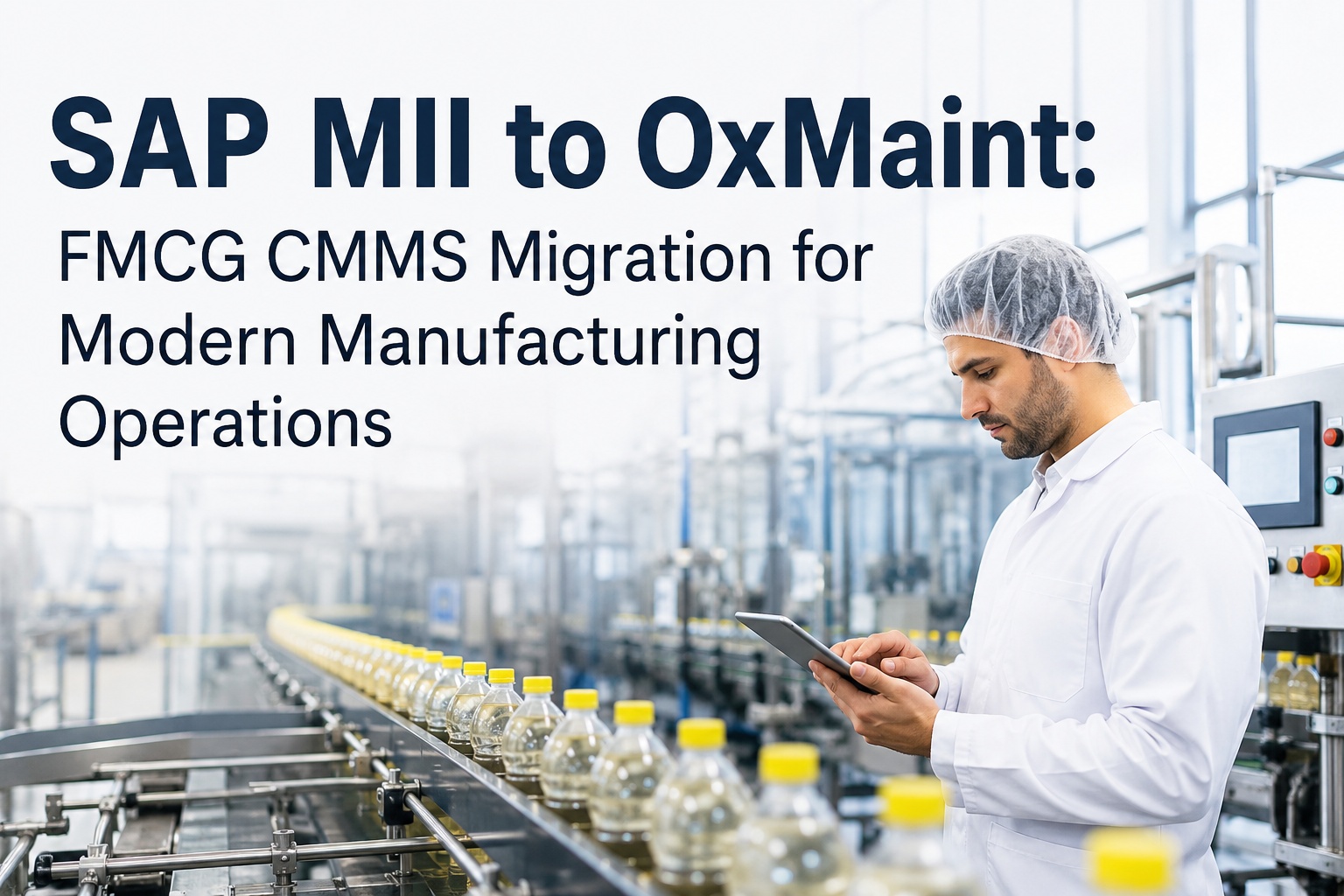
SAP MII mainstream maintenance ends December 31, 2027. Extended support runs through December 31, 2030. For an FMCG plant running MII as the integration and intelligence layer between SAP ERP and the packaging lines, the planning window has effectively already opened — because migration timelines for complex MII environments run 12 to 24 months, and starting in 2026 already puts you against the clock. This guide is for FMCG and CPG Plant Heads, IT, and MES leaders mapping out where the maintenance management layer fits in the new SAP DM / S/4 stack — and why a dedicated CMMS alongside SAP DM is usually a faster, cheaper, and operationally cleaner way to land the maintenance side of the migration than rebuilding MII custom logic inside SAP DM line by line.
SAP MII to OxMaint: A Migration Path for FMCG Manufacturers
With SAP MII end-of-mainstream-maintenance approaching, where the CMMS fits in the new SAP DM and S/4HANA stack for CPG plants — and how to migrate the maintenance layer without taking a packaging line offline.
What SAP actually said, and what it means for FMCG plants
SAP confirmed that mainstream maintenance and support for SAP MII and SAP ME will end December 31, 2027, with extended support possible through December 31, 2030 at premium cost. SAP's strategic replacement is SAP Digital Manufacturing, a cloud-native MES on the Business Technology Platform, with clean-core APIs, embedded analytics, and native S/4HANA integration. There is no automatic migration path. Custom MII logic — and there is always custom MII logic — has to be redesigned for the SAP DM API model. Direct database access is no longer permitted in SAP DM. Most of what MII did with low-level enhancements, ad-hoc tables, and tightly coupled integrations has to be rethought.
For an FMCG plant running 4 to 12 packaging lines, the practical question is not whether to migrate. It is what to keep, what to rebuild, and where to put the maintenance side of the operation. That last question is where most migration plans get vague. SAP DM will hold the production order and the batch execution context. SAP S/4HANA Asset Management (SAP PM in the new world) will hold the asset master and the financials. The maintenance workflow density — PMs, breakdowns, spare parts at the line, mobile execution, OEE-linked work order triggers — is a different problem with a different right answer.
The cost of delay compounds. Every quarter spent on MII past 2027 carries premium support fees, declining vendor expertise in the market, and a shrinking pool of available migration consultants. By 2029, plants that have not started will be competing for migration resources with everyone else who waited. The plants that move early get to pick their own pilot site, their own pace, and their own integration partners. The plants that move late take what is left.
Before and after: where did each maintenance function live?
Three migration paths, and how the CMMS choice shapes each one
Most FMCG manufacturers facing the MII sunset converge on one of three architectural patterns. The right path depends on how much custom MII logic the site carries, how cloud-ready the IT estate is, and whether the operations team is willing to take the production execution layer to cloud-native MES at the same time as the maintenance layer.
What MII did for maintenance, and where each function lands
In practice, what most FMCG plants built on MII for the maintenance side was a patchwork — a downtime dashboard, a custom KPI report, a few work-order escalation rules, an OEE feed, sometimes a parts reservation flow. None of it was MES-grade execution, but it was glue, and it worked. The migration question is where each piece of that glue lands when MII goes away.
| MII function | New home in SAP DM stack | Or: in a dedicated CMMS |
|---|---|---|
| Plant maintenance dashboard | Digital Manufacturing Insights (DMI) | Native maintenance KPI dashboard — PM compliance, MTTR, MTBF, backlog |
| Work order escalation logic | Custom BTP workflow (rebuild) | Out-of-the-box escalation engine with mobile push |
| OEE / downtime feed to work orders | SAP DM event integration via BTP | Direct BMS / PLC / MES integration, work order auto-generated |
| Spare parts reservation at the line | S/4 MM via DM API call | CMMS reserves against the WO, posts back to S/4 MM at close |
| Mobile technician tablet | Custom DM UI (rebuild) | Native mobile app, scan, sign, capture, photos |
| Changeover & cleaning work orders | SAP DM production order linkage | CMMS triggers on production order completion |
| Audit trail & e-signatures | Custom BTP build | Out-of-the-box GMP-grade audit trail and signature |
The CMMS column is where most plants land for everything maintenance-specific. SAP DM and DMI are excellent at production execution and shop-floor analytics. They are not, and were never intended to be, maintenance management systems. Trying to make them play that role is what produces the long-tail of custom development that derailed MII in the first place.
There is a separate reason this split matters operationally. A maintenance team working inside the MES has to wait on every MES release cycle for changes to their work order screens, their PM scheduling logic, their KPI dashboards. A maintenance team working inside a dedicated CMMS moves at its own cadence — and the maintenance head can roll out new work order templates, calibration schedules, and mobile workflows without filing a change request against the MES backlog. That autonomy is worth more than most plants realise until they have it.
The business case the plant head has to defend
FMCG plants run on tight margins and high volume. A single unplanned stop on a high-speed packaging line costs between $5,000 and $15,000 per hour in lost output, wasted materials, and recovery labour. The industry average across industrial manufacturers reaches $260,000 per hour for top-tier downtime cost. For a typical 5-line CPG factory, total annual downtime exposure runs $400K to $1.2M. Migration is a capital decision, and the maintenance side of the migration is where the operating case actually closes.
A 5-phase migration plan that does not stop the line
Big-bang cutovers fail in FMCG. No plant manager will sign off on taking a packaging line offline for migration testing during shipping season. The proven pattern is phased — pilot one site, prove the pattern, scale across the network. The CMMS rolls out in parallel with the MES migration, which actually makes both projects easier because maintenance no longer has to wait on the MES team's release calendar.
Phases 2 and 3 are where the value harvest begins. Most FMCG sites see measurable downtime reduction and PM compliance lift inside the first 90 to 120 days of the pilot — long before the MES migration has even started its cutover testing. That early proof is the operational evidence the plant head takes to the CFO when defending the rest of the rollout budget. The CMMS pays for itself before the SAP DM project does.
Who owns what in the migration team
A clean migration depends on clean role definition. The CMMS layer sits at the intersection of IT, MES, operations, and maintenance — so an unclear owner is a project killer. The table below is the role split that most FMCG migrations land on.
Frequently asked questions
When exactly does SAP MII support end?
Why a dedicated CMMS instead of building maintenance in SAP DM?
Can OxMaint connect to both MII and SAP DM during the migration?
How does the CMMS integrate with S/4HANA Asset Management?
Do we have to wait for SAP DM cutover before deploying the CMMS?
Is OxMaint available on-premise as well as cloud?
What if we are still on SAP ECC, not S/4HANA?
How quickly can we start a pilot?
Start the maintenance layer of your migration now
SAP DM cutover takes 12 to 24 months. The CMMS layer does not have to wait. Start a free trial on one packaging line, prove the pattern, and have the maintenance side already running by the time the MES team is ready for cutover.