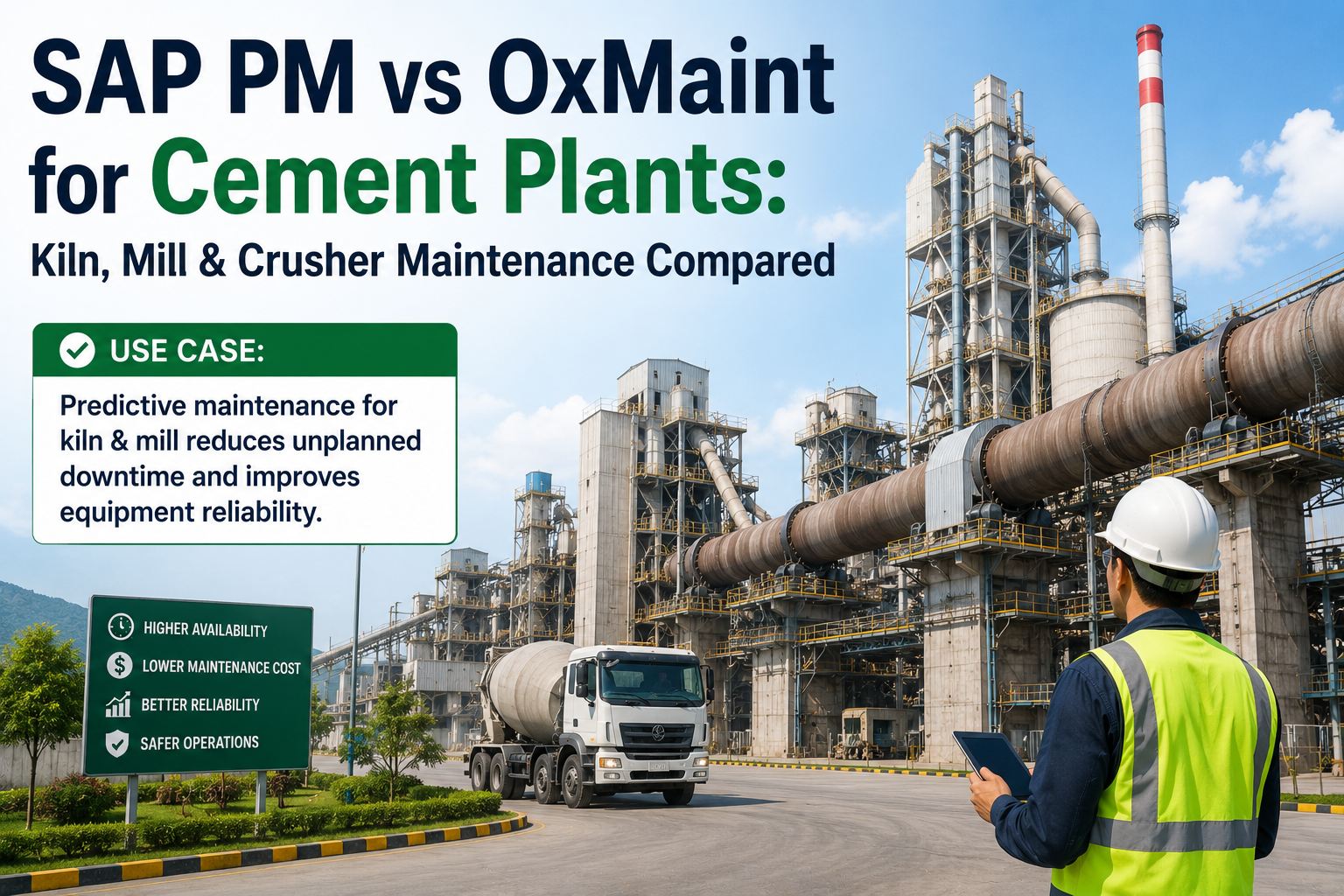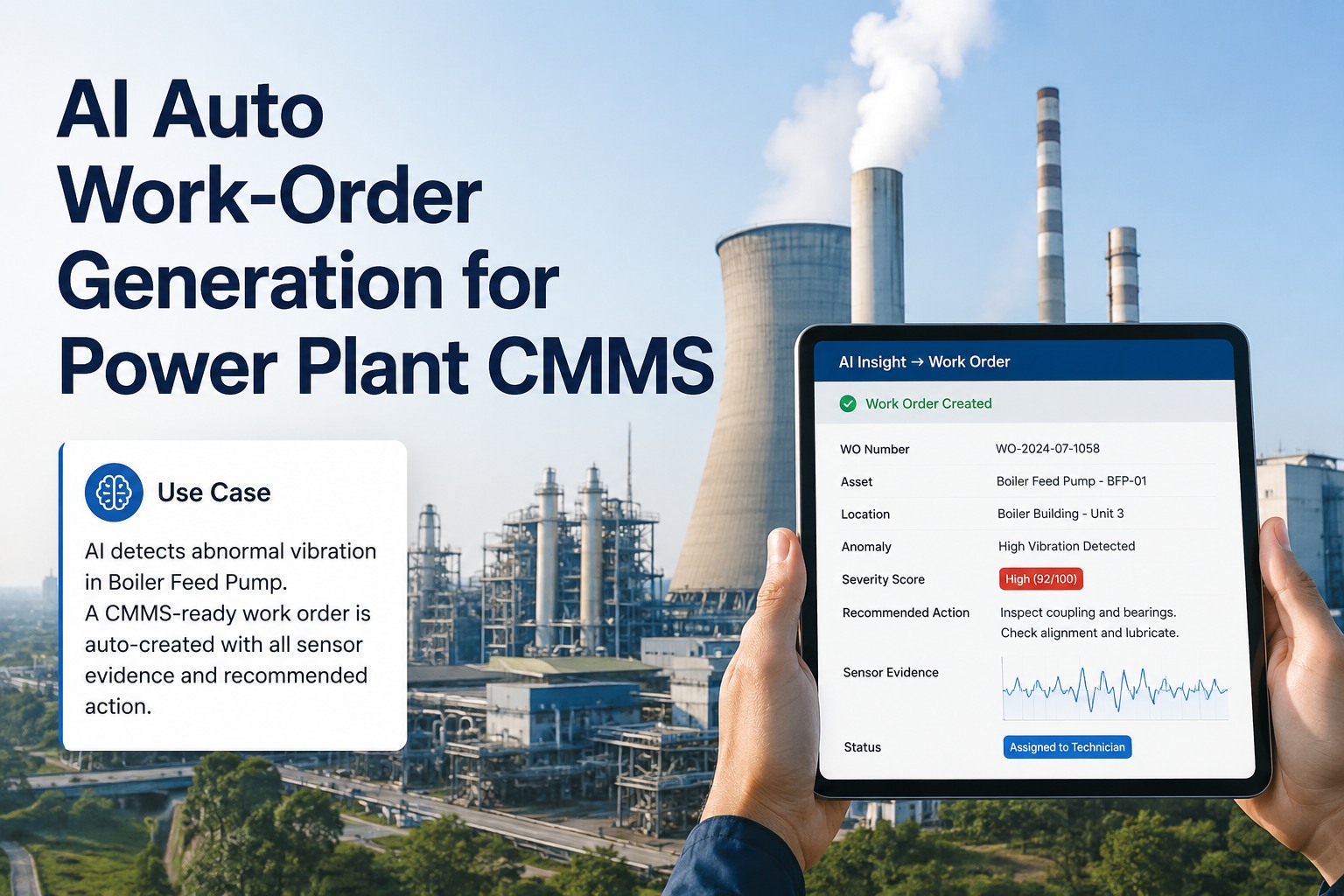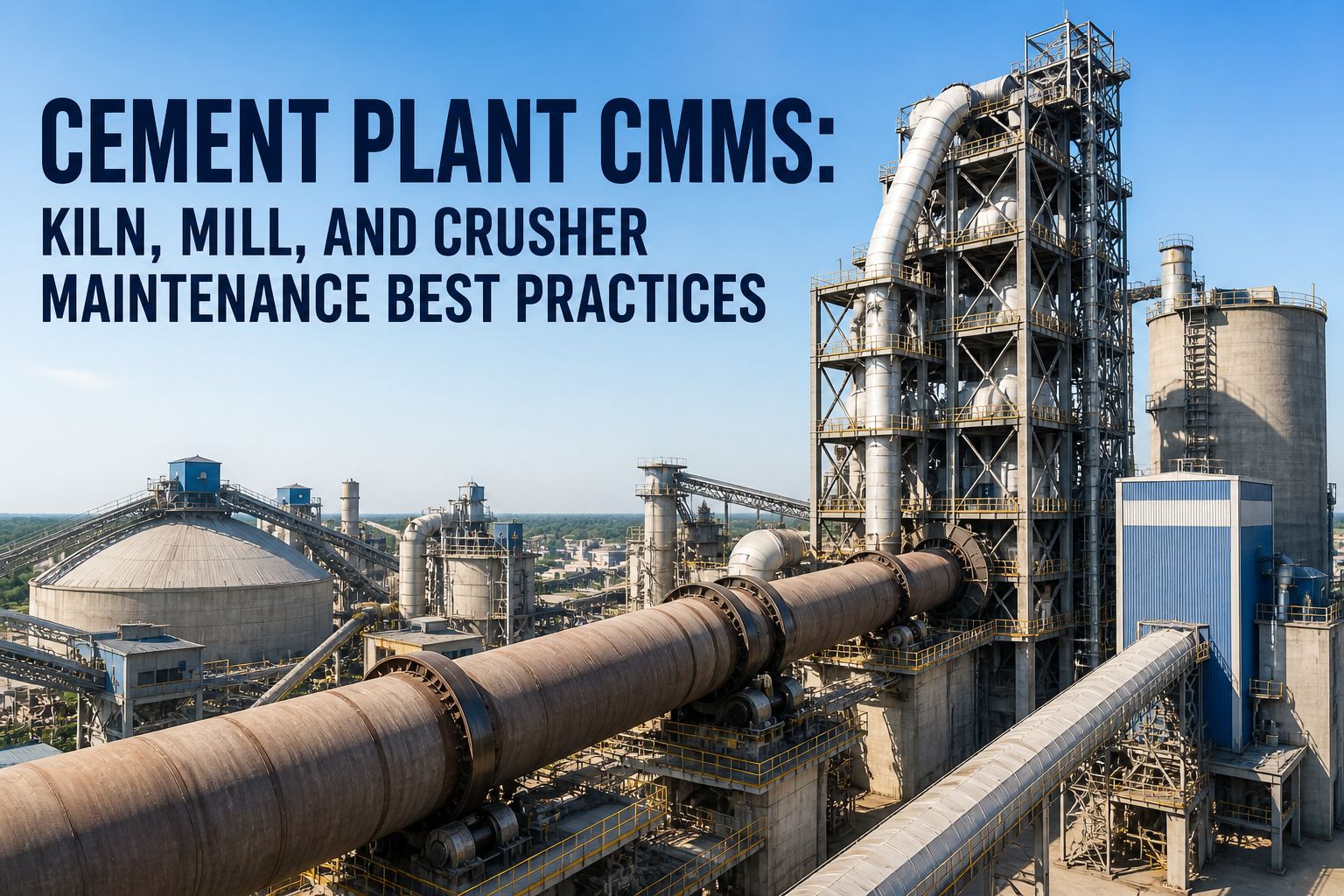
Cement plants are continuous-process beasts. A rotary kiln must run 365 days between shutdowns, raw mills and coal mills cannot tolerate bearing failures, and every hour of unplanned downtime costs $50,000 to $300,000 in lost clinker production. SAP S/4HANA gives a cement operator the financial backbone — procurement, inventory, settlement, cost accounting — but it does not, on its own, prevent a kiln shell hot spot from becoming a 24-hour emergency stop. That gap is where OxMaint CMMS fits. This page lays out exactly how the two systems compose for a cement plant: S/4HANA in the back office, OxMaint on the shop floor, both reading from the same equipment master.
Two Systems. One Plant. The Kiln Never Stops.
S/4HANA owns the ledger. OxMaint owns the wrench. Together they protect the asset that defines your plant's economics — the rotary kiln — and the dozens of supporting assets that have to outlast a full clinker campaign.
The Maintenance Gap Inside Every SAP S/4HANA Cement Plant
S/4HANA is a magnificent enterprise system. It is also designed for the back office, not the burner platform. Cement plant heads who have lived inside both worlds describe the same gap: the data flowing into S/4HANA is accurate at the cost ledger level but blind at the equipment-condition level. A CMMS does not replace S/4HANA — it bridges that gap.
The Financial & Procurement Backbone
- Equipment master and functional location hierarchy
- Material master and MRO inventory accounting
- Procurement, vendor master, purchase requisition flow
- Work order settlement to cost centers and internal orders
- Depreciation, fixed asset register, audit trail
- Long-term BW reporting and S/4HANA analytics
The Shop-Floor Execution Layer
- Kiln shell temperature and hot-spot early warning
- Mill bearing and gearbox condition monitoring
- Mobile work orders for technicians inside the plant
- Predictive triggers from vibration, thermal, and load data
- Refractory life tracking across the campaign
- PM compliance dashboards for the reliability engineer
The Asset Map: What Each System Owns Across the Plant
A cement plant has six major asset clusters, each with a distinct failure profile. S/4HANA holds the equipment master and cost record for all of them. OxMaint runs the field-level reliability work — the condition monitoring, the PM compliance, the technician workflow. The boundary is the same across every cluster.
Where the Real Money Hides: Three Cement-Specific Workflows
Three workflows distinguish a cement-specialist CMMS from a generic maintenance tool. Each one targets a failure mode that, if missed, costs hundreds of thousands of dollars per occurrence — and each one closes a loop that SAP S/4HANA does not natively close.
Shell scanner data → predictive work order → SAP cost capture
Continuous infrared shell scanners stream temperature data to OxMaint's predictive engine. A drifting hot spot triggers a work order to inspect refractory in that ring 30 or more days before the spot becomes critical. Refractory parts pulled from SAP inventory via standard goods-issue; cost settles to the kiln cost object. The same kiln campaign that used to end with an emergency stop now ends with a planned reline during a scheduled window.
Vibration trend → condition-based work order → SAP confirmation
Raw mill and cement mill main bearings ride on tight tolerances. A drift in vibration signature 30–45 days before seizure is detectable; the question is whether the signal triggers an action. OxMaint converts the signal into a condition-based work order, schedules the intervention during a planned mill stop, and posts the confirmation back to SAP via BAPI. Bearing replacements move from emergency-shipped to ground-shipped — a real number on the cost line.
Scope build → contractor mobilization → SAP work-order settlement
The annual cement plant shutdown is a coordinated event across hundreds of contractors and thousands of tasks. OxMaint manages the scope build, daily progress capture, scope-change handling, and contractor competency check. SAP retains the work order objects for cost settlement and audit trail. Two systems, one shutdown, no spreadsheets passed between supervisors at 2 a.m.
The Integration: Conservative, Standard, Audit-Ready
No SAP customizations. No ABAP development. No proprietary middleware. The integration uses standard SAP interfaces — OData on S/4HANA, BAPI for legacy ECC if you still run it — and reads from the released APIs your SAP Basis team already trusts. Three flows carry the bulk of the traffic.
Master Data Sync — SAP → OxMaint
Direction: One-way
Equipment master (EQUI), functional locations (IFLOT), material master (MARA), cost centers (CSKS), maintenance plans. OData APIs (API_EQUIPMENT, API_FUNCTIONAL_LOCATION, API_MATERIAL_STOCK_SRV) on S/4HANA; BAPI_EQUI_GETLIST and BAPI_FUNCLOC_GETLIST on ECC. Master data ownership stays with SAP.
Work Order Confirmation — OxMaint → SAP
Direction: One-way
When a technician closes a work order in OxMaint, labor hours, operation status, and remarks post back as a confirmation via BAPI_ALM_CONF_CREATE (followed by BAPI_TRANSACTION_COMMIT). Cost settles to the maintenance order's cost center or internal order.
Goods Movement — OxMaint → SAP
Direction: One-way
When refractory bricks or bearings are issued against a work order, OxMaint posts a goods movement to SAP MM via BAPI_GOODSMVT_CREATE (movement type 261 against the maintenance order). Stock is deducted in real-time; the cost charges the maintenance order automatically.
Deployment: Both Cloud and On-Premise for Cement Operators
Cement plants vary widely in their IT posture. Some operate inside corporate cloud strategies aligned with S/4HANA Cloud. Others run OT-segregated networks where on-premise deployment is non-negotiable. OxMaint offers both — and many multi-plant cement groups run a hybrid model, with cloud at HQ for cross-plant analytics and on-premise at each plant for local execution.
Self-hosted inside the plant
Best fit when the plant operates an OT-segregated network, has data residency requirements, or runs legacy SAP ECC on-premise. Customer-managed upgrades; full IT control over data and infrastructure.
Multi-tenant on enterprise infrastructure
Best fit for multi-plant cement groups standardizing on cloud-first IT, already deploying S/4HANA Cloud, or wanting zero plant-side server footprint. Quarterly feature releases; outbound HTTPS only.
Plant on-premise, HQ in cloud
The pattern most major cement operators converge on. Each plant runs OxMaint on-premise for local execution and offline resilience; HQ runs a cloud tenant for cross-plant reliability benchmarking, predictive model training, and group-level KPIs.
Outcomes Cement Operators Track After Deployment
Six months after a CMMS layer goes live on top of S/4HANA, the numbers cement operators consistently report — across published case studies and benchmark data — fall into a narrow band. Use these as the baseline against which to set your own internal targets.
Bridge the Maintenance Gap Without Disturbing S/4HANA
Book a working session with a solutions engineer who has deployed alongside SAP S/4HANA at cement plants running 5,000+ tpd kilns. We will map your kiln, mill, and crusher assets to the OxMaint layer, walk through your S/4HANA version and integration approach, and decide whether cloud, on-premise, or hybrid deployment fits your IT posture best.