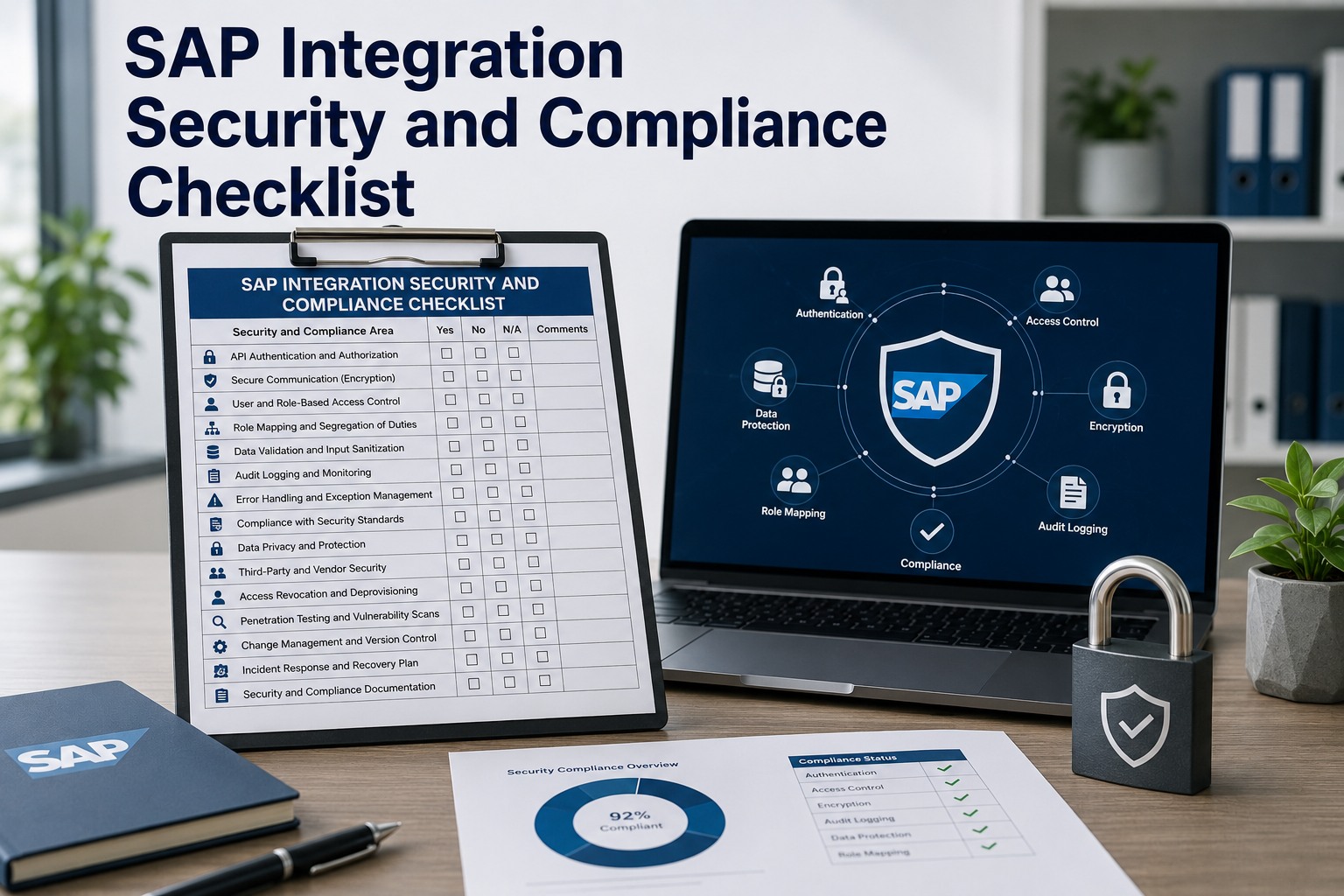
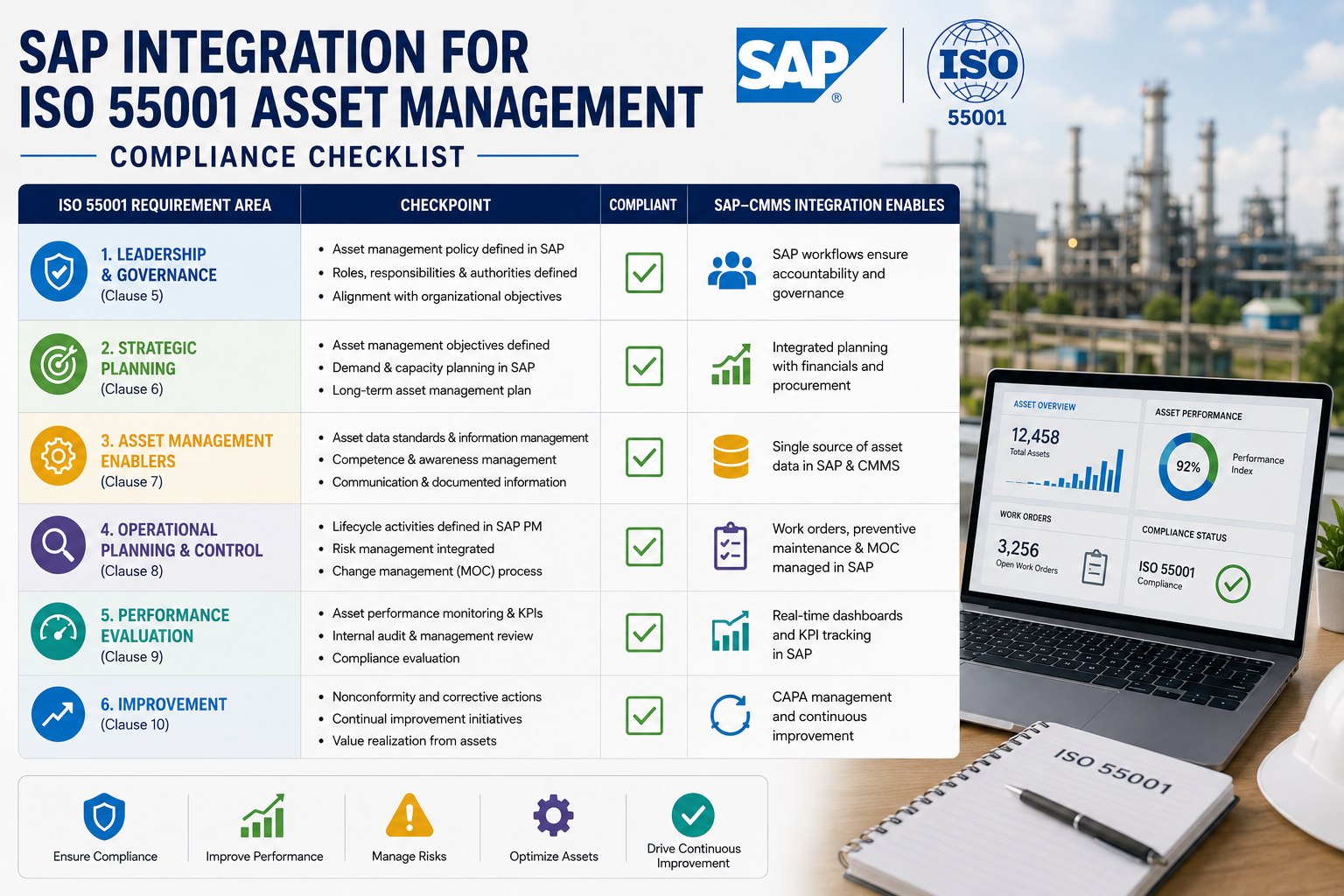
Enterprise procurement has changed. A SAP-CMMS integration that can't produce a documented security control inventory, current SOC 2 Type II report, and compliance framework mapping no longer survives vendor evaluation. The procurement teams asking the questions aren't IT—they're security architects, GRC specialists, and risk officers who know what they're looking for. This 30-item, six-pillar checklist covers what disciplined integration teams document before any enterprise security review. Each item maps to specific ISO 27001, SOC 2, NIST CSF, and GDPR controls. Book a free demo to walk through checklist execution.
$4.44M
Average global cost of a data breach in 2025, with API-related incidents commanding 20% premium
Source: IBM industry research
6
Security pillars covering the full SAP integration attack surface and compliance scope
Source: This framework
30
Specific controls, each mapped to ISO 27001, SOC 2, NIST CSF, and GDPR requirements
Source: This page
99%
Of organizations encountered API security problems in the past year
Source: API security research
Why Security Checklists Beat Security Theater
Most SAP integration security failures aren't sophisticated attacks—they're configuration oversights that compound over months until a breach makes them visible. A token TTL set to 24 hours instead of 30 minutes. A service account granted broader scope than the integration actually requires. An audit log that captures events but doesn't retain them past 30 days. A change deployed without security review because the change happened to be technically small. None of these are dramatic failures. All of them are findings on every security audit, on every SOC 2 report, on every customer security questionnaire. The checklist exists to convert assumed security into documented security with evidence.
The discipline also produces the secondary benefit that increasingly matters more than the security itself: procurement-eligibility. Enterprise buyers now treat security documentation as a gate, not a line item. An integration without a complete control inventory and current attestation reports loses deals to competitors with weaker security but better documentation. Security and integration leaders ready to operationalize this checklist on their current environment can Sign up free to begin a security checklist review against the six-pillar framework.
The Six-Pillar SAP Integration Security Checklist
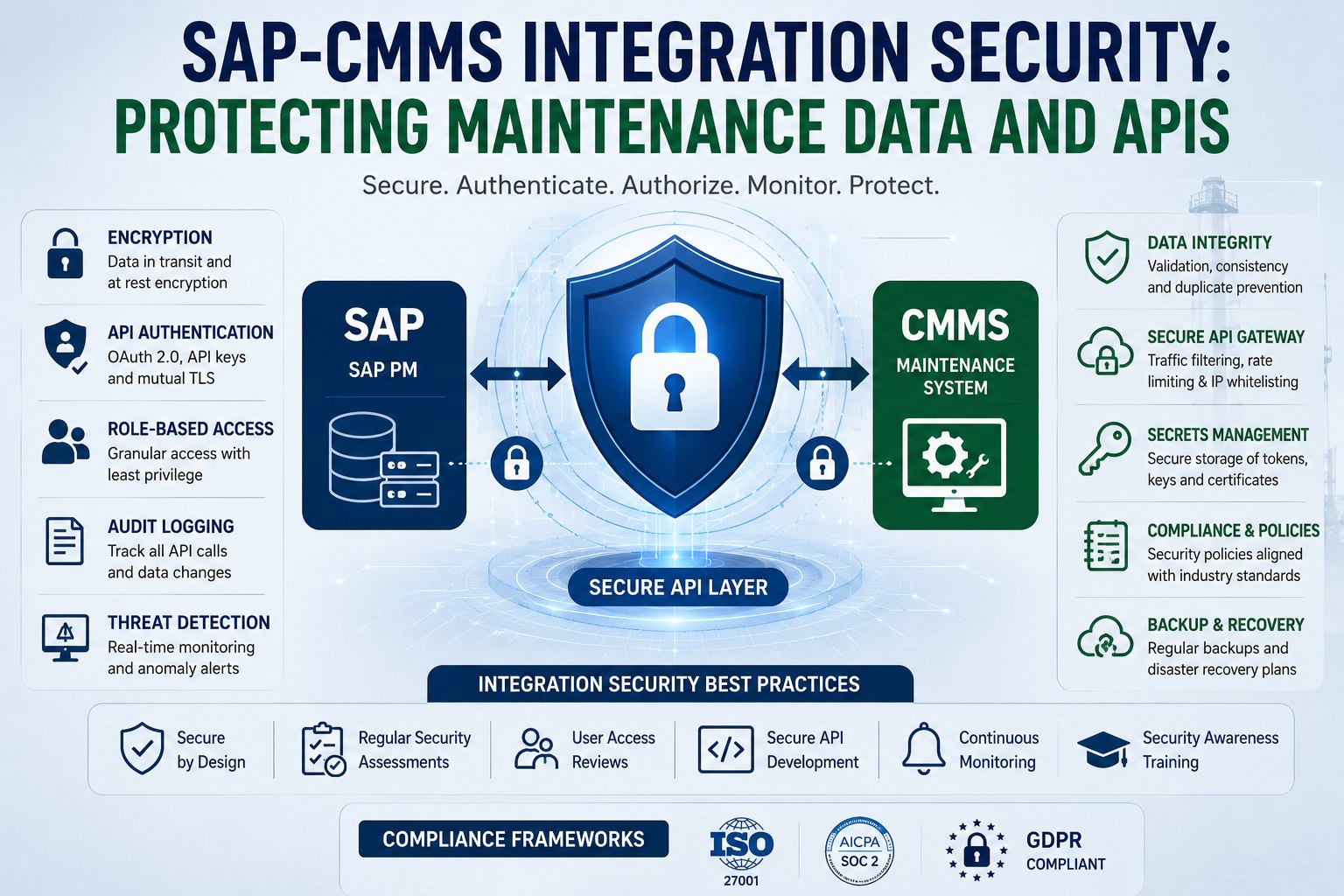
The checklist below organizes 30 security controls into six pillars. Each item carries framework mapping badges showing which ISO 27001 Annex A controls, SOC 2 Trust Services Criteria, NIST CSF functions, and GDPR articles it satisfies. The mapping is what makes the checklist procurement-ready and audit-defensible.
ISOISO 27001 Annex A
SOCSOC 2 Trust Services Criteria
NISTNIST SP 800-53 Control Family
GDPRGDPR Article reference
- OAuth 2.1 with PKCE configured for all API clientsISO A.9.4CC6.1IA-2
- Service accounts have unique credentials per integrationISO A.9.2CC6.1
- Short-lived access tokens (15-60 minute TTL)ISO A.9.4IA-2
- Token rotation procedures documented & testedCC6.1IA-5
- Mutual TLS (mTLS) for service-to-service authenticationISO A.13.2SC-13
- RBAC roles documented per integration scopeISO A.9.2CC6.3AC-3
- Least-privilege principle enforced on service accountsCC6.3AC-6
- Authorization matrix signed off by security architectISO A.9.4CC6.3
- Periodic access review (quarterly minimum cadence)CC6.2AC-2
- Privileged access management for emergency scenariosISO A.9.4AC-6
- TLS 1.3 enforced on all integration endpointsISO A.13.2CC6.7SC-13
- AES-256 encryption at rest with KMS-managed keysISO A.10.1CC6.7SC-28
- Sensitive data classified & tokenization appliedISO A.18.1CC6.7Art 32
- Key rotation policy documented & automatedISO A.10.1SC-12
- Secrets management (no hardcoded credentials anywhere)CC6.1IA-5
- Comprehensive audit logging on all integration eventsISO A.12.4CC7.2AU-2
- Log retention per compliance (minimum 12 months)ISO A.12.4CC7.2
- Audit log immutability (tamper-proof storage)ISO A.12.4AU-9
- Real-time monitoring & alerting on security eventsCC7.2AU-6
- Incident response runbooks documented & rehearsedISO A.16.1CC7.3IR-4
- API endpoints behind firewall with IP allowlistISO A.13.1CC6.6SC-7
- DDoS protection & rate limiting configuredCC7.1SC-5
- Network segmentation between OT and IT zonesISO A.13.1AC-4
- Vulnerability scanning quarterly minimum cadenceISO A.12.6CC7.1RA-5
- Penetration testing annually with documented findingsCC7.1CA-8
- ISO 27001 certification current & SOC 2 Type II attestedISO 27001Type II
- DPIA / GDPR impact assessment filed where requiredArt 35
- Vendor SOC 2 Type II reports reviewed annuallyCC9.2
- Change management with security review gatesISO A.12.1CC8.1CM-3
- Annual security awareness training for integration teamsISO A.7.2CC1.4AT-2
The highest-citation pillar is P3 Encryption & Data Protection—nearly every item maps to multiple frameworks because data confidentiality controls satisfy the broadest set of compliance requirements. The lowest-citation but operationally critical pillar is P6 Compliance Governance, which produces the certification artifacts that enterprise procurement explicitly asks for during vendor evaluation. A complete checklist score plus current attestations is what positions a SAP-CMMS integration platform as procurement-eligible at Fortune 500 buyers. Security and integration leaders ready to score their environment can Sign up free to score the six-pillar checklist on a current integration.
Three Compliance Gaps That Disqualify Vendors From Enterprise Procurement
Three specific compliance gaps account for the majority of "vendor security questionnaire failed" outcomes that exclude integration platforms from enterprise sales cycles. Each is preventable through disciplined checklist execution.
Gap 1
No Current SOC 2 Type II
A SOC 2 Type I report (point-in-time) or expired Type II (more than 12 months old) is treated as no attestation by most enterprise procurement teams. The Type II report is the artifact U.S. enterprise security architects expect and the absence of it shortens the conversation before technical evaluation even begins.
Prevented By
P6 item 1 (current SOC 2 Type II attested) with rolling annual audit cycle to ensure attestation never lapses
Gap 2
Audit Log Cannot Be Reproduced
Vendor claims comprehensive audit logging in policy, but a test event in a sandbox doesn't produce the expected log entry, or the log entry lacks the forensic detail (timestamp, source IP, action) that compliance auditors require. The control exists on paper but doesn't actually operate.
Prevented By
P4 items 1, 3, & 4 (comprehensive logging + immutability + real-time monitoring) verified through actual event generation and log retrieval testing
Gap 3
Long-Lived Service Tokens
Service account tokens with TTL measured in days or weeks rather than minutes, often discovered when a security questionnaire asks about token rotation procedures and the answer reveals that "rotation" means manual annual replacement. Modern security standards (OAuth 2.1, NIST IA-5) require short-lived tokens with automated rotation.
Prevented By
P1 items 3 & 4 (short-lived tokens + rotation procedures) operationally verified, not just policy-documented
The unifying theme: each gap is a control that's claimed but not demonstrated. Enterprise security reviewers test, not trust. The checklist exists specifically to convert claims into demonstrable evidence that survives any reasonable level of due diligence. Security architects ready to convert their current control posture into demonstrable evidence can Sign up free to build an evidence-backed security control inventory.
See the Six-Pillar Checklist Running on Live Integration Architecture
Walk through each pillar with control-by-control evidence and framework mapping, demonstrating actual operational compliance rather than documented policy. 30-minute live walkthrough.
From Checklist Complete to Audit-Ready: The 90-Day Path
Completing the checklist is the start, not the end. Audit-ready means the controls operate, the evidence is captured, and an external reviewer can verify both. The cadence below is what disciplined programs follow to translate a completed checklist into audit-defensible posture.
Days 1–20
Control Inventory & Gap Analysis
Complete the six-pillar checklist with current-state assessment. Identify gaps and partial implementations. Map remediation priorities by framework impact and procurement-readiness urgency.
Days 21–55
Remediation & Evidence Capture
Implement missing controls. Build evidence collection mechanisms for each control. Validate operational effectiveness with actual event generation, not just policy review.
Days 56–75
Internal Audit & Validation
Run internal audit cycle against checklist. Verify each control operates as documented. Build evidence package mapped to ISO 27001, SOC 2, NIST, and GDPR requirements.
Days 76–90
External Attestation & Reporting
External SOC 2 audit kicked off. Customer-facing security documentation package finalized. Compliance dashboard live for ongoing monitoring. Procurement-ready posture confirmed.
By day 90, the integration platform is positioned to pass enterprise security questionnaires on first review, surface compliance evidence on demand, and answer the security architect's hardest questions with operational evidence rather than policy citations. Security and compliance leaders ready to map this cadence to their current state can Book a free demo to walk through the 90-day audit-ready roadmap on their architecture.
Expert Perspective: What Distinguishes Audit-Ready Security Programs
The integration security programs I've seen pass enterprise scrutiny share a property that often surprises new security teams: they invest as much energy in evidence as they do in controls. Every control has an explicit evidence requirement, an automated capture mechanism, and a retention policy. When the customer's security architect asks "can you show me an audit log entry for a failed authentication attempt three weeks ago," the answer is a screen share in 30 seconds, not a multi-day evidence-gathering exercise. The programs that struggle have the same controls but treat evidence as something to assemble when asked—and the assembly process inevitably reveals that some controls aren't as operational as the documentation claimed. The differentiator isn't the security architecture. It's the discipline of treating evidence as a first-class product feature.
Evidence Is a Product Feature
Every control has automated evidence capture, queryable storage, and retention aligned to compliance requirements. Evidence-on-demand beats evidence-on-request every time in enterprise security review.
Map to Frameworks Explicitly
Every control inventoried with explicit ISO 27001, SOC 2, NIST, and GDPR mapping. Procurement teams ask which controls satisfy which framework requirements—answer the question directly, not in narrative.
Test Controls, Don't Trust Them
Internal audit verifies operational effectiveness through actual event generation, not policy review. Controls that work in policy but not in practice surface during customer audits—the worst possible discovery moment.
Make Enterprise Security Review a Routine Conversation
Six pillars. Thirty mapped controls. Framework citations on every item. Evidence on demand. See the framework running on a live SAP integration architecture with full compliance documentation.
Frequently Asked Questions
What's the difference between SOC 2 Type I and Type II reports?
A SOC 2 Type I report is a point-in-time assessment that describes the controls in place on a specific date. A Type II report covers a 12-month observation period and includes evidence that the controls actually operated throughout that window. Enterprise procurement teams almost universally require Type II because it demonstrates sustained operational effectiveness rather than a snapshot. Type I is sometimes accepted as an interim artifact for organizations pursuing their first Type II, but it's not equivalent for procurement purposes. A vendor presenting only a Type I should expect questions about the timeline for Type II completion.
How do ISO 27001 and SOC 2 overlap, and do we need both?
The control families overlap roughly 60-70 percent. ISO 27001 is an international management-system certification with 114 controls across 14 domains, audited annually by independent certification bodies and recertified every three years. SOC 2 is an American AICPA framework producing a Type II attestation report with detailed control findings. Multinational enterprises typically require both—ISO 27001 for European and Asian procurement, SOC 2 for U.S. enterprise procurement. Pursuing both simultaneously is more efficient than sequentially because the overlapping controls satisfy both frameworks; the incremental work to add the second is typically 30-40 percent of the standalone effort.
What does GDPR require specifically for SAP-CMMS integrations?
GDPR applies whenever the integration processes personal data of European Union or UK residents. For maintenance integrations, this typically means technician names, employee IDs, contact information, and labor hours. The headline requirements are: Article 32 (security of processing, including encryption and access control), Article 35 (DPIA for high-risk processing), Article 30 (records of processing activities), and Article 33 (breach notification within 72 hours). The checklist items in P3 (encryption) and P6 (DPIA, governance) directly address these. GDPR scope is determined by data subject location, not server location, so EU/UK personnel data triggers GDPR even on US-hosted systems.
How often should controls be re-verified?
Different controls warrant different verification cadences. Authentication and access controls (P1, P2) benefit from quarterly verification because they change frequently as integrations and users evolve. Encryption controls (P3) are typically verified annually unless changes occur. Audit logging (P4) is continuously verified through automated monitoring with quarterly sampling. Network and infrastructure controls (P5) follow vulnerability scanning cadence (quarterly) and pen testing cadence (annually). Compliance governance (P6) follows the certification audit cycle (annual SOC 2, annual ISO 27001 surveillance, three-year ISO recertification).
What evidence should we capture to demonstrate each control operates?
Each control needs objective evidence supporting both existence and operation. Authentication controls require audit log samples showing token issuance, validation, and rotation events. Authorization controls require RBAC matrix documentation plus access review meeting minutes. Encryption controls require TLS configuration evidence, KMS key rotation logs, and tokenization function output samples. Audit logging requires log samples with full forensic detail plus retention verification. Network controls require firewall rule listings, vulnerability scan reports, and pen test findings. Compliance governance requires certification documents, training attendance records, and change management approval records. The principle: an external reviewer should be able to reproduce the control status from captured evidence.