SAP Integration for ISO 55001 Asset Management Compliance Checklist
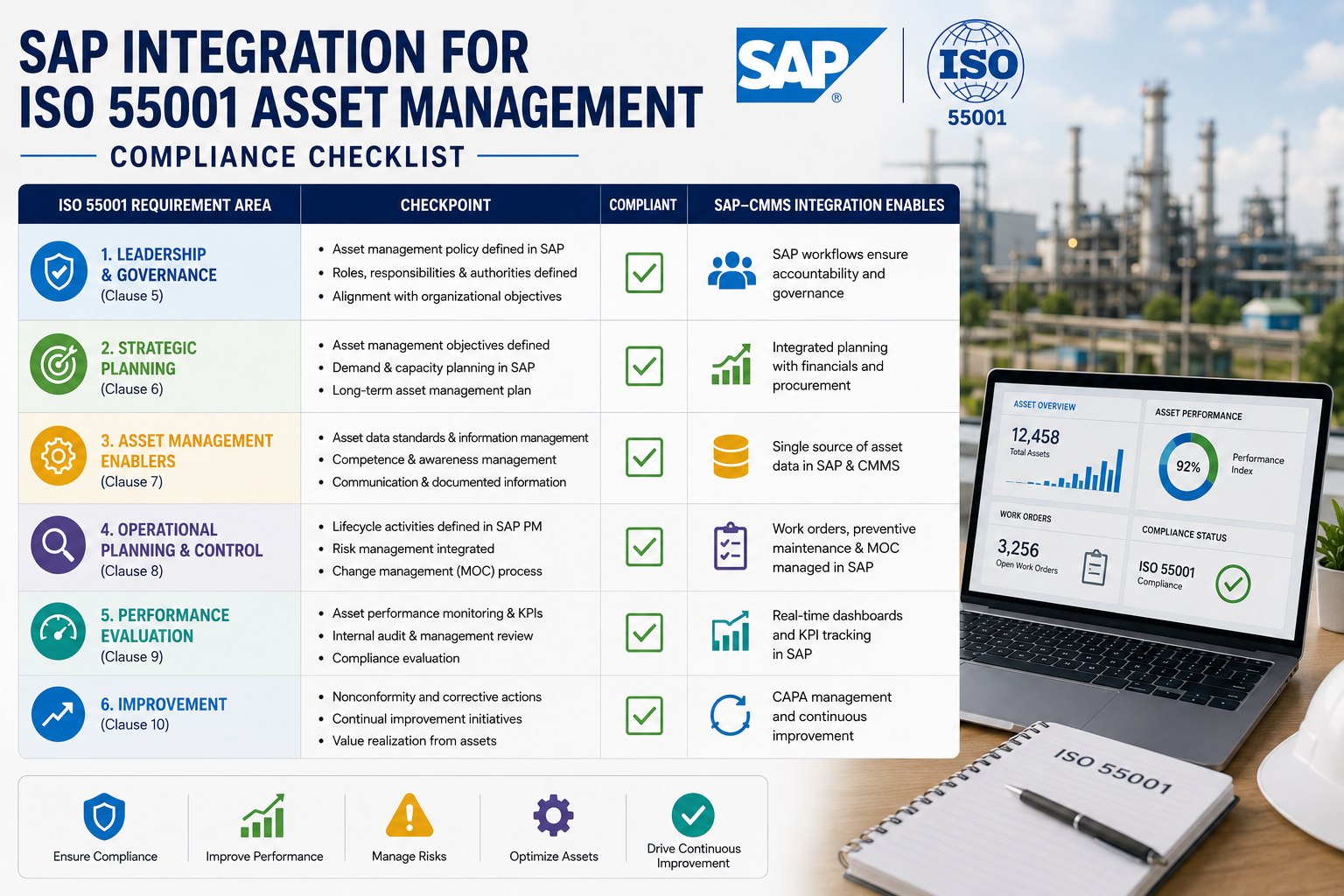
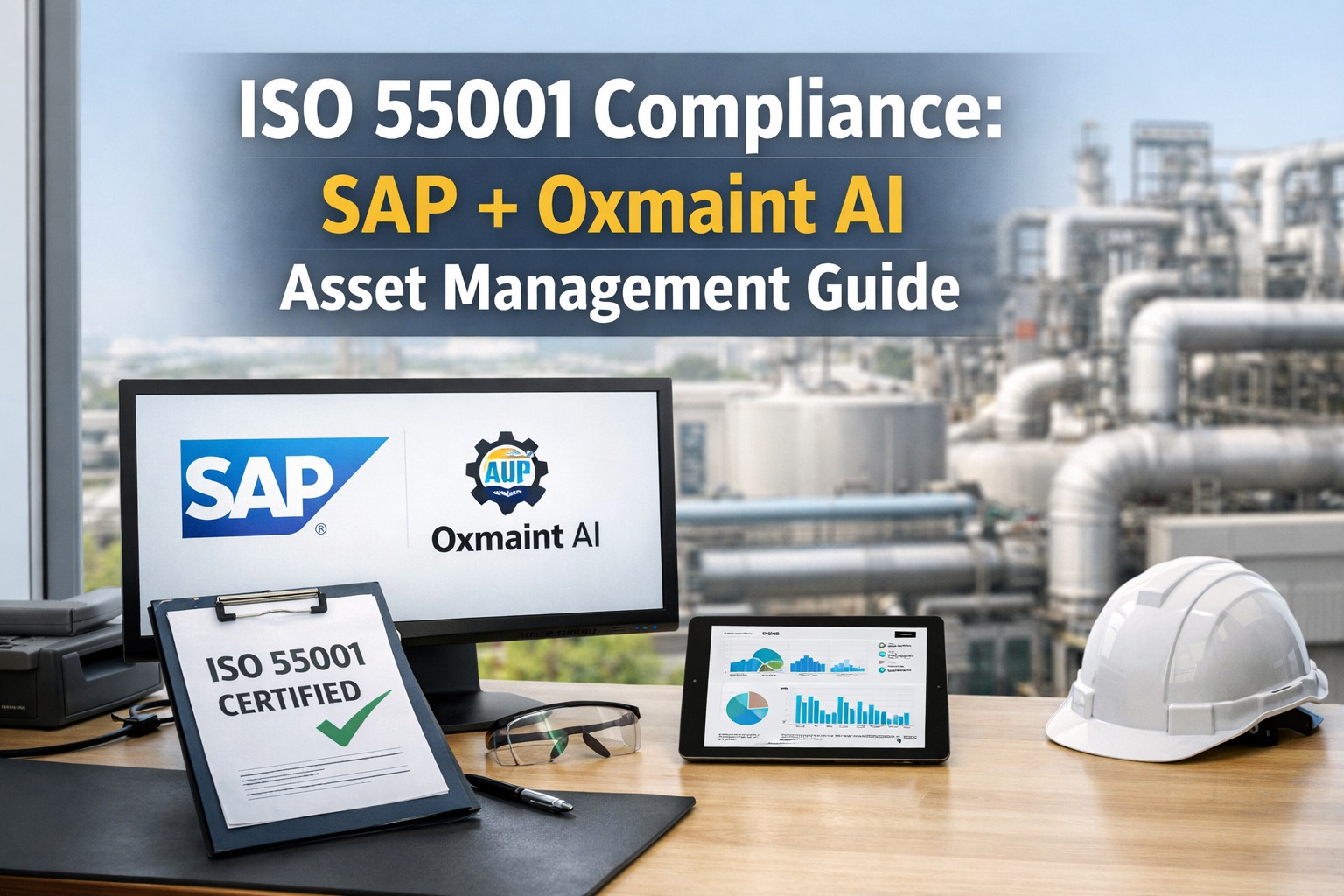
ISO 55001 certification is increasingly required by customers, regulators, and insurers. The standard's appeal is its discipline: a documented asset management system with measurable objectives, demonstrable risk management, and continuous improvement evidence. The challenge is what auditors actually want—not policy statements but operational evidence that the system works. SAP-CMMS integration becomes essential because the evidence ISO auditors need lives in maintenance data: work orders, condition monitoring, performance metrics. This checklist maps the 8 ISO 55001 areas where integration produces certification-ready evidence. Book a free demo to see audit-ready integration.
ISO 55001 AUDIT REALITY
Audit Evidence Lives in Maintenance Data, Not Policy Documents
8
Compliance Areas to Assess
SAMP
Strategic Asset Management Plan
PDCA
Plan-Do-Check-Act Cycle
98%+
Doc Completeness with Integration
Why ISO 55001 Compliance Demands SAP-CMMS Integration
The disconnect that derails most ISO 55001 certification attempts: leadership thinks compliance lives in documents while auditors think compliance lives in operations. A policy statement that asset management is important means nothing without operational evidence that the organization actually does asset management—work orders aligned to objectives, performance metrics tracked over time, corrective actions closed with traceability. The documents matter; the operational evidence that backs them matters more.
SAP-CMMS integration produces this operational evidence as a side effect of normal operations. Every work order becomes evidence of operational planning. Every condition reading becomes evidence of performance monitoring. Every CAPA closure becomes evidence of continual improvement. Without integration, plants chase evidence reactively before each audit; with integration, the evidence accumulates continuously. Asset management leaders ready to assess their ISO 55001 readiness can Sign up free to assess your ISO 55001 readiness.
The 8-Clause ISO 55001 Compliance Checklist
The checklist below covers the eight ISO 55001 clause areas every certification project must address. Each row shows the typical compliance status most plants reach without integration, what's required by the standard, what evidence auditors expect, and how integration delivers that evidence. The Strategic Asset Management Plan anchors as the gold area because it's typically the largest gap and the highest-value integration outcome.
8 CLAUSES · TYPICAL STATUS · EVIDENCE · INTEGRATION ANSWERS
ISO 55001 Compliance Assessment Map
COMPLIANTPARTIALGAP
PHASE A · Context & Leadership
PHASE B · Strategic Planning
PHASE C · Operations & Improvement
01
Context of the Organization
CLAUSE 4
COMPLIANT
PARTIAL
GAP
WHAT'S REQUIRED
Stakeholder needs identified; asset management scope defined; interfaces with other systems
Performance reports; audit findings; CAPA records with effectiveness verification
INTEGRATION DELIVERS
Performance trending dashboards; audit support data extraction; CAPA workflow with closure tracking
2Context & Leadership
4Strategic Planning
2Operations & Improvement
04SAMP Anchor
Status indicators reveal the pattern: most plants reach PARTIAL on documentation-heavy clauses but GAP on the clauses requiring operational evidence (Objectives, SAMP, Performance Evaluation). Integration moves all three GAP areas to COMPLIANT. Asset management leaders ready to map their compliance gaps can Sign up free to map your compliance gaps.
SEE IT IN PRACTICE
Walk Through Audit-Ready ISO 55001 Integration
30-minute walkthrough showing how integration delivers ISO 55001 evidence automatically—from SAMP support to CAPA closure—running in a real audit-readiness workflow.
Common ISO 55001 Audit Findings That Integration Prevents
External auditors find the same gaps repeatedly across pre-integration plants. SAMP documents that exist as static PDFs without lifecycle decision evidence. Asset management objectives without measurement trending. Risk registers that haven't been updated since the last audit. Internal audit findings without closure verification. Management review minutes without action tracking. Competency records that don't match work-order assignments. Documented procedures that don't reflect actual operations. Change management records with gaps in the chain of approval. Each finding traces to the same root cause: evidence created for audits rather than evidence flowing from operations. Integration architecture inverts that dynamic—evidence flows continuously, audits become sampling exercises against a strong baseline rather than reconstruction exercises against weak documentation.
PDCA Cycle: How ISO 55001 Maps to Daily Operations
ISO 55001's structure follows the PDCA cycle (Plan-Do-Check-Act) that underlies all ISO management system standards. Understanding which clauses fall into which PDCA quadrant clarifies how integration supports each phase—and why Act (Clause 10) is typically the weakest area in pre-integration assessments.
Clause 10: Nonconformity, corrective action, continual improvement. Typically the weakest area.
The Act phase weakness is what most certification efforts struggle with: closing the loop from findings to verified corrective action. Integration makes the loop trackable and demonstrable. Asset management leaders ready to close the PDCA loop can Sign up free to close the PDCA cycle.
ROI of ISO 55001-Aligned Integration
ISO 55001-aligned integration ROI shows up in metrics that matter to certification bodies and asset management leaders: audit findings, evidence accessibility, documentation completeness, recertification effort, and stakeholder confidence.
PRE-INTEGRATION vs ISO-ALIGNED INTEGRATION
Certification Performance Delta
ISO 55001 Audit Findings
Common
Near-zero
−85%
Time to Produce Audit Evidence
Days
Hours
−90%
Documentation Completeness
65%
98%+
+33 pts
Recertification Effort
6+ mo
6-8 wk
−75%
CAPA Closure Tracking
40%
95%+
+55 pts
98%+
Documentation completeness achievable with integration
6-8 wk
Recertification effort instead of half-year scrambles
The compounding effect: continuous evidence accumulation means audit preparation becomes routine, not project-mode. Certification leaders ready to model ISO ROI can Book a free demo to model ISO 55001 ROI.
Expert Perspective on Asset Management Certification
"
The organizations I've watched succeed with ISO 55001 share a counterintuitive property: they didn't approach certification as a documentation project. They approached it as an operational discipline project. The documents got built along the way—not as the goal but as artifacts of the discipline. The organizations that struggle do the opposite: they treat certification as a stack of documents to produce, get them written, pass the audit, and then watch the discipline degrade until the next surveillance audit forces another scramble. ISO 55001 done right transforms how the organization runs assets; done wrong it just produces shelfware. The integration architecture determines which path you're on. Continuous operational evidence is one path; periodic documentation projects are the other. The path you choose at the start of certification effort determines what you'll have ten years later.
01
Discipline Project, Not Documentation Project
Treat ISO 55001 as operational transformation, not documentation production. Documents are artifacts of the discipline.
02
Evidence Should Flow Automatically
If you're hunting for evidence before audits, the architecture is wrong. Evidence should accumulate continuously.
03
Surveillance Audits Reveal Truth
First certification audits can be staged. Annual surveillance audits expose whether the discipline is real or theatrical.
90-Day ISO 55001 Audit-Readiness Roadmap
The 90-day program below establishes audit-ready ISO 55001 alignment—gap assessment, evidence architecture, PDCA integration, and mock audit refinement.
90-DAY AUDIT-READINESS ROADMAP
From ISO 55001 Gap Assessment to Mock Audit Pass
DAYS 1–25
01
ISO 55001 Gap Assessment
Assess current state against all 8 clause areas. Identify GAP and PARTIAL items. Document evidence shortfalls. Prioritize closure.
What's the difference between ISO 55001 and ISO 9001 for maintenance?
ISO 9001 is the general quality management system standard; ISO 55001 is the specific asset management system standard. Where ISO 9001 addresses quality of products and processes broadly, ISO 55001 addresses how an organization manages its physical assets across the lifecycle—from acquisition through operation through disposal. The structures are similar (both follow PDCA), but the content differs: ISO 55001 emphasizes Strategic Asset Management Plans, asset lifecycle decisions, risk-based maintenance, and financial alignment with asset performance. For asset-intensive industries (utilities, manufacturing, infrastructure, transportation), ISO 55001 is the more specific and demanding framework. Many organizations hold both certifications.
Do we need ISO 55001 certification or is alignment enough?
It depends on stakeholder requirements. Certification is required when: customers demand it (increasingly common in infrastructure contracts), regulators expect it (some jurisdictions for utilities), or insurance underwriters require it (driving lower premiums). Alignment without certification is sufficient when: stakeholders aren't demanding it, the organization wants the discipline without the audit overhead, or budget constraints prevent third-party certification. The operational benefits of ISO 55001 don't require certification—the discipline produces value regardless. Many organizations align to the standard initially, then pursue formal certification when stakeholder requirements emerge or competitive positioning warrants it.
What evidence do ISO 55001 auditors typically require?
ISO 55001 auditors require evidence across all 8 clause areas. Top-cited evidence types: Strategic Asset Management Plan (SAMP) with current version control, asset register with completeness verification, performance metrics with trending over time, risk register with treatment status, internal audit findings with corrective action closure, management review meeting minutes with action tracking, competency records for asset management roles, document control evidence for all asset management documents, change management records showing controlled changes, and CAPA closure with effectiveness verification. Auditors increasingly want to see this evidence in operational systems rather than static documents—they sample work orders, review condition monitoring data, and trace from objectives through measurements through corrective actions.
How long does ISO 55001 certification typically take?
Initial certification timelines vary by organizational maturity. For organizations starting from low maturity (no asset management discipline), 18-24 months is realistic. For organizations with mature maintenance practices and good documentation, 9-12 months is achievable. The phases: gap assessment (1-2 months), gap closure (3-9 months depending on starting state), internal audits (1-2 months), management review (1 month), external certification audit (Stage 1 documentation review + Stage 2 implementation audit, 2-3 months elapsed). Surveillance audits then occur annually with full recertification every 3 years. Integration accelerates timeline by automating evidence capture—organizations with integrated SAP-CMMS architecture commonly complete certification 30-50% faster than peers without integration.
How does SAMP differ from a normal maintenance plan?
A maintenance plan addresses what maintenance work to do and when. A Strategic Asset Management Plan (SAMP) addresses the broader asset portfolio: which assets to keep, which to replace, which to dispose of, in what sequence, with what investment, supporting what business objectives. Maintenance plans are tactical (months to years); SAMPs are strategic (3-10+ years). Maintenance plans optimize reliability within existing asset bases; SAMPs optimize the asset base itself against business strategy. SAMP development requires integration across asset condition, financial systems, business strategy, and risk management—precisely why ISO 55001 SAMP requirements are typically the highest-value integration outcome and the area where compliance gaps are largest in pre-integration assessments.