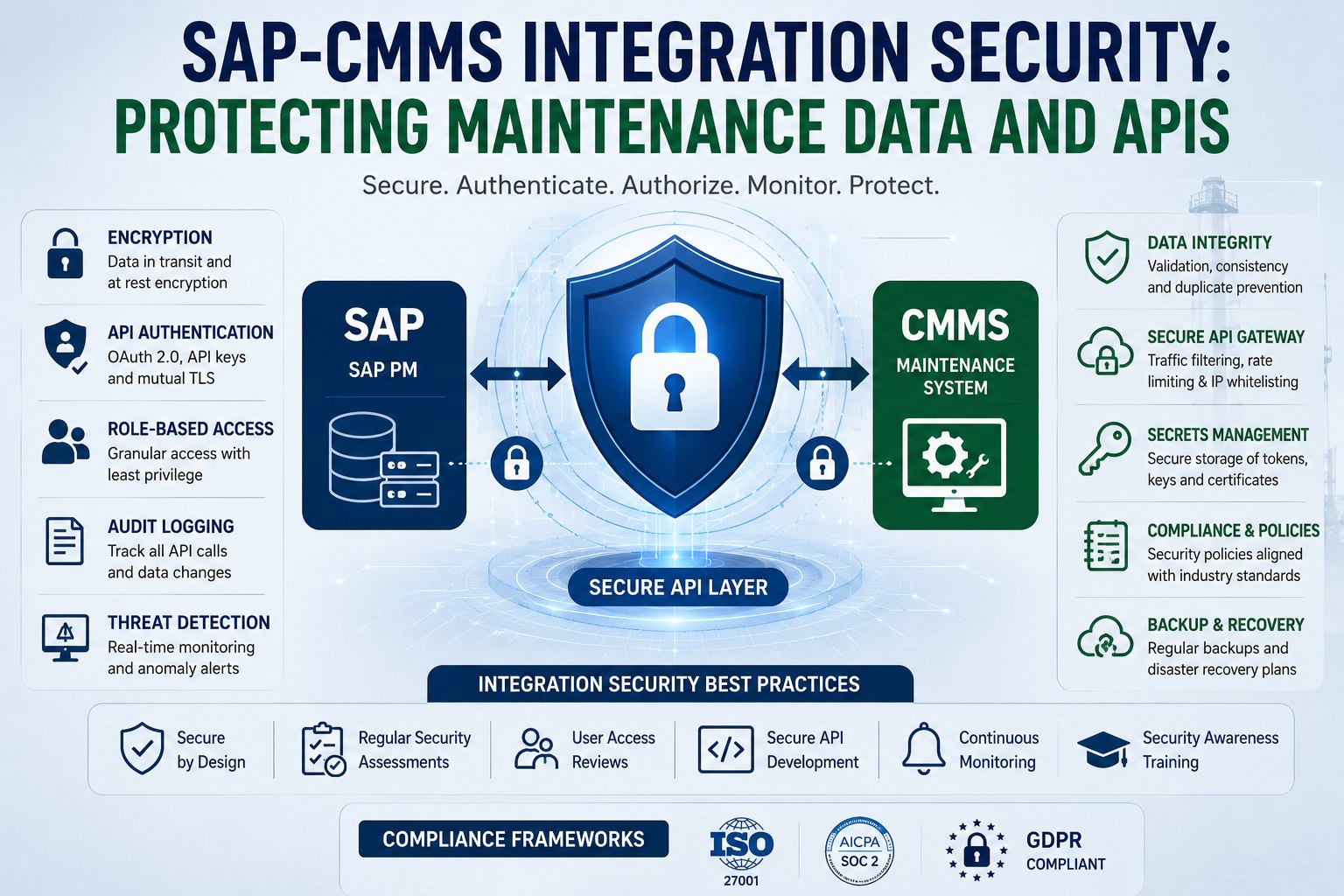
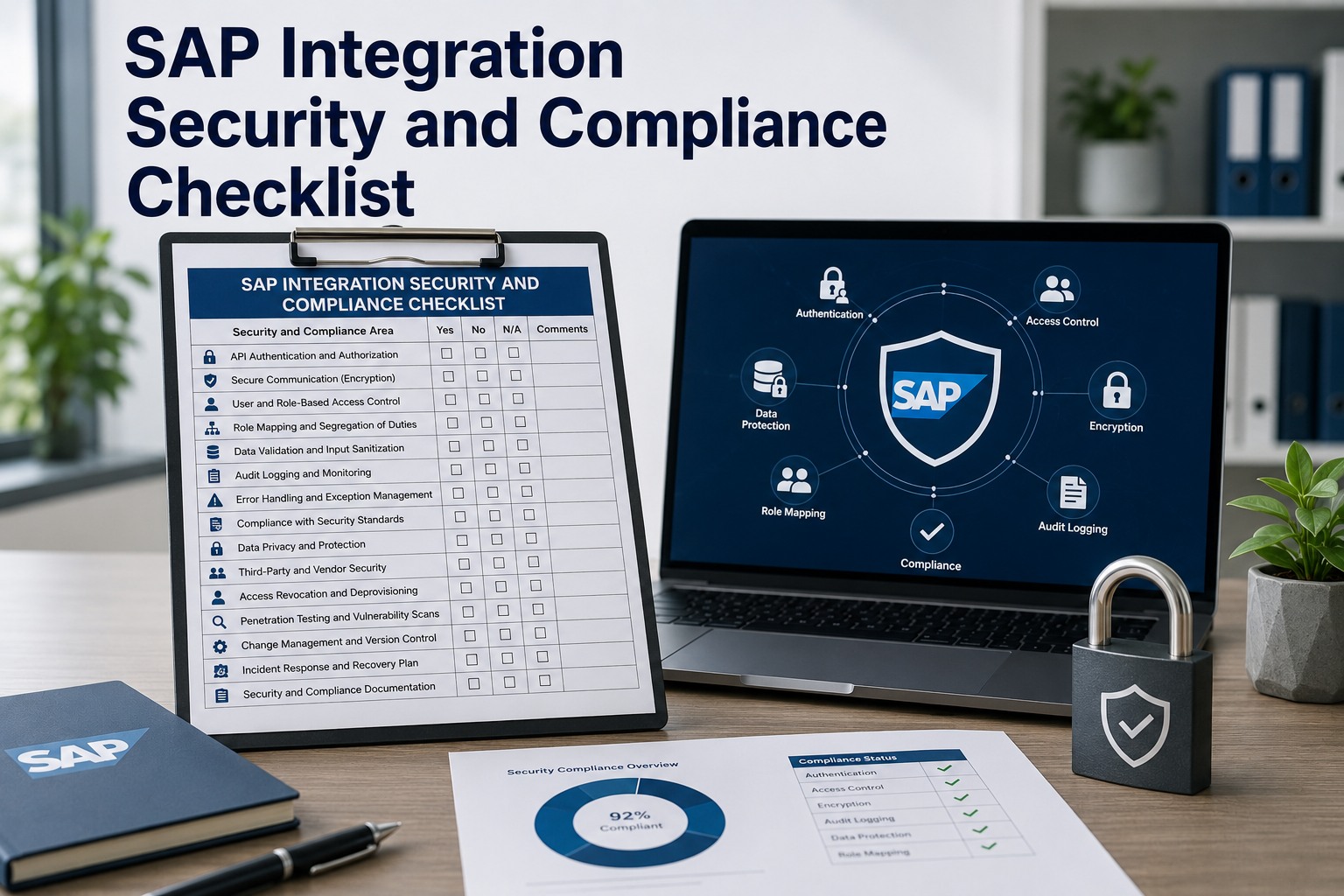
Every SAP-CMMS integration is also an attack surface. A misconfigured API token can expose equipment master data; a TLS misimplementation can let credentials leak; an over-permissioned service account can give an attacker the same read-write access your maintenance planners have. In 2025, average industrial data breach costs landed at $4.44 million per incident, with API misconfigurations cited as the leading attack vector in OT/IT integrations. Securing the integration is no longer a network team responsibility—it's an architectural requirement that lives inside the integration itself. Book a free demo to walk through secure SAP-CMMS deployment.
$4.44M
Global average cost of a data breach in 2025, up year over year
Source: IBM / industry research
99%
Of organizations encountered API security problems in the past year
Source: API security industry survey
+200%
Increase in DDoS attacks targeting APIs through 2025
Source: API security research
18%+
Annual growth in API risk exposure for manufacturing & IoT operations
Source: Industry threat research
Why SAP-CMMS Integration Security Is Different From Generic API Security
Generic API security frameworks assume web-facing services serving authenticated user traffic. SAP-CMMS integrations operate in a fundamentally different threat environment: they connect operational technology to enterprise systems, they carry financial-impact data that maps directly to cost centers, and they typically run with elevated service-account privileges that can read or modify the equipment master and inventory records that govern plant operations. A compromise of an SAP-CMMS integration token can produce consequences that span ransomware deployment, intellectual property exfiltration, and operational disruption simultaneously—threats that don't exist for a typical SaaS web API.
This is why integration security has to be designed in layers, with controls at the network, transport, API, application, and data tiers operating independently and reinforcing each other. No single control prevents all attacks. The architecture that produces a defensible security posture combines multiple control surfaces—each with specific threats it addresses and specific compliance citations it satisfies. Security and maintenance leaders ready to assess current integration exposure can Sign up free to begin a defense-in-depth posture review on existing integrations.
The Five-Layer Defense-in-Depth Model
The visualization below shows the layered security architecture that production-grade SAP-CMMS integrations implement. Each layer addresses a specific category of threat, satisfies specific compliance citations, and operates independently of the others. An attacker who breaches Layer 1 still faces Layer 2; one who compromises Layer 3 still hits Layer 4. That is the defining property of defense in depth—multiple independent controls protecting the same resource.
L1
NETWORK
Firewall · VPN · IP Allowlist
Blocks
- Untrusted IP origins
- Port scanning
- Direct internet exposure
Compliance
ISO A.13.1.3
NIST SC-7
L2
TRANSPORT
TLS 1.3 · Mutual TLS (mTLS)
Blocks
- Man-in-the-middle attacks
- Credential eavesdropping
- Session hijacking
Compliance
ISO A.13.2.3
NIST SC-13
L3
API
OAuth 2.1 · JWT · Rate Limit
Blocks
- Unauthorized API access
- Token replay attacks
- Brute-force credential stuffing
Compliance
ISO A.9.4.2
NIST IA-2
L4
APPLICATION
RBAC · Audit Log · Session
Blocks
- Privilege escalation
- Lateral movement
- Insider threat actions
Compliance
ISO A.9.2.5
NIST AC-3
L5
DATA
AES-256 · KMS · Tokenization
Blocks
- Data exfiltration value
- Data tampering at rest
- Key compromise impact
Compliance
ISO A.10.1.1
NIST SC-28
The most common mistake in integration security audits is treating the layers as alternatives rather than as a stack. A vendor saying "we use TLS 1.3" is offering Layer 2 only and saying nothing about the other four. A vendor saying "we use OAuth 2.0" is offering Layer 3 only. Production-grade integrations implement all five layers, document each, and present compliance citations against each. Security architects ready to assess vendor and internal integrations against this model can Sign up free to run a five-layer security audit on a sample integration.
From OAuth Token to Audit Trail: The Authentication Lifecycle
The single most-attacked surface in a modern SAP-CMMS integration is the OAuth authentication flow. Token compromise was the root cause of the Salesforce OAuth incidents in 2025 that triggered industry-wide reassessment of API security postures. The lifecycle below shows what a hardened OAuth 2.1 flow looks like in production, from initial credential issuance through audit-trailed expiration.
T+0
Client Credentials Issued
Service account provisioned in SAP. Client ID and secret generated. Secret stored in KMS, never logged. Initial RBAC scope assigned. All issuance events audit-logged.
T+5 sec
Token Request & mTLS Handshake
CMMS requests access token. Mutual TLS validates both client and server certificates. Client credentials transmitted over TLS 1.3. Request rate-limited to baseline thresholds.
T+6 sec
JWT Issued with Scoped Claims
JSON Web Token issued with explicit scope claims (read:equipment, write:notification). Token bound to client cert via JWT confirmation method. Short TTL (typically 15-60 min).
Active
Token Use & Continuous Validation
Each API call validates JWT signature, scope, and binding. Token revocation list checked. Every successful and failed authentication event logged with timestamp, source IP, and action.
T+TTL
Token Rotation or Revocation
Token expires automatically at TTL. Refresh follows full re-authentication flow. Suspected compromise triggers immediate revocation across all active sessions. Audit trail retained for compliance retention period.
The properties that make this flow defensible aren't novel—they're the OAuth 2.1 specification implemented strictly. Short-lived tokens limit blast radius. Bound JWTs prevent token replay. Continuous validation catches revocations. Mandatory audit logging satisfies the audit trail requirement that every compliance framework demands. Legacy implementations that use long-lived bearer tokens stored in environment variables fail every audit and produce most of the breach incidents.
Compliance Frameworks Your Integration Must Satisfy
Three compliance frameworks dominate the integration security audit landscape for SAP-CMMS deployments. Each has overlapping but distinct control families, and a hardened integration architecture can satisfy all three simultaneously when designed for the strictest of them.
ISO 27001
International ISMS Standard
Information Security Management System certification. Required by most enterprise procurement in Europe and a growing share globally. 114 controls across 14 domains. Annex A.13 (Communications) and A.9 (Access Control) most directly govern integrations.
Audit Cycle
Annual surveillance audit · 3-year recertification · Independent certification body
SOC 2
AICPA Trust Services
American Institute of CPAs framework. Required by most U.S. enterprise procurement. Type II reports cover security, availability, processing integrity, confidentiality, and privacy across a 12-month observation period. ~60-70% overlap with ISO 27001.
Audit Cycle
Annual Type II audit · 12-month evidence window · CPA-firm attestation
NIST CSF
U.S. Cybersecurity Framework
U.S. National Institute of Standards and Technology cybersecurity framework. Mandatory for federal contractors (CMMC), increasingly required for critical infrastructure operators. Five functions—Identify, Protect, Detect, Respond, Recover—map to specific integration controls.
Audit Cycle
Self-assessment or third-party · CMMC for defense suppliers · Continuous monitoring
The practical guidance for SAP-CMMS deployments serving multinational operations: design the integration architecture to satisfy ISO 27001 and SOC 2 simultaneously. The control overlap is high enough that hitting one accelerates the other, and the combination satisfies enterprise procurement requirements across virtually all geographies. NIST CSF mapping is typically added when the customer base includes U.S. critical infrastructure or federal contractors.
See Defense-in-Depth Running on a Live SAP-CMMS Integration
Walk through the five security layers in a live production architecture: network controls, TLS handshake, OAuth token flow, RBAC enforcement, encryption at rest. 30 minutes, with compliance citations mapped.
ROI: The Cost of Insecure Integration vs Hardened Operations
The financial case for hardened integration security sits on three compounding factors: avoided breach remediation costs (typically six to seven figures per incident), avoided regulatory penalties (GDPR alone reaches millions per violation), and procurement-eligibility maintenance that prevents losing enterprise customers when an attestation lapses. The numbers below come from documented industry research on API and integration security incidents.
Swipe to compare
$1.2M+
Expected annual avoided incident cost at typical industrial operator
60-90 days
Typical hardening timeline from current state to defense-in-depth
The risk-weighted economics make hardened integration security one of the highest-ROI investments in the entire SAP-CMMS deployment. A 24-percentage-point reduction in annual breach probability combined with a $4.4 million typical incident cost produces roughly $1 million in annual expected-loss reduction—an order of magnitude larger than the hardening investment. Security leaders ready to model their specific risk exposure can Book a free demo to walk through risk-adjusted ROI on their integration architecture.
Expert Perspective: Where Integration Security Programs Stall
The integrations that get breached share a common pattern: a security team that owns policy but doesn't own integration architecture, an integration team that owns architecture but doesn't own security, and a vendor that promises "enterprise-grade security" without producing the SOC 2 Type II report that would substantiate it. The successful programs eliminate that gap by treating integration security as one discipline executed across teams, with shared control ownership and shared evidence production. The vendor with the strongest security posture isn't necessarily the one with the most certifications—it's the one who can produce a layer-by-layer architecture document, the corresponding compliance citations, and the audit log evidence that the controls actually operate.
Demand the Architecture Document
Any vendor should be able to produce a layer-by-layer security architecture for their SAP integration. A vendor who can't is operating without one. The conversation ends here for most procurement evaluations.
Read the SOC 2 Type II Report
A SOC 2 Type II report covers a 12-month observation period and lists actual control findings. The certificate is meaningless without the underlying report. Insist on reviewing the most recent one under NDA before signing.
Test the Audit Log
Generate an authentication event in a test environment and verify it shows up in the audit log with full forensic detail. If it doesn't, the audit trail control isn't actually operating—regardless of what the vendor's policy says.
90-Day Path to Hardened Integration
The roadmap below is what security architects and integration leads execute together when they move from a legacy SAP-CMMS integration to a defense-in-depth posture aligned with ISO 27001 and SOC 2. The pace matters: visible control evidence by week six, full layer coverage by day 90, audit-ready package within a quarter.
Days 1–20
Current-State Audit
Map all SAP-CMMS API endpoints. Inventory existing tokens, service accounts, and RBAC scopes. Identify gaps against the 5-layer model. Capture compliance citations needed for each gap.
Days 21–45
Network & Transport Hardening
Deploy IP allowlists, firewall rules, and VPN where required. Enforce TLS 1.3 across all endpoints. Configure mutual TLS for service-to-service authentication. Validate Layer 1 & Layer 2.
Days 46–70
API & Application Controls
Migrate to OAuth 2.1 with JWT and short TTL. Implement scope-restricted access. Activate RBAC with role review. Enable comprehensive audit logging. Validate Layer 3 & Layer 4.
Days 71–90
Data Protection & Audit Pack
Verify AES-256 at rest with KMS-managed keys. Activate tokenization for sensitive fields. Generate audit pack mapping to ISO 27001 Annex A and SOC 2 trust services. Schedule mock audit.
By day 90, the integration architecture is documented, the controls are operating, the audit log is producing evidence, and the next compliance review is a routine exercise rather than a multi-week scramble. Security and integration leaders ready to start the current-state audit can Sign up free to begin the 5-layer audit on existing integration endpoints.
Make Your Next Security Audit a Routine Review
Five layers of defense. Documented compliance mapping. Audit-ready evidence on demand. See defense-in-depth SAP-CMMS integration running with ISO 27001 and SOC 2 alignment.
Frequently Asked Questions
What's the difference between ISO 27001 and SOC 2, and do we need both?
ISO 27001 is an international standard requiring an Information Security Management System certified by an independent body, with annual surveillance audits and three-year recertification. SOC 2 is an American AICPA framework producing a Type II attestation report covering a 12-month observation period. The control families overlap roughly 60-70 percent, so satisfying one accelerates the other. Multinational operators typically pursue both: ISO 27001 for European and Asian procurement requirements, SOC 2 for U.S. enterprise procurement requirements.
How does OAuth 2.1 differ from OAuth 2.0 for integration security?
OAuth 2.1 consolidates security best practices that emerged after the original OAuth 2.0 specification. Key differences for SAP-CMMS integrations: mandatory PKCE (Proof Key for Code Exchange) for all client types, deprecation of the implicit grant flow, deprecation of resource owner password credentials grant, mandatory short-lived access tokens with refresh token rotation, and explicit guidance on bound tokens to prevent replay. Production integrations should target OAuth 2.1 alignment even when interacting with OAuth 2.0 endpoints, which most enterprise integration platforms now support.
What's the right TTL for service-account access tokens?
Industry guidance has converged on 15 to 60 minutes for typical service-account access tokens, with refresh tokens valid for 24 hours or less. Shorter TTLs limit blast radius if a token is compromised. The trade-off is the additional load on the authentication endpoint and the complexity of token refresh logic. For high-volume integrations, 30 minutes is a common balance point. For high-sensitivity integrations (financial, compliance-critical), 15 minutes is preferred. Tokens exceeding 24 hours fail most modern security audits.
How do we audit existing SAP-CMMS integrations against the 5-layer model?
A structured audit walks each layer in sequence. Layer 1: enumerate all integration endpoints, verify network controls (firewalls, IP allowlists), and check for direct internet exposure. Layer 2: validate TLS configuration (1.3 enforced, weak ciphers disabled), test for mTLS where appropriate. Layer 3: review token issuance procedures, TTL settings, scope claims, rate limits. Layer 4: audit RBAC scope assignments and audit log completeness. Layer 5: verify encryption at rest with KMS-managed keys and tokenization of sensitive fields. Each layer audit produces evidence that maps directly to ISO 27001 Annex A controls and SOC 2 trust services criteria.
What questions should we ask CMMS vendors about their SAP integration security?
Five questions reliably separate hardened vendors from marketing claims. First: produce the integration architecture document showing all five layers and the controls at each. Second: provide the most recent SOC 2 Type II report under NDA, including control findings. Third: confirm OAuth 2.1 alignment with short-lived tokens and PKCE. Fourth: document the audit log structure, including what events are logged, retention period, and how to retrieve evidence for compliance reviews. Fifth: demonstrate the token rotation and revocation process in a live environment. A vendor that can't answer all five comfortably is not yet positioned to operate a production integration with SAP master data and financial systems.