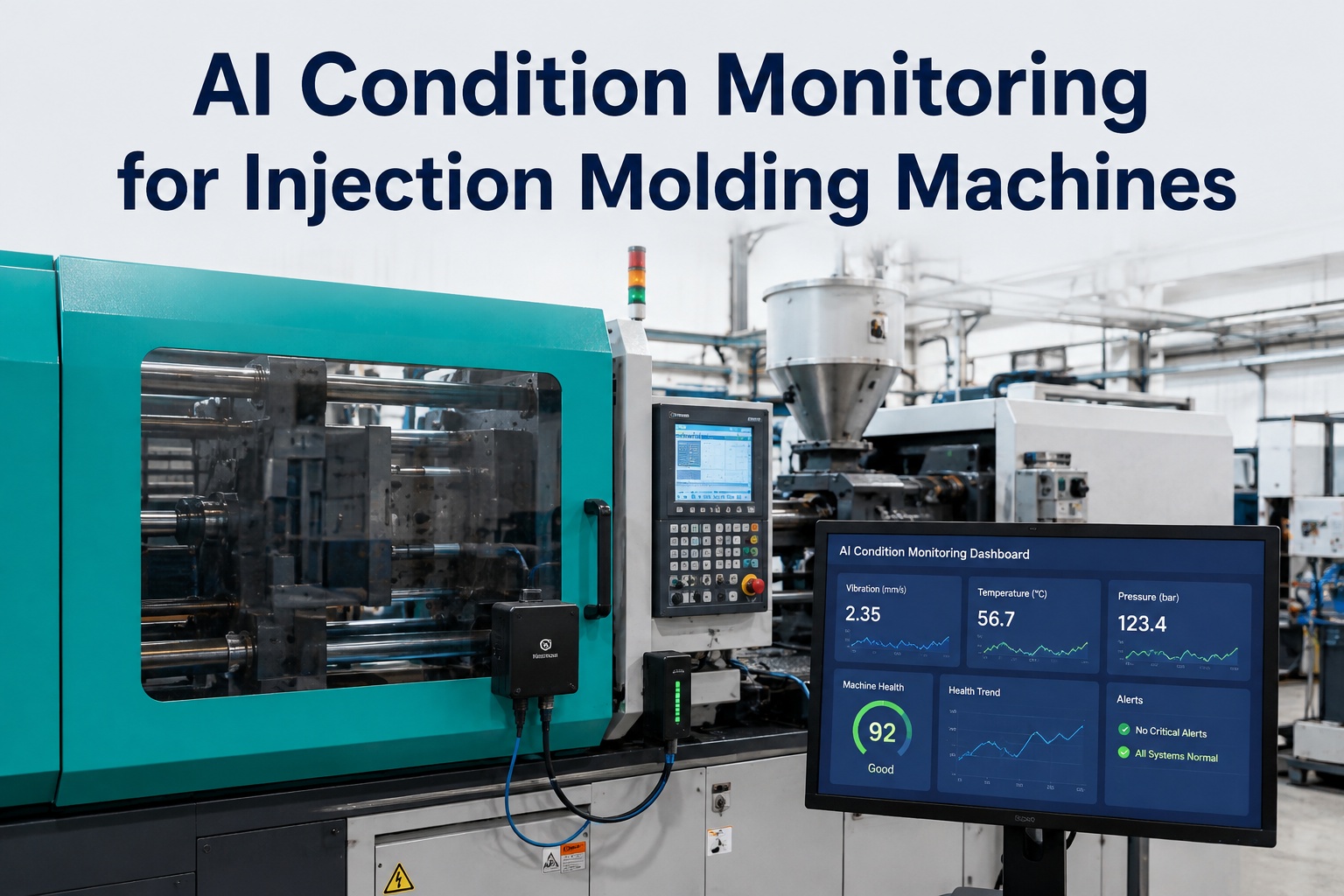
AI condition monitoring turns the vibration, temperature, hydraulic, and cycle-signal streams already flowing from an injection molding machine into work orders that fire weeks before the failure. This guide covers the six signal families, the failure-mode-to-signal signature map, and the deployment path that turns instrumented presses into a live predictive program. Start free on OxMaint to configure your press fleet, or book a demo.
AI Condition Monitoring for Injection Molding · From Signal to Work Order
6 signal families · multivariate anomaly detection · CMMS-live routing.
6
Distinct signal families every instrumented press streams — hydraulic, thermal, motor, screw, clamp, cycle
2–6 wk
Typical P-F lead time on hydraulic and bearing failures detected by AI vs threshold-alarm approach
Multi-var
AI catches multivariate anomalies (pressure + temp + amperage correlated drift) that single-threshold alarms miss
Euromap 77
OPC UA companion spec for injection molding — the modern connectivity foundation for signal ingestion
The 6 Signal Families · What an Instrumented Press Streams
Every modern injection molding machine emits six signal families, and each family has failure modes it detects earliest. Multi-signal fusion is where AI beats threshold alarms — a small pressure drop that looks fine, combined with a small amperage rise that looks fine, becomes a hydraulic pump wear signature that neither alarm would catch alone.
01
Hydraulic
Pressure · Flow · Temp
System pressure at injection, holding, and clamp. Oil temperature, filter pressure differential. Catches pump wear, check valve degradation, filter fouling.
02
Thermal (Barrel)
6–10 heater zones
Zone-by-zone barrel temperature vs setpoint. Heater band amperage, thermocouple drift, PID stability. Catches band failure, TC break, insulation degradation.
03
Motor & Drive
Amperage · Vibration
Servo motor amperage per axis, VFD current, vibration on drive-end bearings. Catches motor bearing wear, alignment issues, drive fault trending.
04
Screw & Barrel
Torque · Back-pressure
Screw drive torque during recovery, backpressure profile, plastification rate. Catches screw / barrel scoring, check ring wear, non-return valve failure.
05
Clamp System
Tonnage · Tie-bar strain
Clamp force profile, tie-bar strain-gauge readings, platen parallelism. Catches tie-bar cracking, platen misalignment, toggle wear, mold protection failures.
06
Cycle Metrics
Cycle time · Cushion · Peak P
Cycle time, cushion position, peak injection pressure per shot. Multi-shot trending catches process drift before scrap climbs or ejection fails.
AI vs Threshold Alarms · The One-Line Difference
Threshold alarms fire when a single signal crosses a preset limit — high oil temp, low pressure, high amperage. AI condition monitoring learns the multivariate correlation between signals under normal operation, then flags when the correlation itself drifts — days or weeks before any single signal crosses its threshold.
Threshold Alarm
Single Signal · Preset Limit
Fires when one signal exceeds a fixed value. Simple, fast to configure, no false-positive tuning. Misses correlated multivariate drift and slow degradation entirely.
AI Multivariate
Learned Baseline · Anomaly Score
Learns normal correlation across signal families; flags when the fingerprint shifts. Catches the 2-signal-drift-in-tandem pattern weeks before either signal alarms alone.
Failure Mode → Signal Signature Map
Every injection-molding failure mode leaves a distinct multi-signal fingerprint. The map below is the field-standard reference for the six most-common failure modes on the press, with the signals AI models watch and the typical P-F lead time before hard failure.
| Failure Mode | Signal Signature | P-F Lead Time |
|---|
| Hydraulic pump wear | Pressure ripple ↑ · flow @ setpoint ↓ · pump amperage ↑ · oil temp ↑ | 4–8 weeks |
| Check valve / ring wear | Cushion drift ↑ · back-flow during holding · shot-to-shot pressure variance ↑ | 2–4 weeks |
| Heater band failure | Zone amperage → 0 or ↑ (short) · TC reading vs setpoint diverges · adjacent zone compensation | Hours – days |
| Thermocouple drift | TC vs profile diverges · zone stability declines · PID output oscillates | Days – weeks |
| Motor bearing wear | Vibration RMS ↑ · specific bearing frequencies emerge · motor amperage baseline ↑ | 4–12 weeks |
| Tie-bar cracking | Strain-gauge asymmetry across 4 tie-bars · clamp force imbalance · platen deflection ↑ | Weeks – months |
Load the Injection Molding Signal Templates on OxMaint — Free Forever
Sign up on OxMaint's free forever plan and load the 6 signal-family templates per press. Euromap 77 / OPC UA connectors ingest data continuously, AI baselines learn in the first weeks, and anomaly-flagged work orders route to the right craft automatically. No card, no time limit.
The 4-Step Deployment · Data Foundation to Work-Order Loop
Every AI condition monitoring rollout follows the same four steps. Skip any one and the program stalls at "dashboard exists, no work orders fire" — the most common failure mode in industrial AI deployments.
Step 01
Data Foundation
Euromap 77 / OPC UA connection to press controllers. Signal-family point map, high-resolution sampling, historian storage sized for the model horizon.
Step 02
Baseline Learning
4–8 weeks of representative production data across product mix, shift patterns, and material batches. Autoencoder or LSTM models train on the multivariate signature of normal operation.
Step 03
Anomaly Score Tuning
Threshold on the anomaly score tuned against real events and near-misses. Balance point between too many false positives and missed degradation.
Step 04
Auto Work-Order Loop
Anomaly score above threshold auto-generates a diagnostic WO with the signal delta captured, routed to the right craft with recommended checks per suspected failure mode.
KPIs a Molding Reliability Team Should Actually Track
The dashboard below is the tight set for a live AI condition monitoring program — the numbers that prove the AI is contributing to uptime, not just adding another notification stream to ignore.
Prediction Lead Time
Target: median ≥ 14 days on hydraulic + bearing modes
Days between first AI flag and actual failure (or intervention). The single most-referenced KPI on a predictive program.
True Positive Rate
Target: ≥ 80% of AI-flagged WOs find real degradation
Field-verified detection rate. Below 60% erodes tech trust; above 90% likely means the model missed the subtle early cases.
MTBF (Critical Modes)
Trend: rising month-over-month post-deployment
Segmented by hydraulic pump, check ring, motor bearing, heater band, tie-bar. AI-driven intervention lifts these systematically.
Unplanned Downtime %
Target: falling toward < 3%
Downtime not scheduled by maintenance. Direct measure of whether the AI is converting unplanned events into planned interventions.
Scrap Rate
Track by machine + material + shift
Cycle-metric anomalies (cushion drift, peak pressure trend) catch process degradation before scrap climbs. Trending scrap is the leading indicator.
Time-to-Acknowledge WO
Target: < 30 min from AI flag to tech acknowledgment
Measures whether the CMMS routing is landing on the right craft in the right shift. Long acknowledge times = broken routing.
How OxMaint Runs the Full AI Condition Monitoring Program
The signal ingestion, AI baseline, anomaly scoring, and CMMS routing all run on one platform — Euromap 77 / OPC UA connectors to the press fleet, multivariate models per signal family, and diagnostic work orders that land on the phone with the signal delta and recommended checks attached.
Ingest
Euromap 77 · OPC UA · MTConnect
Standards-based ingestion from the press controller — Arburg, Engel, Krauss-Maffei, Sumitomo, Nissei, Milacron and others through the OPC UA companion spec.
Learn
Baseline Per Press + Product
Autoencoder / LSTM baselines learned per press per product family — the multivariate signature of normal operation for that specific run.
Detect
Anomaly Score + Failure-Mode Classifier
Above-threshold anomaly triggers failure-mode classifier — hydraulic vs thermal vs bearing vs check-ring — with confidence per candidate.
Route
Auto WO to Right Craft
WO routed to hydraulic tech, controls tech, or mechanical tech per classified failure mode. Signal delta + recommended check-sequence attached.
Track
MTBF + Lead-Time + TP Rate
Every AI-flagged WO logged with actual finding — feeds the true-positive-rate KPI and the MTBF trend by failure mode.
Improve
Model Retrained on Verified Events
Field-verified anomalies feed back to model training — accuracy compounds over months as the failure library grows.
Turn Your Press Data Stream Into Live Work Orders
Free forever plan — no card, no time limit. Connect one press via OPC UA, let the baseline learn for 4 weeks, and every anomaly-flagged event becomes a diagnostic WO with signal delta attached. Or book 30 minutes and we'll walk your press fleet end-to-end on the platform.
Frequently Asked Questions
What signals should an AI condition monitoring program on an injection molding machine actually watch?
Six signal families cover the credible failure modes on a modern press. Hydraulic — system pressure at injection / holding / clamp, oil temp, filter pressure differential. Thermal — barrel zone temperature vs setpoint across 6–10 zones, heater band amperage. Motor and drive — servo motor amperage per axis, drive-end bearing vibration. Screw and barrel — recovery torque, backpressure profile, plastification rate. Clamp — tonnage profile, tie-bar strain gauges, platen parallelism. Cycle metrics — cycle time, cushion position, peak injection pressure. AI value comes from correlating across families, not from watching any single signal harder.
How is AI condition monitoring different from threshold alarms on the same signals?
Threshold alarms fire when one signal crosses a preset limit — simple to configure, but they miss the correlated multivariate drift that precedes most real failures. AI multivariate models learn the normal correlation between signals under production conditions, then flag when the correlation itself shifts — days or weeks before any single signal crosses its threshold. A small pressure drop that looks fine alone, combined with a small amperage rise that also looks fine alone, becomes a diagnosable hydraulic pump wear signature that neither individual alarm catches.
What P-F lead time is realistic on injection molding failures?
Depends on the failure mode. Hydraulic pump wear typically 4–8 weeks. Check valve or ring wear 2–4 weeks. Motor bearing wear 4–12 weeks. Tie-bar cracking weeks to months. Heater band failure much shorter — hours to days — because it's usually a sudden electrical event, but even then AI can catch the thermocouple drift and PID compensation pattern that precedes it. Cycle-metric anomalies (cushion drift, peak-pressure trend) typically give days to weeks on process-side degradation before scrap climbs.
How long does the AI baseline need to learn before it's useful?
Four to eight weeks of representative production data on the specific press and product family. "Representative" is the operative word — the baseline needs to cover the product mix, shift patterns, material batches, and seasonal conditions the press actually runs, or the model will flag legitimate variation as anomaly. Deployments that ship after two weeks of a single-product run tend to generate false positives when the product changeover hits and erode tech trust before real value shows up.
Book a demo to see the phased baseline flow.
Does OxMaint connect to Arburg, Engel, Krauss-Maffei, and other major press brands?
Yes — through the Euromap 77 OPC UA companion specification that most modern press controllers support natively, plus MTConnect for older or non-Euromap installations. That covers Arburg, Engel, Krauss-Maffei, Sumitomo, Nissei, Milacron, and the other major press manufacturers. Signals ingest into the same asset hierarchy, and the AI baseline learns per press per product family so anomaly detection is specific to that press's normal operating fingerprint.
Sign up free to connect your first press today.