IoT Sensor Integration with CMMS: Condition Monitoring Setup Guide
A water utility in Arizona was replacing pump bearings every 14 months on a fixed calendar schedule — spending $22,000 per replacement cycle whether the bearing needed it or not. After installing vibration sensors and connecting them to OxMaint, the first bearing ran 26 months without replacement. The second failed at 11 months — caught by sensor data three weeks before it would have caused an unplanned outage. Same asset class, different failure timeline, different maintenance need. That is the shift IoT sensor integration makes possible: from scheduled guessing to condition-based maintenance, driven by real data from the asset itself. OxMaint's IoT integration connects vibration, temperature, pressure, and current sensors to automatic work order generation — so your CMMS acts on real conditions, not calendar dates.
IoT Integration + Sensor Alerts — OxMaint
Connect any sensor to OxMaint — vibration, temperature, pressure, current — and turn every threshold breach into an automatic work order
Average unplanned downtime cost — detectable 2–4 weeks early with correct sensor thresholds
72 hrs
Average early warning window when vibration sensors detect bearing defect frequencies
35%
Reduction in total maintenance spend when IoT-triggered condition-based maintenance replaces fixed PM schedules
Four Sensor Types — Four Different Failure Signals
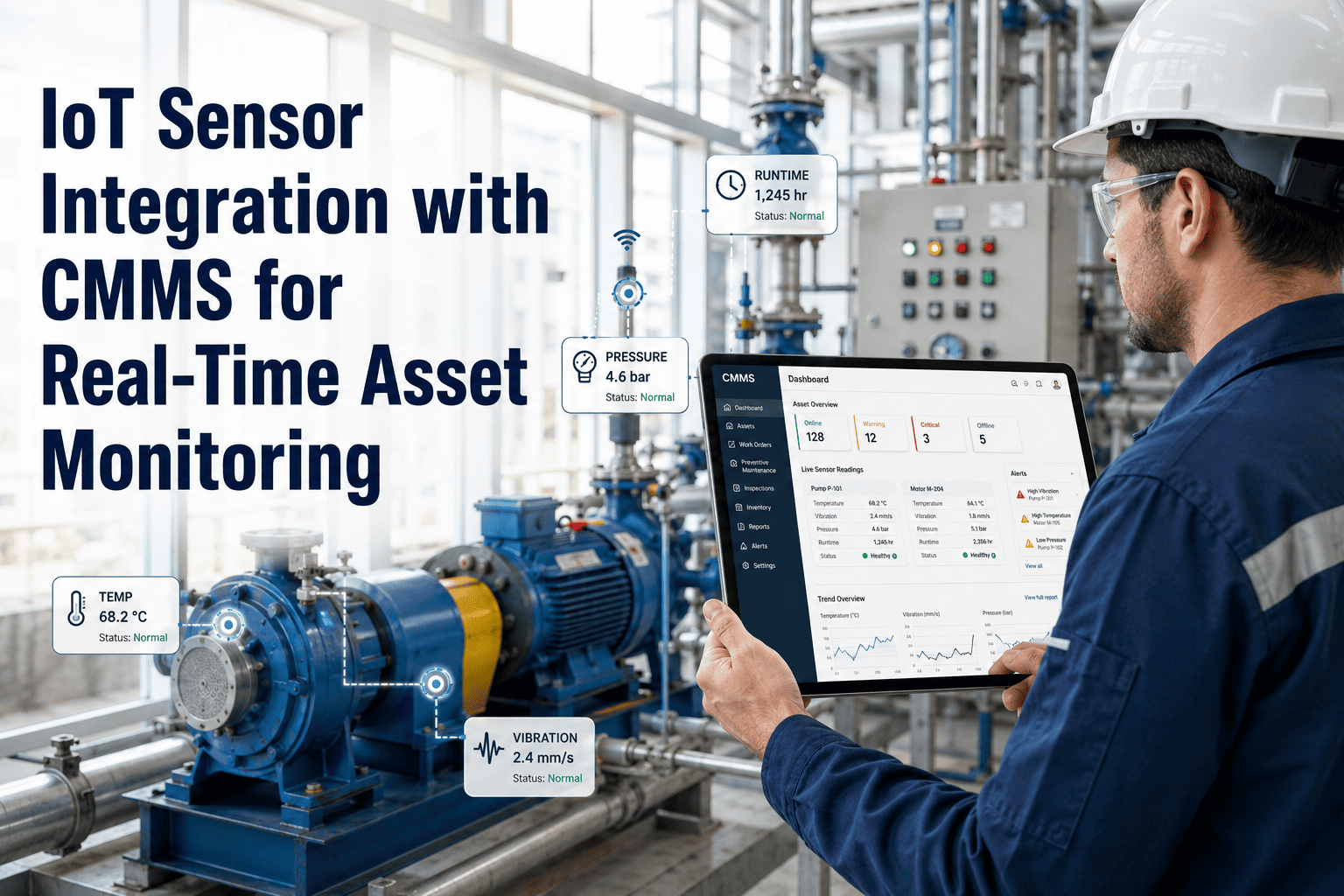
Different assets fail differently. A motor running hot before winding failure needs a temperature sensor. A pump cavitating needs a vibration sensor. A compressed air system leaking slowly needs a pressure sensor. A variable frequency drive overloading needs a current sensor. OxMaint connects to all four sensor types and maps each one to the right asset class, threshold, and alert rule.
Vibration
Most deployed
Pumps · Motors · Fans · Compressors · Gearboxes
Detects:
Bearing defect frequencies (BPFI, BPFO)
Unbalance and misalignment
Looseness and resonance
Alert at: 4 mm/s RMS (ISO 10816 Zone B/C boundary)
Compressed air · Hydraulics · Water supply · Steam · HVAC
Detects:
Slow leaks accumulating over days
Filter blockage (pressure differential)
Valve failure and line restriction
Alert at: ±8% from normal operating pressure setpoint
Current (Amps)
Load monitoring
Motors · VFDs · Conveyors · Pumps · Compressors
Detects:
Motor overloading before thermal trip
Phase imbalance — winding failure risk
Mechanical load increase (wear indicator)
Alert at: >110% full-load amps for more than 60 seconds
How IoT Connects to OxMaint — The Setup Process
Connecting sensors to a CMMS requires four steps: sensor hardware installation, data transmission configuration, threshold mapping in the CMMS, and work order rule creation. The common failure point is step three — thresholds set too sensitive generate alert fatigue, thresholds too wide miss the early warning signal entirely. OxMaint provides threshold templates for every major asset class built from reliability engineering standards.
IoT → CMMS Setup — Four-Step Configuration
1
Sensor Install
Mount sensor on asset — no shutdown required for most wireless clamp-on sensors. Tag to OxMaint asset record.
2
Data Transmission
Choose protocol: MQTT for IoT gateways, Modbus TCP for PLC-connected sensors, or direct REST API for cloud sensors.
3
Threshold Setup
Apply OxMaint threshold templates per asset class — or set custom values. Define warning (amber) and critical (red) levels.
4
WO Rules
Define which sensor breach creates which WO type — amber triggers inspection, red triggers immediate repair with tech assigned.
Technology Stack — What Powers Condition-Based Maintenance
IoT sensors are the data source, but the technology stack that makes condition-based maintenance work spans from hardware protocols to AI analytics to ERP integration. Facilities across the USA, Germany, Canada, UAE, and Australia achieving world-class maintenance programmes connect these layers in OxMaint.
Wireless IoT Sensors
LoRaWAN and Bluetooth 5.0 sensors require no wiring — battery life 3–5 years. Ideal for retrofitting existing assets without shutdown.
PLC Fault Integration
PLC alarm codes map directly to OxMaint work order templates. Fault fires → correct repair procedure, parts list, and tech assigned in seconds.
AI Digital Twin
Digital twin models simulate failure progression from live sensor data — predicting remaining useful life (RUL) and triggering WOs at the optimum intervention point.
AI Camera Vision
Thermal and optical cameras detect overheating components, oil leaks, and surface wear — feeding visual evidence automatically into OxMaint work orders at creation.
SAP / ERP Integration
Sensor-triggered WO costs flow into SAP automatically at closure — no manual cost entry. Parts consumption updates inventory without a separate purchasing step.
OxMaint Sensor Dashboard
All connected sensors visible in one live dashboard — current reading, trend, threshold status, and linked WOs. One view for every asset, every site, every sensor type.
Sensor Alert Configuration — What Gets Set and Why
The most common IoT implementation failure is threshold misconfiguration. Too sensitive and technicians ignore alerts. Too loose and the sensor misses the event it was installed to catch. This table shows the recommended two-level alert structure used by reliability engineers across manufacturing, utilities, and facilities management.
Sensor
⚠️ Warning (Amber)
? Critical (Red)
WO Generated
Response Time
Vibration
4 mm/s RMS
7 mm/s RMS
Inspection WO (amber) · Repair WO (red)
48 hrs · Same day
Temperature
+15°C above baseline
+25°C above baseline
Inspection WO · Emergency WO
24 hrs · <2 hrs
Pressure
±8% of setpoint
±15% of setpoint
Check WO · Urgent repair WO
48 hrs · Same day
Current (Amps)
>105% FLA for 120s
>115% FLA for 30s
Load review WO · Motor inspection WO
24 hrs · <4 hrs
What Facilities Achieve After IoT CMMS Integration
These outcomes reflect the 12-month results reported by OxMaint customers across manufacturing, utilities, facilities management, and food processing sectors in the USA, Canada, UK, and Australia after completing IoT sensor integration.
70%
Reduction in unexpected equipment failures
82%
Of sensor alerts result in a WO that prevents a failure
50%
Reduction in planned PM hours — replaced by condition-based scheduling
90%
Of sensor-triggered WOs closed within the defined response SLA
We put vibration sensors on our 12 most critical pumps and connected them to OxMaint. In 6 months we caught 3 bearing failures before they happened — saving us $130,000 in emergency repair and production loss. The sensors paid for themselves in the first incident.
— Plant Reliability Engineer, Food Processing Facility · California · OxMaint IoT user since 2023
Frequently Asked Questions
Vibration sensors offer the broadest failure coverage and highest ROI for rotating assets. Start there on your top 5 highest-consequence assets, then add temperature sensors on motors and electrical assets.
Yes. OxMaint connects via MQTT, Modbus TCP, REST API, and direct OPC-UA — compatible with most industrial sensor gateways, SCADA systems, and cloud IoT platforms already deployed on-site.
Use a two-level threshold system — warning (amber) for inspection, critical (red) for immediate repair. Apply a 60–120 second time-hold before alerting: eliminates false positives from momentary spikes without missing sustained breaches.
Yes. LoRaWAN sensors transmit up to 10 km with no existing Wi-Fi required. Cellular-based sensors work anywhere with mobile coverage. OxMaint supports both — choose the protocol matching your site conditions.
First sensor connected and first alert rule configured in under 2 hours for standard protocols. Full multi-site deployment with SAP integration typically takes 2–4 weeks. Book a demo to see the setup process live.
IoT Integration — OxMaint
Connect Your First Sensor. Close Your First Predictive Work Order.