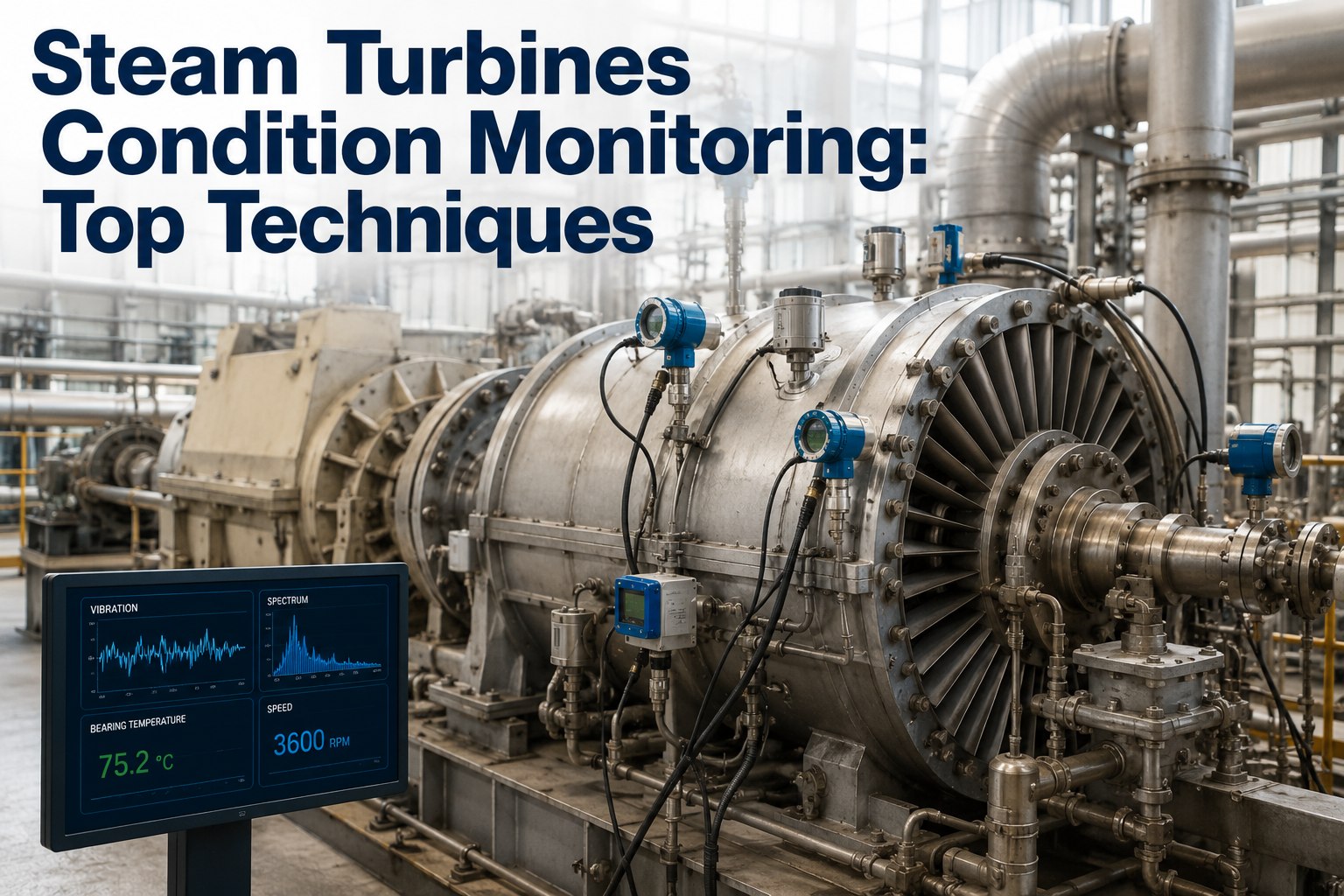
Condition monitoring for steam turbines is the practice of continuously tracking vibration, temperature, oil quality, and performance parameters to detect mechanical faults weeks before they cause catastrophic failures. Modern steam turbines maintenance programs rely on these early warning signals to shift from reactive repairs to predictive maintenance—reducing unplanned downtime by up to 50% and extending asset life by thousands of operating hours. Whether you manage a 500 MW power plant or an industrial cogeneration unit, implementing the right steam turbines condition monitoring techniques is critical for safety, efficiency, and regulatory compliance. This guide covers the top monitoring methods, sensor placement strategies, and threshold-setting best practices. To see how OxMaint turns sensor data into automated work orders, you can Start Free Trial today.
STEAM TURBINE RELIABILITY GUIDE
Are your steam turbines one vibration spike away from an unplanned outage?
A single undetected bearing fault can escalate into a $2M+ rotor replacement and weeks of lost generation. Condition monitoring catches these faults early—but only if abnormal readings automatically trigger maintenance action before failure cascades.
TECHNIQUE BREAKDOWN
Top Steam Turbines Condition Monitoring Techniques Ranked by Impact
Not all monitoring methods deliver equal value. The techniques below are ranked by how early they detect specific failure modes common to steam turbines—from blade erosion to bearing wear.
Steam Turbines Vibration Monitoring
The single highest-impact technique for rotating equipment. Accelerometers and proximity probes detect shaft orbit, unbalance, misalignment, and bearing wear. ISO 10816 thresholds categorize vibration severity—zone C (7.1–11.2 mm/s RMS for large machines) triggers an alert; zone D demands immediate shutdown. Permanently installed accelerometers on each bearing housing catch 60–70% of mechanical faults 2–8 weeks before failure.
Steam Turbines Temperature Monitoring
Thermocouples and RTDs on journal and thrust bearings monitor metal temperatures in real time. A bearing operating above 85°C signals degraded lubrication or impending wear. Exhaust temperature monitoring also detects blade fouling and deposit buildup—every 5°C rise above baseline can indicate 2–3% efficiency loss. Steam turbines temperature monitoring is essential for preventing thermal runaway in high-speed, high-load bearings.
Oil Analysis & Tribology
Spectrometric and ferrographic oil analysis detects wear-metal particles (iron, copper, lead, tin) trending upward months before vibration symptoms appear. Water content above 200 ppm in turbine oil accelerates bearing corrosion. Particle counts (ISO 4406 cleanliness codes) reveal filter degradation. Monthly sampling with trend analysis is the gold standard for steam turbines reliability programs targeting bearing wear and lubricant degradation.
Performance & Efficiency Trending
Tracking steam flow, pressure, temperature, and power output against vendor performance curves reveals internal degradation. A 3% drop in stage efficiency often points to blade erosion, solid-particle impingement, or seal leakage. This technique catches faults that vibration and oil analysis miss—especially blade erosion in the high-pressure section where steam velocities exceed 600 m/s.
Acoustic Emission Monitoring
High-frequency acoustic sensors (100–400 kHz) detect crack propagation, steam leak path formation, and early-stage cavitation in the condenser or feed pumps. Particularly valuable for blade root crack detection on LP turbines where conventional vibration sensors are less sensitive. Online acoustic emission systems provide continuous steam turbines fault detection without requiring turbine disassembly.
SENSOR STRATEGY
Steam Turbines Sensor Placement: Where to Mount for Maximum Coverage
Even the best sensors deliver poor results if mounted incorrectly. The map below shows the critical measurement points on a typical condensing steam turbine and the fault each location detects.
Front Standard Bearing
Sensors: Accelerometer + Proximity Probe + RTD
Detects journal bearing wear, shaft unbalance, and misalignment at the high-pressure end. Vibration velocity threshold: 7.1 mm/s alert, 11.2 mm/s alarm. Bearing temperature alert: 80°C.
HP Turbine Exhaust
Sensors: Pressure Transducer + Thermocouple
Monitors stage pressure drop and exhaust temperature. Rising exhaust temperature with constant load signals blade erosion or deposition. Baseline deviation of 8°C triggers inspection work order.
IP / LP Casing
Sensors: Accelerometers + Acoustic Emission
Detects blade resonance, LP blade crack initiation, and casing distortion. Acoustic emission sensors on LP blade roots catch micro-cracking 1,000+ operating hours before visible vibration shifts.
Thrust Bearing
Sensors: RTD + Eddy Current Probe
Axial displacement eddy current probes detect rotor thrust excursion—critical for preventing blade-tip rub. Thrust bearing metal temperature above 90°C indicates imminent thrust shoe failure.
Lube Oil Supply Header
Sensors: Flow + Pressure + Particle Counter
Continuous particle counting (ISO 4406) and moisture detection (ppm) on the supply header catch lubricant degradation before it reaches bearings. Trend data triggers automated oil-change work orders.
Generator End Bearing
Sensors: Accelerometer + RTD + Partial Discharge
Detects generator bearing wear, alignment drift between turbine and generator, and stator winding degradation. Vibration at 2× line frequency (100/120 Hz) indicates electrical fault signatures.
REAL-WORLD IMPACT
The Cost of Ignoring Steam Turbines Health Monitoring
Consider a 180-asset power generation facility running two 150 MW condensing steam turbines. Without online monitoring, the plant averages 3.2 unplanned outages per year—each costing $180K in parts, labor, and lost generation. That is $576K in annual reactive maintenance costs, plus 14 days of total downtime.
With steam turbines online monitoring and automated work-order generation, the same facility could reduce unplanned outages to fewer than one per year, saving an estimated $400K+ annually. The payback period for a full condition monitoring system—sensors, data acquisition, and CMMS integration—typically ranges from 8 to 14 months for mid-sized turbine fleets.
THRESHOLD PLAYBOOK
How to Set Warning and Alarm Thresholds That Actually Trigger Action
A monitoring program fails when thresholds are too sensitive (alarm fatigue) or too loose (missed faults). Use this structured approach—based on ISO 10816, API 670, and OEM baseline data—to set defensible, actionable limits.
| Parameter | Normal (Zone A/B) | Alert (Zone C) | Alarm (Zone D) | Auto-Action |
|---|---|---|---|---|
| Vibration Velocity (mm/s RMS) | 0.7 – 2.8 | 7.1 | 11.2 | Generate inspection work order at Alert; emergency trip recommendation at Alarm |
| Bearing Metal Temp (°C) | 55 – 75 | 85 | 95 | Check lube oil flow & cooling at Alert; load reduction at Alarm |
| Axial Displacement (mil) | ± 5 | ± 12 | ± 18 | Inspect thrust bearing; review steam pressure balance |
| Oil Water Content (ppm) | < 100 | 200 | 400 | Auto-generate oil purification work order at Alert |
| Stage Efficiency Drop (%) | 0 – 1.5 | 3.0 | 5.0 | Schedule internal inspection during next planned outage |
| Oil Particle Count (ISO 4406) | 18/16/13 | 21/19/16 | 24/22/19 | Filter replacement work order at Alert; oil change at Alarm |
Set baselines using 30 days of steady-state operating data after a major overhaul. Re-baseline annually or after any major repair. OxMaint stores baselines per asset and automatically flags when a new trend deviates—so your team does not have to eyeball charts or remember last quarter's numbers.
See OxMaint close the loop on your turbine data
Book a 30-minute demo and watch a real vibration alert trigger a work order, assign a technician, and log the repair—automatically.
HOW OXMAINT HELPS
How OxMaint Turns Steam Turbine Sensor Data Into Scheduled Repairs
Sensors produce data. OxMaint turns that data into action. The OxMaint AI-powered CMMS and EAM platform connects directly to your condition monitoring infrastructure—so every abnormal reading becomes an automatic, traceable work order with the full trend history attached.
Automated Threshold-to-Work-Order Engine
Configure multi-tier alerts (Alert / Alarm / Critical) for vibration, temperature, oil quality, and performance data. When a steam turbines vibration monitoring sensor crosses a threshold, OxMaint auto-generates a work order, assigns it to the right technician, attaches the trend chart, and orders any required spare parts from inventory.
Outcome: 40–60% faster response to emerging faults; zero readings ignored
Asset-Centric Reliability History
Every sensor reading, work order, parts replacement, and inspection is logged against the specific turbine asset record. Pull up any bearing, rotor, or seal and see its complete reliability timeline—trend data, past interventions, MTBF, and remaining useful life predictions powered by AI analytics.
Outcome: Defensible audit trail for ISO 55000 compliance and insurance reporting
Predictive Maintenance Analytics
OxMaint's AI engine analyzes multi-parameter trends—vibration spectrum, temperature rise rate, oil particle acceleration—to predict remaining useful life and recommend interventions before the next planned outage. Stop repairing on a fixed calendar; repair when the data says the turbine needs it.
Outcome: 25–35% reduction in unnecessary preventive maintenance spend
Spare-Parts Integration & Planning
When a monitoring alert fires, OxMaint checks spare-parts inventory for bearings, seals, and filters before the work order is released. If stock is below minimum, an automated purchase request is generated. No technician arrives on-site to find the critical part is on backorder.
Outcome: 50% reduction in work-order-to-completion cycle time
EARLY WARNING SIGNALS
Steam Turbines Early Warning Signals: The 7-Fault Detection Timeline
Understanding which monitoring technique detects each fault—and how early—lets you prioritize sensor investment and inspection intervals. The timeline below maps the progression of seven common steam turbine failure modes.
Bearing Wear (Journal & Thrust)
Detection lead time: 4–8 weeks. Oil analysis detects rising iron and copper particles first (Week 1). Vibration amplitude at 1× RPM increases as clearance grows (Week 3). Bearing temperature rises above baseline (Week 5). Without monitoring, failure occurs at Week 8 with potential rotor damage. OxMaint auto-escalates from Alert to Critical across these milestones.
Blade Erosion (HP Section)
Detection lead time: 6–12 months. Stage efficiency trending catches a 2–3% performance drop months before any mechanical symptom. Exhaust temperature rises as blade profiles degrade. Acoustic emission detects surface pitting initiation. Vibration changes appear late—often only after significant material loss. Performance trending is the primary early warning tool.
Misalignment (Turbine-Generator Coupling)
Detection lead time: 2–4 weeks. Vibration spectrum shows dominant 2× RPM peak with phase analysis confirming angular or parallel offset. Proximity probes on both bearings show 180° phase difference. Trend data correlates with thermal growth during startup. Early correction prevents coupling wear and secondary bearing damage.
Oil Degradation & Water Ingestion
Detection lead time: 8–16 weeks. Particle count trends rise gradually as additive packages deplete. Water content above 200 ppm indicates steam seal leak or cooler failure. Oxidation products (varnish precursors) detected via MPC (Membrane Patch Colorimetry) weeks before bearing deposits form. Automated oil sampling in OxMaint ensures no missed intervals.
Shaft Vibration (Rub & Instability)
Detection lead time: 1–7 days. Subsynchronous vibration (0.4–0.5× RPM) indicates oil whirl or whip. Full rub produces integer harmonics with thermal bow. These faults escalate fast—online monitoring with automated alarm logic is essential. OxMaint's threshold engine can trigger an immediate load-reduction recommendation to stabilize the rotor.
FREQUENTLY ASKED QUESTIONS
Steam Turbines Condition Monitoring: Common Questions
What is the best condition monitoring technique for steam turbines?
Vibration monitoring is the highest-impact single technique for steam turbines, detecting 60–70% of mechanical faults—bearing wear, unbalance, misalignment, and shaft instability—2–8 weeks before failure. However, no single method covers all failure modes. The best programs combine vibration, temperature, oil analysis, and performance trending for comprehensive coverage. OxMaint integrates data from all four technique categories into one asset reliability dashboard.
How often should steam turbine oil be sampled for condition monitoring?
For critical steam turbines, oil should be sampled monthly for spectrometric analysis, particle count, and water content. High-water-risk units (steam seal leaks) may require weekly moisture checks. Quarterly ferrographic analysis provides deeper wear-particle morphology insight. OxMaint auto-schedules sampling tasks and compares results against ISO 4406 cleanliness targets, triggering purification or change work orders when limits are breached. You can Start Free Trial to automate your oil sampling schedule.
What vibration standards apply to steam turbine monitoring?
ISO 10816 (now ISO 20816) provides vibration severity evaluation criteria for large rotating machines with power ratings above 300 kW. API 670 defines machinery protection system requirements. ISO 7919 covers shaft vibration measurement on non-reciprocating machines. Zone A/B is normal operation; Zone C (7.1 mm/s for large machines) is a warning; Zone D (above 11.2 mm/s) requires immediate action or trip. OxMaint lets you configure thresholds per standard and per asset.
How much does a steam turbine condition monitoring system cost?
A full online monitoring system for a single large steam turbine—sensors, data acquisition unit, cabling, and CMMS integration—typically ranges from $80K to $250K depending on sensor count and complexity. With average unplanned outage costs of $180K+ per event, most facilities achieve payback within 8–14 months after preventing just one or two failures. OxMaint's CMMS platform integrates with your existing sensor infrastructure, minimizing additional hardware investment. To get a tailored ROI estimate, Book a Demo.
Can condition monitoring prevent blade erosion in steam turbines?
Performance and efficiency trending is the most effective early detection method for blade erosion. A 2–3% drop in stage efficiency, rising exhaust temperature at constant load, and changing pressure profiles across turbine stages all indicate blade surface degradation. Acoustic emission sensors can detect early-stage crack initiation in LP blade roots. While monitoring cannot reverse erosion, it gives you 6–12 months of lead time to plan a re-blading outage during a scheduled maintenance window rather than an emergency.
Stop reacting to turbine failures. Start predicting them.
OxMaint connects your steam turbine sensors to automated work orders, AI-driven predictions, and a complete asset reliability history. See it live on your assets in 30 minutes.
Free 14-day trial · No credit card