Commercial fleet operations have historically treated maintenance as a scheduled cost — fixed intervals, blanket replacements, and reactive repairs when breakdowns occur between services. AI-driven predictive maintenance changes the economic model entirely. By integrating telematics data, IoT sensor streams, and machine learning models trained on failure patterns across vehicle populations, fleet operators can reduce unplanned breakdowns by up to 70%, extend component service life by 20–35%, and shift the maintenance cost curve from reactive to optimised. This article covers how Oxmaint.ai's AI fleet maintenance platform applies predictive analytics to commercial vehicle operations and what the transition from interval-based to condition-based maintenance actually requires in practice. Book a demo to see the predictive fleet maintenance platform.
AI Fleet Maintenance: Predictive Analytics, IoT Integration & Automated PM for Commercial Vehicles
For fleet managers, operations directors, and maintenance chiefs managing commercial vehicle fleets — the shift from interval-based to AI-driven predictive maintenance is the single highest-ROI infrastructure change available in fleet operations today.
The Problem With Scheduled Maintenance in Commercial Fleet Operations
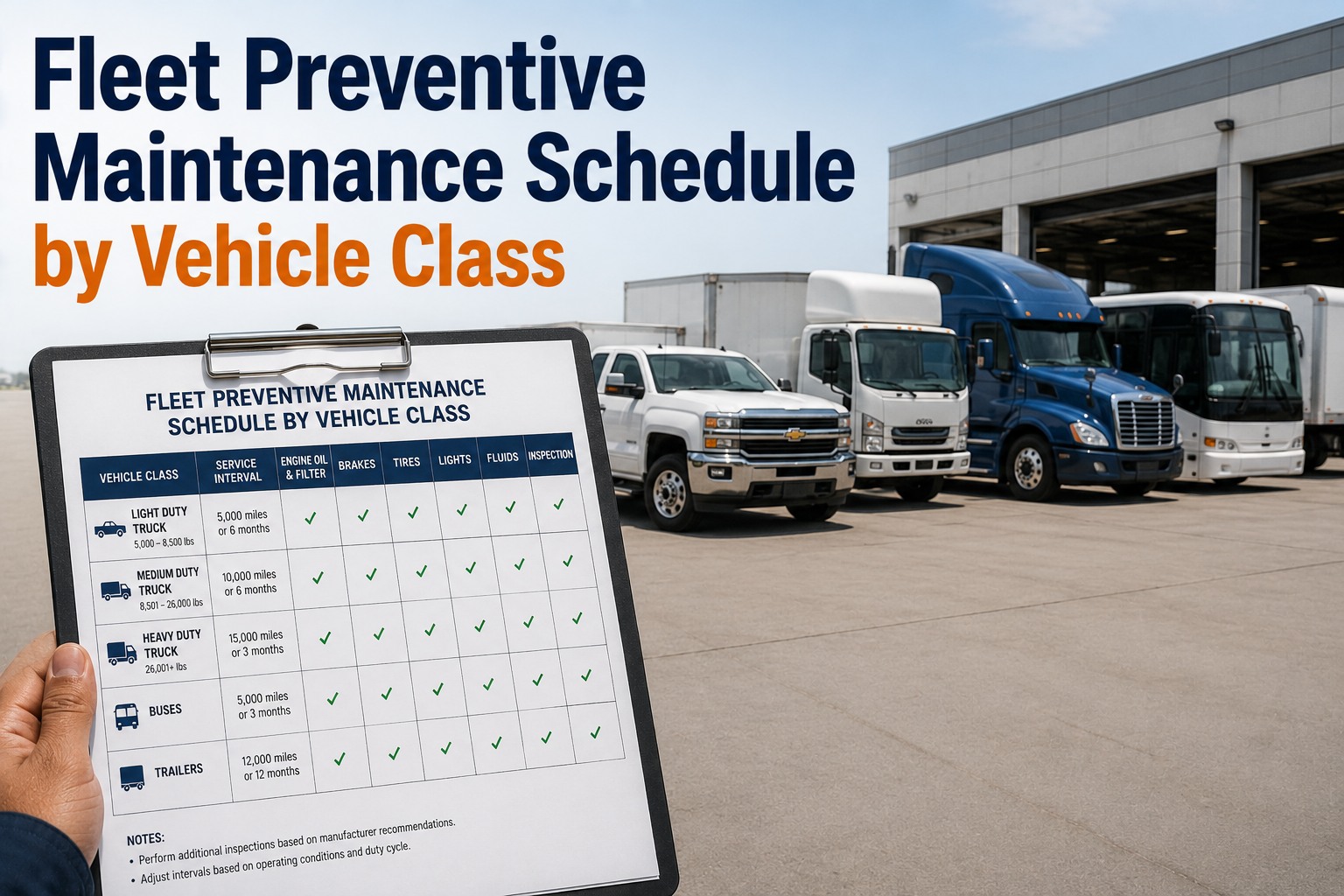
Fixed maintenance intervals — oil changes every 10,000 km, tyre rotation every 15,000 km, brake inspection every 30,000 km — were designed for an era before telematics and sensor data. They create two equally wasteful outcomes: components replaced well before the end of their usable life because the interval arrived, and failures that occur between intervals because the component's actual condition was never assessed. Both outcomes cost money that predictive maintenance eliminates.
The data that makes predictive maintenance possible has been available in commercial fleet telematics systems for over a decade — engine hours, idle time, fuel consumption patterns, brake actuation frequency, load cycles, and now powertrain temperature monitoring and vibration analysis from IoT sensors. What was missing was the analytical layer that translates this data stream into actionable maintenance predictions. Oxmaint.ai's AI maintenance engine provides that layer — trained on fleet failure patterns and continuously updated by each fleet's own operational data.
Indicative fleet maintenance cost comparison — actual savings vary by fleet type, utilisation profile, and telematics maturity
The Technology Stack Behind AI Fleet Maintenance
Four technology layers must work together to deliver genuine predictive maintenance capability. Oxmaint.ai integrates all four within a single fleet management platform.
IoT & Telematics Data Collection
Vehicle ECU data via OBD-II or J1939 CAN bus, telematics GPS and engine telemetry, tyre pressure monitoring, and supplementary IoT sensors for temperature, vibration, and fluid condition monitoring — all feeding a unified data stream at configurable collection intervals.
Machine Learning Failure Models
Supervised ML models trained on historical failure event data — matched against pre-failure sensor signatures — identify the parameter combinations that precede each failure type 3–30 days before occurrence. Models are continuously refined by each fleet's actual failure and non-failure outcomes.
Predictive Alert Generation
When model confidence for a specific failure mode exceeds the configured threshold, an alert is generated identifying the vehicle, the component at risk, the predicted failure window (typically 3–14 days), and the recommended intervention — before the maintenance work order is created and scheduled.
Automated Work Order & Scheduling
Confirmed predictive alerts generate CMMS work orders automatically — assigned to the correct maintenance bay, with the right parts pre-ordered, and scheduled in the maintenance calendar during a planned off-route window. No manual intervention required to translate the prediction into a maintenance action.
What Oxmaint.ai's AI Fleet Maintenance Platform Delivers
Practical, measurable capability across the four dimensions that define fleet maintenance performance — not theoretical AI that requires a data science team to operate.
Vehicle Health Scoring & Failure Prediction
Every vehicle in the fleet receives a real-time health score — a composite indicator derived from its current sensor readings, recent fault code history, utilisation intensity, and comparison against the fleet population baseline. Vehicles with health scores trending downward are flagged for investigation before the score reaches the threshold where failure risk becomes acute.
The failure prediction engine identifies the most probable failure mode for each at-risk vehicle and provides the estimated time-to-failure range — giving fleet managers the scheduling window to bring the vehicle in during a planned maintenance slot rather than responding to a roadside event at 2am. Start a free trial to see health scoring configured for your fleet.
Telematics Integration & IoT Sensor Data Management
Oxmaint.ai integrates with major telematics providers and directly with vehicle ECU data via OBD-II and J1939 CAN bus interfaces. Engine temperature, oil pressure, transmission fluid temperature, brake wear indicators, tyre pressure, and vibration data from supplementary IoT sensors all flow into the platform's data pipeline without requiring manual data entry or custom integration development.
The integration layer normalises data from mixed telematics environments — a common reality in larger fleets that have accumulated multiple telematics systems across vehicle acquisition cycles. Fleet managers no longer need to reconcile data from different systems; the platform presents a unified view across all vehicles regardless of the telematics hardware installed. Book a demo to discuss your telematics integration options.
Intelligent Maintenance Scheduling & Route Coordination
A predictive alert that creates a work order nobody can schedule within the predicted failure window is worth nothing. Oxmaint.ai's scheduling engine coordinates predictive maintenance windows against the vehicle's operational schedule — identifying the nearest planned off-route period that falls within the predicted intervention window and placing the work order in the maintenance calendar automatically.
For fleet operators running tight utilisation schedules, the scheduling intelligence is as important as the prediction accuracy. The platform calculates the cost trade-off between scheduling maintenance slightly early (before the optimal condition window) and deferring to the next natural off-route opportunity — and presents this trade-off to the maintenance planner as a data-supported scheduling recommendation rather than a binary requirement.
Fleet Performance Analytics & Maintenance ROI Reporting
Every predictive intervention creates a data point: a predicted failure that was addressed before it occurred. Tracking these interventions — the component replaced, the predicted failure mode, the cost of the preventive action versus the estimated cost of the breakdown it prevented — builds the maintenance ROI case that justifies the predictive maintenance investment and drives continuous improvement in prediction model accuracy.
Oxmaint.ai's analytics module surfaces the metrics that matter to fleet leadership: breakdown rate trend, cost-per-kilometre trend, mean time between failures per vehicle type, and prediction accuracy rate by failure mode category. These metrics are available in real time and exportable for board-level reporting, insurer submissions, and regulatory compliance documentation. Start a free trial to see the fleet analytics dashboard.
Reduce Breakdowns. Extend Vehicle Life. Lower Maintenance Cost.
Oxmaint.ai's AI fleet maintenance platform gives your team predictive failure alerts 3–14 days in advance, automated work order generation, and the scheduling intelligence to act on predictions without disrupting fleet operations.
Interval-Based PM vs. AI Predictive Maintenance
The operational and financial case for transitioning from fixed-interval maintenance to AI-driven predictive fleet maintenance is measurable across every key performance dimension.
| Performance Dimension | Interval-Based PM | Oxmaint.ai AI Predictive |
|---|---|---|
| Unplanned Breakdown Rate | 8–15% of vehicles experience a roadside breakdown per year despite scheduled PM | 70% reduction — breakdowns occur when prediction model fails, not from ignored component degradation |
| Component Utilisation | 20–40% of replaced components have remaining serviceable life — replaced because the interval arrived | Components replaced at actual end-of-condition-based life — 25–35% average service life extension |
| Maintenance Scheduling | Fixed calendar — maintenance performed when the interval arrives regardless of vehicle utilisation or operational demands | Condition-based scheduling within predicted intervention window — maintenance fits the operational schedule |
| Data Utilisation | Telematics data collected but not analysed — fault codes generate alerts but not predictive interventions | Full telematics, ECU, and IoT sensor data stream analysed continuously for early failure signatures |
| Total Maintenance Cost | $12,800 per vehicle per year average across commercial fleets (UK/US benchmark) | $7,100 per vehicle per year average — 44% reduction through breakdown elimination and parts optimisation |
Scroll horizontally to compare on mobile
In the first six months after deploying Oxmaint.ai's predictive platform across our 340-vehicle distribution fleet, we had 23 interventions triggered by the AI — components replaced before failure. We tracked each one against the historical failure pattern for that vehicle type, and our maintenance team estimates we prevented 19 roadside breakdown events. At our average cost per event, that's a six-figure saving in the first half-year alone, before counting the extended component life on the parts that would have been replaced at the next scheduled service.— Fleet Operations Director, National Distribution Company, United Kingdom
Frequently Asked Questions
How long does Oxmaint.ai's AI model need to train before it generates reliable predictions for a new fleet?
Oxmaint.ai uses pre-trained base models built on fleet failure patterns across vehicle populations before a new fleet's data is available. These base models begin generating predictions from day one of data ingestion — with confidence scores that reflect the model's certainty at each stage. As the fleet's own operational and failure data accumulates over 3–6 months, the model is progressively personalised to the specific vehicle types, utilisation patterns, and operating environment of that fleet. Most fleets see prediction accuracy improving measurably after the first full service cycle of data has been captured. Book a demo to discuss the model onboarding process for your fleet type.
Which telematics platforms does Oxmaint.ai integrate with for fleet data collection?
Oxmaint.ai integrates with major telematics platforms including Samsara, Geotab, Verizon Connect, Trimble, Teletrac Navman, and others via API integration. For vehicles without existing telematics, direct OBD-II and J1939 CAN bus data collection is available through the Oxmaint IoT gateway device. Mixed telematics environments — common in larger fleets — are handled through the platform's normalisation layer, which presents unified vehicle data regardless of the telematics hardware source. Start a free trial to check compatibility with your current telematics setup.
How does the platform handle false positive predictions — alerts that predict failures that don't materialise?
All predictions carry a confidence score — only alerts exceeding the configured threshold (typically 75–85% confidence) generate automatic work orders. Lower-confidence signals are surfaced as monitoring flags that the maintenance team can review without immediate action. When a maintenance intervention occurs following a prediction and the component is found to be within tolerance, that outcome is fed back into the model as a false positive signal that adjusts the detection threshold for that failure mode. The model's false positive rate is tracked and displayed in the fleet analytics dashboard — most fleets achieve false positive rates below 12% within the first six months of operation.
Can Oxmaint.ai manage both AI predictive work orders and standard scheduled PM intervals within the same maintenance calendar?
Yes. Oxmaint.ai manages both predictive work orders and scheduled interval PM within the same maintenance calendar. During the transition from interval-based to AI predictive maintenance, most fleets run both systems in parallel — maintaining statutory and manufacturer-recommended interval PM while adding predictive work orders for the component categories where AI monitoring is active. The platform's scheduling engine coordinates both work order types to avoid conflicting maintenance appointments for the same vehicle. Over time, as prediction confidence grows, fleets typically reduce the frequency of interval-based PM for the components covered by predictive monitoring. Book a demo to see the combined maintenance calendar management.
How quickly can a fleet of 50–200 vehicles be onboarded onto Oxmaint.ai's predictive maintenance platform?
A fleet of 50–200 vehicles can be fully onboarded onto Oxmaint.ai within 2–3 weeks of starting the free trial. The onboarding process covers vehicle asset registration, telematics integration configuration, existing PM schedule import, and mobile app deployment for drivers and maintenance technicians. Historical telematics and maintenance records can be imported to accelerate the initial model training phase. By the end of the second week, most fleets are receiving their first AI-generated predictive alerts alongside their standard scheduled PM calendar.
Your Fleet Data Is Already Predicting Failures. You Just Need a System to Listen.
Every vehicle in your fleet is generating the data that predicts its next failure. Oxmaint.ai's AI maintenance platform translates that data stream into scheduled interventions — 3 to 14 days before the breakdown that would otherwise stop your vehicle by the side of the road.