A vibration sensor the size of a matchbox, bolted to a motor housing and streaming data every 10 seconds over a wireless mesh network, detected a 0.3 mm/s increase in the 4.7x bearing pass frequency on a cement mill drive motor — 37 days before the bearing would have seized. The total cost of the planned replacement: $4,200 in parts and 3 hours of scheduled downtime. The cost if the bearing had failed without warning: $127,000 in emergency repair, collateral shaft damage, and 4.5 days of lost production. That single sensor paid for itself 30 times over in one event. This is the reality of IoT-driven predictive maintenance in 2025 — not a futuristic concept but a proven, deployed technology that connects physical equipment to machine learning algorithms through networks of low-cost wireless sensors. The combination of IoT data infrastructure and AI pattern recognition has matured to the point where any plant with WiFi coverage and a CMMS can implement predictive capabilities on critical assets within weeks, not years. Book a demo with Oxmaint to see how IoT sensor data flows directly into automated work orders that prevent failures before they disrupt production.
The convergence of three technology trends made this possible: industrial IoT sensors dropped below $500 per point, cloud computing eliminated the need for on-premise data infrastructure, and AI algorithms became accurate enough to predict specific failure modes 2–8 weeks ahead with 85–95% confidence. The missing piece for most plants is not the technology — it is connecting sensor intelligence to the maintenance execution system so predictions become scheduled repairs automatically. Sign up for Oxmaint to bridge that gap.
The IoT Sensor Ecosystem for Predictive Maintenance
Not all sensors serve the same purpose. Each type captures a different physical signal that reveals a different class of equipment degradation. Building the right sensor network means matching sensor types to failure modes on your specific critical assets — not blanketing the plant with identical devices.
Vibration Sensors
PRIMARYTriaxial wireless accelerometers capture vibration spectra across 0–10 kHz range. AI extracts bearing pass frequencies, harmonic patterns, and envelope signatures that classify specific failure modes 2–8 weeks before functional failure.
Temperature Sensors
ESSENTIALRTD probes and wireless thermocouple transmitters track bearing housing, motor winding, and process temperatures. A gradual 0.5°C/day upward trend in a bearing is invisible on daily rounds but unmistakable to an AI tracking the trajectory over weeks.
Current / Power Sensors
HIGH VALUECurrent transformers and power analyzers capture motor electrical signatures. AI detects rotor bar cracks, stator winding degradation, and mechanical load changes through current spectrum analysis — without touching the rotating equipment.
Ultrasonic / Acoustic
ADVANCEDUltrasonic microphones detect high-frequency emissions from compressed gas leaks, electrical arcing, and bearing lubrication breakdown. A single compressed air leak survey typically recovers $5,000–$20,000 in annual energy waste.
Oil Quality Sensors
SPECIALISTInline oil condition sensors continuously measure particle count, moisture content, viscosity, and dielectric constant. Replaces periodic lab analysis with real-time trending that catches contamination events within hours instead of weeks.
Connect Your Sensors to Intelligent Maintenance
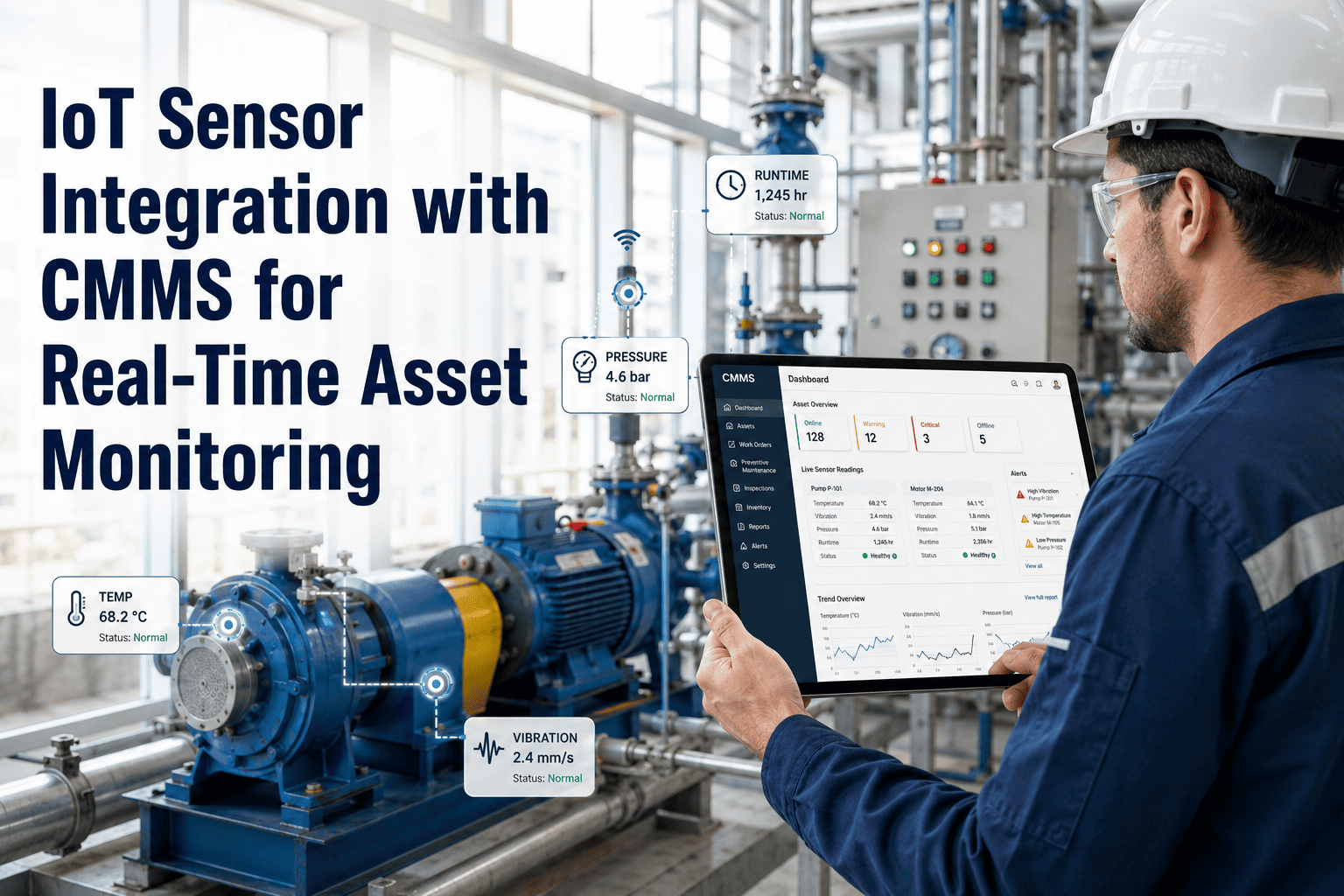
Oxmaint ingests data from any industrial IoT sensor via MQTT, OPC-UA, and Modbus — no proprietary hardware required. Predictions flow directly into CMMS work orders with parts, crew, and timing optimized automatically.
How AI Transforms Raw Sensor Data into Maintenance Decisions
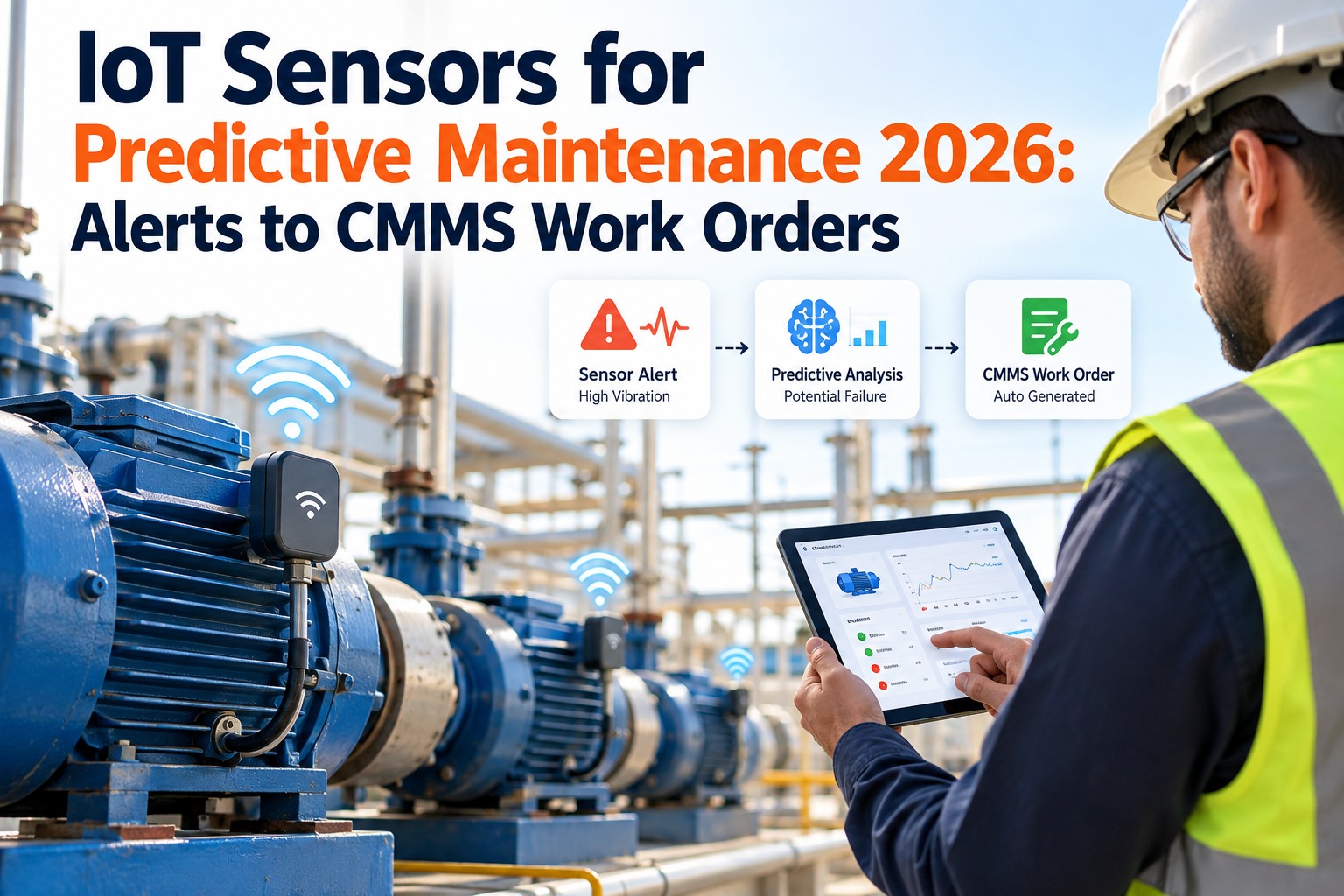
IoT sensors generate millions of data points per day. Without AI, this data is noise — dashboard screens full of green lines that nobody watches until something turns red (by which point it's too late). The AI analytics layer converts this raw stream into three actionable outputs: anomaly alerts, failure mode classification, and remaining useful life estimates.
Data Ingestion & Edge Processing
Raw sensor data streams to an edge gateway that filters noise, compresses time-series, and forwards clean data to the cloud analytics engine. Edge processing reduces bandwidth by 80–90% while preserving all diagnostic-quality signal content.
Digital Fingerprint & Baseline Learning
ML models ingest 4–12 weeks of normal operating data to create each asset's unique behavioral fingerprint — its vibration signature under different loads, temperature response at various speeds, and power profile across operating modes. This fingerprint becomes the reference for all future anomaly detection.
Multi-Signal Anomaly Detection
The AI continuously compares live data against the learned baseline across all connected sensors simultaneously. A 0.3 mm/s vibration increase alone might not trigger an alert — but combined with a 2°C bearing temperature rise and a 3% motor current increase, the system confirms a developing inner-race bearing defect with 92% confidence.
Failure Classification & RUL Prediction
The system classifies the specific failure mode developing — bearing inner race, outer race, cage, shaft misalignment, impeller imbalance, insulation degradation — and estimates Remaining Useful Life with confidence intervals. Output example: "Fan DE Bearing — Stage 2 inner race defect, 18–25 days to functional failure, 89% confidence."
CMMS Work Order Automation
The prediction flows into Oxmaint's CMMS as a pre-populated work order: equipment ID, failure description, recommended action, required parts (auto-checked against inventory), estimated repair time, and optimal scheduling window. No manual translation. No dropped handoffs. Prediction becomes execution in one automated flow.
Before IoT vs. After IoT: What Changes in Daily Operations
The transformation is not just technical — it changes how maintenance teams spend their time, how managers allocate budgets, and how plants achieve uptime targets.
Before IoT + AI
After IoT + AI
Implementation Roadmap: Sensor to Prediction in 90 Days
Deploying IoT predictive maintenance does not require a plant-wide infrastructure project. The fastest path to ROI is a focused pilot on 10–20 critical assets that expands after proving value. Schedule a demo to see the implementation plan customized for your plant.
Asset Criticality Assessment & Sensor Selection
Identify your 10–20 highest-impact assets using failure history, production criticality, and repair cost data. Select sensor types matched to each asset's dominant failure modes. Vibration + temperature covers 80% of rotating equipment needs.
Sensor Installation & Network Configuration
Mount wireless sensors on selected assets. Configure mesh network through existing plant WiFi or dedicated LoRaWAN gateway. Connect data pipeline to cloud analytics platform and CMMS. Typical installation: 2–4 sensors per asset, 30 minutes per sensor.
Baseline Learning & Model Training
AI ingests 4–6 weeks of normal operating data to build each asset's digital fingerprint. Cloud platform with pre-trained models for common equipment types (motors, fans, pumps) accelerates this phase. No data science team required — models auto-configure.
First Predictions & Validation
System begins generating anomaly alerts and RUL estimates. Maintenance team validates predictions against their own observations and experience. Tune alert thresholds to minimize false positives while catching all genuine developing faults.
CMMS Integration & Scale-Up
With pilot ROI proven, expand sensor coverage to the next tier of critical assets. Predictions flow directly into Oxmaint work orders with auto-populated parts, crew assignments, and scheduling. Continuous model improvement begins as the AI learns from every confirmed or missed prediction.
ROI: The Numbers from Real Deployments
IoT predictive maintenance generates return from three concurrent streams that compound over time. Request a demo to see ROI projections based on your specific asset fleet.
Each prevented event saves $50K–$300K in emergency costs, lost production, and collateral damage. 5–10 prevented events per year create the bulk of PdM ROI.
Condition-based replacement eliminates 30–40% of unnecessary PM interventions. Replace only what needs replacing, when it needs replacing — not before, not after.
Assets running within optimal parameters — without thermal shocks and cascading damage from undetected degradation — last 20–40% longer, deferring millions in CAPEX replacement.
For every $1 spent on sensors, platform, and integration, plants recover $8–12 in avoided downtime, reduced maintenance, and extended asset life. Payback: 6–18 months.
Turn Sensor Data into Prevented Failures
Oxmaint combines IoT sensor integration with a full CMMS platform — so AI predictions become scheduled work orders with parts reserved, crews assigned, and timing optimized. One platform from sensor to wrench.
Frequently Asked Questions
What IoT sensors are needed for predictive maintenance?
The three highest-impact sensor types are wireless triaxial vibration sensors (detecting bearing, alignment, and balance faults), temperature sensors (RTD or thermocouple for bearing and motor monitoring), and current transducers (detecting motor anomalies through electrical signature analysis). For most rotating equipment, one vibration sensor plus one temperature sensor per bearing housing captures 80% of predictable failure modes. Ultrasonic and oil quality sensors add value for specific asset types like steam systems, hydraulics, and large gearboxes.
How much does an IoT predictive maintenance system cost?
Wireless vibration sensors cost $200–500 per monitoring point with 3–5 year battery life. Temperature sensors run $100–300 per point. Software platforms range $5–25 per monitored asset per month for cloud-based solutions. A pilot on 15–20 critical assets typically costs $15K–40K including sensors, gateway, and software. Full plant deployment on 100–200 assets runs $50K–150K in year one. With documented 10:1 ROI, payback occurs within 6–18 months.
How long until we get our first failure prediction?
Sensor installation takes 1–2 weeks. The AI needs 4–8 weeks of normal operating data to learn each asset's baseline behavior. Cloud platforms with pre-trained models for common equipment shorten this to 4–6 weeks total. First actionable predictions typically arrive within 6–8 weeks of installation. Accuracy improves continuously as the model accumulates more data and observes actual failure outcomes.
Do we need special network infrastructure for IoT sensors?
Most modern industrial IoT sensors use wireless protocols — Bluetooth Low Energy for short range, WiFi for medium range, and LoRaWAN for long range in large plant environments. If your plant has existing WiFi coverage, most sensors connect directly. For plants without coverage, a single LoRaWAN gateway ($200–500) can cover an entire facility within a 2–5 km radius. No hardwiring, no conduit runs, no shutdown required for installation.
How accurate are AI predictions from IoT sensor data?
Mature AI models achieve 85–95% accuracy detecting developing failures 2–6 weeks before functional breakdown. Accuracy depends on sensor quality, data continuity, and historical failure examples. Multi-sensor fusion (combining vibration + temperature + current) significantly outperforms single-parameter monitoring. False positive rates run 5–10% in well-calibrated systems — most teams prefer a small false alarm rate over missing a catastrophic failure.
Can IoT sensors work in harsh industrial environments?
Yes. Industrial-grade IoT sensors are designed for IP67/IP68 ingress protection (dustproof and water-submersible), operating temperatures from -40°C to +125°C, and vibration/shock resistance per IEC 60068 standards. Sensors deployed on cement kilns, mining crushers, and offshore platforms perform reliably in conditions far harsher than typical manufacturing environments. The key specification to verify is the operating temperature range and ingress protection rating for your specific installation locations.
How does Oxmaint integrate with IoT sensors for predictive maintenance?
Oxmaint connects to IoT sensors and SCADA systems via standard industrial protocols including MQTT, OPC-UA, and Modbus. The platform is hardware-agnostic — it works with any sensor brand, not just proprietary devices. Sensor data feeds into Oxmaint's AI analytics engine which learns asset baselines, detects anomalies, classifies failure modes, and estimates remaining useful life. Predictions automatically generate CMMS work orders with parts verified against inventory, technicians assigned by skill matrix, and repair windows optimized against production schedules — all within a single integrated platform.