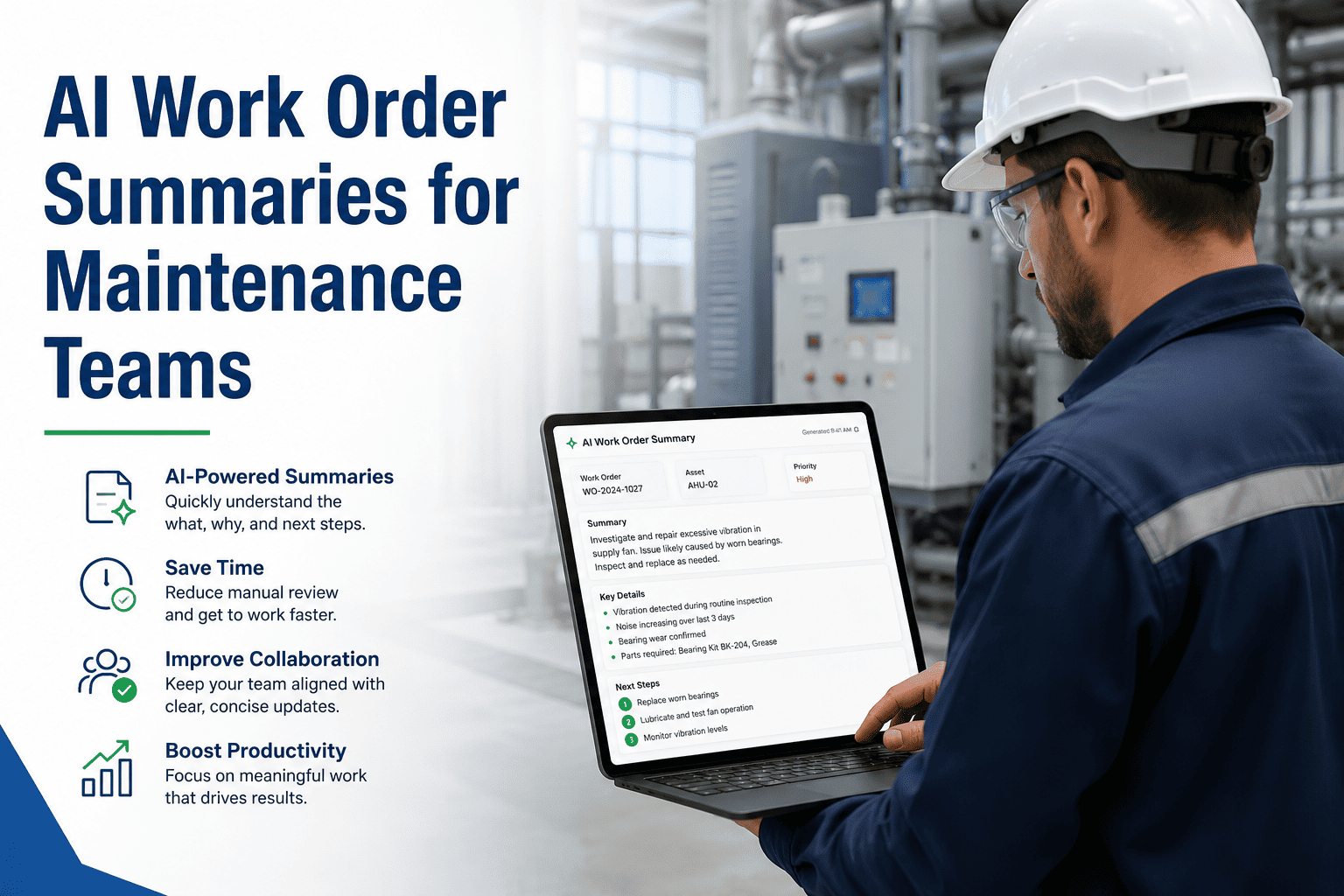
A technician closes a work order with notes that read: "checked pump. noise. replaced seal. ok now." A maintenance manager reviewing that note four months later — during a failure investigation, a regulatory audit, or a capital planning meeting — cannot tell what kind of noise, which seal, what caused it, or whether the fix addressed the root cause or just the symptom. Unstructured technician notes are the gap between maintenance work being done and maintenance knowledge being captured. LLMs deployed inside a CMMS can now transform those four words into a structured summary that includes the observed symptom, the diagnosis, the action taken, the parts used, and the recommended follow-up — automatically, at work order closure, before the technician leaves the site. Work order backlogs fell 32% at AI-pilot sites according to Deloitte 2024 research, and administrative effort dropped 38% in facilities deploying AI-assisted work order workflows (Capgemini 2025). The productivity case is real — and it compounds because better notes make every future repair on that asset faster. Book a demo to see OxMaint's AI & Automation features — or start free today.
AI Guide · AI & Automation · Work Order Management
How AI Summarizes Work Orders and Technician Notes
What AI work order summaries do, where they save the most time, and how OxMaint's AI turns raw technician notes into structured maintenance records — without changing how your team works in the field.
38%
Reduction in admin effort with AI work order workflows (Capgemini 2025)
32%
Drop in work order backlog at AI-pilot sites (Deloitte 2024)
80%
Of frontline technicians will rely on AI daily by 2028 (Gartner 2025)
Before and After — What AI Does to a Technician's Notes
This is the transformation that matters most. The same information the technician entered in 30 seconds becomes a structured, searchable, actionable maintenance record — without the technician doing anything different in the field.
5 Ways AI Work Order Summaries Save Time Across Your Maintenance Operation
01
Faster manager review — scan summaries instead of reading raw notes
A maintenance manager reviewing 40 closed work orders in a morning shift check can scan AI-structured summaries in 10 minutes. The same review from raw technician notes takes 40+ minutes — and misses patterns that the AI surfaces by cross-referencing with asset history.
02
Automatic repeat failure detection across work orders
AI compares each new work order against the asset's full repair history. When it identifies the same symptom or part replacement occurring for the second or third time, it flags the pattern in the summary and recommends a root cause investigation — before the next failure happens.
03
New technician context from day one
When a technician is assigned to an asset they have not worked on before, the AI summary of the last 5–10 work orders gives them the repair history, known failure patterns, and previous recommendations in 30 seconds — the institutional knowledge that would previously require finding the last technician and asking them directly.
04
Audit and compliance documentation on demand
AI-structured summaries satisfy compliance documentation requirements better than raw notes — they include structured fields, timestamps, parts used, and actions taken. When an audit requests maintenance records for a specific asset over a 12-month period, the AI summary package is the record, not a manual compilation of handwritten notes.
05
SOP generation from field experience
After 5–10 similar repairs, AI can generate a draft standard operating procedure from the aggregated technician notes — capturing what experienced technicians actually do in the field rather than what a procedure written at a desk says they should do. Best-practice knowledge is captured automatically as the team works.
AI & AUTOMATION · OXMAINT
Your Technicians Already Know What Happened. OxMaint AI Captures It in a Way That Lasts.
OxMaint AI transforms raw closure notes into structured summaries, flags repeat failure patterns, and generates the asset knowledge base that makes every future repair faster — without changing how your team works in the field.
What AI Extracts From Unstructured Notes — The Data Points That Matter
Expert Review
"The institutional knowledge problem in maintenance is not that experienced technicians lack knowledge — it is that the systems they work in are not designed to capture it. A technician who has repaired the same pump bearing four times in three years knows exactly what causes it to fail, how to diagnose it quickly, and what preventive action would extend its life. That knowledge lives in their head. When they retire or move on, it goes with them. AI-powered work order summarisation is the first practical mechanism I have seen for capturing that knowledge at the moment it is generated — at work order closure, when the technician is still in front of the asset and the repair is fresh. The summary is not just a documentation improvement. It is a knowledge management tool that converts individual expertise into institutional memory. For the operations manager, the 38% administrative reduction is the immediate benefit. For the organisation over five years, the asset knowledge base that accumulates from AI-structured repair records is the strategic asset."
Anita Sharma, P.Eng., CAT III Vibration Analyst
Professional Engineer (Mechanical) · Category III Vibration Analyst · 20 years maintenance reliability and CMMS implementation · Specialist in maintenance knowledge management and AI-assisted predictive maintenance programme design
Frequently Asked Questions
Does the technician need to change how they write notes for AI to work?
No — AI work order summarisation is designed to work on
exactly the kind of notes technicians actually write: short, informal, and often incomplete. The AI extracts structured information from whatever the technician enters — even fragmentary notes like "checked pump, noise, replaced seal, ok now." Better notes produce better summaries, but the system does not require structured input to function. Over time, technicians often improve note quality voluntarily when they see that AI is making their brief notes more useful — but this is not a prerequisite for the system to add value from day one.
Book a demo to see AI summarisation working on sample notes from your industry.
How does AI detect repeat failure patterns across work orders?
OxMaint AI compares the symptom, diagnosis, and parts used in each new work order against the full repair history for that asset. When it identifies a match — same symptom, same part, same location — it flags the pattern in the AI summary and can automatically trigger a follow-up investigation work order. The pattern detection does not require the technician to reference previous repairs; the AI cross-references the asset history at closure automatically. Patterns that would take a manager 30 minutes to identify by manually scrolling through work order history are surfaced in the summary before the technician leaves the site.
Can AI work order summaries be used for compliance documentation?
AI-generated summaries with structured fields (symptom, action, parts, follow-up) satisfy documentation requirements better than raw notes in most regulatory contexts — because they are consistently structured, linked to the work order timestamp and technician attribution, and include the specific data points that auditors request. For GMP-regulated environments, AI summaries complement the audit trail but do not replace the electronic signature and ALCOA+ requirements that apply to regulated maintenance records. For non-regulated facilities, AI summaries are the documentation standard that most manually-written records fail to reach consistently.
Start free to see OxMaint's AI documentation in your maintenance workflow.
What is the difference between AI work order summaries and AI work order creation?
AI work order creation uses natural language or voice input to generate a new work order — the technician describes the problem and the AI produces a structured request with asset ID, priority, and initial scope. AI work order summarisation operates at the other end of the lifecycle — at closure, transforming what the technician observed and did into a structured record. Both capabilities reduce administrative effort, but at different points: creation reduces the time to open and assign a job; summarisation reduces the time to close it properly and captures the knowledge generated during execution. OxMaint supports both — minimising administrative overhead at every stage of the work order lifecycle.
AI & AUTOMATION · OXMAINT
"Checked pump. Noise. Replaced seal. Ok now." — That's 4 Words. OxMaint AI Makes It a Record.
OxMaint AI transforms raw technician notes into structured summaries, flags repeat failure patterns, surfaces follow-up recommendations, and builds the asset knowledge base that makes your maintenance team smarter with every repair — automatically, at work order closure, without changing how your team works.