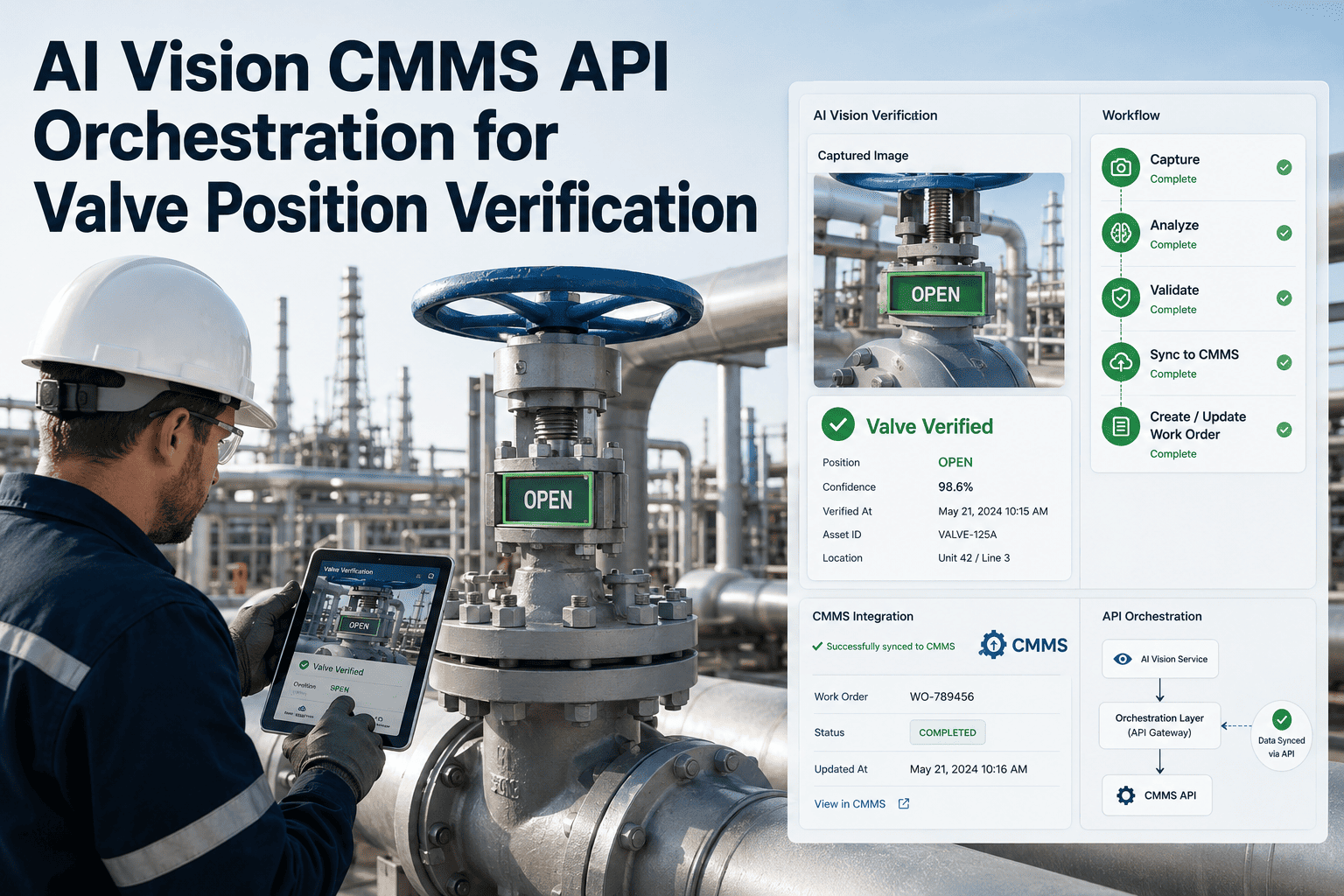
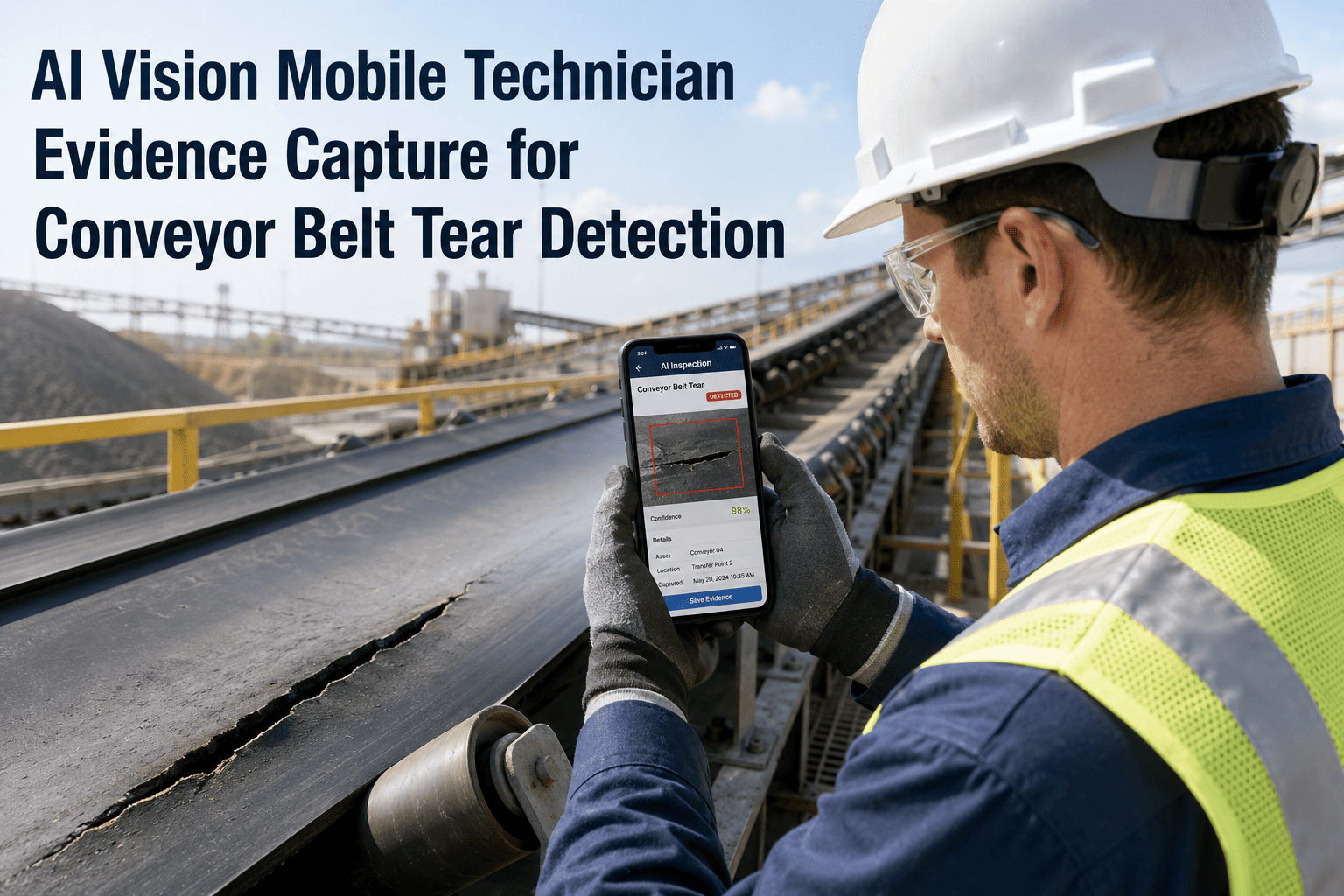
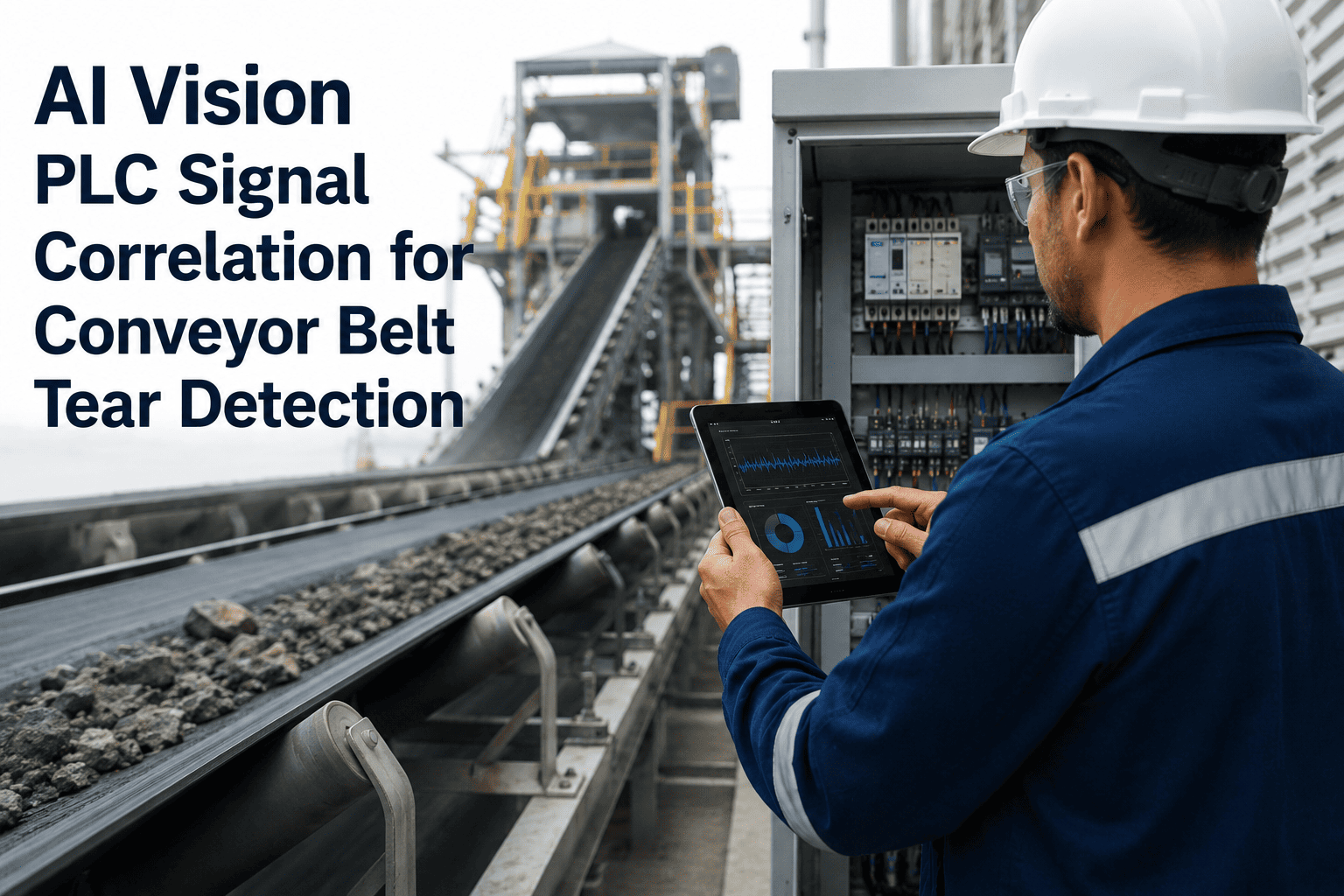
When an AI vision camera detects a conveyor belt tear precursor, the most critical variable in avoiding unplanned downtime is not the detection itself — it is how fast that detection becomes a dispatched technician with the right parts and the right context. CMMS API orchestration is the architecture that closes this gap. OxMaint's AI Vision platform uses a purpose-built API orchestration layer to route belt defect events from camera detection through severity classification, inventory check, technician skill matching, and work order creation in a single automated sequence — in under 60 seconds. For mining operations where every hour of conveyor downtime costs $30K–$150K in lost throughput, this orchestration speed is not a feature. It is a business-critical requirement. Book a demo to see the full API orchestration sequence live.
Mining Technical Guide · API Orchestration
AI Vision CMMS API Orchestration for Conveyor Belt Tear Detection
The 7-Step API Orchestration Pipeline: Detection to Dispatched Technician
CAM
Camera Detection
0 sec
→
AI
Defect Classification
+2 sec
→
SEV
Severity Scoring
+4 sec
→
INV
Inventory Check
+8 sec
→
TECH
Tech Assignment
+12 sec
→
WO
Work Order Created
+20 sec
→
MSG
Technician Notified
< 60 sec
API Integration Map
OxMaint API Connections in a Mining CMMS Architecture
| System | API Protocol | Data Exchanged | Orchestration Role |
| AI Vision Camera |
REST / RTSP |
Defect event, image, location, confidence score |
Trigger — initiates orchestration sequence |
| PLC / SCADA |
OPC-UA / Modbus |
Belt speed, motor current, tension readings |
Corroboration — validates AI detection with signal data |
| Inventory / ERP |
REST / SOAP |
Part availability, storeroom location, lead time |
Parts readiness — confirms parts before technician dispatch |
| Workforce Management |
REST |
Technician availability, skill certification, shift |
Assignment — selects certified technician on duty |
| CMMS (OxMaint) |
REST (native) |
Work order, asset history, PM schedule context |
Record — creates, assigns, and tracks to closure |
| Mobile App |
WebSocket / Push |
Alert with image, location, severity, parts list |
Dispatch — technician receives full context on device |
See API Orchestration Running on Mining Conveyor Data
Book a technical demo. We will walk through OxMaint's API architecture against your existing SCADA, ERP, and workforce management systems — and map the integration to your belt detection requirements.
Expert Review
Engineering Research on API-Driven Maintenance Orchestration
"The latency between defect detection and technician dispatch is the primary determinant of whether predictive maintenance programs deliver on their downtime reduction claims. Organizations with fully orchestrated API architectures — where detection events automatically trigger inventory checks, technician assignments, and work order creation in a single sequence — reduce detection-to-dispatch latency by 94% compared to manual notification workflows. In high-throughput mining environments, this latency reduction directly translates to 30–50% reduction in conveyor-related production losses."
— International Journal of Advanced Manufacturing Technology, API Orchestration in Mining Maintenance, 2024
"CMMS API orchestration for conveyor belt monitoring represents a fundamental shift from event-driven to outcome-driven maintenance architectures. When the API sequence confirms parts availability and technician certification before dispatching — rather than discovering gaps after arrival — first-time fix rates on belt repair work orders increase from industry average 62% to 88–92% in documented implementations. The orchestration investment pays back through labor efficiency alone within the first quarter of deployment."
— Minerals Engineering Journal, Digital Maintenance Architecture for Bulk Handling, Vol. 195, 2024
FAQs
Frequently Asked Questions
Does OxMaint's API orchestration require custom development for each mining site?
OxMaint ships with pre-built integration connectors for the most common mining technology stack: Allen-Bradley and Siemens PLCs via OPC-UA, SAP PM and IBM Maximo for CMMS, and Oracle and Microsoft Dynamics for ERP. Custom development is required only for proprietary or legacy systems not covered by the connector library.
Book a technical demo and provide your technology stack in advance — our integration team will confirm connector availability and estimate any custom development scope before the call, so you arrive with a realistic implementation picture.
How does the orchestration handle a P1 belt tear event when the required parts are out of stock?
When the inventory check step returns zero stock for a required part, OxMaint triggers three parallel actions: an emergency purchase order to the preferred supplier with lead time alert, a parts substitution query against the CMMS BOM for approved alternates, and a supervisor escalation notification with the stockout detail. The work order is still created and dispatched, but the technician receives the stockout alert and approved alternate parts list before departing — eliminating wasted trips and compressing emergency procurement time.
Start a free trial to configure your stockout escalation rules.
Can OxMaint's orchestration handle multiple simultaneous belt tear events across a multi-conveyor system?
Yes — OxMaint's API orchestration layer processes concurrent defect events in parallel queues, with priority scoring that automatically elevates the highest-severity event for first dispatch when technician availability is constrained. For multi-conveyor mine sites, the system maintains independent asset queues per belt and cross-references technician assignments to prevent double-booking.
Book a demo designed for your conveyor count and shift staffing model — we will configure a realistic multi-belt scenario and show you the priority queue logic in action.
CMMS API Orchestration
Camera Detection to Dispatched Technician in Under 60 Seconds
OxMaint's AI vision API orchestration connects every system in your mining maintenance stack — detection, inventory, workforce, and CMMS — in a single automated sequence that runs faster than any dispatcher can.