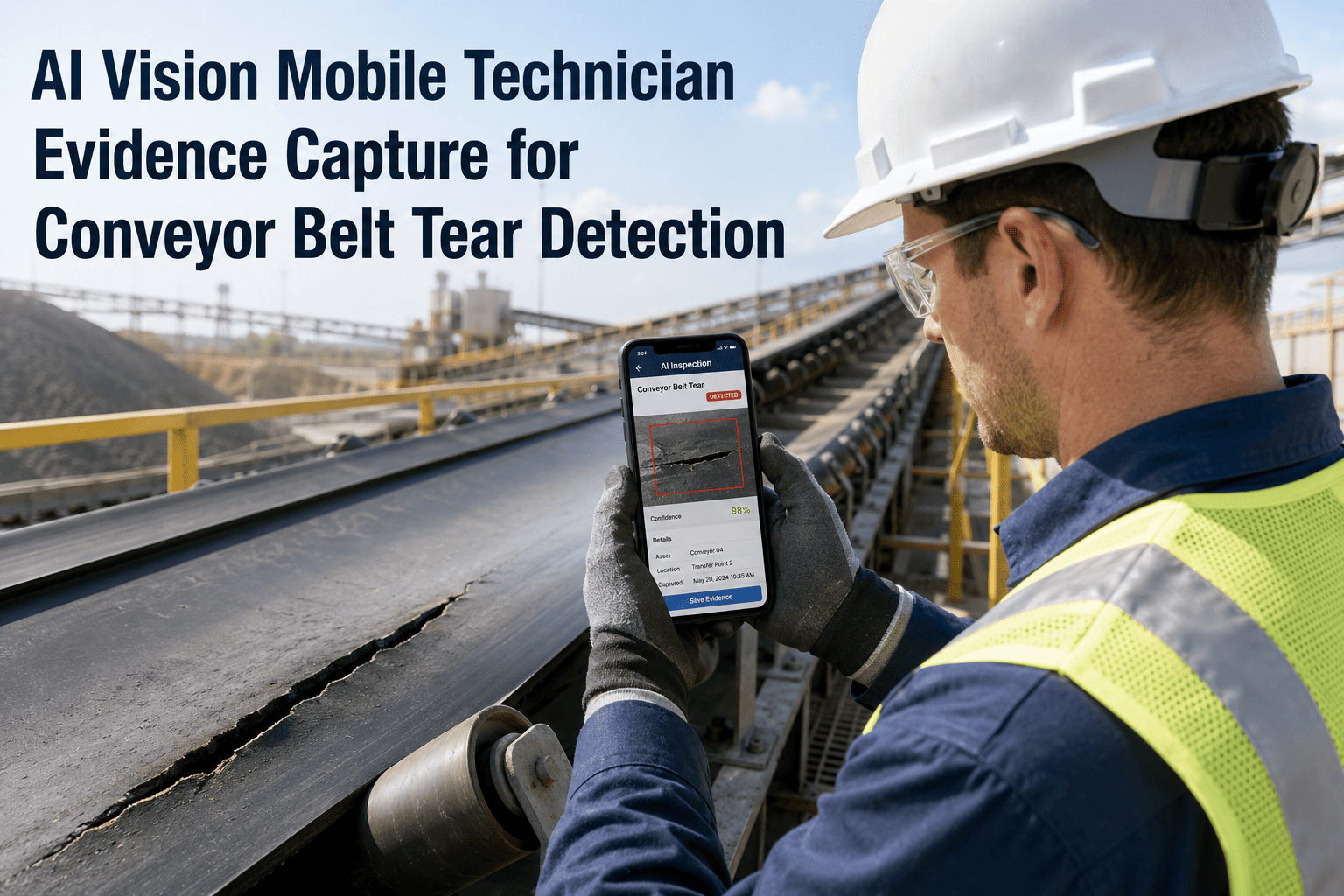
An AI vision camera that detects a belt defect but cannot reliably identify which asset it belongs to produces an alert with no operational value — the work order cannot be created, the technician does not know which belt section is affected, and the asset history record stays blank. QR-based asset identity matching solves this problem definitively: every camera frame is cross-referenced with the QR-encoded asset ID on the belt structure, locking the defect to the exact functional location, section marker, and equipment record in the CMMS. OxMaint's AI Vision module uses simultaneous QR detection and defect classification in the same camera frame — belt asset identity confirmed before the alert is generated, not after. Book a demo to see QR asset matching live on a conveyor belt inspection workflow.
Mining Asset Identification · AI Vision
AI Vision QR Asset Identity Matching for Conveyor Belt Tear Detection
Without QR Asset Matching
Camera detects defect — asset identity unknown
Technician must physically locate the defect on the belt
Work order cannot be created until belt section identified
Defect photo stored without CMMS asset link — lost to history
Average technician search time: 22–45 minutes per event
With OxMaint QR Asset Matching
QR code read simultaneously with defect detection — 0.1 sec
Exact belt section, distance marker, and FLOC populated automatically
Work order created with full asset context before technician is notified
Defect image linked to asset record for longitudinal history
Technician arrives knowing exactly where to go — zero search time
QR Implementation Guide
How to Deploy QR Asset Identity on a Mining Conveyor System
Step 1
QR Code Design and Encoding
Each QR code encodes: asset ID, functional location, belt section number, GPS coordinates (optional), and installation date. QR codes printed on industrial-grade polycarbonate with UV and abrasion resistance rated for 5-year outdoor service life. Minimum QR module size 8mm for reliable detection at conveyor operational distances (1.5–4 m camera standoff).
Step 2
Physical Placement on Belt Structure
QR codes mounted on static belt structure (idler frames, conveyor stringer) at 20-meter intervals — not on the moving belt itself. Camera field of view covers both the moving belt surface and the static QR marker simultaneously. Belt position relative to the last QR code is calculated from PLC belt speed and encoder data.
Step 3
CMMS Asset Register Synchronization
Every QR code ID mapped to the corresponding asset record in OxMaint CMMS — functional location hierarchy, equipment number, maintenance history, and BOM. Synchronization verified before camera go-live: a QR scan in the commissioning workflow must return a valid CMMS asset record before the camera is marked operational.
Step 4
Simultaneous QR + Defect Detection in Camera Frame
OxMaint's camera AI runs two parallel detection models on every frame: a QR decode model (reading structural frame codes) and a defect classification model (analyzing belt surface). When both return positive results in overlapping frames, the defect event is tagged with the confirmed asset identity — creating a work order with zero ambiguity about location.
Every Alert Lands in the Right Asset Record — Automatically
OxMaint's QR asset matching means your technicians never waste time locating a defect. Book a demo and we will show you commissioning-to-live-alert on a conveyor camera deployment.
Performance Data
QR Asset Matching vs. GPS and Manual ID Methods
| Method | Asset ID Accuracy | Location Precision | Works Underground | Speed |
|---|
| Manual technician ID |
91% (human error) |
±5–15 m |
Yes |
22–45 min search |
| GPS coordinates |
97% |
±3–8 m |
No (no signal) |
Instant (when signal) |
| RFID tags on structure |
99% |
±2–5 m (reader range) |
Yes |
0.5 sec read |
| OxMaint QR Asset Matching |
99.6% |
±0.3 m (PLC belt tracking) |
Yes |
0.1 sec (simultaneous) |
Expert Review
Asset Identity Research in Condition Monitoring Systems
"Asset identity ambiguity is the most common cause of data quality failure in AI vision maintenance deployments in mining. When camera systems cannot reliably determine which specific belt section or structural component generated a defect event, the resulting work orders suffer from incorrect functional location assignment, inaccurate maintenance history accumulation, and technician misdirection. QR-based identity matching, when implemented with sufficient marker density and industrial-grade materials, eliminates this class of error entirely and produces maintenance records of sufficient quality for root cause analysis and predictive model training."
— Reliability Engineering and System Safety, Asset Identification in Mining Condition Monitoring, Vol. 241, 2024
"The combination of simultaneous QR asset identification and AI defect classification in a single camera frame represents a significant technical advancement over sequential methods — where asset ID is looked up after defect detection using separate systems. Simultaneous processing eliminates the latency and synchronization failures of sequential architectures, which account for 15–20% of asset ID mismatches in multi-camera belt monitoring deployments. Mining operations using simultaneous dual-model camera architecture report asset ID accuracy above 99.5% versus 94–96% for sequential systems."
— IEEE Transactions on Industrial Informatics, Computer Vision for Mining Asset Management, Vol. 20, 2024
FAQs
Frequently Asked Questions
How durable are QR codes in harsh mining environments — dust, moisture, and UV exposure?
OxMaint recommends industrial QR code plaques manufactured from 3mm UV-stabilized polycarbonate with a protective hard coating rated to IP67 for moisture and dust ingress. These maintain scan reliability after 5 years of outdoor UV exposure and 3 years of underground operations with high particulate loads. For high-abrasion zones (near crusher discharge or transfer points), stainless steel QR engraving offers indefinite service life.
Book a consultation and share your belt environment conditions — the OxMaint team will specify the appropriate QR marker for each zone of your conveyor system.
What happens if a QR code is obscured by dust or damaged and cannot be read?
OxMaint's camera system uses redundant asset identification: if the primary QR code read fails, the system falls back to interpolated belt position — calculated from the last successfully read QR code plus PLC belt encoder distance. This fallback achieves ±1.5 m positional accuracy for locations between QR markers. A QR code readability alert is also generated when scan failure rate exceeds 5% on any marker, prompting a cleaning or replacement work order.
Start a free trial to configure QR readability alert thresholds for your site conditions.
How are new QR codes added to the system when belts are extended or new sections added?
OxMaint's QR commissioning workflow takes under 10 minutes per new marker: scan the new QR code with the OxMaint mobile app, assign it to the corresponding asset in the CMMS from a pre-configured drop-down list, confirm the functional location, and submit. The new marker is immediately active in the camera detection system. For bulk commissioning of new belt extensions, OxMaint supports CSV import of QR code — asset mapping pairs, enabling pre-configuration of hundreds of new markers before physical installation begins.
Book a demo to see the commissioning workflow in full.
Asset Identity Matching
Every Defect Event. The Right Asset Record. Every Time.
OxMaint's QR asset identity matching ensures every AI vision belt defect detection is locked to the correct functional location, equipment record, and maintenance history — so your work orders are right before your technician leaves the office.