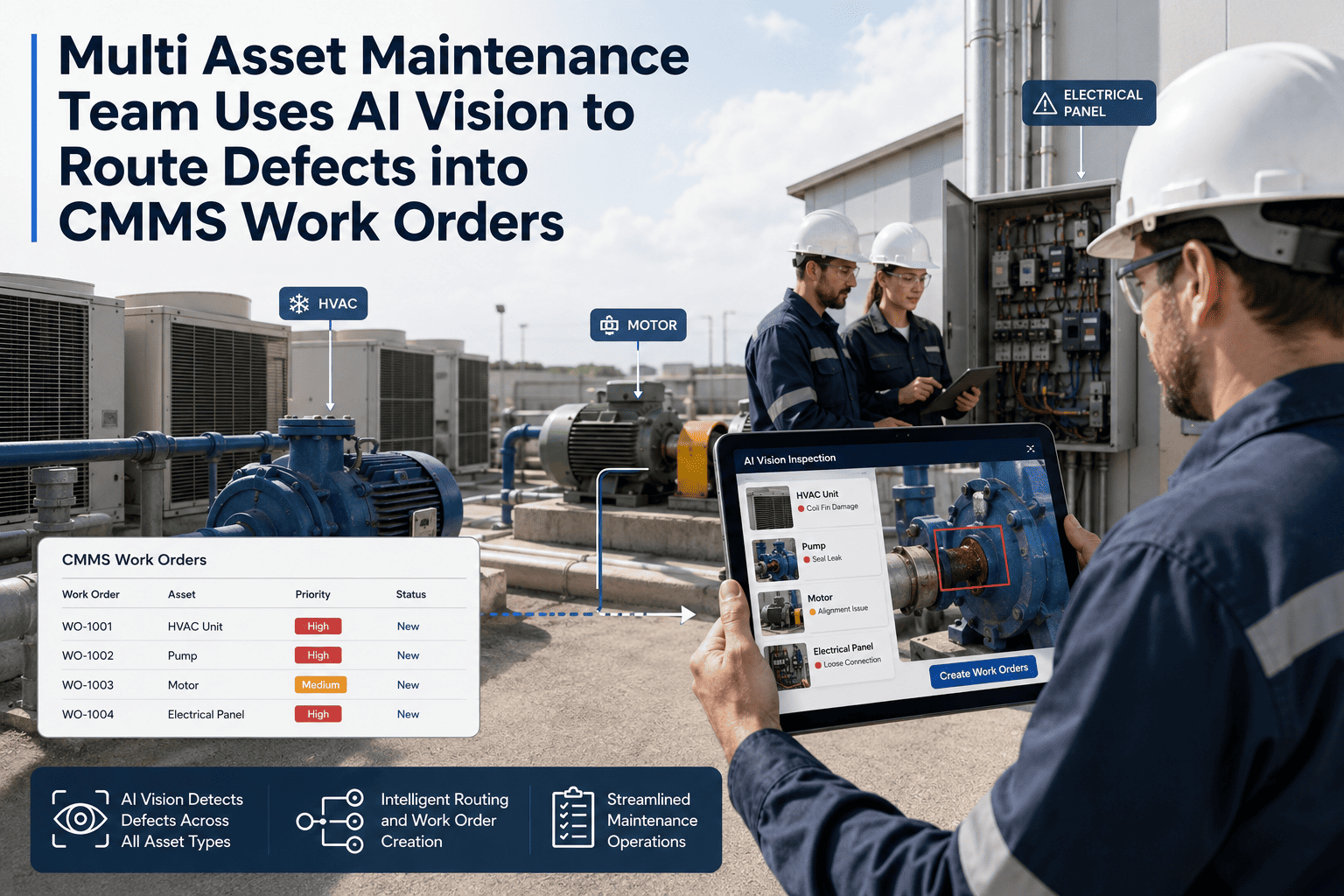
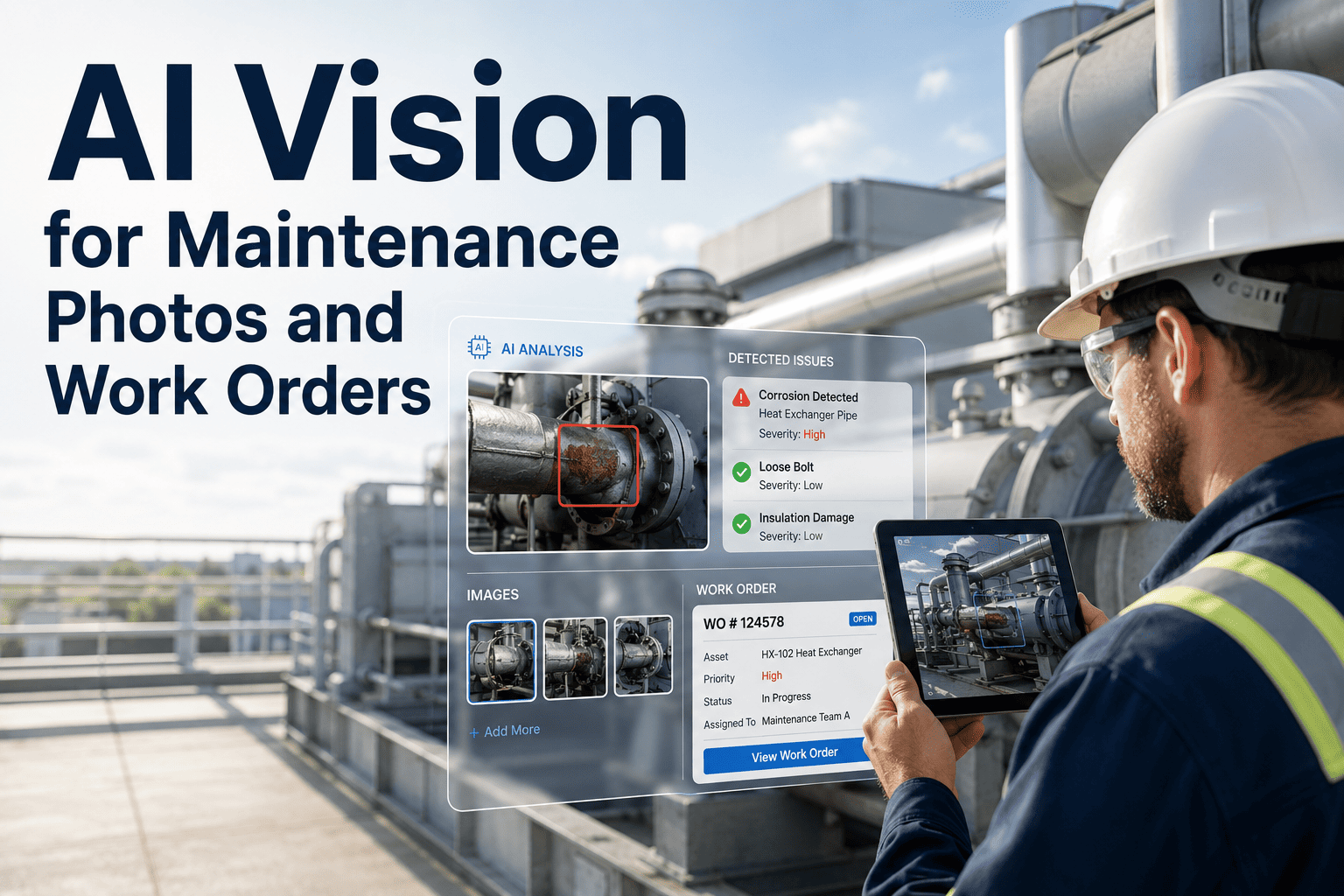
Power plant maintenance teams operating gas turbines, steam generators, and high-voltage switchgear face a fundamental inspection problem: the assets most likely to cause catastrophic failure are the hardest to inspect safely with human eyes. AI vision defect detection systems deployed alongside OxMaint CMMS work order automation are changing this equation — thermal cameras identify hotspots inside live switchgear bays, computer vision algorithms detect hairline cracking on turbine casing surfaces, and every detection instantly becomes a prioritised work order routed to the correct maintenance crew. When that detection also connects to OxMaint's SCADA integration layer, real-time operational data enriches the maintenance record — so the repair crew sees not just what the camera found, but what the process was doing at the moment of detection. For power generation facilities where every unplanned outage costs tens of thousands per hour, connecting AI defect detection to CMMS work orders is the single highest-leverage maintenance investment available.
AI Vision · CMMS · Power Plant Maintenance
AI Vision Defect Detection Connected to CMMS Work Orders for Power Plants
How power plant maintenance teams use AI visual defect detection integrated with OxMaint CMMS to convert camera findings into immediate, prioritised work orders — reducing fault-to-repair time and protecting plant uptime.
$180K
average cost per hour of unplanned power plant outage — the direct ROI target for defect detection
91%
of power plant defects detectable visually before they cause functional failure
7 min
average time from AI defect detection to assigned work order in OxMaint with SCADA context
3.6x
faster fault-to-repair cycle when CMMS work orders are generated automatically from AI detection
Power Plant Assets Where AI Defect Detection Has Highest Impact
Gas Turbines
Thermal + Visual
Hot section blade tip clearance, combustor liner cracking, and turbine casing surface defects — detected by thermal and visible-spectrum cameras before performance degradation becomes a trip event.
Critical Priority
HV Switchgear
Thermal Imaging
Corona discharge, connection overheating, and insulator degradation detected thermally in live panels — eliminating the need for manual inspection under high-voltage hazard conditions.
Safety Critical
Cooling Towers
Visual + Moisture
Fill pack deterioration, fan blade imbalance indicators, and structural casing degradation monitored continuously — with defect images auto-linked to cooling system asset records in OxMaint.
Performance Risk
Steam Generators
Thermal + Acoustic
Tube leak indicators, insulation integrity, and valve actuator condition monitored in real time — detection events connected to OxMaint work orders with full SCADA process context at time of fault.
Critical Priority
Transformers
Thermal Imaging
Bushing overheating, tank surface corrosion, and oil level anomalies detected thermally — with automatic work order escalation on hotspot detection above configured thresholds.
High Impact
Pump & Valve Systems
Visual + Vibration
Seal leakage, mechanical seal wear indicators, and external corrosion on BFPs and condensate extraction pumps — AI visual detection linked to PM intervals in OxMaint schedule.
Reliability Risk
SCADA Integration: How OxMaint Enriches AI Defect Work Orders
Without SCADA Integration
Work order contains: defect image + asset ID + timestamp
Technician arrives without process context — cannot correlate defect to operating condition
Root cause analysis requires manual cross-referencing of SCADA historian
Repair records and process data stay in separate systems — audit trail incomplete
With OxMaint SCADA Integration
Work order contains: defect image + asset ID + timestamp + SCADA snapshot at detection
Technician sees load, temperature, pressure readings at moment of defect detection
Root cause correlation built into the work order — accelerates diagnosis on arrival
Repair record and process context merged — complete audit chain in a single OxMaint record
| Defect Category |
Detection Method |
SCADA Context Added |
Work Order Priority |
| Thermal hotspot — HV equipment |
Thermal camera — continuous |
Load level, ambient temp, time of day |
Critical — immediate |
| Surface crack — turbine casing |
AI visual — scheduled scan |
Start/stop cycles, operating hours |
High — next window |
| Seal leakage — pump system |
Visual + moisture sensor |
Flow rate, pressure differential |
High — same shift |
| Fill pack degradation — cooling tower |
Visual imaging — weekly route |
Cooling demand, ambient conditions |
Medium — planned |
| Insulation breach — steam line |
Thermal infrared scan |
Steam pressure, line temperature |
Critical — immediate |
Expert Review — Power Plant Predictive Maintenance
The most underutilised data asset in most power plants is the combination of AI defect detection output and SCADA historian records. Each system is powerful independently — together, they give maintenance teams something completely new: a work order that doesn't just say what was found, but explains the operating context that produced the defect. When that work order is in OxMaint, the repair technician arrives knowing the asset's thermal state, load history, and fault frequency before opening a panel. That's how you cut diagnostic time in half and get plant output back online faster.
Chief Reliability Engineer, Combined Cycle Power Generation Facility
Connect AI Defect Detection to Your Power Plant Work Order Workflow
OxMaint integrates AI vision detection with SCADA data — converting camera findings into context-rich, prioritised work orders your maintenance teams can act on immediately.
74%
reduction in mean time to repair when AI detection work orders include SCADA process context
99.2%
work order completion rate when AI detections auto-generate and route tasks in OxMaint
Zero
unactioned AI defect alerts when OxMaint routes to correct crew automatically
Frequently Asked Questions
How does OxMaint integrate AI vision defect detection with SCADA data for power plant work orders?
OxMaint's SCADA integration pulls real-time and historical process data from plant SCADA systems via OPC-UA or API connection. When an AI camera detects a defect, OxMaint simultaneously queries the SCADA historian for process readings at the moment of detection — load, temperature, pressure, flow — and attaches this context to the generated work order. Maintenance technicians receive a work order with both visual evidence and operational context, enabling faster diagnosis and more accurate root cause identification.
Book a demo to see the SCADA integration in action.
What AI camera systems are compatible with OxMaint's power plant work order integration?
OxMaint integrates with thermal imaging cameras, visible-spectrum AI cameras, and multi-sensor inspection systems via REST API and MQTT protocols — covering the primary AI vision hardware used in power generation environments. Camera platforms from FLIR, Opgal, Hikvision AI series, and custom OEM inspection systems can connect to OxMaint's detection ingestion layer. Asset zone mapping configures which camera monitors which asset, ensuring every detection is linked to the correct OxMaint asset record without manual intervention.
Can AI defect detection work orders trigger maintenance scheduling in OxMaint PM plans?
Yes — OxMaint allows AI detection events to feed back into preventive maintenance scheduling. A high-frequency detection pattern on a specific asset can automatically adjust PM intervals, pulling forward the next scheduled inspection or triggering a condition-based maintenance task outside the fixed schedule. This closes the loop between real-time defect detection and long-term asset reliability planning — moving the power plant maintenance program from calendar-based to condition-driven without requiring manual schedule re-entry.
How does OxMaint handle false positives from AI defect detection systems?
OxMaint's detection workflow includes configurable severity thresholds and confidence score filters — meaning only detections that meet both the AI model's confidence requirement and the configured severity level generate automatic work orders. Detections below threshold are logged for review without creating unactioned work orders. Technicians can flag false positives in OxMaint, which feeds back to threshold calibration. This keeps the work order queue actionable and prevents alert fatigue that degrades maintenance team responsiveness over time.
Turn Power Plant Defect Detections into Immediate Maintenance Action
OxMaint connects AI vision cameras to CMMS work orders with full SCADA context — so every defect your cameras find becomes a structured, routed, and tracked repair task before the next shift begins.