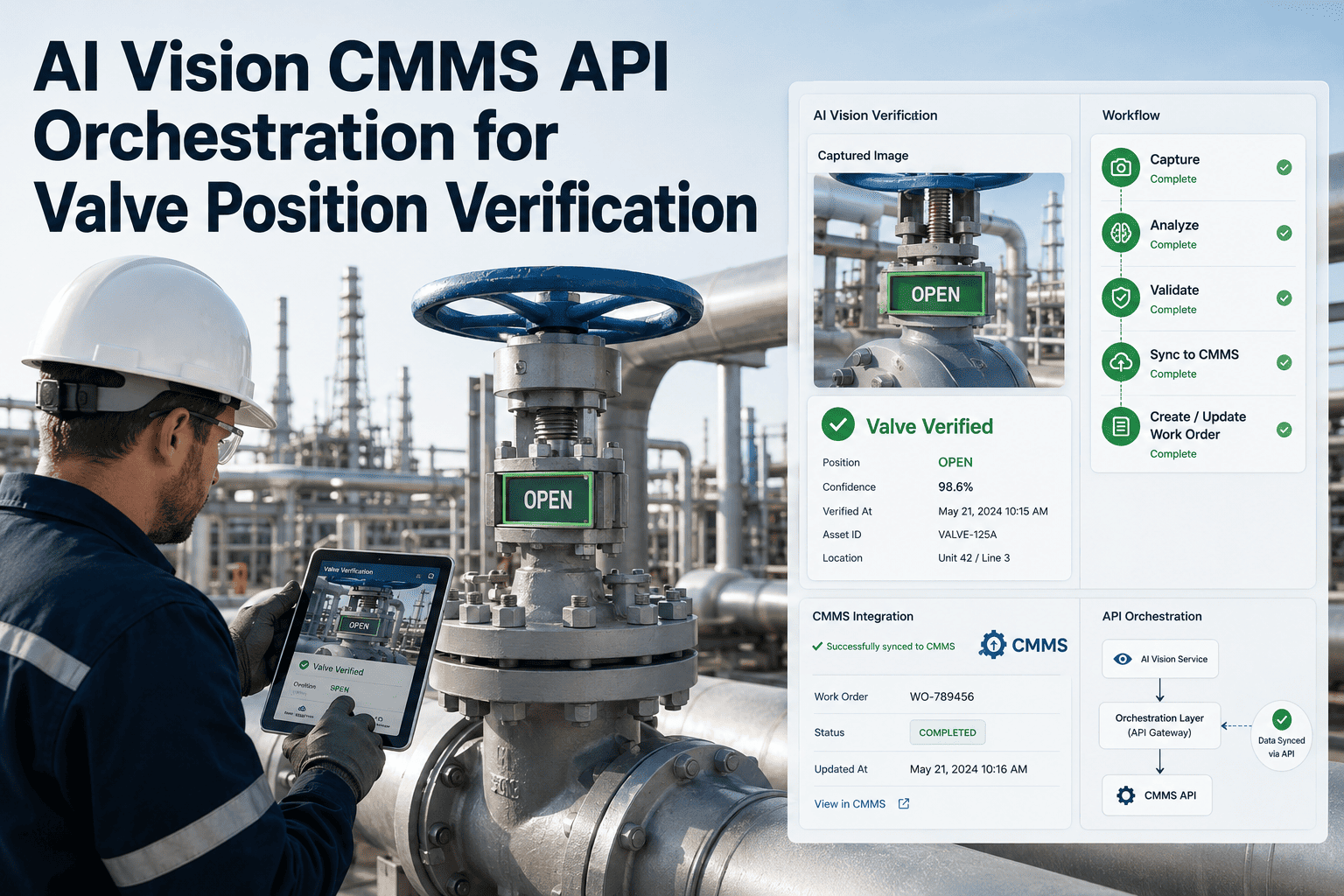
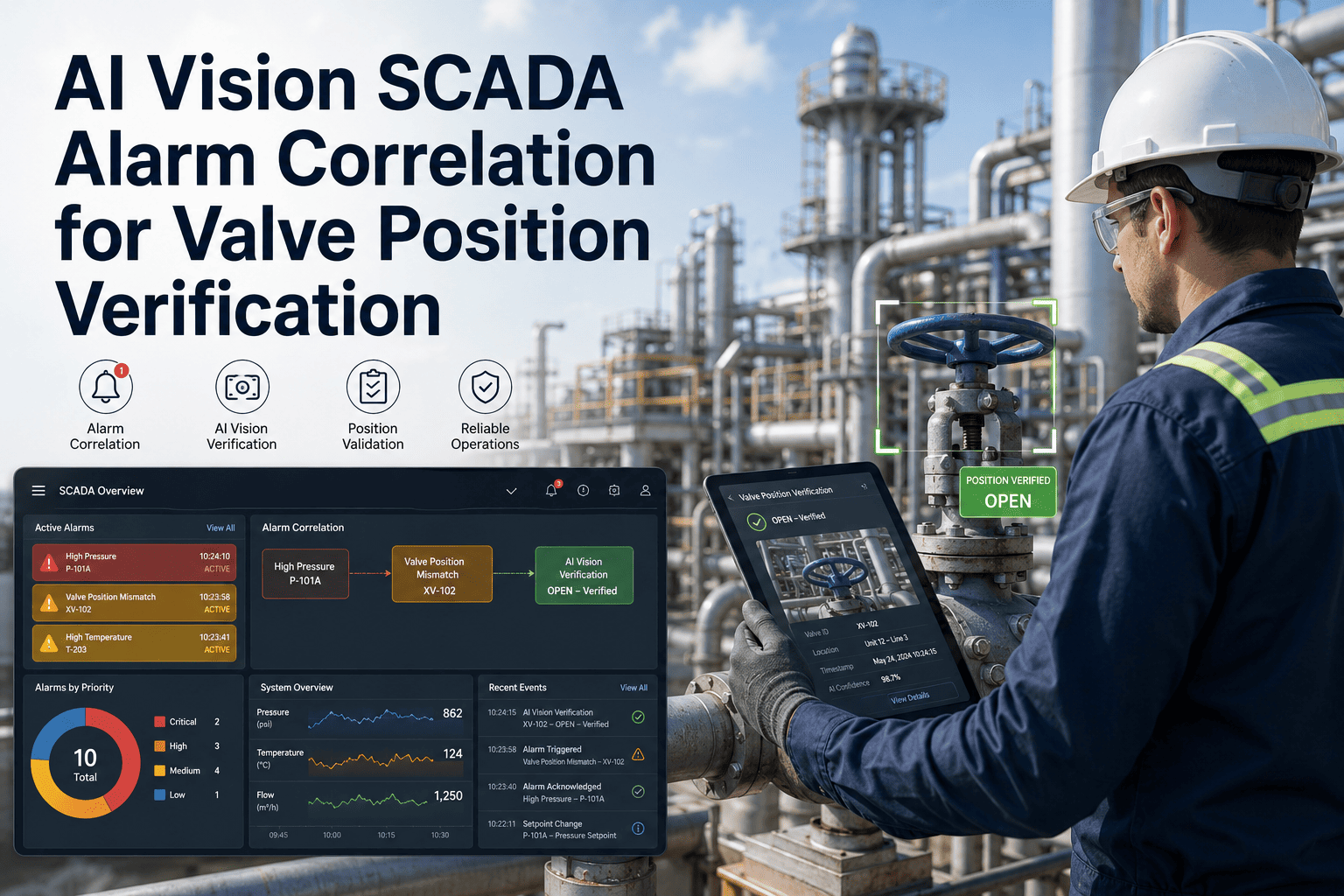
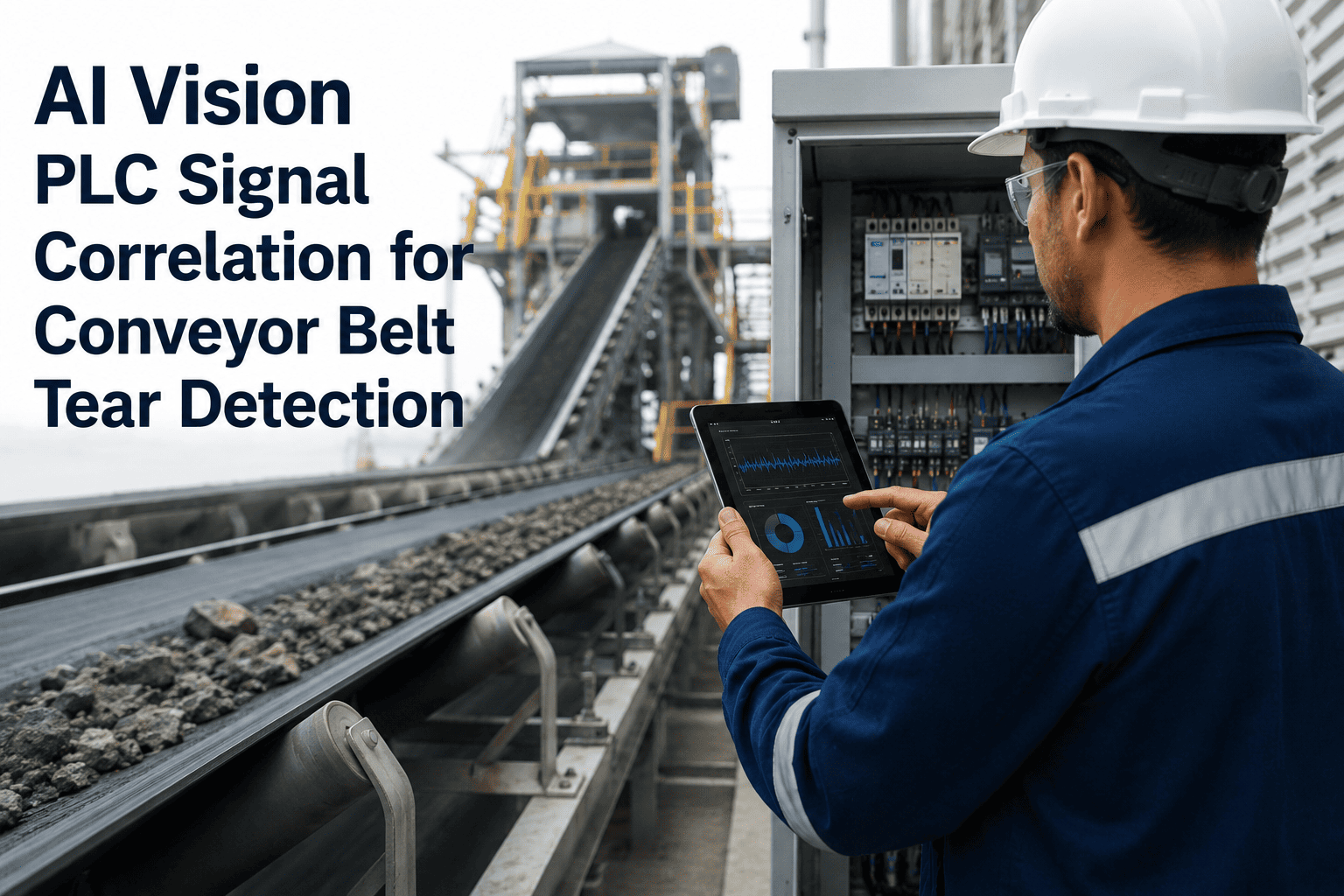
PLC systems report valve position as a digital signal — open, closed, partially open — but the signal and the physical reality do not always agree. A valve can report fully closed while visually sitting at 30 percent open due to actuator wear, linkage failure, or sediment buildup. In process industries, this discrepancy between PLC-reported and physically verified valve position causes pressure imbalances, contamination events, and compliance failures that cost millions per incident. OxMaint AI Vision solves this by correlating every PLC valve position signal with a real-time camera frame, confirming that what the controller reports matches what the camera sees. Discrepancies trigger an immediate corrective work order with visual proof attached. Book a demo to see how AI visual verification closes the gap between PLC signal and physical valve state.
AI Vision · PLC Integration · Valve Verification
AI Vision PLC Signal Correlation for Valve Position Verification
OxMaint cross-checks every PLC valve position signal against a live AI camera frame — catching physical discrepancies that no digital sensor alone can detect.
PLC Signal vs AI Camera
PLC Reports
CLOSED
vs
AI: 28% OPEN
Confidence
98.4%
WO Created
Response time
4 seconds
Auto-routed
The Risk
Why PLC Signals Alone Miss Physical Valve Failures
HIGH RISK
Actuator mechanical failure
Actuator reports position based on encoder, not actual disc position. A broken linkage gives a false "closed" signal while flow continues.
MEDIUM RISK
Sediment / scale buildup
Valve physically cannot reach commanded position due to deposit accumulation. PLC records the command, not the result.
HIGH RISK
Positioner calibration drift
Control signal and physical disc position diverge over time without recalibration. Process flows become uncontrolled.
MEDIUM RISK
Feedback sensor failure
Position sensor fails open or closed, giving the PLC a permanently stale reading while the valve operates independently.
Verification Framework
How AI Vision Validates PLC Valve Signals
1
PLC Signal Captured
OxMaint receives valve position data from PLC via OPC-UA, Modbus, or REST API on every state change or on a scheduled polling interval.
2
Camera Frame Acquired
AI camera captures the valve body at time of signal. Fisheye correction and valve marker recognition applied to determine visual position.
3
Signal vs Visual Compared
OxMaint AI model compares PLC-reported position to camera-measured position. A discrepancy above the configured threshold triggers an alert.
4
Work Order or Pass Logged
If verified: pass record logged with timestamp and photo. If discrepant: priority work order created with visual evidence and PLC signal data attached.
Verify Every Valve. Trust Every Reading.
Stop relying solely on PLC signals for valve position accuracy. OxMaint AI Vision gives you visual confirmation in 4 seconds — and auto-creates work orders when signals and reality diverge.
Industry Impact Table
What Valve Position Discrepancies Cost Per Sector
| Industry | Valve Discrepancy Scenario | Consequence | Estimated Cost |
| Oil and Gas |
Emergency shutoff reads closed, physically open |
Uncontrolled flow during incident |
$500K–$5M per event |
| Pharma / Biotech |
CIP valve open during sterile fill |
Batch contamination and recall |
$1M–$20M per batch |
| Water Treatment |
Dosing valve position inaccurate |
Over/under treatment, compliance failure |
$50K–$500K in fines |
| Chemical Processing |
Reactor feed valve reads closed, partially open |
Excess reactant, runaway risk |
Safety + production loss |
| Food and Beverage |
Ingredient valve position drift |
Recipe deviation, product recall |
$100K–$2M per run |
Expert Review
What Process Engineers Say
We had a contamination event in our sterile suite that traced back to a valve the PLC showed as fully closed for three days. AI vision verification would have flagged the 12 percent open position the first time the camera scanned it. We deployed OxMaint six weeks after that incident and have not had a verified position mismatch go undetected since. The system catches what the sensor cannot.
Process Validation Engineer · Biopharmaceutical Manufacturer · GMP Facility
In water treatment, a valve position error is a compliance event. Before AI vision correlation, our operators were doing manual visual rounds twice a shift to verify critical valve positions — taking two people out of service for 45 minutes each time. With OxMaint correlating the PLC signal to a camera frame continuously, those manual rounds are down to one spot check per day. That is 30 hours of labor recovered per week across the plant.
Operations Manager · Municipal Water Treatment Facility · 22 Years Experience
FAQ
Frequently Asked Questions
What types of valves can AI Vision verify?
OxMaint AI Vision supports gate valves, ball valves, butterfly valves, globe valves, and rotary control valves. The model uses valve-type-specific position markers and angle estimation techniques. Valves must have a visible body and indicator in the camera frame — an installation review confirms suitability before deployment.
Book a demo to assess your valve fleet for AI vision verification coverage.
How does the system handle partially open or throttled valve positions?
The AI model outputs a continuous position estimate (0–100 percent open) rather than a binary open/closed result. Discrepancy thresholds are configurable per valve — a control valve tolerates a smaller deviation before flagging than an isolation valve. The threshold configuration is set during the commissioning session with OxMaint's engineering team.
Start free to explore the threshold configuration interface.
Which PLC communication protocols does OxMaint support?
OxMaint supports OPC-UA, Modbus TCP/RTU, EtherNet/IP, PROFINET, and direct API polling for PLC signal ingestion. The platform can also receive valve state data from your existing SCADA historian rather than directly from the PLC. A protocol mapping session is included in the deployment onboarding.
Book a demo to review your PLC communication environment with our integration team.
Can verification results be exported for regulatory compliance records?
Yes. Every valve verification event — pass or discrepancy — is stored in OxMaint with a timestamped photo, PLC signal value, AI-estimated position, and resolution status. Exports are available in CSV, PDF, or direct API pull for integration with your compliance document management system.
Start free to view the compliance export formats available.
PLC-Correlated
Camera-Verified
Continuous Monitoring
Compliance-Ready
When PLC Says One Thing and the Valve Does Another — OxMaint Catches It First
AI Vision PLC correlation gives your facility a continuous second opinion on every valve position — catching actuator failures, calibration drift, and sediment blockage before they become process events.