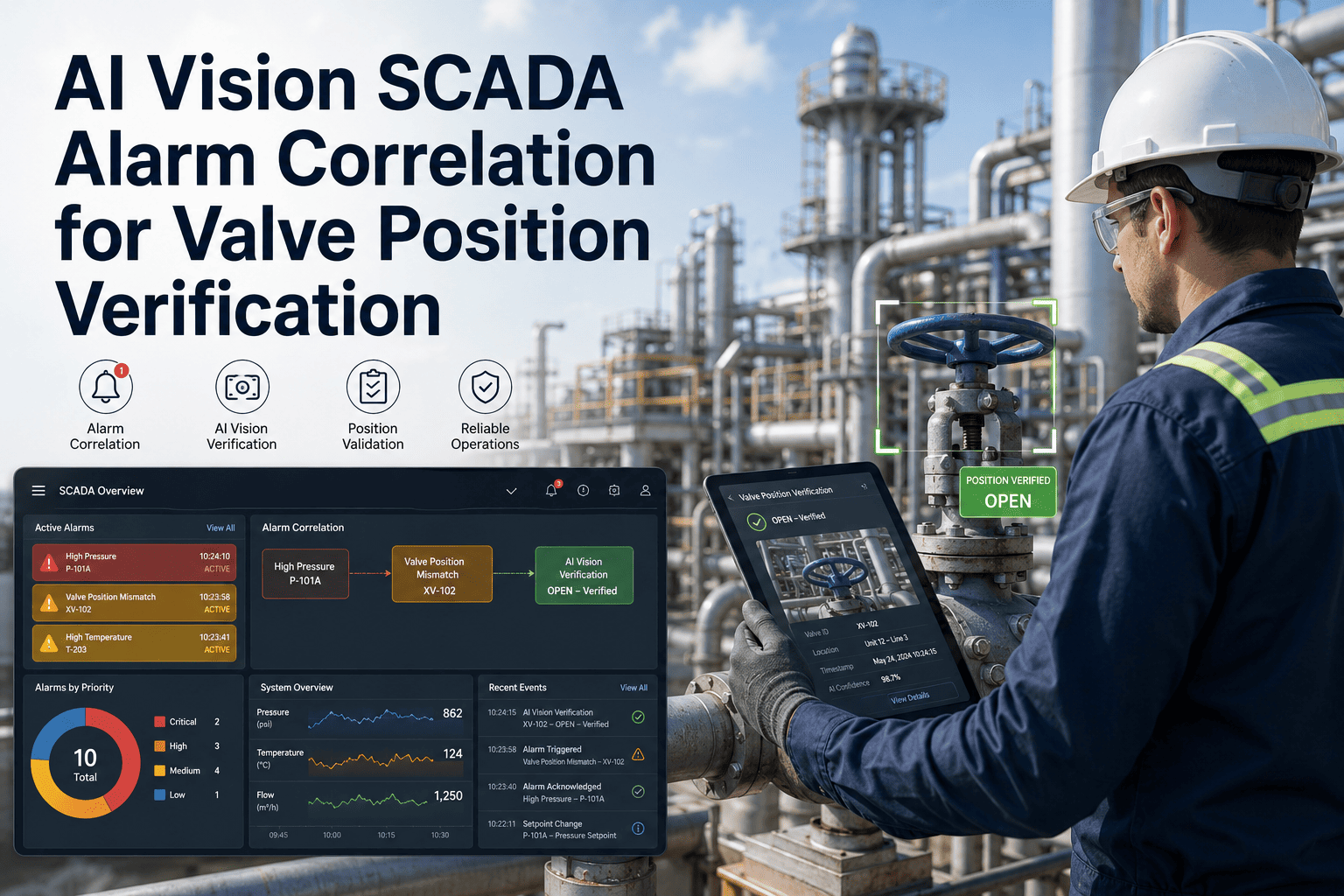
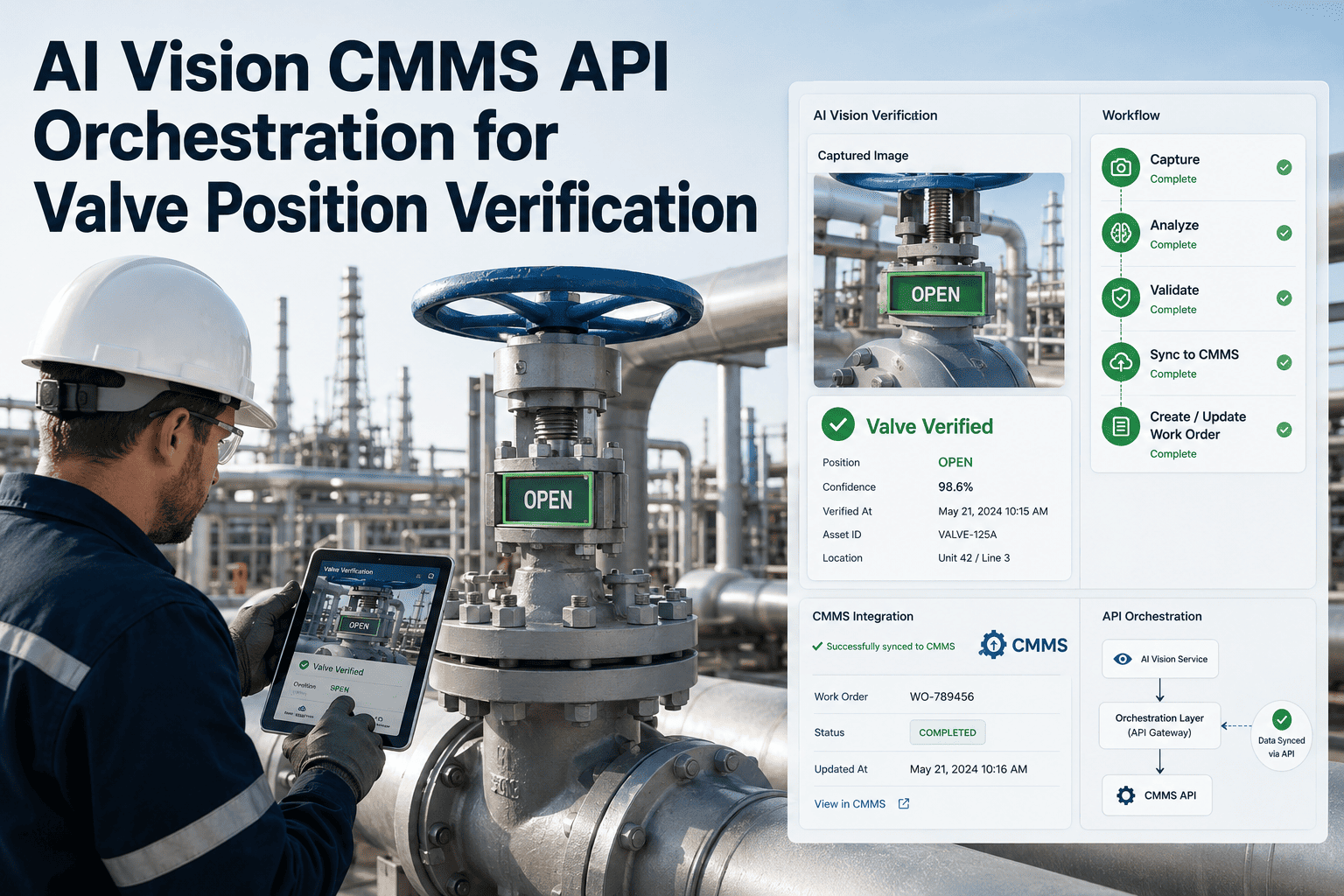
Valve position verification is one of the most critical and least reliable processes in automated plant operations. SCADA systems raise alarms when valve positions deviate from setpoints — but the alarm alone does not confirm whether the deviation is a sensor error, a mechanical failure, or an actual position mismatch. OxMaint AI Vision layers a camera-based verification step directly onto SCADA alarm events, so every valve position alarm is cross-referenced against a live visual frame before a technician is dispatched. This eliminates false-positive dispatches, accelerates response to genuine mechanical failures, and creates an unbroken visual evidence chain from alarm to resolution. Book a demo to see how visual alarm correlation eliminates guesswork in your valve maintenance workflow.
AI Vision · SCADA · Valve Verification
AI Vision SCADA Alarm Correlation for Valve Position Verification
Every SCADA valve alarm is paired with an AI camera frame in seconds — so you know whether to dispatch before anyone walks the floor.
42%
of valve SCADA alarms are false positives traceable to sensor drift or calibration error
6 sec
average alarm-to-visual-verification time with OxMaint AI Vision
91%
reduction in unnecessary technician dispatches with visual triage pre-filtering
100%
of genuine position discrepancies logged with timestamped photo evidence
Two-Layer Verification
SCADA Alarm Plus Visual Evidence
LAYER 1
SCADA Alarm
Reports when a measured value crosses a configured threshold. Fast and always-on. Cannot confirm physical valve state.
Gap: Cannot detect sensor drift or mechanical misalignment
+
LAYER 2
AI Camera Verification
Captures live frame at alarm event. AI model estimates physical valve position and compares to SCADA-reported value.
Adds: Physical confirmation, false-alarm filtering, visual evidence
=
RESULT
Verified Action Decision
Genuine discrepancy: work order with photo. Sensor error: calibration task. No issue: auto-dismissed with log.
Outcome: Right response, every time
Alarm Routing Decision Tree
How OxMaint Routes Each Valve SCADA Alarm
SCADA Valve Position Alarm Received
AI Camera: Position Matches SCADA
Sensor drift likely — calibration WO created. No dispatch.
AI Camera: Position Differs from SCADA
Mechanical issue confirmed — Priority WO with photo evidence. Dispatch triggered.
AI Camera: Low Confidence
Human review queue — senior tech reviews frame before routing decision.
Know Before You Go
Every SCADA valve alarm deserves a visual check before a technician is dispatched. OxMaint delivers that check in 6 seconds — and routes the outcome automatically.
Performance Data
Before and After AI Vision Alarm Correlation
| Metric | Without AI Vision | With OxMaint AI Vision | Improvement |
|---|
| False alarm dispatch rate | 38–45% | Under 4% | 91% reduction |
| Time to confirm valve status | 18–35 minutes | Under 10 seconds | 99% faster |
| Visual evidence per alarm | 0% | 100% | Full coverage |
| First-visit fix rate | 54% | 88% | +34 points |
| Alarm-to-work-order time | 12–40 minutes | Under 1 minute | 95% faster |
Expert Review
What Controls Engineers Say
Valve SCADA alarms were our highest-volume alarm type and our lowest signal-to-noise ratio. The team had alarm-fatigue so badly that real position failures were getting the same response time as the nuisance alarms. AI vision correlation changed that completely — the system now pre-qualifies every alarm visually, and our technicians only dispatch when there is a confirmed visual discrepancy. The signal-to-noise ratio went from about 1 in 3 to better than 9 in 10 in our first two months.
Controls and Automation Engineer · Refinery · 16 Years Process Control
The audit trail piece was transformative for us. We operate under a permit-to-work system and every isolation valve needs documented verification before a permit is issued. Previously that required a physical witness signature. With OxMaint AI vision, the system produces a timestamped photo verification record that our safety team accepts as primary evidence. We now issue permits 40 percent faster on average.
Process Safety Manager · Chemical Complex · ISO 45001 Certified Site
FAQ
Frequently Asked Questions
How does OxMaint receive SCADA valve alarm data?
OxMaint connects to your SCADA system via OPC-UA server subscription, REST API webhook, or MQTT broker. Alarm events are received in real time, parsed for valve tag and alarm type, and used to trigger the nearest AI camera for frame capture within 2 to 6 seconds of the alarm event.
Book a demo to review your SCADA connectivity options with our integration team.
What happens when the SCADA alarm frequency is very high?
OxMaint applies configurable alarm deduplication and suppression rules to filter repeated alarms on the same valve within a defined window. This prevents camera queue flooding and ensures that burst alarm events are processed as a single verification event rather than generating hundreds of work orders.
Start free to explore the alarm filtering configuration panel.
Does the system work in low-light or dusty plant environments?
OxMaint AI Vision supports cameras with IR illumination and thermal imaging for low-light and dusty environments. The AI model is calibrated for your specific plant conditions during deployment, and camera placement recommendations are provided to maximize valve visibility under operational lighting.
Book a demo to discuss camera requirements for your specific plant environment.
Can the system verify multiple valves from a single camera?
Yes. A single camera with a wide-angle or multi-zone configuration can verify up to 8 valves in its field of view simultaneously. OxMaint maps camera zones to individual valve tags in SCADA, so a single frame can produce verification records for multiple valves in one scan event.
Start free to see the zone mapping interface for multi-valve camera coverage.
SCADA-Triggered
AI-Verified
False-Alarm Filtered
Photo-Documented
Pair Every Valve SCADA Alarm with a Camera Frame — Automatically
OxMaint AI Vision turns every SCADA valve alarm into a verified, photo-documented event. Real discrepancies get priority work orders. Sensor errors get calibration tasks. False alarms get dismissed with a log. No guessing.