ai-downtime-prediction-for-food-processing-lines

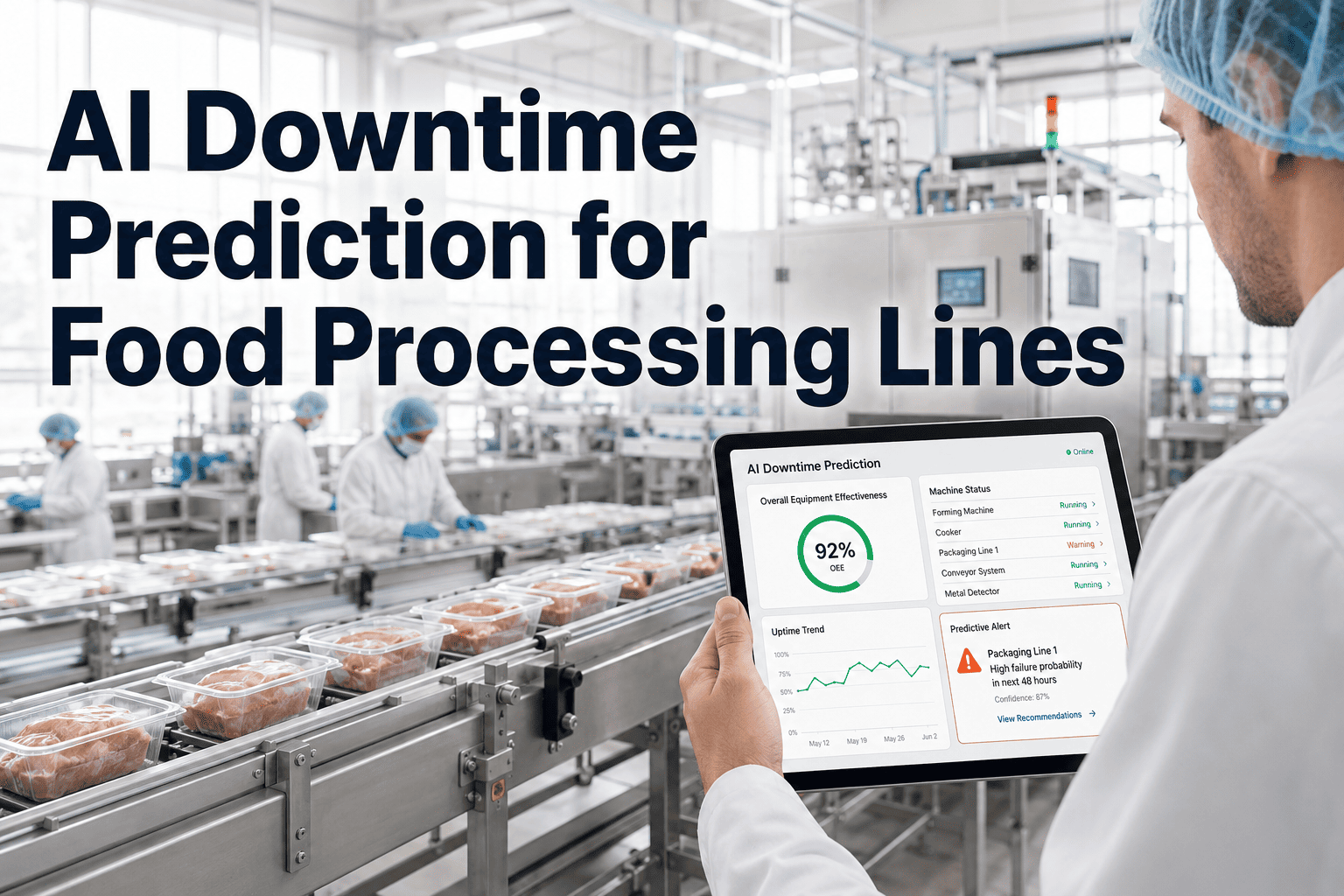
AI Downtime Prediction for Food Processing Lines


A stopped food processing line doesn't just cost production time — it triggers a chain of losses that compounds by the hour. Product in transit spoils. Packaging lines back up. Cold chain integrity breaks down. Regulatory documentation gaps open. The companies absorbing these hits repeatedly share one common factor: they are still running maintenance on schedules rather than on data. AI downtime prediction changes that equation by reading equipment behavior in real time and flagging failure signatures before they become stoppages, giving maintenance teams the window to act planned rather than scramble reactive.

Food Manufacturing · AI Predictive Maintenance

Stop Line Stoppages Before They Start

AI downtime prediction gives food processing teams 5–14 days of advance warning on equipment failures — enough time to schedule a fix, source a part, and keep production running without a spoilage event or a missed shift.

$3,000
Average cost per hour of unplanned food line downtime — excluding spoilage losses

70–90%
Downtime reduction achievable at AI predictive maintenance maturity

40–60%
Breakdown reduction from scheduled PM alone — AI predictive adds further gains on top
What's Actually at Stake

The True Cost of One Unplanned Stoppage

Food processors face a compounding loss structure that most maintenance cost models undercount. A single unplanned line stoppage triggers direct repair costs, product loss, clean-down costs, shift overtime, and potential regulatory documentation gaps — all at once. Here's how it adds up for a mid-size processing facility.


Equipment Repair
$2,400

Product Loss / Spoilage
$5,800

Labour Overtime
$1,800

Clean-Down Cost
$900

Compliance Admin
$600

Total Per Event
$11,500+

Estimates based on industry benchmark data for a 2-shift mid-size food processing facility. Source: McKinsey Operations Survey 2024 / Deloitte Manufacturing Maintenance Report 2025.

How It Works

How Oxmaint Predicts Food Line Failures

1
Connect Your Equipment
Oxmaint connects to existing sensors, PLCs, runtime meters, and temperature monitors on fillers, conveyors, cookers, freezers, packaging lines, and CIP systems. No new hardware required for most facilities.
2
AI Builds Each Asset's Baseline
Using 60–90 days of operating data, the AI model learns normal behavior for each piece of equipment — factoring in product changeovers, seasonal load variations, and shift patterns unique to your facility.
3
Deviation Detection Before Failure
When a conveyor motor starts drawing more current than its learned baseline, or a filler head develops seal wear that shows in cycle time data, Oxmaint flags it — typically 5–14 days before the failure would occur.
4
Structured Work Order, Right Now
The alert auto-generates a work order with the equipment's full service history, recommended corrective action, and parts list. The maintenance team gets a planned job — not a crisis call during a production run.
Equipment Coverage

Food Processing Assets Oxmaint Monitors

Equipment Type Key Failure Mode Monitored Sensor / Data Source Avg Prediction Lead Time
Rotary Filler / Doser Seal wear, head misalignment, fill weight drift Fill weight sensor, cycle time data 7–12 days
Conveyor Systems Belt wear, gearbox bearing failure, drive motor load increase Current draw, vibration sensor 5–10 days
CIP / Sanitation Systems Pump degradation, valve leak, temperature inconsistency Flow meter, temperature, pressure 3–7 days
Blast Freezer / Chiller Refrigerant charge loss, coil frost buildup, fan motor wear Suction pressure, superheat, current 10–14 days
Packaging / Wrapping Line Film tension irregularity, sealer temperature drift, label skip Servo drive data, temperature sensor 5–8 days
Cooking / Retort Vessel Steam valve wear, pressure inconsistency, agitator bearing Pressure, temperature, torque 8–14 days
See Oxmaint in Action
See Exactly Which of Your Lines Oxmaint Would Monitor

Book a 30-minute demo with your equipment list and we'll map your processing assets to Oxmaint's prediction models — showing you where your highest stoppage risk is today.

Results

What Changes After AI Prediction Goes Live

-67%
Unplanned Line Stoppages
Teams shift from reactive repair to planned interventions, with most failure events captured and resolved before production impact.
-58%
Emergency Spare Parts Cost
Planned repairs allow standard lead-time parts procurement instead of same-day emergency sourcing at premium prices.
+91%
PM Compliance Rate
AI-generated work orders with clear priority and asset context drive completion rates well above manual scheduling benchmarks.
+17pts
OEE Improvement
Line availability, performance, and quality all improve when maintenance becomes proactive and unplanned stops decrease significantly.
Expert Perspective

What Maintenance Leaders in Food Processing Say

In food manufacturing, the real risk isn't the repair cost — it's the spoilage. We had a retort failure on a Friday evening that cost us three batches worth $140,000 because the maintenance team didn't have a signal until the pressure alarm triggered during a run. Predictive monitoring on the vessel would have caught the steam valve degradation five days earlier. That single event justified the platform cost for the year.

Robert Mensah
Plant Manager · Meat Processing, West Africa · 18 years food manufacturing
★★★★★
The compliance angle is underappreciated. Every unplanned stoppage creates a documentation gap — what failed, when, what action was taken, what product was affected. Regulators want that chain complete. AI predictive maintenance doesn't just reduce downtime; it automatically documents every alert, every work order, and every resolution with timestamps. That paper trail is exactly what an audit requires. Book a demo to see Oxmaint's audit-ready reporting for food facilities.

Anjali Thadani
Quality & Compliance Manager · FMCG Food Group · 13 years regulatory and maintenance compliance
★★★★★
Questions

What Food Processing Teams Ask

Does Oxmaint require shutting down lines to install sensors or integrate with equipment?
No production shutdown is required for Oxmaint integration. For facilities with existing PLCs or SCADA systems, Oxmaint connects via standard API or OPC-UA protocols and reads live data without interrupting control logic. For assets without existing instrumentation, wireless clip-on vibration and temperature sensors can be attached during a scheduled maintenance window — typically under 30 minutes per asset — without interfering with production. Sign up free to start with manual data and add sensors progressively.
How does the AI handle changeovers and different product runs that affect equipment behavior?
Oxmaint's prediction models are trained with product run context, so the AI distinguishes between equipment behavior during a high-viscosity sauce run versus a thin liquid filling cycle. Changeover periods are flagged as transition events in the model, preventing false-positive alerts during the brief period when a line is transitioning between products. This context-aware modeling significantly reduces nuisance alerts compared to simple threshold-based systems that trigger during every changeover.
Can Oxmaint document equipment failures and maintenance actions in a format suitable for FDA or FSSC 22000 audits?
Yes. Every alert, work order, and resolution in Oxmaint carries a full audit trail including asset ID, timestamp, alert trigger data, assigned technician, parts used, and completion signature. Reports export in PDF or CSV format and are structured to align with HACCP equipment maintenance documentation requirements. The system can also generate scheduled maintenance compliance reports showing what PMs were completed, when, and by whom — the core evidence set for food safety management system audits.
How soon after go-live will the AI start generating useful failure predictions for our lines?
Facilities with existing historical maintenance records and sensor data loaded into Oxmaint typically see calibrated predictions within 4–6 weeks. Facilities starting fresh run in an observation period of 60–90 days as the AI builds baseline models from live data. During the observation period, PM compliance, work order management, and inspection reporting all deliver immediate value — predictive failure alerts are an added layer that matures over the first quarter. Book a demo to see the onboarding timeline for your facility size.
Get Started

Predict Failures. Protect Your Lines. Prevent Spoilage.

Oxmaint gives food processing teams AI-powered failure prediction, structured work orders, and compliance-ready documentation — built for the speed and hygiene requirements of food manufacturing environments.
Share This Story, Choose Your Platform!