Reliability-Centered Maintenance (RCM) is only as effective as the system that executes it. For manufacturing plants, CMMS RCM integration bridges the gap between failure-mode analysis and daily work order execution—ensuring every identified risk is automatically tracked, assigned, and resolved before downtime occurs. By automating RCM work orders through a centralized manufacturing maintenance system, plants typically reduce unplanned downtime by 30–50% and extend asset life cycles by 20% or more. OxMaint's AI-powered platform transforms your RCM strategy into automated, condition-based tasks without requiring a six-month implementation. You can deploy OxMaint in weeks and Start Free Trial access today to see measurable reliability improvements in your first quarter.
CMMS RCM FOR MANUFACTURING
Is Your RCM Analysis Sitting in a Binder While Assets Keep Failing?
Plants spend 6–9 months mapping failure modes and criticality, only to execute tasks on spreadsheets or disconnected systems. OxMaint links every RCM failure mode directly to an automated work order trigger—closing the loop between analysis and execution in days, not years.
THE COST OF DISCONNECTED RCM
Why RCM Manufacturing Programs Stall Without CMMS Automation
Over 60% of RCM initiatives fail to deliver sustained results—not because the analysis is wrong, but because the execution relies on manual tracking, tribal knowledge, and paper-based work orders.
Manual work order generation creates execution lag
When a failure mode requires a 30-day inspection, a planner must manually remember to generate and assign that work order. In plants without manufacturing work order automation, up to 40% of scheduled preventive tasks are missed or delayed, rendering the RCM analysis ineffective.
Untracked KPIs blind reliability engineers to emerging failures
RCM requires continuous feedback to validate failure modes. Without manufacturing CMMS KPI tracking—like MTBF, MTTR, and OEE—engineers cannot see if their maintenance strategies are actually preventing failures or if they need to adjust task frequencies.
Siloed spare parts data extends downtime by hours
If an RCM-driven work order triggers but the required bearings or seals are out of stock, the repair stalls. Manufacturing CMMS integration links failure modes directly to Bill of Materials (BOM) and inventory levels, ensuring parts are pre-staged before catastrophic failure occurs.
Static documents cannot adapt to condition-based triggers
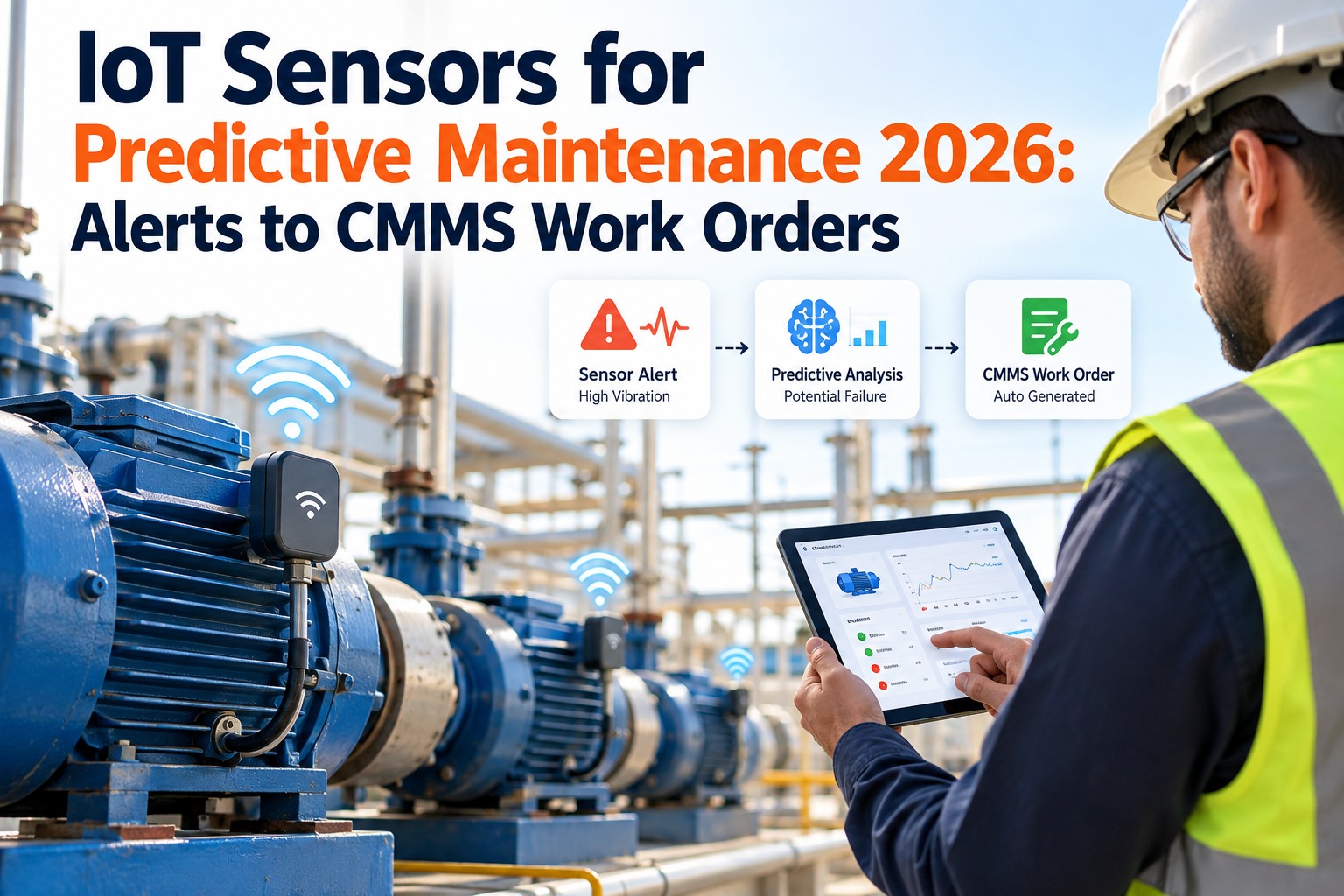
Modern manufacturing digital maintenance relies on IoT sensors and condition monitoring. If your RCM tasks are trapped in a spreadsheet, you cannot automatically trigger a work order when vibration levels exceed 4.5 mm/s RMS. You need a system that acts on real-time data.
HOW TO AUTOMATE RCM WORK ORDERS
Step-by-Step Guide to Manufacturing CMMS Setup for RCM
Transitioning from reactive maintenance to an automated RCM program takes 4–8 weeks when you follow a structured deployment framework aligned with ISO 55000 asset management standards.
Map the Asset Hierarchy to Plant Reality
Build a functional asset hierarchy that mirrors your production line—from process down to the component level. OxMaint allows you to import existing asset registers via CSV, structuring thousands of assets into a navigable tree that supports precise failure-mode tracking.
Link Failure Modes to Automated Task Triggers
Translate your FMEA (Failure Mode and Effects Analysis) into the CMMS. For each identified failure mode, configure a preventive or predictive maintenance trigger. OxMaint lets you set time-based (e.g., every 500 run-hours) and condition-based (e.g., temperature exceeds 85°C) rules.
Digitize Work Orders and Spare Parts BOMs
Attach checklists, safety procedures, and required spare parts to every RCM task template. When a work order auto-generates, technicians receive step-by-step digital procedures on their mobile devices, while the system automatically reserves inventory from the warehouse.
Validate KPIs and Optimize Task Frequencies
Launch live dashboards tracking MTBF, MTTR, and planned maintenance compliance. Compare actual failure rates against RCM predictions. If a component fails before its scheduled interval, OxMaint flags the task for frequency optimization, closing the continuous-improvement loop.
ROI & SAVINGS BREAKDOWN
What Is the ROI of CMMS for Manufacturing Reliability?
A properly deployed CMMS delivers a typical payback period of 6–9 months. The most significant savings come from shifting from reactive firefighting to planned, automated interventions.
RCM Automation ROI Formula
Annual Savings = (Downtime Hours Reduced × Hourly Production Cost) + (Emergency Repair Premium Avoided) + (Spare Parts Waste Eliminated)
Example: A 180-asset plant running 3 shifts costs $4,200 per hour of unplanned downtime. Reducing 15 downtime hours per month saves $756,000 annually. By avoiding emergency contractor premiums ($85/hr vs $145/hr) and optimizing spare parts inventory by 18%, total annual savings exceed $920,000 against a software investment of under $25,000.
| Maintenance Metric | Before CMMS (Reactive) | After OxMaint (Automated RCM) | Impact |
|---|---|---|---|
| MTBF (Mean Time Between Failures) | 14 days | 38 days | +171% improvement |
| Planned Maintenance Ratio (PMR) | 25% | 85% | +60 percentage points |
| Wrench Time (Technician Productivity) | 28% | 52% | +86% productivity gain |
| Spare Parts Inventory Carrying Cost | $180K/yr | $147K/yr | -18% waste reduction |
Stop Losing Revenue to Preventable Equipment Failures
See how OxMaint automates your RCM work orders and links every failure mode to an actionable task. Book a personalized 30-minute demo with our reliability engineers today.
HOW OXMAINT HELPS
OxMaint: The CMMS Built for Manufacturing Reliability Teams
Unlike generic maintenance tools, OxMaint is an AI-powered EAM platform engineered to execute complex RCM strategies without the bloat of enterprise legacy systems.
AI-Powered Predictive Triggers
OxMaint analyzes vibration, temperature, and pressure data to predict failures before they happen. The system auto-generates work orders when equipment deviates from baseline conditions, shifting your team from time-based to true condition-based maintenance.
Outcome: Cut unplanned downtime by 30–50%
Mobile-First Digital Work Orders
Technicians receive automated work orders on their mobile devices with step-by-step RCM checklists, safety Lockout/Tagout (LOTO) procedures, and attached manuals. They can close out tasks, capture photos, and log parts usage directly from the plant floor.
Outcome: Eliminate 100% of paper work orders
Spare Parts & BOM Automation
Every RCM task is linked to a specific asset's Bill of Materials. When a work order triggers, OxMaint automatically checks inventory levels, reserves parts, and generates purchase requisitions if stock falls below safety thresholds.
Outcome: Reduce parts inventory waste by 18%
Real-Time Reliability KPI Dashboards
Monitor MTBF, MTTR, OEE, and PM compliance in real-time. OxMaint's analytics engine flags tasks that need frequency adjustments based on actual failure data, giving plant managers the insights they need to optimize maintenance strategies continuously.
Outcome: Achieve 85%+ planned maintenance ratio
REAL-WORLD SCENARIO
A 180-Asset Automotive Parts Plant Cut Downtime by 38% in 90 Days
A Tier-1 automotive supplier was spending $42,000 annually on emergency maintenance contractors and losing 22 production hours per month to unplanned stamping press failures. Their RCM analysis was complete but trapped in Excel spreadsheets. By deploying OxMaint, they mapped 180 critical assets, automated 340 preventive tasks, and linked vibration sensors to condition-based triggers. Within the first quarter, MTBF improved by 152%, unplanned downtime dropped 38%, and the plant achieved a 78% planned maintenance ratio—generating over $310,000 in recovered production value.
CMMS DEPLOYMENT BEST PRACTICES
Manufacturing CMMS Best Practices for Long-Term Success
Software is only half the equation. These proven best practices ensure your manufacturing automated maintenance program sustains results for years.
Data Integrity & Asset Setup
- Standardize asset naming conventions before import (e.g., PLT-AREA-LINE-ASSET-NUM)
- Enforce mandatory fields for failure codes and root cause analysis on every work order close-out
- Audit spare parts BOMs quarterly to ensure accuracy above 95%
Adoption & Technician Training
- Train technicians in 2-hour role-specific sessions, focusing on mobile work order closure
- Eliminate paper work orders completely within 30 days to force digital adoption
- Tie PM compliance KPIs to performance reviews to ensure accountability
FREQUENTLY ASKED QUESTIONS
CMMS RCM for Manufacturing: Top Questions Answered
How does a CMMS support RCM in a manufacturing environment?
A CMMS supports RCM by translating failure mode analysis into automated, trackable work orders. Instead of relying on planners to manually schedule inspections, the system auto-generates tasks based on time, runtime hours, or condition triggers, ensuring every identified risk is actively mitigated and tracked against KPIs like MTBF and OEE.
How long does it take to deploy a CMMS for manufacturing maintenance?
With a modern platform like OxMaint, a mid-sized manufacturing plant can fully deploy in 2–4 weeks. This includes asset hierarchy import, RCM task automation, spare parts integration, and mobile technician training. Legacy enterprise systems often take 6+ months, but OxMaint's streamlined setup gets you live in days. You can Book a Demo to see the deployment timeline for your specific plant.
What KPIs should we track with manufacturing CMMS integration?
The most critical KPIs for manufacturing reliability include Mean Time Between Failures (MTBF), Mean Time to Repair (MTTR), Overall Equipment Effectiveness (OEE), Planned Maintenance Ratio (PMR), and Work Order Compliance. Tracking these metrics proves whether your RCM strategies are actually reducing downtime and extending asset life.
Can a CMMS automate condition-based maintenance triggers?
Yes. Advanced CMMS platforms like OxMaint integrate with IoT sensors and condition monitoring systems to trigger work orders automatically. If a bearing's vibration exceeds a predefined threshold (e.g., 4.5 mm/s RMS), the system generates a high-priority inspection task without human intervention, catching failures weeks before they occur.
Is it difficult to switch from spreadsheets to a manufacturing maintenance system?
Switching from spreadsheets is straightforward with the right platform. OxMaint provides CSV import tools for assets, parts, and historical work orders, along with guided onboarding. Most plants migrate their data in under a week and see immediate value from automated PM scheduling and mobile work orders, paying back the investment within 6–9 months.
Ready to Automate Your RCM Work Orders?
Join hundreds of manufacturing plants running their reliability programs on OxMaint. Deploy in weeks, train technicians in hours, and see measurable downtime reduction in your first quarter.
Free 14-day trial · No credit card required