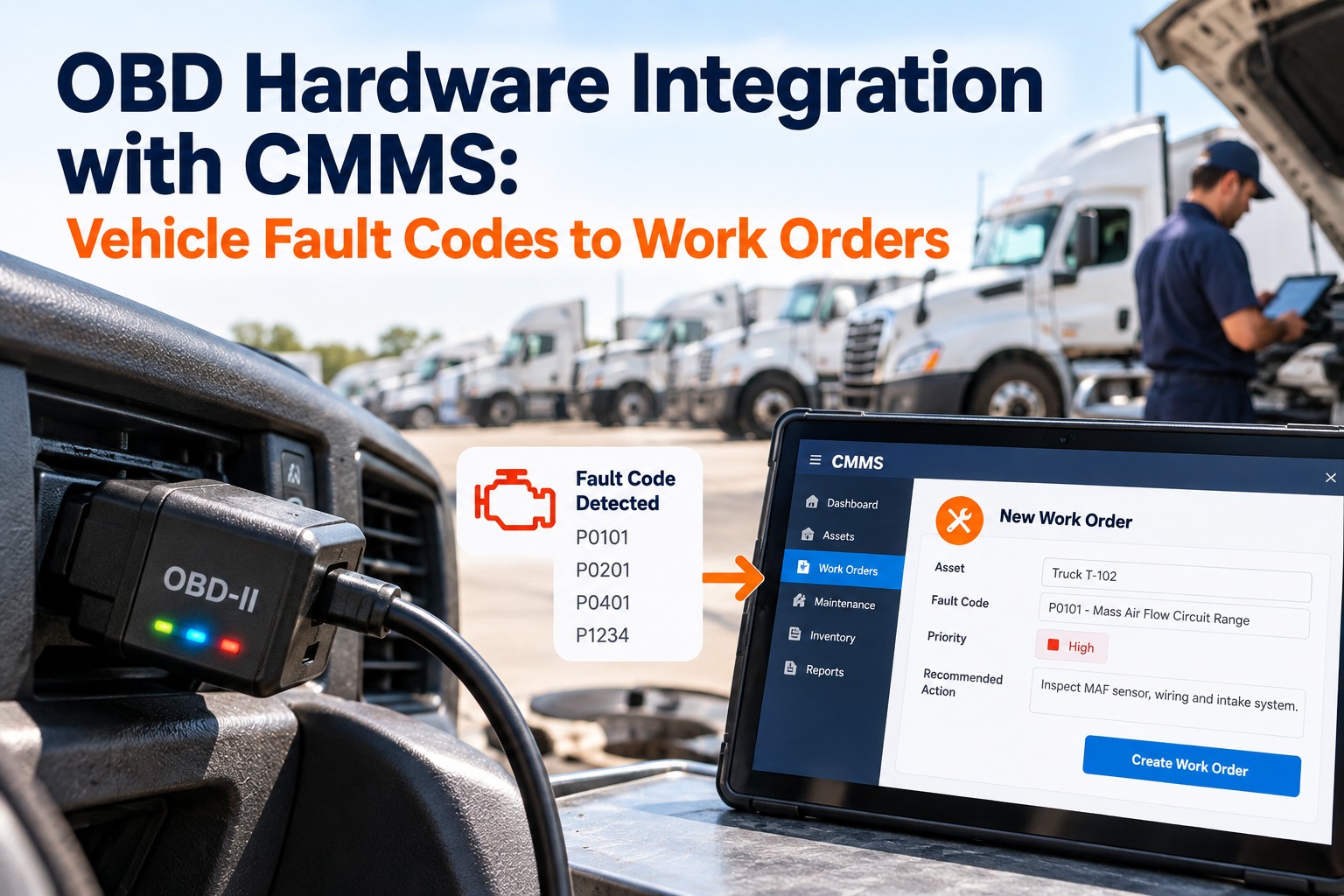
A check-engine light comes on somewhere out on a route, a driver maybe mentions it at end of shift, and by the time anyone pulls the code the fault has either cleared, worsened, or grounded the truck. Fault codes that live in the dashboard instead of the maintenance system are warnings nobody acts on — until they become breakdowns. This guide shows how OBD and telematics hardware feeds vehicle diagnostics straight into maintenance, turning a diagnostic trouble code into a prioritized work order with no manual step, and how OXMAINT AI, the AI-powered fleet CMMS, closes the loop from ECU to technician.
OBD Hardware Integration with CMMS: Vehicle Fault Codes to Work Orders
A code in the dashboard the shop never sees, a check-engine light reported days late, a breakdown that started as an ignored DTC — that's fault data without integration. OXMAINT AI, the AI-powered CMMS and maintenance management software, connects the vehicle to the shop: OBD and J1939 hardware streams every fault code in real time, the system maps it to a prioritized work order with SOPs and parts attached, and usage data triggers PM on actual wear — so a code becomes a scheduled repair, not a roadside call.
Reading a Diagnostic Trouble Code
Before a code can route to the right work order, the system has to understand it. Every DTC follows a structure that says which system failed and how — and OXMAINT AI reads that structure across both light-duty OBD-II and heavy-duty J1939. Knowing the families is the foundation of automated routing. Book a demo to see code mapping in OXMAINT AI.
On heavy equipment, J1939 codes carry an SPN (the suspect parameter) and an FMI (the failure mode), so the system knows not just which component but how it failed — the same principle, more detail, same automated routing.
Thresholds That Fire a Work Order on Their Own
A stored fault code isn't the only trigger — live engine parameters crossing a threshold generate work orders too, catching trouble before a code even sets. OXMAINT AI turns configured limits into automatic maintenance actions. These are examples of the rules a fleet can set. Start free and configure threshold alerts in OXMAINT AI.
| Parameter | Threshold | Action generated |
|---|---|---|
| Coolant temperature | > 95°C sustained 10 min | Cooling-system inspection work order |
| Oil pressure | < 20 PSI at operating temp | Immediate oil-system inspection |
| ATF temperature | > 108°C | Route-restriction flag + transmission service |
| Battery voltage | < 12.8 V while running | Charging-system / alternator inspection |
| Long-term fuel trim | > 8% persistent | Fuel injector / intake inspection |
| Engine load | > 88% average over route | Air filter + turbo inspection |
The Fault-to-Work-Order Pipeline
The point of integration is that no human has to notice, log, or forward a code. OXMAINT AI runs an automated pipeline from the moment the ECU sets a fault to the moment a technician has a work order with everything attached. Book a demo to walk the pipeline in OXMAINT AI.
A Code in the Dashboard Helps No One. A Code in the CMMS Fixes the Truck.
The gap between a fault and a repair is where breakdowns live. Direct ECU capture means zero manual reporting — every engine fault flows straight into the maintenance system, mapped, prioritized and staged, before a driver thinks to mention the warning light.
What the Hardware Streams
Fault codes are only part of the feed. OBD and telematics hardware streams a continuous picture of each vehicle's health and usage, and OXMAINT AI turns all of it into triggers — for repairs and for preventive maintenance timed to real wear. Start free and stream your fleet data into OXMAINT AI.
Connects to the Hardware You Already Run
An integration only works if it fits the devices already in the trucks. OXMAINT AI connects across plug-and-play dongles, hardwired heavy-duty trackers and the major telematics platforms. Book a demo to confirm your hardware works with OXMAINT AI.
We used to find out about fault codes when a driver remembered to say the light was on, which was usually after something let go on the road. Wiring the OBD data straight into our maintenance system flipped that — a code now lands in the shop queue the moment the ECU sets it, already tagged with a priority and the parts we'll need. The codes that used to become tows are scheduled repairs now, and the usage-based PM means we service on real miles instead of guessing.
Frequently Asked Questions
Turn Every Fault Code Into a Work Order.
Wire your fleet into the OXMAINT AI maintenance management software — OBD and J1939 hardware streaming fault codes in real time, automatic mapping to prioritized work orders with SOPs and parts attached, threshold-triggered alerts, usage-based PM, and DOT-ready records. Fix the truck before it leaves you stranded.