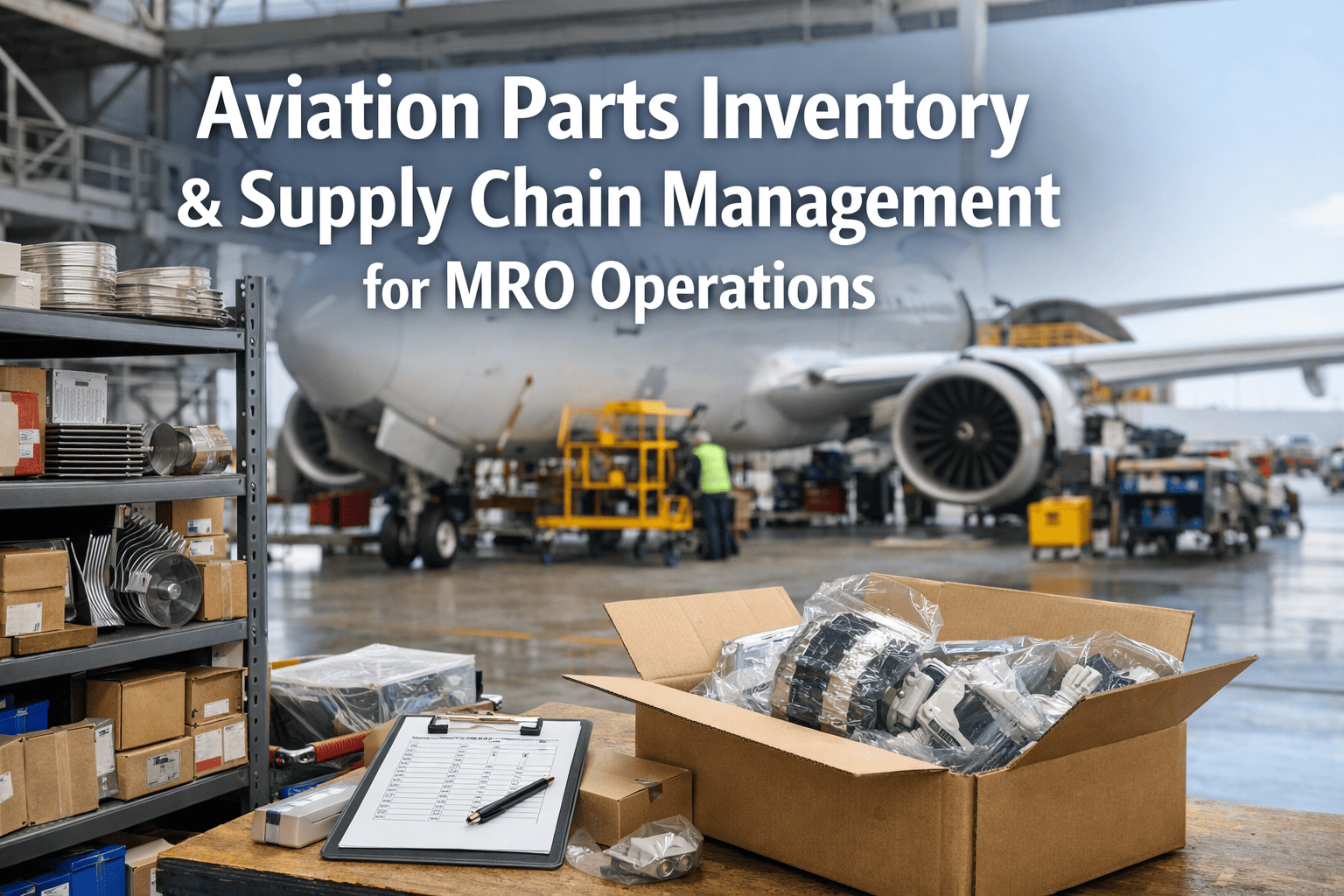
Aviation Parts Inventory & Supply Chain Management for MRO Operations
Aviation MRO operations face a critical challenge: ensuring the right part is available at the right time without carrying excessive inventory that drains capital. A single AOG (Aircraft On Ground) situation can cost airlines $150,000 per day, yet maintaining excessive rotable component inventory ties up millions in working capital. When parts tracking relies on spreadsheets and manual bin counts, the result is expedited shipping costs, duplicate ordering, expired shelf-life components, and regulatory traceability failures. Schedule a demo to see how OxMaint centralizes aviation parts inventory and supply chain management across your MRO operation.
Industry FocusAviation Parts Inventory & Supply Chain Management for MRO Operations16 min read
Aviation Parts Inventory Reality in 2026
$8.2M
Average value of rotable component inventory per MRO facility requiring precise tracking and condition management
73%
Of aviation MROs report stock discrepancies between physical counts and system records impacting part availability
4.8×
Higher expedited freight costs at MROs without integrated parts management versus facilities with automated inventory systems
Quick Answer
Aviation parts inventory and supply chain management is the comprehensive system for tracking, managing, and controlling aircraft components from acquisition through installation — covering rotable parts, consumables, shelf-life monitoring, vendor coordination, and regulatory traceability. In 2026, effective MRO inventory management requires real-time bin location tracking, automated reorder points, serialized component history, integration with maintenance work orders, and complete audit trails satisfying FAA Part 145 and EASA Part 145 documentation requirements.
Aviation Parts Categories & Inventory Complexity
Aviation inventory encompasses fundamentally different part types — each requiring distinct tracking protocols, shelf-life management, and traceability documentation. A bearing costs $400 and is consumed on installation; a landing gear assembly costs $280,000, cycles through overhaul, and requires complete life-limited part tracking across 15-year service intervals.
Rotable Components
High-value repairable parts cycled through overhaul — landing gear, APUs, actuators, fuel controls — requiring serialized tracking, TSN/CSN monitoring, and vendor return management.
Time-sensitive materials requiring expiration monitoring — adhesives, sealants, lubricants, rubber components — with automated alerts at 90, 30, and 7 days before expiry.
Expiry AlertsFIFO Control
Critical Inventory Management Challenges in Aviation MRO
Aircraft grounded waiting for parts cost airlines $150,000 per day in lost revenue and passenger compensation. Without real-time inventory visibility and automated reorder triggers, MROs discover stock-outs during critical maintenance windows — forcing expedited shipping at 4–6× normal freight costs or emergency vendor purchases without competitive pricing.
02
Shelf-Life Expiration & Material Waste
Adhesives, sealants, and rubber components expire silently in warehouse bins without automated monitoring — discovered only when pulled for installation and rejected by quality inspectors. MROs report 8–12% annual write-offs on shelf-life inventory, representing $200,000–$400,000 in preventable material losses per facility annually.
03
Regulatory Traceability Gaps & Audit Failures
FAA Part 145 and EASA Part 145 require complete parts traceability from acquisition through installation — including supplier certificates, batch numbers, and installation records. Manual parts tracking produces documentation gaps that fail during regulatory audits, triggering findings that can suspend operating certificates until corrective actions are verified.
04
Rotable Component Lifecycle Visibility Loss
High-value rotable parts cycle between aircraft installation, removal for overhaul, vendor repair shops, and warehouse storage — often crossing multiple facilities and repair cycles. Without serialized component tracking linked to maintenance records, MROs lose visibility to TBO status, repair history, and current location of $8.2M average rotable inventory.
Eliminate AOG Situations With Real-Time Parts Visibility
OxMaint provides bin-level inventory tracking, automated reorder points, and serialized component history — integrated with maintenance work orders for complete parts-to-aircraft traceability.
Core Inventory Management Capabilities for Aviation MRO
Each capability addresses the operational realities of aviation parts management — high-value rotable tracking, regulatory documentation requirements, AOG prevention, and capital efficiency across complex supply chains.
Parts Tracking
Serialized Component Tracking
Complete Lifecycle Visibility for Rotable Parts
Every serialized component tracked from receipt through installation — capturing vendor source, FAA 8130-3 documentation, installation aircraft/position, removal reason, and repair shop routing.
TBO monitoring alerts at 80% and 95% of calendar or cycle limits. Complete repair history visible on mobile devices during pre-installation inspections. See aviation parts tracking features.
Automated Reorder Points & Vendor Integration
Min/max inventory levels configured per part number with automated purchase requisitions generated when stock falls below reorder point — eliminating manual monitoring and preventing stock-outs during scheduled maintenance.
Vendor lead times, pricing tiers, and preferred supplier logic built into reorder automation. Integration with ERP systems for PO generation and receiving confirmation. See supply chain automation capabilities.
Automation
Reorder Point Automation
Compliance
Regulatory Documentation
FAA & EASA Traceability Requirements
Complete parts traceability documentation satisfying FAA Part 145.211 and EASA Part 145.A.42 — including supplier certificates, receiving inspection records, batch control, and installation work order linkage.
Audit-ready parts history exports generated in under 20 minutes — from initial receipt through current aircraft installation or warehouse location, with all supporting documentation attached.
Technology Integration for Modern Aviation Inventory
Advanced technologies transform traditional parts management into predictive, automated systems that prevent stock-outs, reduce carrying costs, and ensure regulatory compliance without manual intervention.
AI-Powered Demand Forecasting
Machine learning analyzes historical usage patterns, maintenance schedules, and fleet composition to predict parts demand 60–90 days ahead — optimizing reorder quantities and reducing expedited freight costs by 40%.
SAP & ERP Integration
Bi-directional integration with SAP, Oracle, and aviation-specific ERP systems — synchronizing inventory levels, purchase orders, receiving transactions, and financial accounting without duplicate data entry or reconciliation overhead.
Digital Twin Warehouse Mapping
3D digital twin visualization of warehouse layout with real-time bin occupancy, part location mapping, and optimized picker routing — reducing average part retrieval time from 8 minutes to under 90 seconds for 12,000+ SKU facilities.
Aviation Parts Management Checklist
Essential inventory control processes for aviation MRO operations — covering receiving, storage, issuance, and cycle count procedures that satisfy regulatory audit requirements.
Receiving & Inspection
✓Verify FAA Form 8130-3 or EASA Form 1 certificates
✓Physical inspection against packing slip and PO
✓Serial/batch number documentation in system
Storage & Shelf Life
✓Assign bin location with barcode scanning
✓Record expiration dates with 90/30/7-day alerts
✓FIFO queue enforcement for time-sensitive items
Issuance & Tracking
✓Link parts issuance to maintenance work order
✓Technician signature and aircraft tail number
✓Automated inventory deduction and reorder check
Cycle Counts & Audits
✓Monthly cycle counts on high-value rotables
✓Quarterly full counts on consumable inventory
✓Variance investigation for discrepancies over $500
Customer Success Story
"OxMaint cut our AOG situations by 67% in six months by giving us real-time parts visibility across three hangars. The automated reorder system eliminated stock-outs on critical consumables, and we reduced expedited freight costs by $180,000 annually."
— Director of Materials, Regional MRO Facility (42 aircraft capacity)
Parts Management Transformation Outcomes
These metrics represent benchmark comparisons between manual inventory tracking systems and OxMaint-deployed operations with integrated parts management across aviation MRO facilities.
Before OxMaint
✗AOG situations averaging 4.2 per month due to parts unavailability
✗11% shelf-life write-offs from expired adhesives and sealants
✗Manual parts traceability requiring 6–8 hours for audit requests
✗73% inventory accuracy on cycle counts versus system records
After OxMaint
✓AOG situations reduced to 1.4 per month with real-time stock alerts
✓Shelf-life expiration reduced to under 2% with automated monitoring
✓Complete traceability reports generated in under 20 minutes
✓98.5% inventory accuracy maintained with mobile cycle counting
Frequently Asked Questions
QHow does OxMaint prevent AOG situations from parts unavailability?
Real-time inventory tracking with automated reorder points triggers purchase requisitions when stock falls below minimum levels. Mobile alerts notify warehouse staff of critical stock levels during active maintenance windows.
QCan OxMaint track rotable components through repair cycles and multiple facilities?
Yes. Serialized component tracking follows parts from aircraft removal through vendor repair shops and back to warehouse storage, maintaining complete TBO status, repair history, and location visibility across the entire lifecycle.
QDoes the system satisfy FAA Part 145 and EASA traceability requirements?
Complete parts traceability from receipt through installation includes supplier certificates, batch control, and work order linkage — generating audit-ready documentation satisfying regulatory requirements in under 20 minutes.
QHow does shelf-life monitoring work for adhesives and sealants?
Automated alerts at 90, 30, and 7 days before expiration with FIFO queue enforcement ensure time-sensitive materials are issued before shelf-life limits, reducing write-offs from 11% to under 2%.
QCan the system integrate with existing SAP or ERP platforms?
Bi-directional integration synchronizes inventory levels, purchase orders, and receiving transactions with SAP, Oracle, and aviation-specific ERP systems without duplicate data entry or manual reconciliation.
Transform Your Aviation Parts Management
Real-time inventory visibility, automated reorder points, and complete regulatory traceability — deployed in 14 days with zero hardware requirements.



.png)