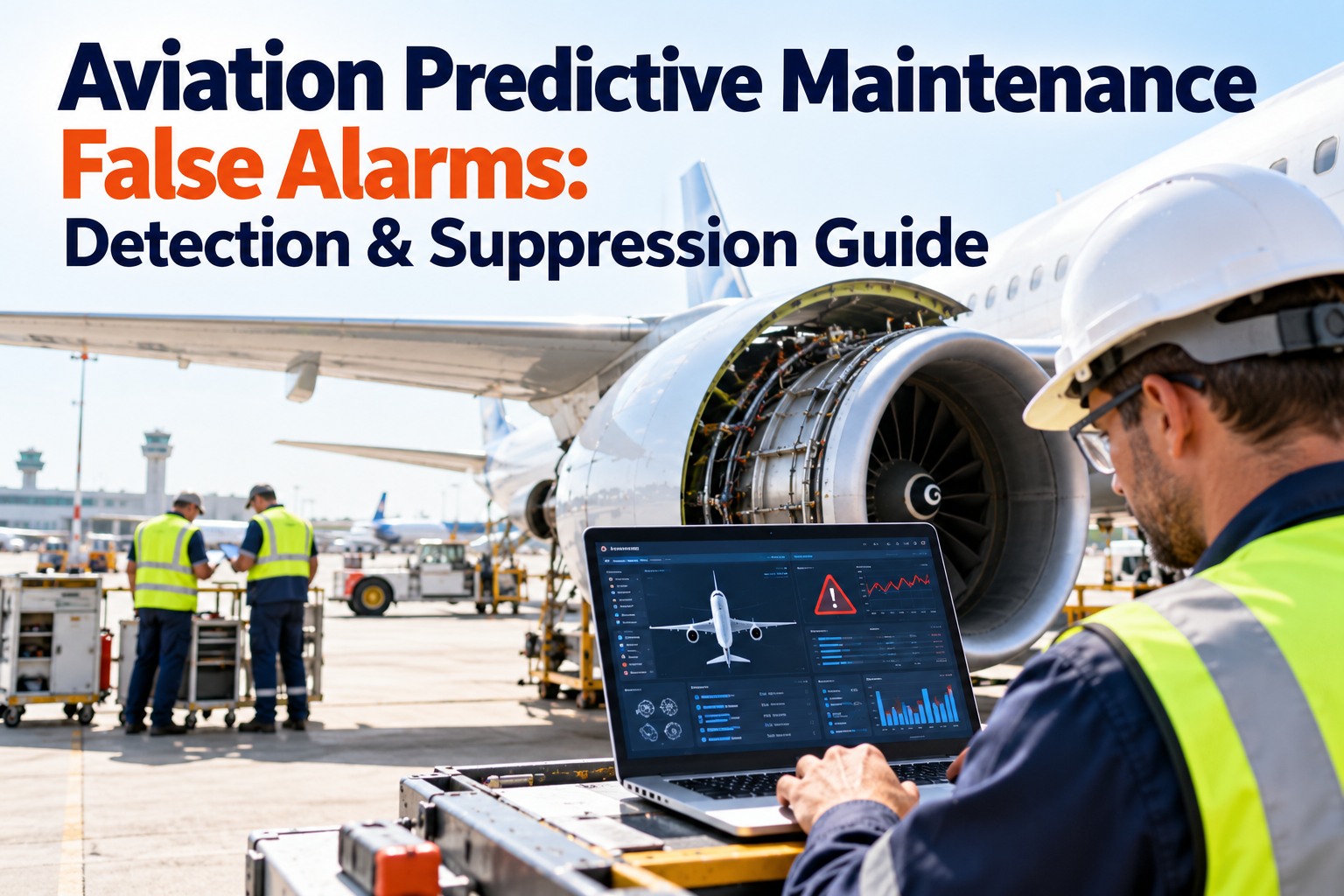
An aviation predictive-maintenance model that cries wolf is worse than one that stays silent. A false alarm on an engine EGT margin fires a borescope inspection, moves the aircraft off a revenue leg, triggers a logbook write-up that follows the airframe into the next audit, and — after enough repetition — teaches the maintenance control crew to click past the alert. Alert fatigue is a reliability problem, not a UX problem. This guide walks the confusion matrix, the false-alarm cost pyramid, the five-stage suppression framework, the human-in-the-loop verification pattern and the model-performance scorecard. OXMAINT AI is the AI-powered aircraft maintenance software that ingests predictive-model alerts, applies the suppression framework, routes the verified-live alerts to a WO and feeds the FP / FN labels back to the model so next quarter's precision climbs.
AVIATION PREDICTIVE MAINTENANCE · FALSE ALARM DETECTION & SUPPRESSION · 2026
Aviation Predictive Maintenance False Alarms: Detection & Suppression Guide
Four confusion-matrix outcomes, five suppression stages, one human-in-the-loop verification. OXMAINT AI ingests model alerts, suppresses the noise and feeds the labels back so precision climbs over time.
4
confusion outcomes · TP / FP / TN / FN
1
feedback loop closes model → CMMS → model
0
tolerated FN on safety-critical signals
The Confusion Matrix — Four Outcomes, Not Two
A predictive alert has four possible outcomes against reality. Confusing them is where every false-alarm program fails. OXMAINT AI labels each ingested alert into exactly one of the four cells — loaded as the ground truth in the aircraft maintenance software.
Actual: fault
Actual: no fault
Alert fired
TP · True Positive
Model called it; the fault was real. The win.
FP · False Positive
Model called it; nothing was wrong. The alert-fatigue builder.
No alert
FN · False Negative
Model missed it; the fault happened anyway. The safety problem.
TN · True Negative
No alert, no fault. The silent majority.
The False-Alarm Cost Pyramid — Why FPs Are Not Free
A false positive looks cheap — a tech walks to the aircraft, verifies no fault, closes the WO. The real cost compounds up the pyramid. OXMAINT AI tracks each layer against the FP record.
Grounded aircraft (AOG) · revenue loss
$10-100k+ per incident
MEL dispatch deferral · schedule disruption
$5-20k per rebook / rotation
Non-routine inspection labor · parts
$500-5k per unneeded teardown
Logbook write-up · recurring audit noise
Compounds over airframe life
Alert fatigue · genuine TPs ignored
The safety consequence
The Five-Stage Suppression Framework
A false-alarm program is not model tuning alone. The five stages below each cut the FP rate without raising the FN rate — applied together, they compound. OXMAINT AI runs the whole framework between the model's output and the mechanic's phone.
01
Threshold tuning
Confidence threshold set per signal class, not globally; safety-critical signals keep a low threshold, non-safety signals ride higher.
→
02
Dwell & dedup
Alert must persist for a dwell window and not duplicate a recent event. Catches sensor noise and transient events.
→
03
Context gate
Cross-signal check: an EGT margin alert that is not accompanied by any fuel-flow or N1 anomaly is routed differently from a cluster.
→
04
Human-in-the-loop verify
A certified engineer reviews the alert in a bounded time window; label the alert as TP / FP before it fires to the line.
→
05
Feedback to model
TP / FP labels feed the model retraining dataset; the FP pattern of this quarter becomes the suppressed pattern of next.
Alert Priority Routing — Four Tiers, Four Response Paths
An alert tier that treats every signal the same is a tier that produces fatigue by design. OXMAINT AI assigns each alert to one of four tiers at ingest, with its own notification path and SLA.
P1 · SAFETY
Safety-critical signal, high confidence
Engine, flight-controls, hydraulics with cross-signal confirmation. Route immediately to maintenance control + duty engineer; AOG decision at human-in-the-loop.
SLA: < 15 min to verify
P2 · RELIABILITY
Reliability signal, high confidence
APU, environmental, auxiliary systems with cross-signal confirmation. Route to line maintenance; verify before next flight.
SLA: before next sector
P3 · MONITOR
Degradation watch, trend-level
Signal trending outside baseline but no cross-signal confirmation. Log and monitor; schedule planned-inspection WO within 7 days.
SLA: 7-day planned check
P4 · LOG
Low-confidence or short dwell
Below threshold or dwell cut it. Logged for model-training; no WO raised, no notification sent.
SLA: none · training signal
Model Performance Scorecard — What Gets Reviewed Monthly
The scorecard is where the suppression framework earns its budget. Six metrics, read monthly against last month, tell whether precision is improving without recall falling.
PREDICTIVE MODEL SCORECARD · FLEET · LAST 30 DAYS
Precision · TP / (TP+FP)
82%
Recall · TP / (TP+FN)
94%
F1 score
0.88
FP per 1,000 flight hours
2.6
Suppression rate (upstream → verified)
68%
Time-to-verify · P1 median
11 min
This month
Target
FP per 1,000 hr still above target — the next model retraining cycle focuses on the sensor-noise cluster that dominates the FP label set
Human-In-The-Loop Verification — The Non-Negotiable Stage
Aviation does not run auto-dispatch on predictive signals. A certified engineer labels every alert before it becomes a maintenance action. The pattern below is how OXMAINT AI structures the verify step.
01
Signal + context packet
Engineer sees the raw signal, the baseline, the cross-signal evidence and the model's confidence — not just the alert text.
02
Three-button decision
CONFIRM · SUPPRESS · HOLD (gather more). Any decision is a labeled training record.
03
Suppress-reason tag
A suppressed alert must carry a reason: sensor known-noisy, recent transient, known maintenance in-work, pattern-false. The reason is the training label.
04
Time-bounded window
Decision must happen inside the alert's tier SLA; a HOLD past the window auto-escalates to the duty engineer.
05
Audit trail
Engineer identity, decision, reason, timestamp pinned to the alert and the airframe record — survives the audit review.
A Model Without Suppression Is Just A Louder Alarm.
OXMAINT AI runs the suppression framework between the model and the maintenance control crew. The alerts that reach the line are the alerts that earn attention; the suppressed alerts become the training data that lifts next quarter's precision.
The Feedback Loop — Model → CMMS → Model
The suppression framework is one half of the program; the feedback loop is the other. Every labeled TP and FP flows back to the model's training dataset so next quarter's model is tuned on this quarter's reality.
01
Model
Predictive model emits alert with confidence + signal + context.
→
02
CMMS ingest
OXMAINT AI receives alert; applies suppression framework; routes verified-live to maintenance control.
→
03
Field verify
Tech verifies at the aircraft; WO closes with TP / FP label + reason tag + photo evidence.
→
04
Retrain feed
Labels + context packet fed back to model team's training set for next retraining cycle.
Common FP Patterns — What Suppression Actually Catches
The majority of FPs cluster around five patterns. OXMAINT AI holds the pattern list as a tag set so the trend is visible.
01
Sensor transient
A single-cycle sensor spike that passes threshold but fails dwell. Catches ~30-40% of upstream FPs on most fleets.
02
Known-noisy sensor
A specific sensor serial that drifts; tagged in OXMAINT AI, alerts auto-suppressed with a serial-swap WO queued.
03
Maintenance-in-progress
An open WO on the asset is causing the signal; alert suppressed with the open-WO reason tag.
04
Normal-ops transient
A specific flight-phase (go-around, hot-day takeoff) triggers a known transient the model has not learned yet.
05
Drift from baseline shift
The asset's baseline has shifted (after an overhaul, after a parameter change); the model still compares to pre-shift.
How OXMAINT AI Runs The False-Alarm Suppression Program
The model ingest, confusion-matrix labeling, suppression framework, HITL verification, scorecard and retrain-feed all live natively in the OXMAINT AI aircraft maintenance software — wire up the predictive-model feed in OXMAINT AI.
Vendor-Agnostic Alert Ingest
Reads alerts from major aviation predictive-maintenance vendors via API; the alert record is the unit, not the vendor.
Suppression Framework
Five-stage framework runs between model and line; threshold, dwell, context, HITL verify, feedback feed.
Tiered Routing
P1 safety / P2 reliability / P3 monitor / P4 log tiers with per-tier SLA and notification path.
HITL Decision Interface
Signal + context + confidence shown together; three-button decision with mandatory reason tag.
Model Scorecard
Live precision / recall / FP-per-1,000-hr / time-to-verify dashboard; monthly review against target.
Retrain Feed Export
Labeled TP / FP / suppress-reason export to the model team on cadence — the feedback loop closes.
Frequently Asked Questions
What's the single biggest contributor to false alarms?
Sensor transients and known-noisy sensors together typically account for the majority of upstream FPs. Dwell + a per-sensor known-noisy tag catch most of them. OXMAINT AI stores the known-noisy tag on the sensor record so the suppression carries across retraining cycles.
Should we accept more FPs to reduce FN risk?
On safety-critical signals, yes — recall takes priority over precision up to the point alert fatigue erodes trust. The scorecard is where you watch that trade-off: a precision slide below ~70-75% usually correlates with mechanics ignoring real alerts. OXMAINT AI tracks the correlation so the tipping point is visible.
Who should run the HITL verification step?
A certified maintenance engineer (A&P or EASA Part 66 as applicable) with authority to make the dispatch call. The decision carries the engineer's identity and license number; OXMAINT AI gates the verify button on license status.
How does this interact with MSG-3 and the operator's MPD?
Predictive-maintenance alerts do not replace MSG-3-driven scheduled tasks; they live alongside them. OXMAINT AI runs both the MPD scheduled tasks and the predictive alerts on the same airframe record, with the predictive alerts tagged as condition-based additions, not replacements for scheduled items.
Suppress The Noise · Keep The Signal · Train The Model.
Wire the predictive-maintenance model into the OXMAINT AI aircraft maintenance software — confusion-matrix labeling, five-stage suppression, four-tier routing, HITL verify, model scorecard and retrain-feed. The alerts that reach the line are the alerts that earn action.