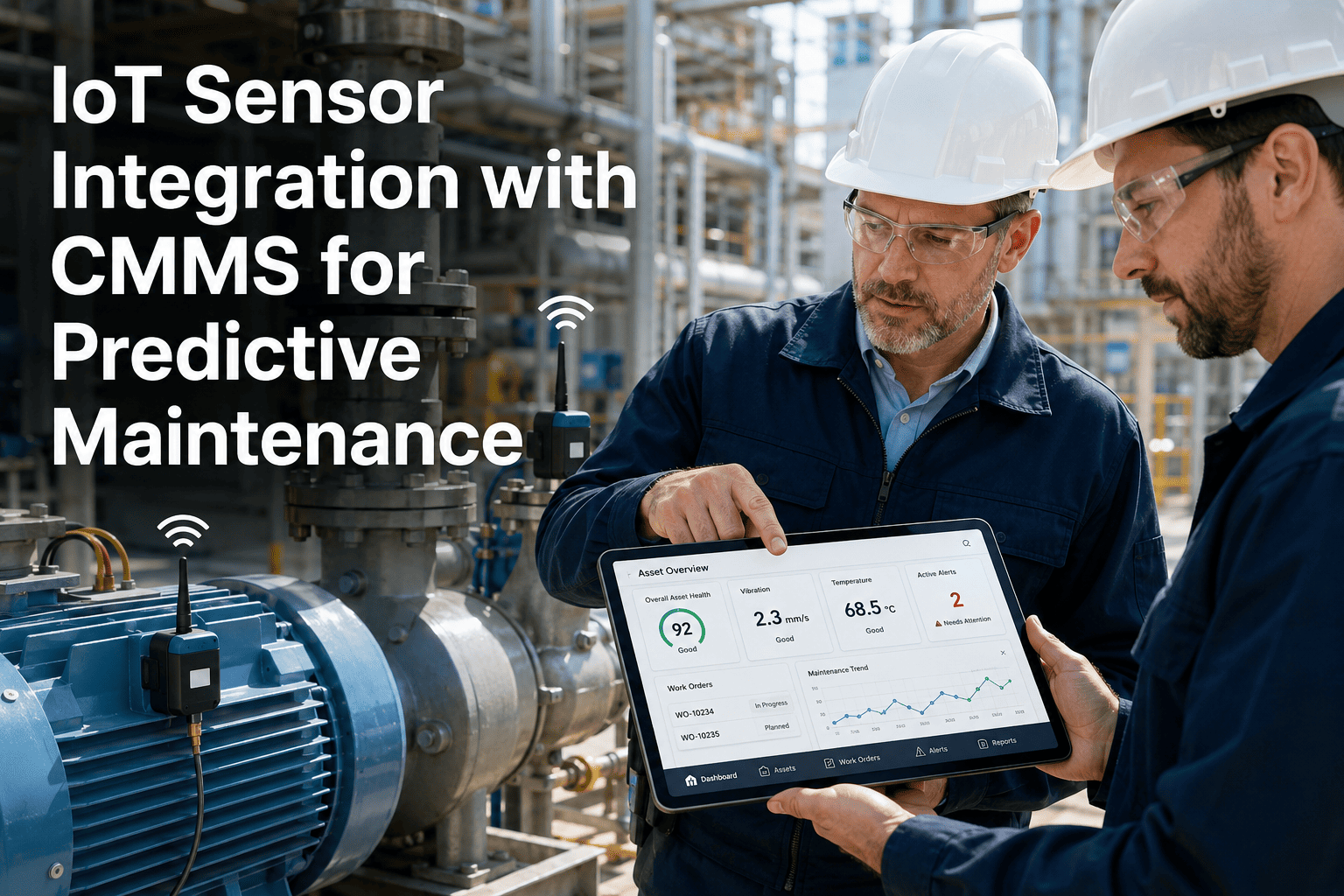
IoT sensors generate continuous streams of equipment health data — vibration frequencies, bearing temperatures, motor current draw, pressure differentials, and runtime hours. But raw sensor data sitting in a monitoring platform is not predictive maintenance. It is just data. Predictive maintenance only happens when that sensor data crosses a defined threshold and automatically triggers a work order assigned to the right technician, with the right parts staged, before the equipment fails. OxMaint's IoT integration connects sensor data directly to CMMS work order creation — so the gap between a sensor alert and a technician at the machine closes from days to minutes. This page covers how IoT-to-CMMS integration works technically, which sensor types it covers, what threshold logic looks like in practice, and what the operational outcomes are for teams that close the loop between monitoring and maintenance execution.
IoT SENSORS · PREDICTIVE MAINTENANCE · CMMS
Your sensors know the equipment is failing. Does your CMMS?
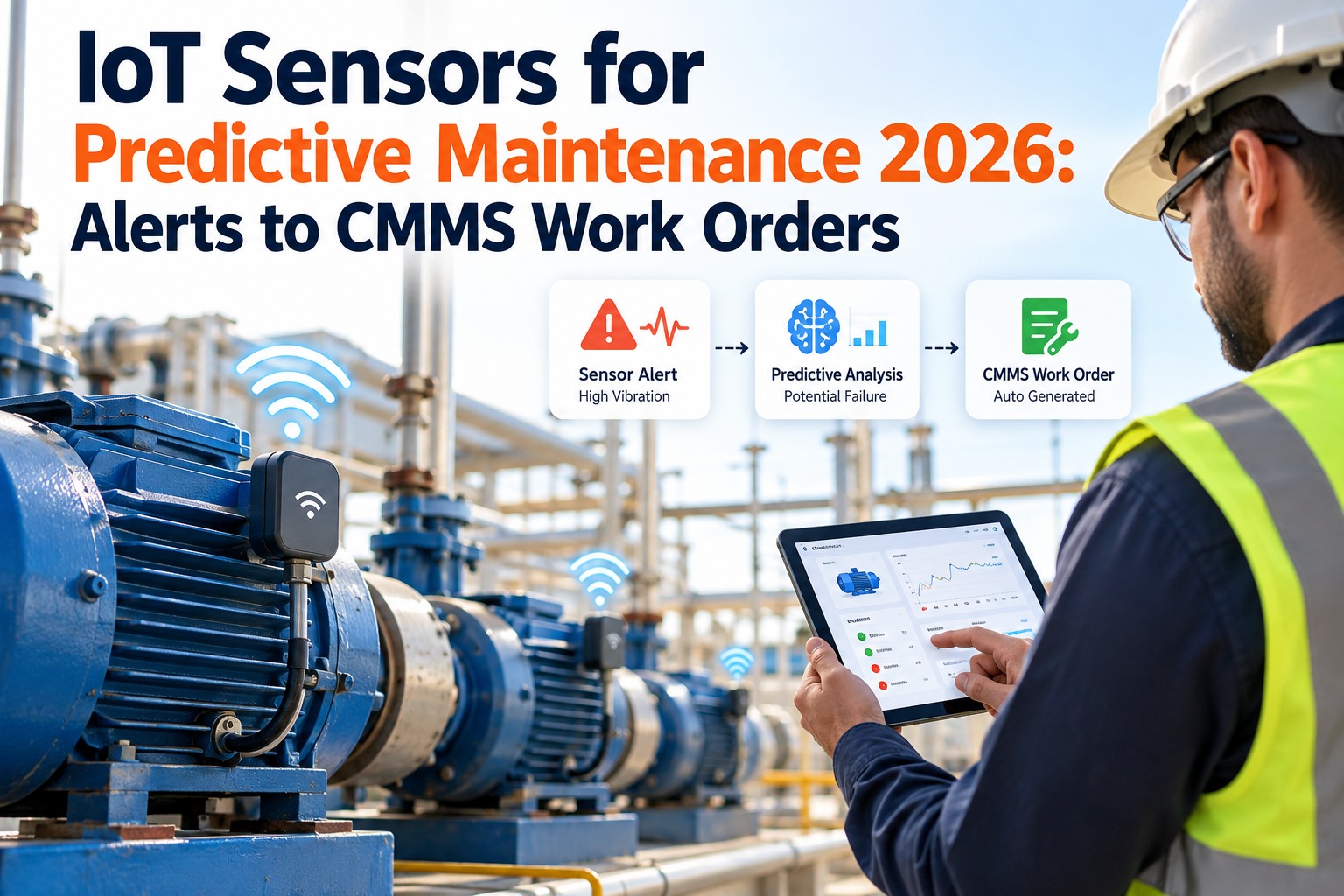
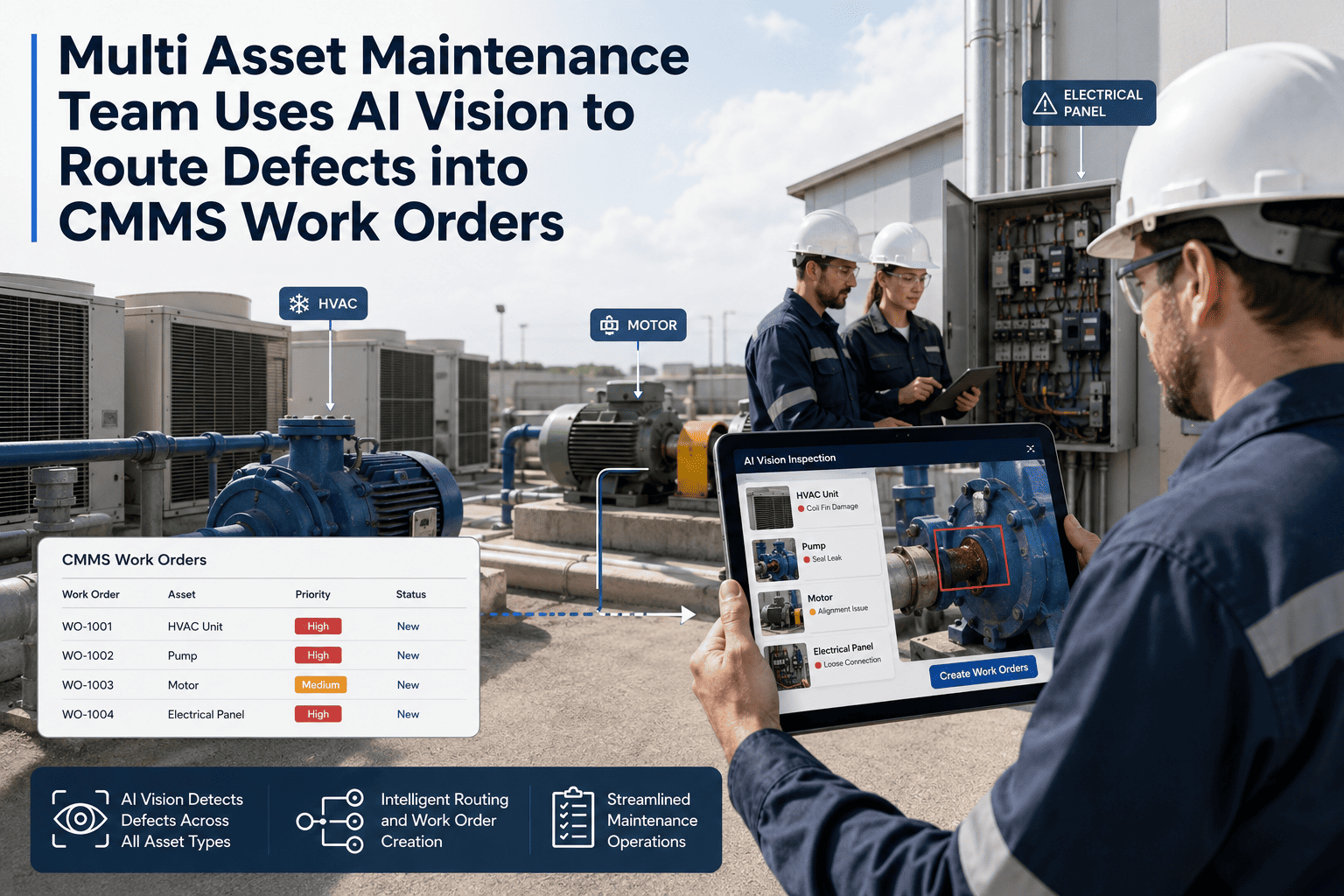
OxMaint connects IoT sensor thresholds directly to work order creation — so a bearing temperature spike becomes a technician assignment in minutes, not days after the failure.
SENSOR COVERAGE
Sensor types OxMaint integrates with for predictive triggers
Vibration
Rotating equipment: motors, pumps, fans, compressors. High-frequency vibration spikes indicate bearing wear, imbalance, or misalignment.
Temperature
Motor windings, gearboxes, bearing housings, electrical panels. Rising temps signal lubrication failure or electrical overload before visible damage occurs.
Pressure
Hydraulic systems, compressed air lines, pipelines. Pressure drops below threshold indicate seal failure, filter blockage, or flow restriction.
Current Draw
Electric motors and drives. Increased current draw indicates mechanical load increase — early sign of conveyor jam, pump cavitation, or drive failure.
Runtime Hours
Any motorized equipment. OxMaint triggers PM work orders automatically when runtime hours reach service interval — no manual scheduling required.
Flow Rate
Pumps, filtration systems, HVAC. Reduced flow against a set baseline triggers inspection work orders before downstream system degradation occurs.
HOW THE INTEGRATION WORKS
From sensor reading to completed work order — the full loop
1
Sensor reads and transmits
Sensor reads equipment parameter every set interval — typically every 1 to 60 seconds depending on sensor type. Data streams to your IoT platform or directly to OxMaint via MQTT or REST webhook.
2
Threshold evaluation
OxMaint evaluates each reading against asset-specific thresholds you define: alert level, warning level, and critical level. Multi-condition logic is supported — e.g., vibration AND temperature both elevated triggers a different priority than one alone.
3
Automatic work order created
When threshold is breached, OxMaint creates a work order automatically: correct asset, correct failure mode, correct priority, and pre-populated with the last sensor readings so the technician arrives with context already in hand.
4
Technician assigned and notified
OxMaint assigns the work order to the right technician based on availability, skill, and location. Mobile push notification goes out immediately — no supervisor intervention required for routine threshold-triggered work.
5
Sensor data attached to asset history
Every sensor event, threshold breach, and resulting work order is stored against the asset's history. Over time, OxMaint builds an equipment health baseline that makes future threshold tuning more accurate.
MEASURABLE OUTCOMES
What teams achieve with IoT-to-CMMS integration running on OxMaint
| Metric |
Without IoT Integration |
With OxMaint IoT Integration |
| Time from fault to work order |
12 to 48 hours (manual reporting) |
Under 3 minutes (automatic) |
| Unplanned downtime events |
High — failures discovered after breakdown |
Reduced 40 to 60% within 6 months |
| PM trigger accuracy |
Calendar-based — service often over/under due |
Runtime-based — service triggers exactly on condition |
| Sensor alert response rate |
Low — alerts go to inboxes, not work orders |
100% of threshold breaches become tracked work orders |
| Maintenance cost per asset |
Higher — reactive repairs cost 3 to 5x more than planned |
Lower — planned interventions before failure |
Expert Review
Prashant Reddy — Reliability Engineering Lead, Process Industry
The gap between IoT monitoring and maintenance execution is where most predictive maintenance programs fail. You can have the best sensors in the world, but if the alert goes to an email inbox instead of a CMMS work order, nothing happens. OxMaint closes that gap natively — threshold breach becomes a work order automatically, and the sensor data travels with the work order so the technician knows the context before they touch the equipment.
SEE THE INTEGRATION LIVE
Book a demo — bring your sensor platform details
Tell us which IoT platform you use — Siemens MindSphere, PTC ThingWorx, AWS IoT, Azure IoT Hub, or your own MQTT broker — and we will show exactly how OxMaint connects and what threshold-to-work-order setup looks like for your equipment types.
FAQS
Common questions about IoT-to-CMMS integration
Which IoT platforms does OxMaint connect to?
OxMaint integrates with major IoT platforms via REST API and MQTT protocol, including AWS IoT Core, Azure IoT Hub, Siemens MindSphere, PTC ThingWorx, and Losant. For edge devices sending raw sensor data, OxMaint can receive MQTT messages directly without an intermediate IoT platform.
Book a demo and we will confirm connectivity for your specific sensor and gateway setup.
Can we set different thresholds for the same sensor type on different assets?
Yes. OxMaint manages thresholds at the individual asset level — not globally. A pump in a high-temperature environment has different normal vibration ranges than an identical pump in a cooler location. You set alert, warning, and critical thresholds per asset, and OxMaint evaluates each sensor reading against the specific asset's parameters.
Start a free trial to configure your first asset threshold set.
How does OxMaint avoid creating duplicate work orders when a sensor fires multiple alerts for the same event?
OxMaint uses configurable de-duplication logic. You define a cooldown window per asset and sensor type — for example, only create one work order per asset per 4-hour window for the same fault condition. If a sensor fires 20 alerts in 10 minutes for the same threshold breach, only one work order is created. Additional sensor readings during the cooldown period update the open work order's sensor data rather than creating new work orders.
Can we use historical sensor data to tune thresholds before going live?
Yes. OxMaint's integration team helps analyze historical sensor data during onboarding to establish realistic baseline thresholds. Rather than using generic industry defaults, your thresholds reflect actual equipment behavior in your operating environment — which significantly reduces false positives in the first months after go-live.
Request a threshold calibration consultation in your demo.
GET STARTED
Close the gap between your IoT sensors and your maintenance team
OxMaint connects sensor thresholds to work order creation automatically — so every fault gets a technician response, every threshold breach builds asset history, and your maintenance team stops reacting and starts predicting.

.png)

