Steel manufacturing operates at the extreme edge of industrial maintenance — blast furnaces running continuously for 15-20 year campaigns at 2,300 degrees Fahrenheit, electric arc furnaces cycling through 1,600C heats every 45 minutes, continuous casters processing 300 tons per hour of molten steel through precision-aligned molds, and hot rolling mills reducing 250mm slabs to 2mm coil at speeds exceeding 80 km/hour. A single unplanned stoppage on a continuous caster costs $180,000-$420,000 in lost production and potential equipment damage. A blast furnace unplanned shutdown — technically called a blowdown — can cost $5-15 million in restart expenses, lost production, and equipment repair. No other manufacturing environment combines this level of thermal stress, mechanical intensity, and continuous operation dependency. The maintenance challenge in steel is not complexity alone — it is that every maintenance decision carries consequences measured in hundreds of thousands of dollars, and every delay between condition detection and maintenance response compounds exponentially into larger failures. Bearing degradation that triggers a gearbox replacement if addressed at week two becomes a complete drive train replacement if ignored until week six. Roll surface defects that cause one heat of scrap if caught during roll change cause 40 heats of off-grade product if the roll continues beyond its optimal life. Generic CMMS platforms were never designed for these conditions — they cannot track refractory campaigns by furnace zone, manage mold lifecycles by heat count, optimize roll change scheduling by tonnage processed, or integrate real-time vibration data from harsh industrial environments. Oxmaint delivers steel-specific asset management with heat-environment support, production-based maintenance triggers, and IoT integration for the real-time condition monitoring that steel operations demand. The platform is built for environments where every maintenance decision has six or seven-figure consequences. See how it works for your mill — book a demo or start a free trial.
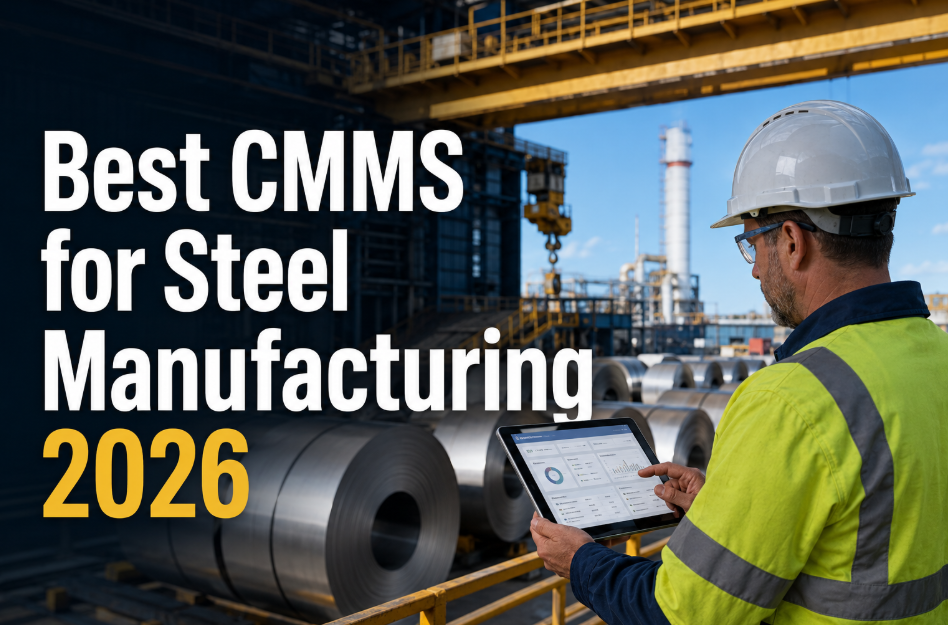
Best CMMS for Steel Manufacturing 2026: Blast Furnaces, Rolling Mills, Casters, and Beyond
Steel mill CMMS comparison covering blast furnace campaign management, EAF heat-based maintenance, continuous caster lifecycle tracking, rolling mill PM, roll shop management, and production-based scheduling for extreme heat environments. Built for operations where downtime is never cheap.
Steel-Specific CMMS for Extreme Environments
Oxmaint provides steel mill asset templates with heat-environment support, production-based triggers (heats, tons, cycles), refractory campaign tracking, and IoT integration for bearing temperature, vibration, and roll wear monitoring. Built for the conditions your equipment actually operates in — not the generic industrial assumptions that generic platforms make.
Why Steel Mills Cannot Use Generic CMMS Platforms
The gap between what generic CMMS platforms offer and what steel mills actually need is not a feature gap — it is a fundamental design philosophy gap. Generic platforms were built for environments where a missed PM results in a repair. In steel, a missed PM results in a blowdown, a caster breakout, or a mill fire. The consequences require an entirely different approach to maintenance management.
An EAF refractory requires inspection every 200 heats — not every 30 days. A plant producing 12 heats per day reaches 200 heats in 17 days. A plant producing 6 heats per day reaches it in 33 days. Calendar-based triggers applied to heat-based wear schedules result in either over-maintenance (wasting refractory) or under-maintenance (risking breakout). Generic CMMS platforms default to calendar triggers. Oxmaint tracks heats processed as a primary maintenance trigger.
Assets operating at 1,300-2,300F degrade through mechanisms — thermal fatigue, refractory spalling, oxidative corrosion — that have no equivalent in standard industrial environments. The CMMS must track temperature exposure history, thermal cycling count, and heat-related degradation indicators as primary asset condition metrics, not incidental data points.
Blast furnace campaigns run 15-20 years. EAF refractory campaigns run 200-800 heats. Caster mold campaigns run 500-1,200 heats. These are not annual maintenance cycles — they are asset lifecycles that require multi-year planning horizons, campaign-specific documentation, and post-campaign analysis that feeds back into future campaign optimization.
Steel production is a tightly coupled system — the BF feeds the steelmaking shop which feeds the caster which feeds the rolling mill. A maintenance window on any asset cascades backward and forward through the process. The CMMS must understand these interdependencies when scheduling maintenance to prevent situations where individual department PM plans create system-wide production conflicts.
Steel mills invest millions in online vibration monitoring, bearing temperature systems, and process control networks. Without CMMS integration, this data sits in separate systems that maintenance teams check reactively rather than automatically triggering work orders when thresholds are exceeded. The gap between detection and action is where equipment failures become catastrophic.
A blast furnace tuyere has a 6-12 week lead time. A continuous caster mold oscillator has an 8-16 week lead time. A rolling mill main reducer has a 24-52 week lead time. If the CMMS does not track these lead times against asset condition and trigger procurement before the need becomes urgent, mills face months of reduced capacity while waiting for critical components to arrive.
Critical Steel Mill Equipment and CMMS Requirements
Each major equipment category in a steel mill has distinct maintenance requirements, failure modes, and consequence profiles. Here is how Oxmaint structures maintenance for steel-specific equipment with industry templates, production triggers, and condition monitoring integration. Want to see these templates configured for your equipment? Book a demo or start a free trial.
Blast furnaces run continuously for campaigns of 15-20 years between major relines — the single longest continuous industrial operation in manufacturing. CMMS must track refractory wear by zone (hearth, bosh, belly, shaft), stave cooler condition and heat flux (with cooling water temperature differential data), tuyere wear and replacement tracking (each tuyere lasts 3-18 months depending on materials), hot blast system valve condition, cast house mud gun and drill equipment maintenance, and torpedo car maintenance for hot metal transport. Campaign-based maintenance planning — not annual budgets — drives BF maintenance strategy. The CMMS must support 20-year planning horizons with milestone-based PM scheduling that accounts for the furnace's position in its campaign lifecycle.
EAFs cycle between ambient and 1,600C every heat, creating extreme thermal fatigue on all components. CMMS must track refractory condition by number of heats (not calendar time — a high-production EAF making 20 heats per day ages refractory 4x faster than one making 5 heats per day), electrode consumption rates and stub loss monitoring, water-cooled panel leak detection history, transformer tap position history and bushing condition, hydraulic tilting system condition, fourth-hole elbow wear tracking, and delta closure mechanism maintenance. Heat-count triggers automate PM scheduling — every 200 heats for sidewall inspection, every 500 heats for bottom gunning evaluation, every campaign end for complete reline assessment.
Casters convert molten steel into solid slabs, blooms, or billets through water-cooled copper molds, segment roller systems, and secondary cooling zones operating at the boundary between liquid and solid steel. CMMS must track mold oscillation condition (stroke and frequency drift indicating wear), mold copper plate wear by grade and casting speed (stainless grades wear plates 40% faster than carbon grades), segment roller bearing temperatures across 12-20 segments each with 4-8 rollers, spray nozzle condition and flow rate by zone (plugged nozzles cause surface cracks), torch cutting equipment wear, and dummy bar condition. Mold lifecycle management — tracking heats cast by steel grade, oscillation cycles, dimensional wear at multiple measurement points — is critical for both quality and safety. A worn mold beyond its service limit creates breakout risk that destroys equipment and endangers personnel.
Hot rolling mills reduce steel thickness from 200-250mm slabs to 2-25mm plate or strip at speeds exceeding 80 km/hour through a series of rolling stands each containing work rolls and backup rolls. CMMS must track work roll wear profiles by stand position and steel grade (rolls in the finishing stands wear differently than roughing stand rolls), backup roll bearing condition, hydraulic gap control system performance (positional accuracy drift indicates hydraulic leakage or servo valve wear), looper tension control system, pinch roll condition, descaler nozzle wear and plugging, and coiler mandrel condition. Roll management is a specialized CMMS function unique to rolling operations — tracking individual roll campaigns, regrinding schedules, remaining diameter, and roll shop queue.
Cold rolling mills operate at speeds up to 2,500 m/min with roll forces exceeding 2,000 tons, requiring precision maintenance of hydraulic systems, roll chocks, work roll bending systems, and strip tension control. CMMS must track work roll surface condition (measured by roughness Ra and waviness Wa at the roll shop), backup roll bearing performance (temperature and vibration), tension roll bearing condition across the entire strip path, weld detector system calibration, strip threading system condition, and emulsion system filter and pump maintenance. Cold mill product quality — surface finish, flatness, thickness tolerance — is directly linked to the precision of maintenance on every roll and strip control system.
Steel ladles transport molten steel from the steelmaking furnace to the caster through 150-300 ton vessels lined with refractory. CMMS must track each ladle individually — refractory lining thickness by zone (using laser scanning or ultrasonic data), number of heats on current lining, temperature cycling history, slide gate mechanism wear (replaced every 15-25 heats), nozzle condition, ladle preheating schedule, and emergency repair documentation. Tundish management requires similar tracking with the addition of stopper rod condition and submergence entry nozzle wear by steel grade and casting speed. A ladle or tundish failure during casting is among the most hazardous events in steel manufacturing.
PM Triggering Methods: Why Steel Mills Need Production-Based Approaches
The maintenance triggering method is not a minor configuration choice in steel manufacturing — it is the fundamental factor that determines whether maintenance happens at the right time or the wrong time. Here is how different approaches perform in real steel environments and why hybrid production-condition triggering delivers the best outcomes.
| PM Trigger Type | How It Works | Steel Environment Effectiveness | Typical Result |
|---|---|---|---|
| Calendar-Based | Fixed time intervals regardless of production | Poor — completely ignores actual equipment wear | EAF refractory changed on 30-day schedule regardless of heats cast — wastes or under-serves based on production rate |
| Operating Hours | PM triggered by total hours equipment is running | Moderate — better than calendar but ignores severity | Rolling mill roll change every 500 hours regardless of tonnage — misses the critical tonnage-to-wear relationship |
| Production Count | PM triggered by heats, tons, coils, or cycles | Good — directly correlates to actual wear mechanism | Caster mold change every 800 heats regardless of grade mix — ignores that stainless processing wears plates 40% faster |
| Condition-Based | PM triggered by monitored condition indicators | Excellent — responds to actual equipment condition | Bearing replacement when vibration exceeds threshold — requires sensor investment and alert infrastructure |
| Hybrid (Oxmaint) | Production baseline with grade and condition adjustments | Optimal — most accurate PM timing for steel environments | Caster mold change at 800 base heats, adjusted to 560 heats when stainless grade proportion exceeds 40% of campaign |
Outage and Turnaround Planning: Where CMMS ROI Is Highest
Planned outages and turnarounds represent the highest-stakes maintenance events in a steel mill — compressed windows where months of deferred work, critical replacements, and inspection obligations must execute with military precision. A turnaround that runs 24 hours over schedule at an integrated mill costs $2-4 million in lost production. Effective outage management through Oxmaint is where the largest single-event ROI occurs. Ready to see turnaround planning configured for your mill? Book a demo or start a free trial.
Throughout the production campaign, all maintenance items requiring an outage are flagged and accumulated in the CMMS with estimated duration, required resources, and consequence-of-deferral ratings. At outage planning time, the complete scope is ranked by criticality and constraint dependencies. No scrambling to compile scope from email threads, maintenance logs, and verbal reports — the CMMS holds the complete picture, ready to export into the outage schedule.
Steel outage tasks have complex interdependencies — BF tuyere replacement cannot begin until the furnace is safely cooled; caster mold change cannot complete until the oscillation test is signed off; roll mill stand maintenance sequence determines which stands can be worked simultaneously and which must wait. The CMMS sequences tasks with dependency tracking and identifies the critical path — the sequence that determines total outage duration.
Major steel mill outages involve 100-500 contractors alongside plant maintenance staff — refractory crews, mechanical contractors, electrical teams, OEM specialists, and inspection firms. The CMMS manages contractor work assignments, safety documentation requirements, hot work permits, confined space entry logs, and completion tracking within the same system used for internal work orders. Contractor performance is documented for future vendor evaluation and invoice verification.
The outage work list generates a consolidated parts and consumables requirement — by item, quantity, delivery date, and staging location. Items with long lead times (16+ weeks for major components) are identified 6-12 months before the outage and procurement is tracked. The single most common cause of outage schedule overruns is missing or delayed parts. Structured pre-staging verification eliminates this failure mode by connecting the parts supply chain to the outage execution plan.
During the outage, every task is tracked against the planned schedule with real-time status updates from mobile devices. When tasks fall behind the critical path, the system identifies recovery options — parallel task sequencing, additional resource allocation, or scope reduction. Supervisors see the full outage status in real time rather than waiting for end-of-shift verbal reports that arrive too late to act on.
Every completed outage becomes a reference database for future outage planning — actual durations vs. estimated, resources used vs. planned, scope additions that emerged during execution, and findings that change future maintenance intervals. This learning loop improves each successive outage. Mills that maintain structured outage post-mortems in their CMMS consistently execute outages 15-20% faster than those that plan each event from scratch.
Steel mill maintenance operates in conditions that destroy generic CMMS assumptions — extreme heat, continuous operation, production-driven wear, campaign-based lifecycles, and consequences measured in millions per event. Oxmaint is built for these conditions with heat-environment asset templates, production-count triggers, IoT condition monitoring integration, and outage management tools that reduce turnaround duration by an average of 2.3 days. That is $4-9 million in recovered production value per outage at typical integrated mill rates.
Steel Mill CMMS and Compliance Requirements
Steel manufacturing operates under an extensive regulatory framework covering environmental emissions, worker safety, and process safety management. The CMMS must support compliance documentation across all applicable standards — not as an afterthought add-on, but as an integrated component of daily maintenance operations where compliance evidence builds automatically from normal work order completion.
Steel mills operate under EPA MACT standards for integrated iron and steel manufacturing (40 CFR Part 63 Subpart FFFFF), NESHAP for electric arc furnaces and argon-oxygen decarburization (Subpart YYYYY), and particulate matter controls for sinter plants and coke ovens. Equipment maintenance records for pollution control equipment — baghouses, electrostatic precipitators, scrubbers, and selective catalytic reduction systems — must demonstrate continuous operation and PM compliance. CMMS documents maintenance activities against specific regulatory requirements, creating audit-ready evidence packages.
Facilities handling molten metal at scale are subject to OSHA's Process Safety Management standard (29 CFR 1910.119) mechanical integrity provisions. This requires documented inspection and testing schedules for pressure vessels, piping systems, relief devices, safety instrumented systems, and emergency shutdowns. CMMS tracks mechanical integrity inspection intervals, documents findings and corrective actions, and produces the compliance records that OSHA inspectors evaluate during PSM audits.
Integrated mills operating captive limestone quarries or iron ore mines must comply with MSHA regulations including equipment examination requirements (mobile equipment daily inspections), electrical equipment maintenance, and ground control maintenance. CMMS manages examination records, documents equipment conditions, and tracks corrective actions — the same documentation that MSHA inspectors review during unannounced inspections.
Steel mills with ISO 14001 certification must demonstrate that maintenance programs for environmental control equipment meet documented performance standards. The CMMS provides the maintenance history, PM compliance rates, and equipment condition documentation that ISO 14001 auditors evaluate during certification and surveillance audits. Environment-tagged work orders ensure that environmental equipment maintenance receives appropriate priority and documentation depth.
CMMS Impact on Steel Mill KPIs
The financial case for steel-specific CMMS is among the strongest in any industry because the consequence of maintenance failures is so severe and so immediate. Here are the documented performance improvements that steel mills consistently achieve after deploying structured, industry-specific CMMS platforms with production-based triggers and condition monitoring integration.
Steel Mill CMMS Implementation: Getting From Zero to Operational
Steel mill CMMS implementations fail most often because they try to do everything at once — build a complete asset registry for 10,000+ components, configure all PM schedules, integrate all sensor systems, and train all users simultaneously. The implementation approach that works is disciplined sequencing that delivers operational value within 30 days while building toward full capability. Here is the phased approach that Oxmaint uses for steel mill deployments. Book a demo or start a free trial to discuss your implementation plan.
Configure asset records for the 20-30 highest-consequence assets first — the blast furnace or EAF, continuous caster, and primary rolling mill drives. Begin routing all maintenance requests for these assets through the CMMS. This delivers immediate value — every work order is now tracked, timestamped, and linked to an asset record — while keeping the initial scope manageable.
Build PM schedules for priority equipment with heat-count, tonnage, and operating-hour triggers. Import current campaign status data — how many heats on the current EAF lining, what tonnage is on the current mill rolls, when was the last caster mold change. The system immediately begins tracking progress toward next PM events and alerting when thresholds are approaching.
Expand the asset registry to cover all process areas — raw materials handling, ironmaking, steelmaking, casting, rolling, finishing, and utilities. Configure IoT data feeds from existing condition monitoring systems. Begin building the historical data that will improve PM timing predictions over the next 12-24 months of operation.
With work orders flowing and PM schedules active, transition the first major planned outage to CMMS-managed execution. This is where the investment in data quality pays the largest single dividend — a structured outage with CMMS scope management, critical path tracking, and parts pre-staging verification versus a whiteboard-and-spreadsheet outage. Most mills see 1-2 day duration reduction on their first CMMS-managed outage.
Frequently Asked Questions
Can Oxmaint handle the asset hierarchy complexity of a steel mill?
How does the platform handle production-count-based PM triggers for multiple steel grades?
Does Oxmaint integrate with steel mill Level 2 and SCADA systems?
Can we manage roll shop operations through the CMMS?
Protect Your Steel Mill Assets With Purpose-Built CMMS
Steel mill maintenance failures cost millions — sometimes in hours. Blast furnace blowdowns, caster breakouts, rolling mill fires. These events are not random — they are the predictable outcome of maintenance programs that cannot track the right metrics, trigger PM at the right time, or integrate the condition data that gives maintenance teams the warning they need to act before failure occurs. Generic CMMS platforms were not built for blast furnace campaigns, EAF heat cycles, caster mold lifecycles, or rolling mill tonnage-based wear. Oxmaint was. Deploy steel-specific maintenance management and start reducing the unplanned downtime that costs your mill $180,000-$420,000 per event — and the cumulative campaign damage that shortens equipment life by years.