Distribution centers and logistics operations run on throughput — every minute of conveyor downtime, every stalled sortation system, every failed dock leveler translates directly into missed shipping windows and customer penalties that compound through the entire supply chain. A single hour of sortation system failure during peak season can delay 12,000+ parcels and trigger $180,000 in contractual penalties before accounting for the downstream customer impact. Yet 62% of logistics facilities still manage maintenance through reactive phone calls, paper work orders, and whiteboard scheduling — accepting conveyor failures as inevitable rather than preventable. The logistics facilities that consistently hit 99.2%+ system uptime are the ones whose CMMS is connected to production counters on conveyor drives, cycle counts on sortation diverters, and door-cycle tracking on dock equipment. They schedule maintenance within narrow windows between shifts, track spare parts by facility zone, and give technicians mobile tools that work across 500,000+ square foot facilities with inconsistent wireless coverage. Platforms like Oxmaint provide logistics-specific configurations that generic CMMS platforms cannot match — conveyor system PM templates organized by drive type and belt section, sortation diverter maintenance triggered by actuator cycle count rather than calendar date, dock equipment lifecycle tracking by door-cycle accumulation, and multi-shift work order handoff visibility that ensures nothing falls between crews during 24/7 operations. The difference between a DC running 96% uptime and one running 99.2% uptime is not more technicians — it is smarter scheduling driven by production-linked maintenance intelligence. Ready to see what that looks like for your facility? Start a free trial or book a demo with our logistics operations team today.
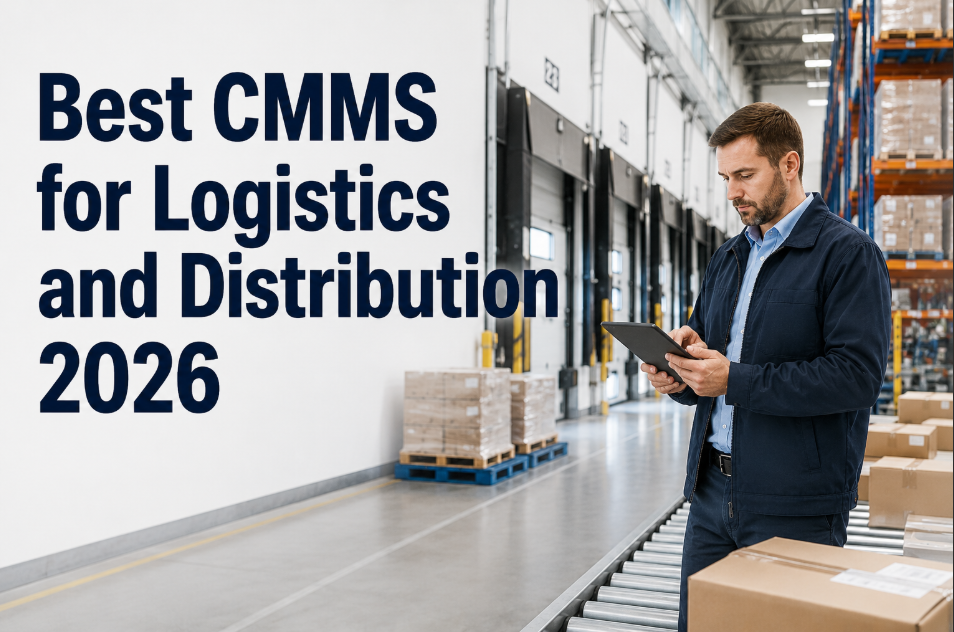
Best CMMS for Logistics and Distribution 2026
Distribution centers, sortation systems, conveyor networks, dock equipment, MHE fleets — the CMMS platforms built for 24/7 logistics throughput and the maintenance teams that protect it from unplanned stops.
Why Logistics Maintenance Is Uniquely Challenging
Distribution centers operate 20–24 hours per day, 6–7 days per week. Unlike manufacturing plants that schedule maintenance during planned shutdowns, logistics facilities have no natural maintenance windows — every hour of the day has throughput flowing through the system. A conveyor system spanning 3 miles of belt with 200+ drive units cannot be taken offline for scheduled maintenance during peak throughput windows. Sortation systems running 15,000 items per hour have diverter actuators cycling millions of times per year — and each diverter failure creates a mis-sort that cascades through downstream operations, corrupting orders and generating customer-facing shipping errors.
Dock levelers, overhead doors, and truck restraints cycle 80–200 times per day and represent the physical interface between your operation and every inbound and outbound truck. A failed dock position during peak receiving halts an entire inbound lane — 40+ trailers queued behind it, each carrying $200,000+ in inventory waiting to enter the DC. Material handling equipment fleets of 50–300 forklifts, reach trucks, and pallet jacks operate across multiple shifts with different operators, each accumulating runtime at different rates that calendar-based PMs cannot account for.
The CMMS that works in logistics must do four things simultaneously: schedule maintenance within narrow windows between shifts without impacting throughput, track equipment wear by operational cycles rather than calendar days, provide mobile work order management for technicians covering 500,000+ square foot facilities, and deliver multi-shift handoff visibility that ensures in-progress repairs are never lost between crews. Oxmaint is configured for exactly this operational intensity — explore how it maps to your DC by starting a free trial or booking a demo with our logistics team.
CMMS Requirements by Logistics Functional Area
Each functional area in a distribution center has distinct maintenance intensity, failure modes, and scheduling constraints. The right CMMS handles all of them with area-specific templates and production-linked triggers.
Miles of conveyor with hundreds of drive motors, idler rollers, belt tracking systems, and transfer points form the circulatory system of every DC. A single drive failure on a main trunk line stops product flow to every downstream zone. PM scheduling must track motor runtime hours and belt linear feet processed — eliminating calendar-based over-maintenance on low-throughput spur lines and under-maintenance on high-volume trunk conveyors running 20 hours per day. Belt tracking adjustments, drive motor bearing lubrication, and transfer point alignment are the PMs that prevent the $45,000-per-hour trunk line failures.
High-speed sortation systems represent the intelligence layer of logistics operations — directing parcels to correct lanes at rates of 200–400 diverts per minute. Diverter actuators cycle millions of times annually, accumulating mechanical wear that manifests as increasingly imprecise timing, mis-sorts, and eventually complete divert failure. Scanner calibration drift causes read failures that compound into manual sort labor. Induction belt tension loss reduces throughput by 8–15% before failure. PM intervals tied to sort volume thresholds — not calendar dates — catch degradation at the right moment across high-volume and low-volume sort positions.
Dock doors are the physical boundary between your controlled DC environment and every truck that arrives or departs. Each dock position cycles 80–200 times daily — leveler extension and retraction, overhead door open and close, restraint engagement and release, and dock seal compression. Hydraulic leveler systems require oil level checks, cylinder seal inspections, and lip hinge maintenance tied to cycle count rather than calendar date. A DC with 120 dock doors operating at different volumes needs position-specific PM schedules — high-volume receiving doors at 15,000-cycle intervals and low-volume shipping doors at 25,000-cycle intervals.
MHE fleets of 50–300 units run across 2–3 shifts daily with different operators, each accumulating runtime at different rates. A reach truck running receiving on first shift logs 6–8 runtime hours daily; the same model on outbound shipping logs 3–4 hours. Calendar-based PMs over-maintain the shipping unit and under-maintain the receiving unit. Runtime-hour-based PMs from telematics data ensure every unit is serviced at the right interval regardless of shift assignment. Battery management PMs for electric fleets — watering schedules, equalization charges, terminal cleaning — require separate tracking from mechanical PMs.
Cold storage DCs and temperature-controlled facilities require HVAC systems that maintain precise temperature zones — a 3°F deviation in a frozen food DC triggers product holds worth $500,000+. Dry sprinkler systems protecting high-rack storage require quarterly inspections per NFPA 25. High-bay lighting at 40+ feet requires scheduled maintenance coordinated with lift equipment availability — a maintenance window that must be pre-planned because it requires aerial lifts that are not always available on demand. Facility systems are lower-criticality than production systems but carry significant compliance and product quality exposure.
Automated storage systems represent the highest capital investment and the highest maintenance complexity in modern DCs. An AS/RS crane operating 20 hours per day at 100+ cycles per hour accumulates mechanical wear on rail wheels, hoist mechanisms, and positioning sensors at rates that require cycle-count-based maintenance rather than time-based intervals. Shuttle systems with 50–200 shuttles per aisle require fleet-level maintenance tracking similar to vehicle fleets — individual shuttle runtime, charge cycles, wheel wear, and communication system health all tracked independently.
The 10 CMMS Capabilities Every Logistics Operation Needs
These capabilities separate logistics-ready CMMS from generic platforms that fail under the intensity, scale, and scheduling constraints of 24/7 distribution operations.
Pre-built PM procedures for major conveyor manufacturers — drive motor, belt, roller, idler, and transfer point inspections with production-linked frequency triggers. Templates organized by conveyor type: belt, roller, accumulation, and sortation.
Diverter actuator cycle counts tracked via PLC integration — PM work orders auto-generated at configurable thresholds per diverter type and position. High-volume positions serviced more frequently than low-volume ones automatically.
In-progress work orders visible across shifts in real time. Incoming crew sees open repairs, pending parts, partial diagnoses, and incomplete PMs without relying on verbal handoff or paper shift logs. Digital shift notes linked to specific assets.
PMs scheduled within defined maintenance windows between shifts — the system prevents scheduling during peak throughput hours and concentrates work in available gaps. Window definitions configurable by day of week and season for peak adjustment.
Digital pre-shift inspection forms for forklifts, reach trucks, and powered equipment — OSHA-compliant, timestamped, digitally signed, and stored permanently. Defect items auto-generate maintenance work orders immediately. Zero paper forms.
Inventory organized by facility zone — conveyor belts stocked near conveyor systems, dock seals near dock areas, forklift tires near MHE charging stations. Minimum stock levels set by zone criticality and lead time, not just part cost.
Full work order management on mobile — receive assignments, view asset history, scan barcodes, capture photos, log labor, close work orders — all offline in areas with poor wireless coverage. Auto-sync when connectivity returns. Zero data loss.
Portfolio-level dashboards for logistics companies operating 5–50+ DCs — uptime, PM compliance, cost-per-square-foot, work order backlog, and OSHA compliance compared across all facilities simultaneously. Regional manager views built in.
Outsourced maintenance work orders tracked in the same system as in-house — vendor name, scope, cost, and completion documentation in the permanent asset record. Side-by-side cost comparison between in-house and contracted repair types.
Connect conveyor drive sensors, sortation PLC counters, dock door cycle monitors, and MHE telematics through IoT gateways — feeding real-time production data into the PM trigger engine for condition-based work order generation.
Reactive DC Maintenance vs Oxmaint-Powered Operations
Two DCs. Same size. Same throughput. Same equipment age. Different maintenance approach. Dramatically different outcomes.
A Day in the Life: Logistics Maintenance With Oxmaint
Tracing a single maintenance technician through an 8-hour shift in a 600,000 sq ft distribution center using Oxmaint — vs the same shift without it.
Technician opens Oxmaint mobile app while walking to the floor. Digital shift log shows: conveyor drive #127 had a belt tracking alarm at 2:14 AM (night crew adjusted but flagged for monitoring), dock door #34 has a hydraulic leak (parts on order, arriving today), and 3 PM work orders are due today — all pre-loaded with asset location, procedures, and parts lists.
12 forklifts require pre-shift inspection before operators can start. Digital OSHA checklists completed on tablet — 8 pass clean, 4 have minor findings (tire wear, horn volume). 1 forklift flagged with hydraulic leak — auto-generated work order created immediately, forklift removed from available pool, operator reassigned to spare unit. All completed in 20 minutes vs 45 minutes on paper.
Oxmaint generated this work order at 4:22 AM when diverter position #47 crossed 500,000 actuator cycles. Technician scans QR code on the diverter — full maintenance history loads instantly showing last 3 service events and the specific actuator model installed. Replacement actuator pre-staged at sortation zone parts cabinet. PM completed in 25 minutes during the 30-minute shift gap between night outbound and morning inbound sort. Zero throughput impact.
Drive motor on trunk conveyor section C-14 trips on overload. PLC sends alert through IoT gateway — Oxmaint auto-creates HIGH priority work order. Push notification reaches nearest qualified technician (our technician is 200 feet away). Asset history shows this motor was flagged for elevated vibration at last PM. Replacement motor available in zone C parts cabinet. Motor swapped in 35 minutes — vs 2+ hours if technician had to be located by radio and parts retrieved from central cage.
Parts for dock #34 hydraulic repair arrived at 10 AM (purchase order auto-triggered 2 days ago when the leak was reported). Technician completes seal replacement during receiving lunch break — dock offline for 45 minutes, zero trailer queue impact. Before/after photos captured on mobile. Work order closed with hydraulic pressure test reading documented.
All 7 work orders (3 scheduled PMs, 1 OSHA-generated forklift repair, 1 emergency conveyor drive, 1 dock hydraulic repair, 1 sortation diverter) completed and closed on mobile. Photos attached. Labor hours auto-calculated. Parts consumption logged. Shift notes for incoming crew entered against specific assets. Technician clocks out — zero post-shift paperwork. 7.2 hours of productive wrench time out of 8-hour shift.
What Distribution Centers Achieve With Oxmaint
Frequently Asked Questions
Can Oxmaint handle maintenance across multiple distribution centers simultaneously?
How does Oxmaint integrate with warehouse management systems and conveyor PLCs?
How do technicians use Oxmaint effectively in a 500,000+ square foot DC with poor wireless coverage?
What is the implementation timeline for a distribution center going live on Oxmaint?
Every Parcel That Ships On Time Starts With Equipment That Runs On Time.
Conveyor downtime, sortation failures, dock equipment breakdowns, and forklift out-of-service events are not inevitable — they are preventable with production-linked maintenance scheduling, zone-stocked spare parts, and mobile tools that work everywhere in your facility. Oxmaint gives your DC the cycle-based PM triggers, multi-shift handoff visibility, and OSHA-compliant inspection workflows that keep throughput flowing during every shift of every day. Most DCs see measurable uptime improvement within 60 days of adoption.

.png)


