Utilities teams managing water treatment plants, power distribution networks, and gas infrastructure face a common challenge: equipment failures that sensors saw coming but maintenance teams never acted on. OxMaint's IoT and sensor integration bridges that gap — connecting live field sensor data directly to your work order system so anomalies become actions, not reports. Whether you're monitoring pump vibration, pressure transducers on distribution mains, or temperature sensors across substations, the right CMMS translates raw telemetry into scheduled interventions before a $300 valve replacement becomes a $180,000 emergency repair. This guide compares the best IoT-connected CMMS platforms for utilities teams in 2026, covering real integration depth, not just checkbox features. Book a free demo to see how OxMaint connects to your existing sensor infrastructure without any custom development.
IoT & Sensor Integration · Utilities CMMS 2026
Best IoT / Sensor Integration Software for Utilities Teams in 2026
Stop reading sensor dashboards. Start converting anomalies into work orders automatically — before failure, not after.
68%
of utilities equipment failures show sensor warning signs 2–4 weeks before breakdown
$2.4M
average annual savings from IoT-enabled predictive maintenance per mid-size utility
41%
reduction in unplanned downtime reported after deploying sensor-integrated CMMS
Why IoT Integration Is Now Non-Negotiable for Utilities
Utilities infrastructure is aging. The average water main in the US is 45 years old. Substations are running equipment well past design life. Sensor networks were installed to provide visibility — but without a CMMS that acts on sensor data, teams end up with dashboards and alerts they cannot respond to fast enough.
Without IoT-CMMS Integration
Sensor alerts go to dashboards, not work orders
Engineers manually check 40+ feeds each shift
Failures diagnosed after they occur
Maintenance crews dispatched on calendar schedules
No audit trail linking sensor data to repair outcomes
With Full IoT-CMMS Integration
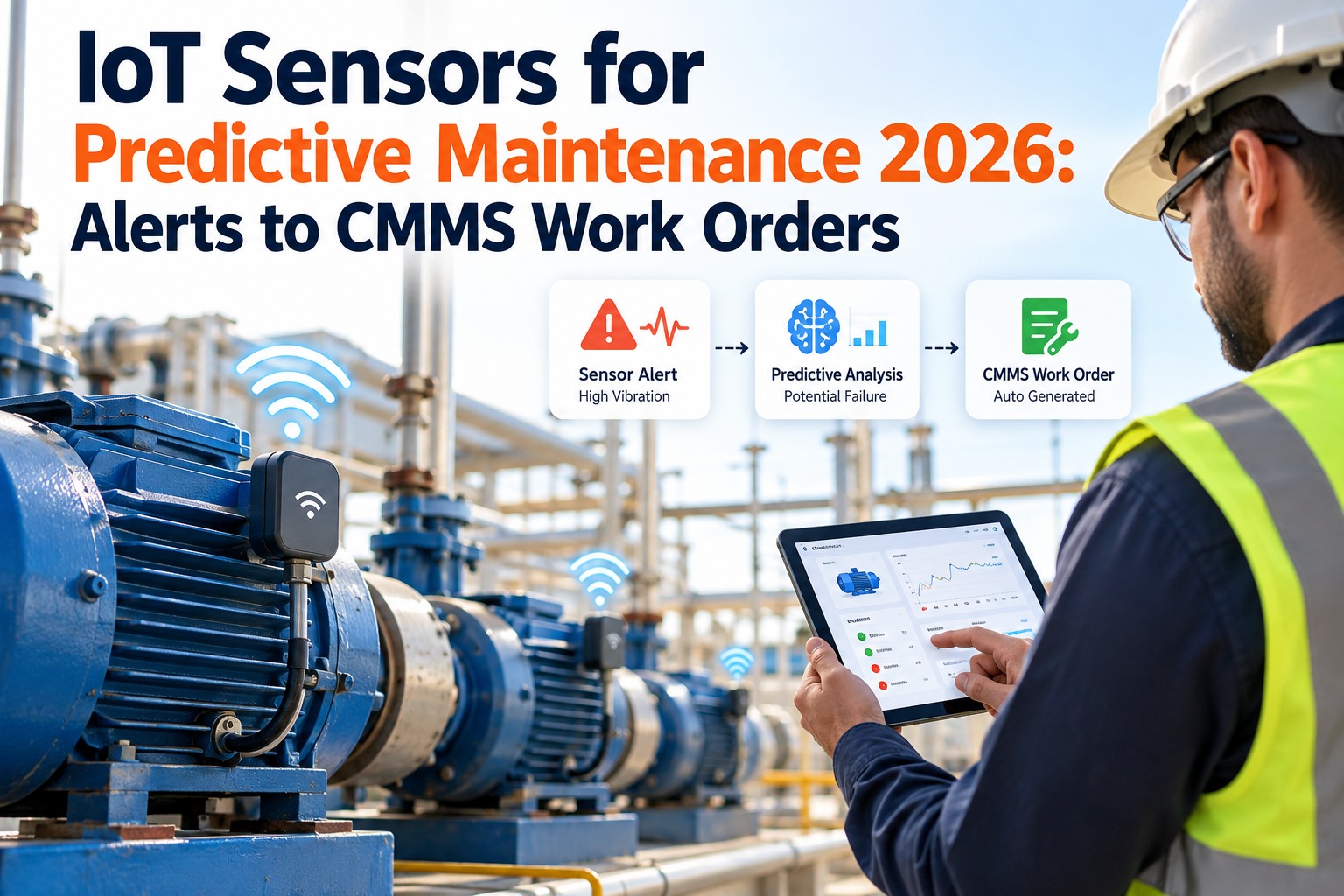
Threshold breach → work order created automatically
Asset-level context attached to every alert
Degradation trends visible 2–4 weeks before failure
Maintenance triggered by condition, not calendar
Sensor readings linked to repair history for AI learning
Top IoT-Integrated CMMS Platforms for Utilities Teams — 2026 Comparison
| Platform |
IoT Protocol Support |
Auto Work Order from Sensor |
Utility-Specific Assets |
Mobile Field App |
Pricing Tier |
| OxMaint |
MQTT, OPC-UA, REST, Modbus |
Yes — threshold-triggered |
Pumps, valves, meters, substations |
iOS + Android offline |
Mid-market |
| IBM Maximo |
OPC-UA, REST |
Via add-on module |
Broad (complex setup) |
Yes |
Enterprise |
| Infor EAM |
REST, JDBC |
Rules-based (manual config) |
Water, power, gas |
Limited |
Enterprise |
| UpKeep |
REST API only |
Partial (webhook required) |
General assets |
Yes |
SMB |
| Fiix |
REST API |
No native auto-trigger |
General assets |
Yes |
SMB–Mid |
| Prometheus Group |
SAP-native, OPC |
Via SAP integration |
Utility-optimized |
Yes |
Enterprise |
OxMaint IoT Integration: How It Works for Utilities
1
Connect Your Sensor Network
OxMaint connects to SCADA systems, PLCs, IoT gateways, and smart meters via MQTT, OPC-UA, Modbus TCP, and REST APIs. No middleware required. Typical utilities deployment connects in under 2 days.
2
Map Sensors to Asset Hierarchy
Each sensor tag is mapped to a specific asset — pump 4B at Station 12, not a flat data feed. Asset history, maintenance records, and live readings are unified in one view per piece of equipment.
3
Set Thresholds and Trigger Work Orders
Define advisory, warning, and critical thresholds per parameter. A pressure drop below setpoint on a distribution main auto-generates a work order, assigns the right crew, and attaches the sensor trend — before the shift ends.
4
Learn and Improve Over Time
When technicians close work orders with failure codes, OxMaint correlates the sensor pattern to the confirmed fault. Over 6–12 months the system's early detection accuracy improves, reducing false positives and missed catches alike.
See OxMaint connect to your sensor infrastructure live
Our engineers will map your sensor tags to assets and demonstrate automatic work order creation in a 30-minute session tailored to your utility type.
Sensor Categories Utilities Teams Monitor with OxMaint
01
Vibration & Acoustics
Pump cavitation, bearing wear, motor imbalance — vibration FFT signatures trigger inspection work orders before mechanical failure.
02
Pressure & Flow
Distribution mains, filter headers, and valve actuators. Pressure drop anomalies linked directly to leak detection and isolation work orders.
03
Temperature
Transformer windings, motor stators, switchgear — rising temperature trends flag thermal degradation weeks before a tripped breaker.
04
Water Quality
pH, turbidity, chlorine residual, and conductivity sensors connected to compliance-triggered work orders and regulatory reporting logs.
05
Electrical Parameters
Current draw, power factor, and harmonic distortion on distribution equipment — deviations linked to asset-level maintenance records.
06
Tank & Level
Storage reservoirs, surge tanks, and wet wells. Level sensor trends trigger pump maintenance work orders and capacity alerts automatically.
Expert Review
DR
David Reuben, P.E. — Utility Asset Management Consultant, 22 years in water and power infrastructure
"The gap I see most often isn't sensor coverage — utilities have invested heavily in instrumentation. The gap is that sensor data lives in SCADA and maintenance lives in spreadsheets. A CMMS that genuinely ingests sensor telemetry and generates condition-based work orders closes that loop. OxMaint's threshold-to-work-order pipeline is the closest to a turnkey solution I've seen for mid-tier utilities who can't afford a full Maximo deployment with a 12-month integration project."
Independent assessment. No paid endorsement.
Frequently Asked Questions
Does OxMaint work with our existing SCADA system without replacing it?
Yes — OxMaint reads from your existing SCADA or IoT gateway via standard protocols (MQTT, OPC-UA, REST, Modbus) in a read-only integration that requires no changes to your control infrastructure. Your SCADA remains the system of record for process control; OxMaint uses the data to drive maintenance actions.
Book a demo to walk through your specific SCADA setup with our integration team.
How are false alarms handled so maintenance crews aren't overwhelmed?
OxMaint uses load-adjusted baselines, not static thresholds — so an alert at peak demand doesn't trigger at off-peak. Advisory, warning, and critical tiers allow teams to filter what generates a work order versus what goes to a monitoring queue. Over time, technician feedback on work order outcomes trains the system to reduce repeat false positives on each specific asset.
Start a free trial to configure thresholds for your fleet.
Which utility types does OxMaint support out of the box?
OxMaint ships with asset templates and sensor parameter libraries for water and wastewater treatment, electrical distribution, gas distribution, and stormwater systems. Each template includes standard failure modes, PM schedules, and recommended sensor thresholds calibrated to utility operating conditions — so deployment starts from a vetted baseline rather than a blank screen. Contact us to discuss your specific infrastructure.
What ROI timeline should a utilities team expect?
Most utility teams see their first confirmed early-detection catch within 60–90 days of sensor connection. Measurable reduction in unplanned downtime typically appears in the 6–9 month window as condition-based work orders replace reactive emergency calls. Full ROI payback on a mid-size utility deployment averages 11–14 months based on avoided repair costs and regulatory penalty avoidance.
Book a demo to model ROI for your asset base.
Your sensors are already detecting the next failure. Is your CMMS acting on it?
OxMaint connects sensor data to work orders automatically — so your team responds before failures, not after. Start free or see a live integration demo.