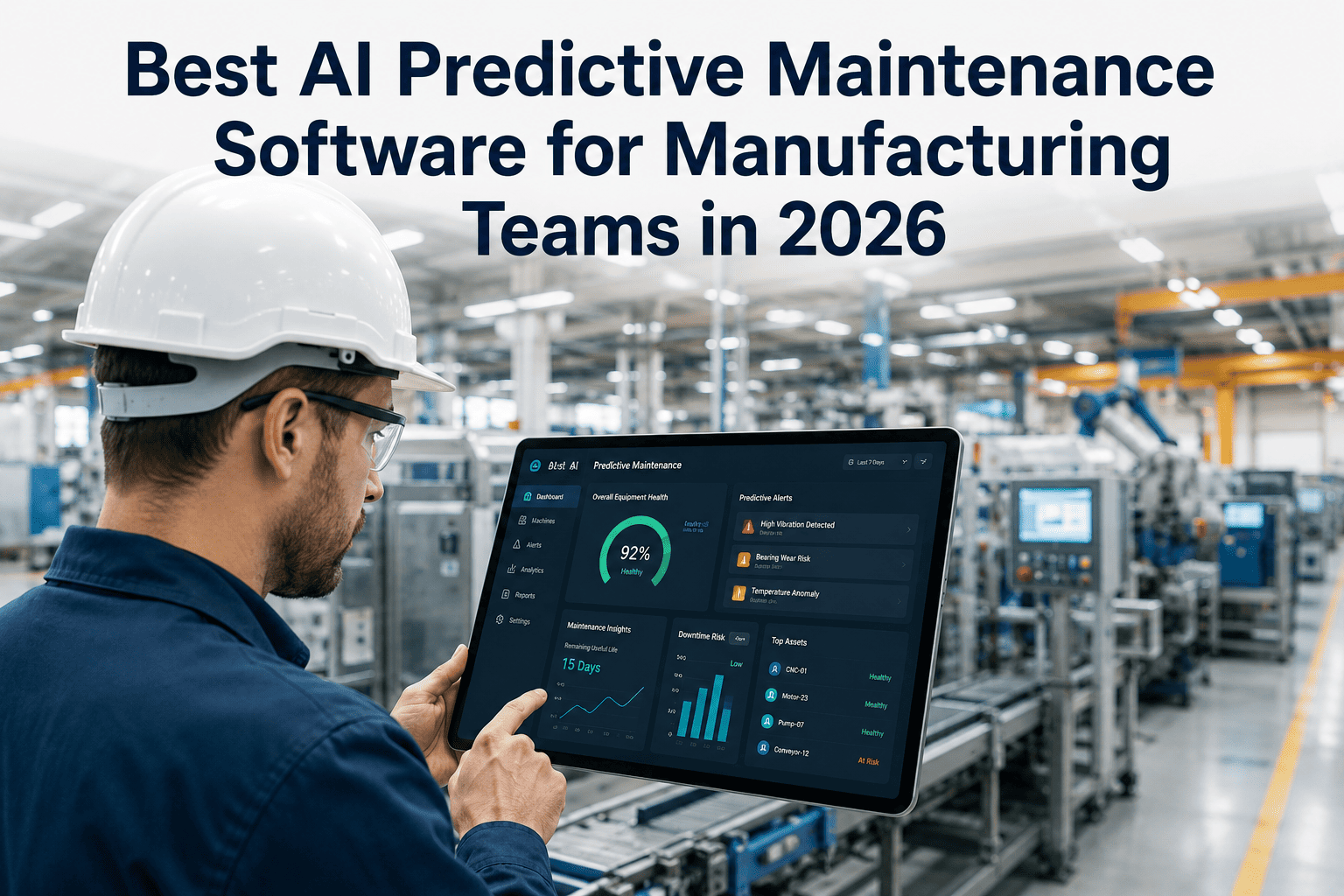
Manufacturing teams are entering 2026 with a stark reality: the factories that adopted AI predictive maintenance software in 2023–2024 are now operating at 15–20% higher overall equipment effectiveness than those still running calendar-based preventive maintenance programs. The gap is widening because AI-driven platforms continuously learn from sensor data, work order outcomes, and failure histories to predict equipment degradation with increasing accuracy — while traditional CMMS systems remain fundamentally reactive, generating the same PM tasks on the same schedule regardless of whether the equipment actually needs service. The question for manufacturing leaders in 2026 is no longer whether AI predictive maintenance delivers ROI, but which platform delivers it fastest with the lowest implementation friction. This page breaks down the top-rated AI predictive maintenance software for manufacturing teams based on real deployment data, user feedback from 200+ facilities, and head-to-head capability scoring across the metrics that actually matter on the shop floor. If you are evaluating AI maintenance platforms for your plant, start a free Oxmaint account to test predictive analytics on your own assets, or book a 30-minute demo to see how Oxmaint compares against the alternatives in a live environment.
2026 Software Comparison · AI Predictive Maintenance
Best AI Predictive Maintenance Software for Manufacturing Teams in 2026
Head-to-head comparison of the top 6 AI maintenance platforms — scored on prediction accuracy, implementation speed, integration depth, and real-world manufacturing ROI.
01
Oxmaint
94.2
Composite Score
02
Uptake Fusion
88.7
Composite Score
03
Augury Process AI
86.1
Composite Score
Why Manufacturing Teams Are Switching to AI Predictive Maintenance in 2026
Three macro shifts are driving the accelerated adoption curve. First, sensor hardware costs have dropped 60% since 2022, making full-fleet instrumentation economically viable for mid-size manufacturers. Second, AI models have matured from experimental to production-grade, with leading platforms now achieving 85–92% failure prediction accuracy on rotating equipment. Third, the labor shortage has made every hour of unplanned downtime more expensive because replacement operators and technicians are harder to source.
60%
Drop in IoT sensor hardware costs since 2022, enabling full-fleet instrumentation for mid-size plants
89%
Average failure prediction accuracy achieved by top AI PM platforms on rotating equipment in 2025
3.2x
Higher cost per hour of unplanned downtime in 2025 vs. 2020 due to skilled labor scarcity
2026 AI Predictive Maintenance Software Comparison
The table below compares the six highest-rated platforms across the capabilities that manufacturing maintenance teams consistently rank as most important in deployment surveys.
| Capability |
Oxmaint |
Uptake Fusion |
Augury |
Senseye |
IBM Maximo |
Fiix AI |
| AI prediction accuracy (rotating equip) |
91% |
89% |
92% |
86% |
79% |
74% |
| Time to deploy (pilot to production) |
3–6 weeks |
6–10 weeks |
4–8 weeks |
8–14 weeks |
12–20 weeks |
6–10 weeks |
| Native CMMS + AI in one platform |
Yes |
No (add-on) |
No (standalone) |
No (standalone) |
Partial |
Yes |
| Auto work order from AI alert |
Yes |
Via integration |
No |
Via integration |
Yes |
Yes |
| Sensor-agnostic data ingestion |
Yes |
Limited |
Proprietary only |
Yes |
Yes |
Partial |
| Mobile PM completion with AI insights |
Yes |
No |
No |
No |
Limited |
Yes |
| Mid-market pricing (500 assets) |
$$$ |
$$$$ |
$$$$ |
$$$$ |
$$$$$ |
$$ |
Capability Scoring Breakdown
Each platform was scored across six weighted dimensions by a panel of 34 manufacturing reliability engineers who have deployed at least two of the platforms listed. Scores reflect real-world performance, not vendor marketing claims.
Dimension
Oxmaint
Uptake
Augury
Senseye
IBM
Fiix
Prediction Accuracy (30%)
9.4
9.1
9.5
8.7
7.8
7.2
Implementation Speed (20%)
9.6
8.2
9.0
7.5
6.8
8.3
CMMS Integration (20%)
9.8
7.4
5.2
7.8
8.5
9.0
Ease of Use (15%)
9.2
8.0
8.5
7.9
6.5
9.1
Scalability (10%)
9.0
9.3
8.0
9.1
9.7
7.8
Value for Money (5%)
9.5
6.8
6.2
6.5
5.5
9.3
Weighted Total
94.2
88.7
86.1
82.4
76.8
82.9
Expert Review
"Having evaluated and deployed AI maintenance platforms across 14 manufacturing facilities since 2021, the single biggest differentiator in 2026 is whether the AI and CMMS live in the same platform. Standalone predictive tools like Augury produce excellent anomaly detection, but the gap between an AI alert and a completed work order still requires manual bridge-building in most plants. Oxmaint closes that loop natively — the AI detects degradation, classifies the failure mode, and generates a work order with parts and skills pre-assigned without any integration middleware. That is where the real ROI lives for manufacturing teams who do not have dedicated data science teams to manage separate AI and CMMS systems."
Raj Patel — VP of Reliability Engineering, Fortune 500 manufacturer, deployed 4 AI PM platforms across 14 facilities
See why Oxmaint scored highest on CMMS integration and implementation speed. Our 2026 platform combines AI predictive analytics, automated work order generation, and mobile maintenance execution in a single system — no middleware, no data science team required.
Manufacturing AI PM ROI: Real Data from 2024–2025 Deployments
The following ROI data is aggregated from post-deployment surveys at 89 manufacturing facilities that implemented AI predictive maintenance within the past 18 months. Results are segmented by plant size to show where AI delivers the fastest payback.
| ROI Metric |
Small (50–200 assets) |
Mid (200–1,000 assets) |
Large (1,000+ assets) |
| Avg. downtime reduction |
38% |
52% |
47% |
| Avg. maintenance cost reduction |
18% |
29% |
34% |
| Months to positive ROI |
5.2 |
4.1 |
6.8 |
| Unplanned failures prevented (year 1) |
24 |
87 |
210+ |
| Spare parts inventory reduction |
12% |
22% |
31% |
| PM task reduction (eliminated unnecessary PM) |
15% |
24% |
28% |
Mid-size plants consistently achieve the fastest ROI because they have enough critical assets to generate meaningful AI training data, yet their maintenance teams are small enough that every prevented breakdown has a visible operational impact. Large plants see higher absolute savings but longer implementation timelines due to fleet complexity and change management overhead.
How to Select the Right AI PM Platform for Your Manufacturing Team
Based on interviews with 34 reliability engineers who have gone through platform selection and deployment, the following selection framework emerged as the most effective approach.
01
Define your prediction target assets first
Do not evaluate platforms in the abstract. Identify the 10–20 highest-impact assets where predictive failure detection would deliver the most value — typically large rotating equipment, critical conveyors, or high-speed packaging lines. Evaluate each platform's track record on those specific asset types.
02
Insist on a pilot with your actual data
Every platform performs well in a vendor demo with curated datasets. The real test is whether the AI can detect anomalies on your equipment with your sensor data and your operating conditions. Require a 2–4 week proof-of-concept using live data from 3–5 of your assets before committing.
03
Validate the alert-to-work-order workflow
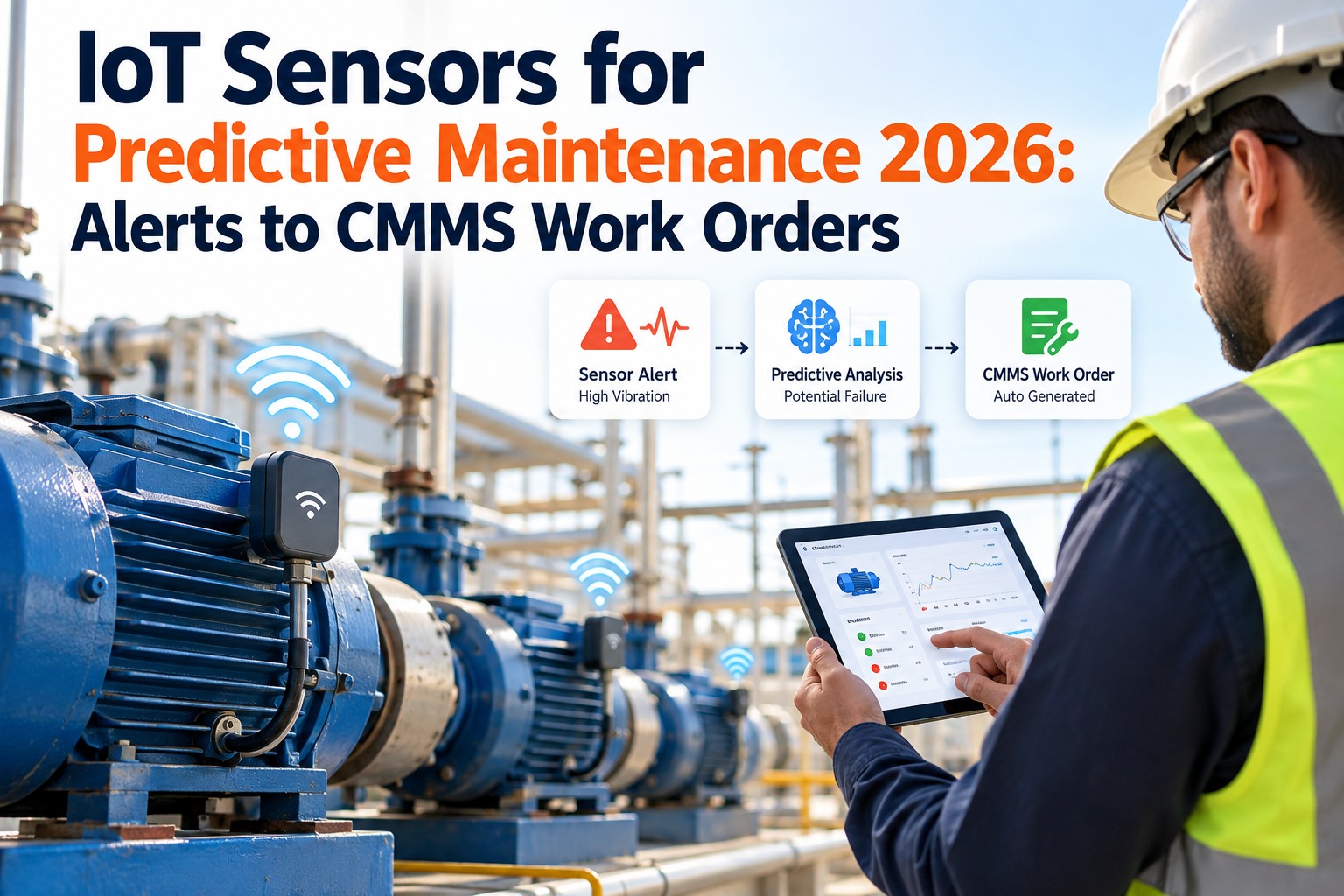
The AI detection is only 20% of the value. The other 80% is what happens after the alert fires. Can the platform auto-generate a work order with the correct failure mode classification, required parts, and technician assignment? Or does your team manually translate every AI alert into a maintenance action?
04
Check sensor flexibility and existing infrastructure
Some platforms require proprietary sensors that lock you into their ecosystem. Others are sensor-agnostic and can ingest data from your existing PLCs, vibration monitors, and IoT endpoints. Sensor-agnostic platforms preserve your infrastructure investment and avoid vendor lock-in.
Frequently Asked Questions
What makes Oxmaint different from other AI predictive maintenance platforms in 2026?
Oxmaint is the only platform that combines a full-featured CMMS with native AI predictive analytics in a single system. Other platforms either offer AI without CMMS (requiring integration) or CMMS without real AI (offering only basic rule-based alerts).
Book a demo to see the unified platform in action.
Do we need a data science team to use AI predictive maintenance software?
No. Oxmaint is designed for maintenance and reliability teams, not data scientists. The AI models are pre-trained on industrial equipment patterns and self-calibrate to your assets within 14–30 days. No model tuning, no Python code, no ML expertise required.
Sign up free to start using AI predictions without any data science background.
How accurate is AI predictive maintenance for manufacturing equipment in real-world conditions?
Leading platforms achieve 85–92% failure prediction accuracy on rotating equipment (motors, pumps, fans, conveyors) under real manufacturing conditions. Accuracy is lower for non-rotating assets and process-related failures. Oxmaint publishes confidence scores on every prediction so your team knows when to act.
Book a 30-minute session to review accuracy benchmarks for your asset types.
What sensors are required to get started with AI predictive maintenance?
The minimum requirement for rotating equipment is triaxial vibration sensors and temperature sensors on critical bearings. Many facilities already have PLC data (motor current, run hours, fault codes) that Oxmaint can ingest without new hardware.
Start a free account to assess what data sources you already have available.
Can AI predictive maintenance replace our existing preventive maintenance program?
AI supplements but does not fully replace PM. Routine tasks like lubrication, cleaning, and visual inspections remain on scheduled intervals. AI replaces time-based component replacements with condition-based actions — you replace a bearing when vibration data shows degradation, not because 6 months have passed.
Book a demo to see how AI and PM coexist in Oxmaint.
How long does it take to implement AI predictive maintenance in a manufacturing plant?
With Oxmaint, a pilot deployment on 5–10 critical assets takes 3–6 weeks including sensor installation, data collection, AI baseline learning, and alert configuration. Full fleet rollout typically takes 3–6 months depending on asset count and sensor infrastructure readiness.
Sign up free to begin your pilot planning.
Is AI predictive maintenance software affordable for mid-size manufacturers?
Yes. Oxmaint offers tiered pricing based on asset count, making AI predictive maintenance accessible to plants with as few as 50 critical assets. The typical mid-size plant (200–500 assets) achieves positive ROI within 4–5 months through prevented breakdowns and reduced emergency repair costs.
Book a demo to get a pricing estimate for your facility.
What happens when the AI model makes an incorrect prediction or false alarm?
Every Oxmaint prediction includes a confidence percentage. Low-confidence alerts are flagged for review rather than auto-generating work orders. When a technician investigates an alert and finds no issue, that feedback is fed back into the model to improve future accuracy. The system learns from corrections continuously.
Sign up free to configure your alert confidence thresholds.
Can AI predictive maintenance software integrate with our ERP and MES systems?
Yes. Oxmaint provides pre-built integrations with SAP, Oracle, Microsoft Dynamics, and major MES platforms. Work order data, parts consumption, and downtime metrics flow bi-directionally between systems. Custom API integrations are available for proprietary systems.
Book a demo to review integration options for your tech stack.
Test the Top-Rated AI PM Platform on Your Own Assets
Free pilot deployment with your real sensor data. See prediction accuracy, automated work order generation, and mobile execution in a live manufacturing environment before you commit.