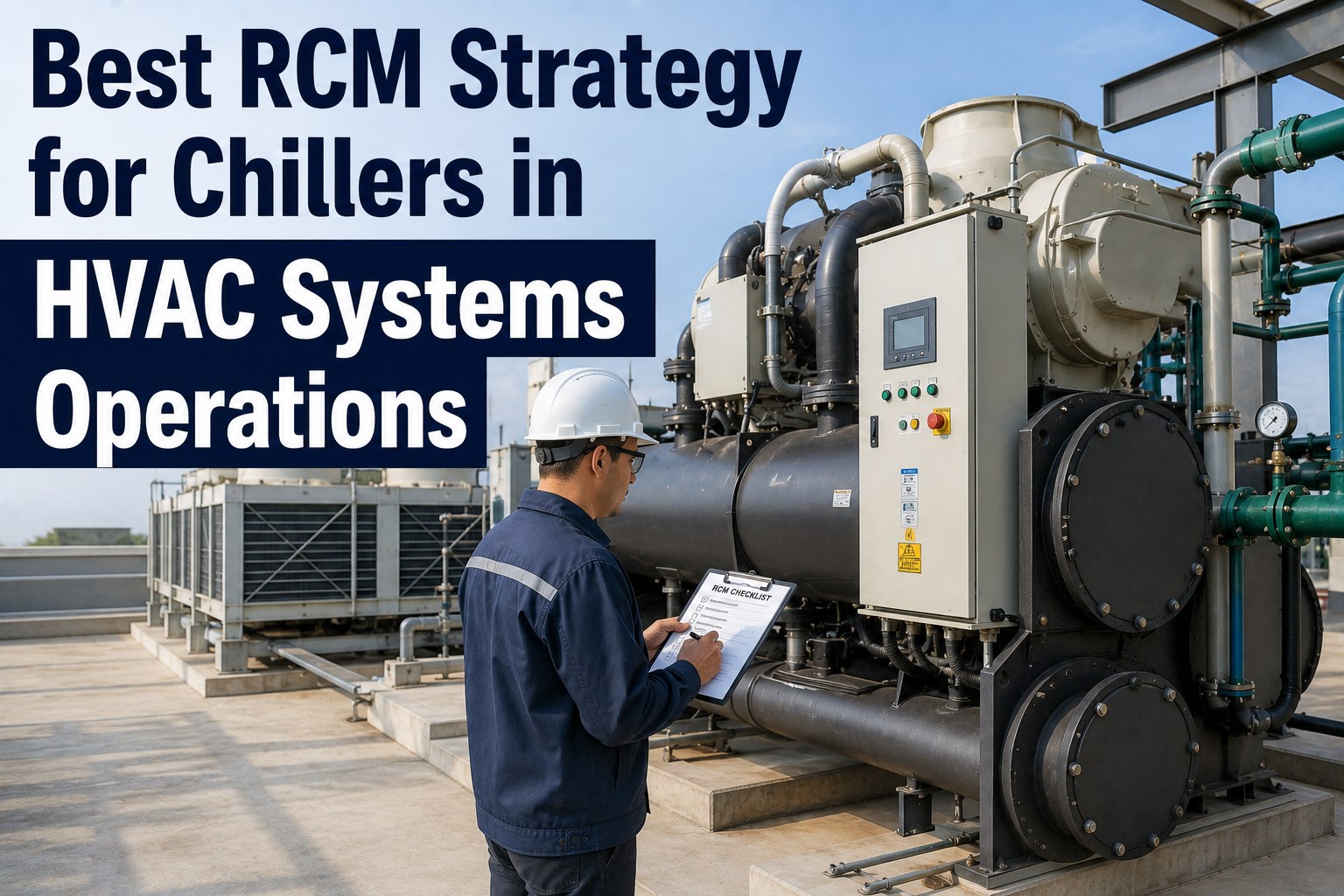
The best RCM strategy for chillers in HVAC & building systems pairs failure-mode-driven task selection with continuous condition monitoring — so compressors, condensers, and cooling towers get the right maintenance at the right interval instead of calendar-based guesswork. Reliability-centered maintenance for HVAC chillers typically cuts unplanned downtime 30–50% and extends asset life 20–40% by focusing effort on the failure modes that actually threaten cooling capacity, energy efficiency, and occupant comfort. This guide walks through the dominant chiller failure modes in HVAC & building systems, the monitoring techniques that catch them early, and a proven RCM task-selection framework you can deploy this quarter. OxMaint's AI-powered CMMS automates the entire RCM workflow — asset hierarchies, condition-based PM triggers, mobile work orders, and analytics that turn chiller telemetry into reliability decisions. Start Free Trial to see how it works on your equipment.
Stop reacting to chiller failures. Start preventing them with a failure-mode-driven RCM strategy.
Most HVAC & building systems teams lose 18–25% of cooling capacity to preventable chiller degradation — fouled condenser tubes, refrigerant leaks, bearing wear, and controls drift. RCM flips that: you map the failure modes that matter, assign the right monitoring or PM task to each, and automate execution so nothing slips.
Top 6 chiller failure modes in HVAC & building systems (and how to catch each one)
RCM starts with a Failure Modes and Effects Analysis (FMEA) — identifying how each chiller component can fail, what causes it, and what the consequence is. These six failure modes account for roughly 75–85% of unplanned chiller downtime in commercial and institutional HVAC systems.
Refrigerant Leaks
Gradual charge loss from vibration-loosened fittings, corroded evaporator tubes, or worn shaft seals. Drops cooling capacity 15–30% and spikes energy use 10–20% before comfort complaints surface. Detection: monthly refrigerant pressure/temperature logs, ultrasonic leak detection quarterly, automatic leak monitors for critical units.
Condenser Tube Fouling
Scale, biofilm, and sediment buildup on water-cooled condenser tubes increases approach temperature and forces compressors to work harder. A 1°F rise in condenser approach temp cuts efficiency ~1–2%. Detection: weekly approach temperature trending, annual eddy-current tube testing, water treatment monitoring.
Compressor Bearing Wear
Rolling-element or sleeve bearing degradation from lubrication breakdown, misalignment, or contamination. Leads to catastrophic compressor failure ($15K–$60K replacement). Detection: monthly vibration analysis (ISO 10816), oil analysis quarterly, acoustic monitoring for early-stage defects.
Electrical & Controls Drift
Sensor calibration drift, contactor wear, loose connections, and control valve stiction cause short-cycling, capacity hunting, and nuisance trips. Often misdiagnosed as mechanical faults. Detection: annual sensor calibration checks, thermographic scans of panels quarterly, trend analysis of kW/ton and cycling frequency.
Cooling Tower / Condenser Water Issues
Poor water chemistry, biological growth (Legionella risk), and scaling reduce heat rejection and accelerate corrosion. ASHRAE 188 compliance requires documented water management. Detection: continuous conductivity/pH monitoring, weekly biocide residual checks, quarterly Legionella testing, annual tower cleaning.
Oil System Contamination
Moisture, acid, or particulate in compressor oil degrades lubrication and damages bearings, seals, and rotors. Common after refrigerant leaks or improper evacuation. Detection: quarterly oil analysis (viscosity, acid number, moisture, wear metals), annual oil filter replacement, moisture indicator checks.
How to choose the right maintenance task for each chiller failure mode
RCM uses a decision tree to assign one of four task types to each failure mode: condition-based monitoring (CBM), scheduled restoration, scheduled discard, or failure-finding. The goal is to match task cost and frequency to failure consequence — not to over-maintain low-risk items or under-maintain critical ones.
Is the failure detectable before it happens?
If yes (vibration, temperature, pressure, oil quality trends show degradation), assign a condition-based monitoring task. Example: monthly vibration analysis on compressor bearings catches wear 4–8 weeks before failure, letting you plan repair during off-peak hours.
Does the component have a predictable wear-out age?
If yes, assign scheduled restoration or discard. Example: condenser tubes typically need cleaning every 12–24 months depending on water quality; oil filters every 12 months. Set the interval at ~80% of observed mean time between failures (MTBF).
Is the failure hidden or protective-function related?
If yes, assign a failure-finding task. Example: test high-pressure cutout switches and low-oil-pressure trips quarterly to ensure they function when needed. These protective devices sit dormant until a fault occurs — you must test them to know they work.
Is run-to-failure acceptable?
Only if the failure has no safety, environmental, or significant operational/economic impact. Example: a non-critical condensate drain valve on a small air-cooled chiller might be run-to-failure if replacement cost is low and downtime tolerable. Document the decision.
Real-world example: A 450-ton centrifugal chiller in a hospital had quarterly calendar-based PMs but still suffered two compressor failures in 18 months ($38K in emergency repairs). After RCM analysis, the team shifted to monthly vibration + oil analysis (CBM), annual eddy-current tube testing, and quarterly controls calibration. Result: zero unplanned failures in 3 years, 22% drop in kW/ton, and $14K/year saved in avoided emergency labor and energy waste.
Best monitoring techniques for HVAC chiller reliability
Condition-based monitoring is the backbone of RCM for chillers — it lets you detect degradation weeks or months before failure, so you can plan repairs during low-load periods instead of scrambling during a heat wave. Here are the five techniques that deliver the highest ROI for HVAC & building systems chillers.
| Technique | What It Detects | Frequency | Typical Cost | Failure Modes Caught |
|---|---|---|---|---|
| Vibration Analysis | Bearing wear, misalignment, imbalance, looseness | Monthly (critical), Quarterly (non-critical) | $150–$400/chiller | Compressor bearing failure, motor defects, coupling wear |
| Oil Analysis | Contamination, degradation, wear metals, moisture | Quarterly | $40–$80/sample | Bearing wear, seal leaks, refrigerant contamination, acid formation |
| Refrigerant Pressure/Temp Trending | Charge loss, fouling, expansion valve issues | Continuous (BAS) or Weekly (manual) | $0 (if BAS-equipped) or minimal labor | Refrigerant leaks, condenser fouling, evaporator fouling, TXV stiction |
| Thermography (IR) | Electrical hot spots, bearing overheating, insulation breakdown | Quarterly | $200–$500/survey | Contactor wear, loose connections, motor winding issues, bearing friction |
| Eddy-Current Tube Testing | Tube wall thinning, pitting, corrosion, cracks | Annually (or every 2 years if water treatment is excellent) | $2K–$5K/chiller | Condenser/evaporator tube failure, refrigerant leaks, waterside corrosion |
Most facilities see payback on a full CBM program within 6–12 months through avoided emergency repairs and energy savings. OxMaint integrates with BAS/BMS systems and IoT sensors to auto-trigger work orders when vibration, temperature, or pressure thresholds are exceeded — no manual data entry, no missed alerts.
How OxMaint operationalizes RCM for HVAC chillers
RCM only works if tasks get executed on time, every time — and that's where most spreadsheet-based programs fall apart. OxMaint's AI-powered CMMS automates the entire RCM workflow, from asset hierarchy and PM scheduling to mobile work orders and reliability analytics.
Condition-Based PM Automation
Set vibration, temperature, pressure, or oil-quality thresholds for each chiller. OxMaint auto-generates work orders when limits are exceeded — no manual trending, no missed alerts. Outcome: catch 85–95% of failures 4–8 weeks early, cut unplanned downtime 30–50%.
Asset Hierarchy & PM Scheduling
Build a chiller plant hierarchy (chiller → compressor → bearings → oil system) and assign RCM-derived PM tasks at the right level. OxMaint schedules calendar-based and meter-based PMs automatically. Outcome: 100% PM completion visibility, zero missed inspections, audit-ready compliance records.
Mobile Work Orders & Technician App
Technicians get work orders on their phone with asset history, manuals, and step-by-step procedures. They log readings, photos, and completion notes in the field. Outcome: eliminate paper work orders, cut admin time 40–60%, improve first-time fix rate 25–35%.
Reliability Analytics & Reporting
Track MTBF, MTTR, PM compliance, and cost per chiller. OxMaint's dashboards show which failure modes are trending, which assets are underperforming, and where to focus RCM refinement. Outcome: data-driven PM optimization, 20–40% asset life extension, defensible capital planning.
See OxMaint on your chillers — book a 30-min demo
We'll show you how to build an RCM-driven PM program for your HVAC & building systems chillers, automate condition-based work orders, and cut unplanned downtime 30–50% in the first year.
Sample RCM-based PM schedule for HVAC chillers
This template shows how RCM task selection translates into a practical PM schedule for a typical water-cooled centrifugal chiller in a commercial building. Adjust frequencies based on criticality, run hours, and observed failure patterns.
| Frequency | Task | Component | RCM Task Type | Failure Mode Addressed |
|---|---|---|---|---|
| Weekly | Log condenser/evaporator approach temps, refrigerant pressures, oil pressure | Refrigeration circuit | Condition-based | Fouling, refrigerant leaks, oil system issues |
| Monthly | Vibration analysis on compressor and motor | Compressor, motor | Condition-based | Bearing wear, misalignment, imbalance |
| Quarterly | Oil analysis (viscosity, acid number, moisture, wear metals) | Oil system | Condition-based | Oil contamination, bearing wear, seal leaks |
| Quarterly | Thermographic scan of electrical panels and motor | Electrical, motor | Condition-based | Contactor wear, loose connections, winding issues |
| Quarterly | Test safety controls (high-pressure cutout, low-oil-pressure trip, flow switches) | Controls | Failure-finding | Protective device failure |
| Semi-Annually | Calibrate temperature and pressure sensors | Controls | Scheduled restoration | Sensor drift, control hunting |
| Annually | Eddy-current testing of condenser and evaporator tubes | Heat exchangers | Condition-based | Tube corrosion, pitting, wall thinning |
| Annually | Clean condenser tubes, inspect water treatment system | Condenser, water system | Scheduled restoration | Fouling, scaling, biological growth |
| Annually | Replace oil filter, inspect/replace refrigerant filter-drier | Oil system, refrigeration circuit | Scheduled discard | Oil contamination, moisture ingress |
OxMaint auto-schedules all of these tasks based on your asset hierarchy and RCM logic — no spreadsheets, no manual calendar entries. Technicians get mobile work orders with procedures and checklists, and completion data feeds back into reliability analytics so you can refine intervals over time.
RCM for HVAC chillers: common questions
What is the best RCM strategy for chillers in HVAC systems?
The best RCM strategy for HVAC chillers combines condition-based monitoring (vibration, oil analysis, refrigerant trending) for detectable failure modes, scheduled restoration for wear-out components (tube cleaning, filter replacement), and failure-finding tasks for protective devices. This failure-mode-driven approach cuts unplanned downtime 30–50% compared to calendar-only PM. Book a Demo to see how OxMaint automates RCM task selection and scheduling.
How often should you perform vibration analysis on a chiller?
Monthly for critical chillers (hospitals, data centers, process cooling), quarterly for comfort-cooling units in commercial buildings. Vibration analysis detects bearing wear, misalignment, and imbalance 4–8 weeks before failure, giving you time to plan repairs during low-load periods instead of emergency shutdowns during peak cooling season.
What are the most common chiller failure modes in building HVAC systems?
The six most common chiller failure modes are refrigerant leaks (15–30% capacity loss), condenser tube fouling (1–2% efficiency loss per °F approach temp rise), compressor bearing wear (catastrophic if undetected), electrical/controls drift (short-cycling, hunting), cooling tower water issues (scaling, Legionella risk), and oil contamination (bearing/seal damage). These account for 75–85% of unplanned chiller downtime.
How much does RCM-based chiller maintenance cost vs. reactive maintenance?
A full RCM program (vibration, oil analysis, thermography, tube testing) costs $3K–$8K per chiller annually. Reactive maintenance on a single compressor failure runs $15K–$60K in emergency repairs, plus $5K–$20K in lost productivity and energy waste. Most facilities see 3–5x ROI in the first year and $8K–$25K annual savings per chiller. Start Free Trial to calculate your ROI.
Can OxMaint integrate with my building automation system (BAS) for chiller monitoring?
Yes. OxMaint integrates with BAS/BMS platforms and IoT sensors to pull real-time chiller data (temperatures, pressures, vibration, kW/ton) and auto-trigger work orders when thresholds are exceeded. This eliminates manual data logging, ensures 100% PM completion, and gives you a single dashboard for all chiller reliability metrics across your portfolio.
Ready to move from reactive to reliability-centered chiller maintenance?
OxMaint's AI-powered CMMS automates RCM task selection, condition-based PM scheduling, mobile work orders, and reliability analytics — so your HVAC & building systems chillers run longer, cost less, and fail less. Start your free trial or book a demo to see it on your assets.
Free 14-day trial · No credit card required · Set up in under 10 minutes


-optimizing-your-maintenance-strategy.png)