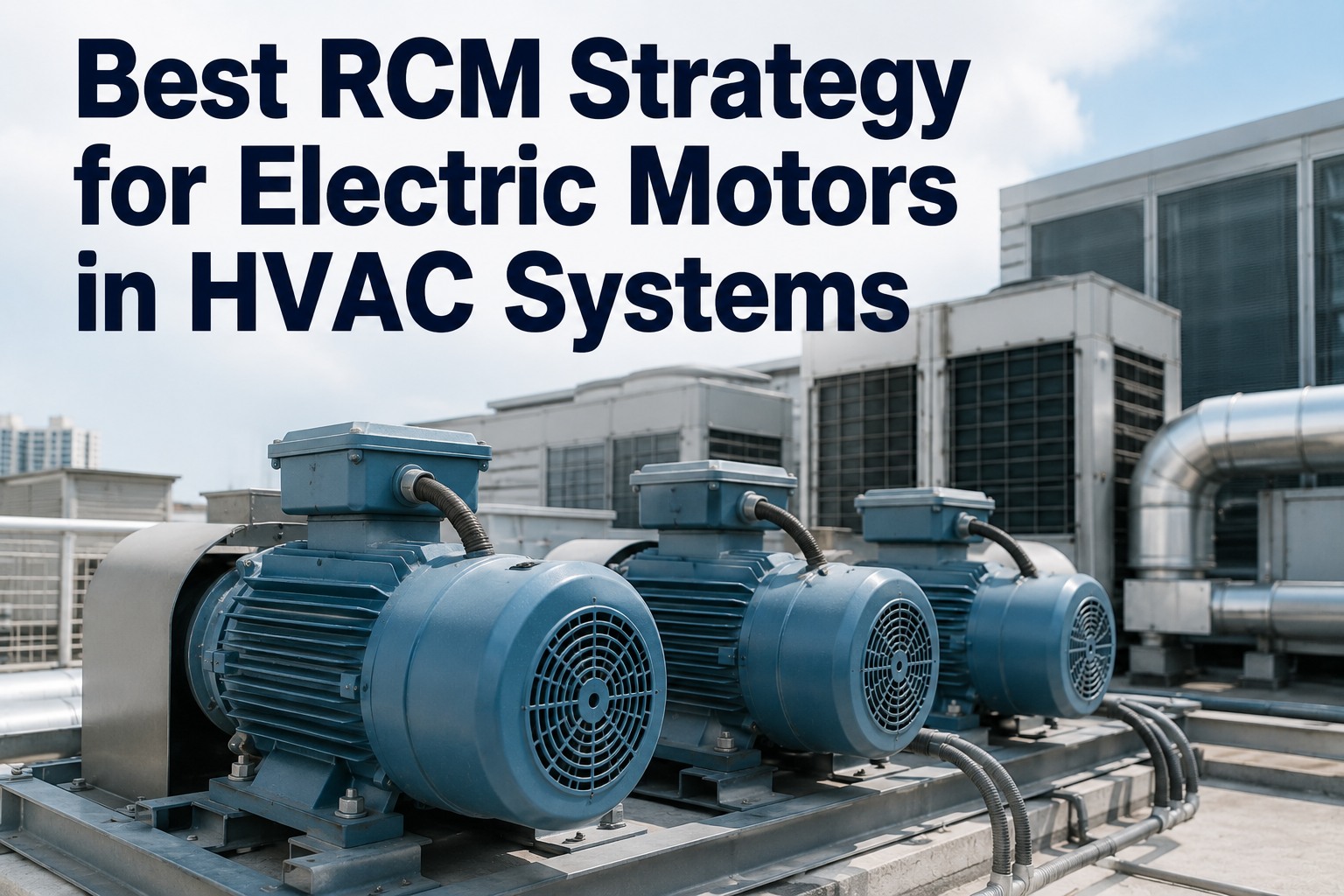
Reliability-Centered Maintenance (RCM) for electric motors in HVAC & building systems is the systematic process of identifying failure modes, determining their consequences, and selecting the most effective maintenance tasks to prevent unplanned downtime. For facility teams managing hundreds of motors across chillers, air handlers, exhaust fans, and pumps, a well-structured RCM strategy reduces motor failures by 40–60% and slashes energy waste caused by degraded equipment. This guide breaks down industry-specific failure modes, condition monitoring techniques, and preventive maintenance schedules that turn motor management from reactive firefighting into controlled reliability. Ready to put this into practice? Start Free Trial with OxMaint and automate your motor maintenance workflows today.
Is your motor maintenance strategy preventing failures — or just reacting to them?
Most HVAC & building teams wait for motors to fail before taking action, costing $5K–$15K per emergency repair plus days of occupant discomfort. A structured RCM approach shifts you to condition-based, predictive maintenance that catches bearing wear and winding faults weeks before a catastrophic breakdown.
Common electric motors failure modes in HVAC and building systems
Understanding how motors actually fail is the foundation of any RCM strategy. Industry studies by the Electric Power Research Institute (EPRI) and IEEE show that failure distribution in HVAC motors follows a predictable pattern — and each mode has a specific, cost-effective detection method.
Bearing Failures
The dominant failure mode. Caused by misalignment, improper lubrication, shaft currents, and contamination. Detected early via vibration analysis (velocity spikes at 1×, 2×, and bearing defect frequencies) and ultrasound. Without monitoring, a worn bearing escalates to rotor rub and stator damage within weeks.
Stator Winding Faults
Insulation degradation from thermal stress, voltage transients, and moisture ingress. Winding resistance imbalance and partial discharge signal early-stage faults. Megohm testing and IR thermography catch turn-to-turn shorts before they cascade into phase-to-ground catastrophic failures.
Rotor & External Faults
Broken rotor bars, eccentricity, and load-coupling issues cause torque pulsation and efficiency loss. Current signature analysis (MCSA) identifies broken bar sidebands around the fundamental frequency. External faults include overload, single-phasing, and undervoltage from the building's power distribution.
Other & Mixed Modes
Cooling fan breakage, junction box contamination, terminal block corrosion, and capacitor degradation in single-phase motors. Many failures are mixed-mode — a contaminated bearing overloads the winding, or an eccentric rotor accelerates bearing wear. RCM requires mapping these interactions per asset.
HVAC and building systems electric motors condition monitoring techniques
Condition-based monitoring is the engine of an effective RCM program. The goal is to detect degradation signatures early enough to plan repairs during scheduled downtime — not during peak cooling season. Here is the tiered monitoring approach for HVAC motor reliability.
Visual Inspection & Thermography
Monthly or quarterly walkthroughs using IR cameras to spot hot spots at connection points, bearings, and windings. A 10°C rise above baseline halts insulation life. Cost: $0 beyond labor. Detects: loose connections, blocked cooling, early bearing friction.
Vibration Analysis & Ultrasound
Quarterly to monthly route-based vibration surveys with handheld accelerometers. Look for velocity trends above 0.12 in/sec (ISO 10816). Ultrasound detects bearing lubrication needs before vibration appears. Identifies: imbalance, misalignment, looseness, late-stage bearing defects.
Wireless IoT Sensor Monitoring
Permanently mounted sensors on critical motors (chiller compressors, supply fans over 25 HP) stream vibration, temperature, and current data 24/7. AI-driven analytics flag anomalies automatically. Catches failures weeks earlier than route-based checks with 30–50% fewer unplanned outages.
Motor Circuit Analysis (MCA) & MCSA
Offline MCA for winding integrity and online MCSA for rotor bar and air gap eccentricity. Performed semi-annually on critical motors. Resistance and inductance imbalance over 2% triggers investigation. Standards: NEMA MG 1, IEEE 841 for severe-duty HVAC motors.
Electric motors PM schedule for HVAC and building systems
A preventive maintenance schedule is the backbone of electric motors maintenance in HVAC and building systems. The schedule below is calibrated for typical commercial building environments — adjust frequencies based on runtime hours, duty cycle, and criticality ranking from your RCM analysis.
| Task | Frequency | Technique / Standard | Detects / Prevents |
|---|---|---|---|
| Visual & audible inspection | Monthly | Walkdown, stethoscope | Noise, odor, leaks, mounting issues |
| Bearing lubrication (grease) | Quarterly / 2,000 hrs | Calculated grease volume per SKF/AGMA | Overheating, friction wear |
| Vibration route survey | Quarterly | Accelerometer, ISO 10816 | Bearing faults, imbalance, misalignment |
| IR thermography scan | Bi-annually | IR camera, NFPA 70B | Hot spots, loose connections, overload |
| Winding resistance & Megger test | Annually | Megohmmeter, IEEE 43 | Insulation degradation, moisture |
| Alignment & soft foot check | Annually or after repair | Laser alignment | Coupling wear, bearing overload |
| MCA / MCSA electrical test | Semi-annually (critical) | Motor circuit analyzer | Rotor bar breaks, winding shorts, eccentricity |
| Filter & cooling duct cleaning | Quarterly | Compressed air, vacuum | Thermal derating, efficiency loss |
RCM in action: a 200-motor commercial campus case study
Consider a 450,000 sq ft mixed-use commercial complex with approximately 200 electric motors across AHUs, chillers, cooling towers, and exhaust systems. The maintenance team was spending $48K annually on emergency motor repairs and replacement, with an average of 14 unplanned motor-related outages per year disrupting tenant comfort.
Before RCM — Reactive Status Quo
- 14 unplanned motor failures per year averaging $3,400 per event
- 2.8 days average downtime per failure during peak season
- No condition data — repairs were run-to-failure by default
- $48K annual emergency repair spend, 30% premium on rush parts
- 20+ tenant comfort complaints monthly linked to HVAC outages
After RCM — Structured Reliability Program
- 4 unplanned failures in year one — a 71% reduction
- 0.5 days average downtime — planned with 2-week lead time
- Vibration and IR data on all critical motors quarterly
- $19K annual maintenance spend — 60% cost reduction
- 3 tenant complaints monthly — 85% improvement in SLA compliance
Annual Savings = ($48K reactive spend − $19K RCM spend) + ($12K avoided downtime cost) = $41,000 / year
Payback Period = $8K sensor & training investment ÷ $41K annual savings = 2.3 months
Electric motors RCM strategy: HVAC and building systems best practices
Rank motors by criticality
Not every motor needs the same strategy. Classify motors as Critical (safety, production-critical), Essential (comfort, redundancy available), or Non-essential. Apply Tier 3–4 monitoring only to Critical motors — typically 15–20% of the population — and run-to-failure with spare on Non-essential units.
Build a complete asset hierarchy
Map each motor to its parent system (AHU-3 → Supply Fan Motor → 15 HP Baldor). Without hierarchy, RCM tasks float disconnected. OxMaint's EAM structure links motors to systems, parts, and work order history so failure patterns become visible across the building portfolio.
Set data-driven alarm thresholds
Generic ISO thresholds are a starting point, not an endpoint. Establish baselines for each motor under normal load, then set alarm bands at 2× and 3× baseline. This eliminates false alarms and catches gradual degradation that absolute thresholds miss.
Close the loop on every work order
RCM fails when inspection data doesn't trigger action. Every vibration anomaly, thermography finding, or MCA result must auto-generate a work order with a deadline. If findings sit in a spreadsheet, the motor fails anyway — just more expensively because you already paid to find the problem.
Track MTBF and MTTR as leading indicators
Mean Time Between Failures should trend upward quarter over quarter. If it plateaus or drops, revisit your task selection. Mean Time To Repair measures wrench-time efficiency — if MTTR is rising, your spare parts inventory or technician training needs attention.
Integrate with building automation systems
Your BAS already monitors motor current, runtime, and status. Feed that data into your CMMS to auto-trigger PM tasks based on actual runtime hours rather than calendar dates. This alone can reduce unnecessary PMs by 25% while catching high-duty-cycle motors that need more frequent service.
See OxMaint manage your motor RCM program — book a 30-minute demo
Watch how OxMaint's AI-powered CMMS automates PM schedules, triggers work orders from condition data, and gives you a live reliability dashboard across every motor in your building portfolio.
How OxMaint powers your electric motors RCM strategy
OxMaint is an AI-powered CMMS and EAM platform built specifically for maintenance and reliability teams managing complex building systems. Here is how OxMaint turns the RCM framework in this guide into daily, automated practice across every asset, technician, and shift.
Automated PM Scheduling
Build the exact PM schedule from this article — lubrication, vibration, thermography, MCA — and OxMaint auto-generates work orders based on calendar dates or runtime hours from your BAS integration. Never miss a quarterly survey again. Outcome: 30–50% reduction in unplanned motor downtime.
Condition Monitoring Integration
Connect wireless vibration sensors and IR camera data directly to OxMaint. When a bearing fault frequency crosses your custom threshold, the system auto-creates a priority work order with the motor's full history attached. Outcome: catch failures 3–6 weeks earlier than route-based checks.
Mobile Work Order Execution
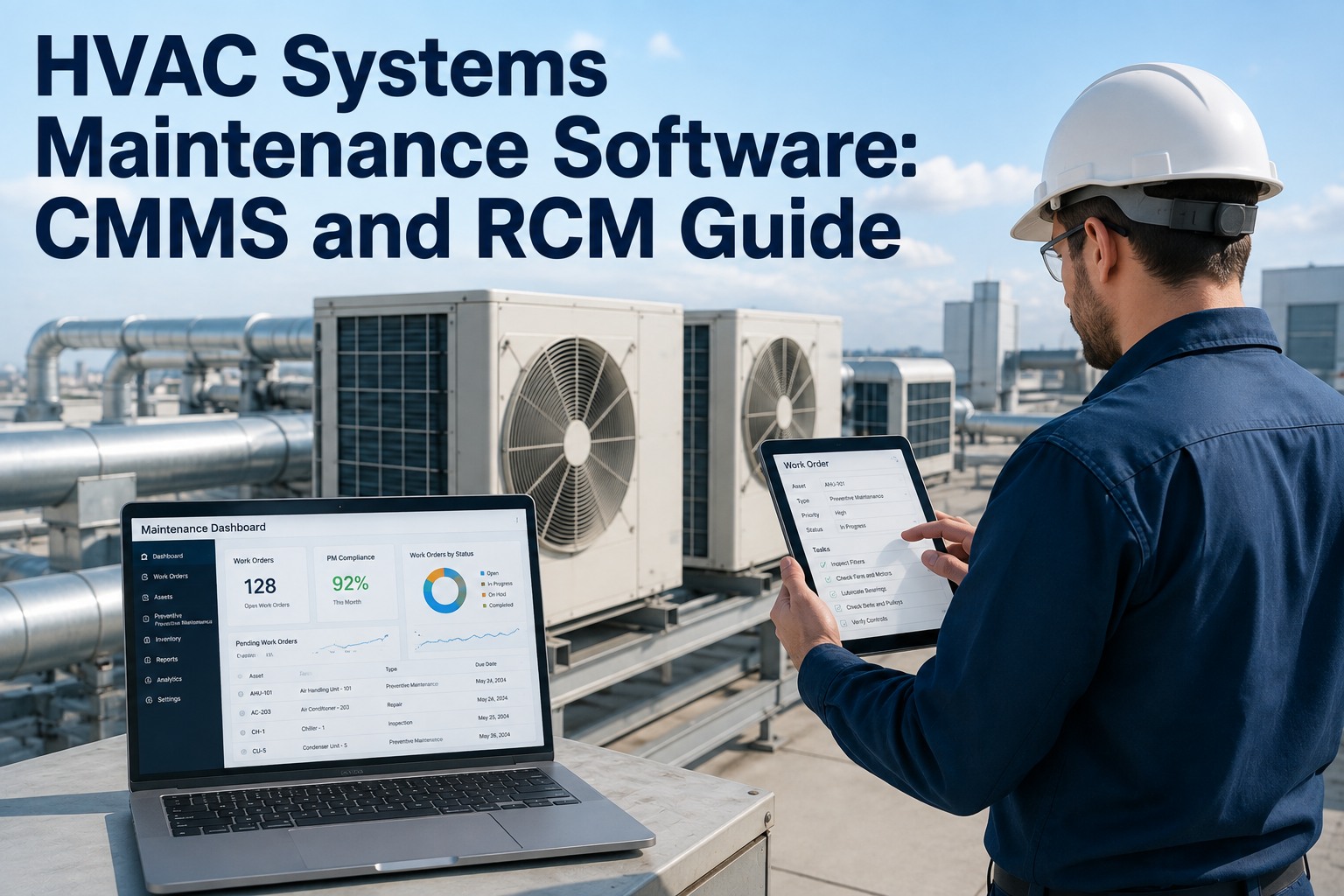
Technicians receive motor-specific work orders on the OxMaint mobile app with checklists, safety procedures, spare parts requirements, and reference photos. Complete and sign off offline in mechanical rooms — data syncs when back online. Outcome: eliminate paper work orders and 40% faster PM completion.
Reliability Analytics Dashboard
Track MTBF, MTTR, PM compliance rate, and failure mode Pareto by motor type, building, or system. OxMaint's AI identifies which motors are chronic offenders and which PM tasks aren't preventing failures — so you can reallocate effort where it matters. Outcome: data-driven RCM task optimization in real time.
RCM for electric motors in HVAC: frequently asked questions
What is RCM for electric motors in HVAC and building systems?
RCM (Reliability-Centered Maintenance) for HVAC motors is a structured framework that identifies each motor's failure modes, assesses their operational consequences, and selects the most cost-effective maintenance task — whether that's run-to-failure, time-based PM, or condition-based monitoring. The goal is to apply the right maintenance intensity to each motor based on its criticality and failure pattern, maximizing reliability while minimizing unnecessary maintenance spend. OxMaint's CMMS platform operationalizes this framework by automating task scheduling and tracking outcomes.
How often should electric motors in HVAC systems be inspected?
Most HVAC motors should receive a visual and audible inspection monthly, a vibration survey and bearing lubrication quarterly, and an IR thermography scan bi-annually. Critical motors driving chillers or large supply fans warrant continuous vibration monitoring via IoT sensors. You can automate these varying frequencies in OxMaint so that no inspection slips through the cracks — book a demo to see the PM automation engine in action.
What is the most common failure mode for HVAC electric motors?
Bearing failures account for approximately 51% of all HVAC electric motor failures, according to EPRI and IEEE studies. The primary causes are improper lubrication, misalignment, shaft currents from VFDs, and contamination. The good news is bearing degradation is highly predictable using vibration analysis and ultrasound — a motor with a developing bearing fault typically shows detectable vibration signature changes 3–8 weeks before functional failure.
How much does an RCM program for HVAC motors cost to implement?
A typical 200-motor commercial building can implement a Tier 1–2 RCM program (visual, vibration routes, thermography) for $5K–$10K in tools and training. Adding Tier 3 continuous monitoring on critical motors adds $8K–$15K for wireless sensors and analytics. Most facilities see payback in 2–6 months through reduced emergency repairs and avoided downtime, with ongoing annual savings of 40–60% versus reactive maintenance.
Can a CMMS automate HVAC motor condition monitoring?
Yes — a modern CMMS like OxMaint integrates with vibration sensors, IR cameras, and building automation systems to automatically trigger work orders when condition data crosses alarm thresholds. Rather than storing inspection results in spreadsheets, the CMMS links every data point to the motor's asset record, auto-schedules the next task based on findings, and tracks MTBF trends over time. This closes the loop between detection and action, which is where most RCM programs fail. Start Free Trial to connect your motor data today.
Stop reacting to motor failures — start preventing them
OxMaint gives you the asset hierarchy, PM automation, condition monitoring integration, and reliability analytics to execute a world-class RCM program for every motor in your HVAC and building systems. Join the maintenance teams who've cut unplanned downtime by 50% or more.
Free 14-day trial · No credit card

-optimizing-your-maintenance-strategy.png)