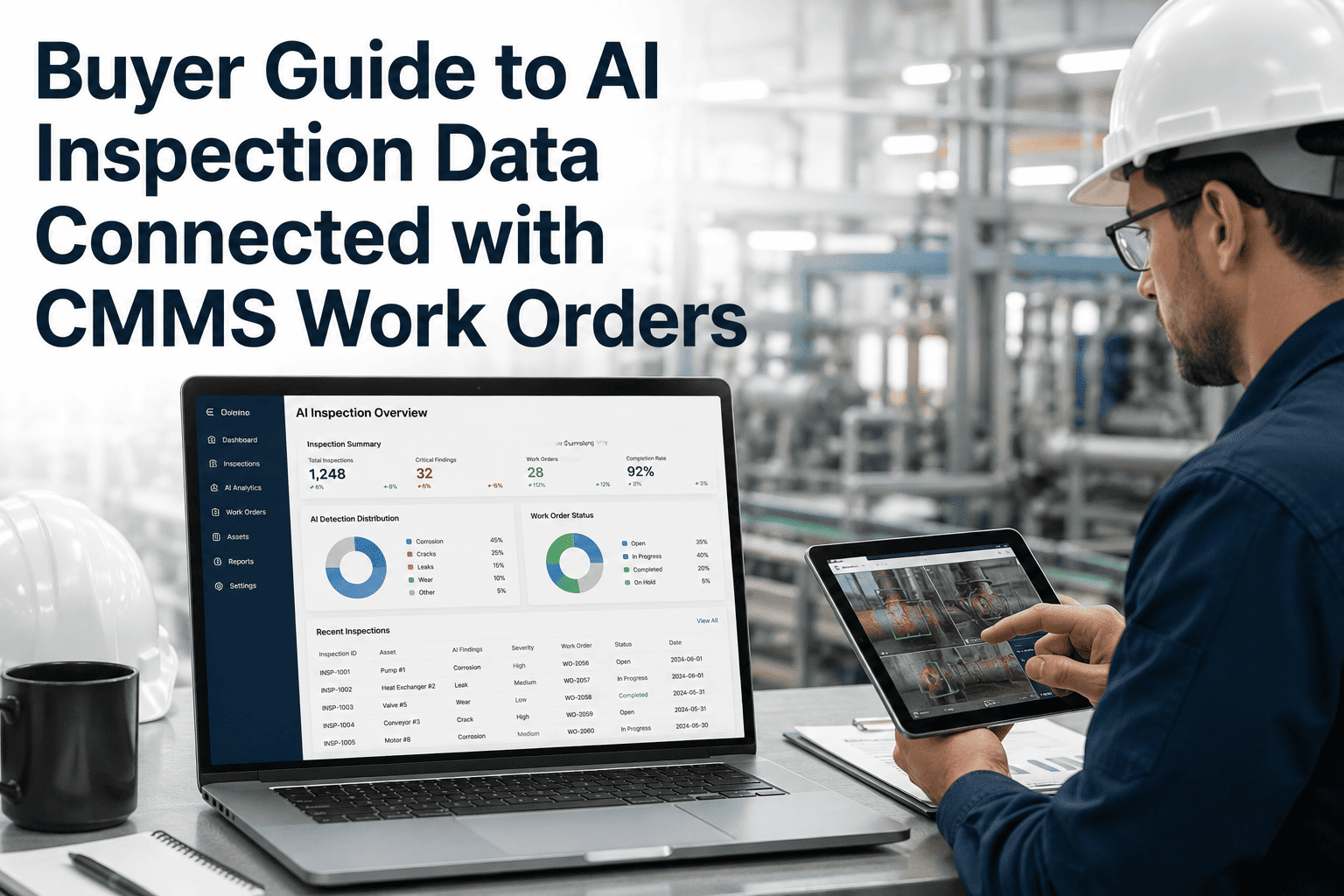
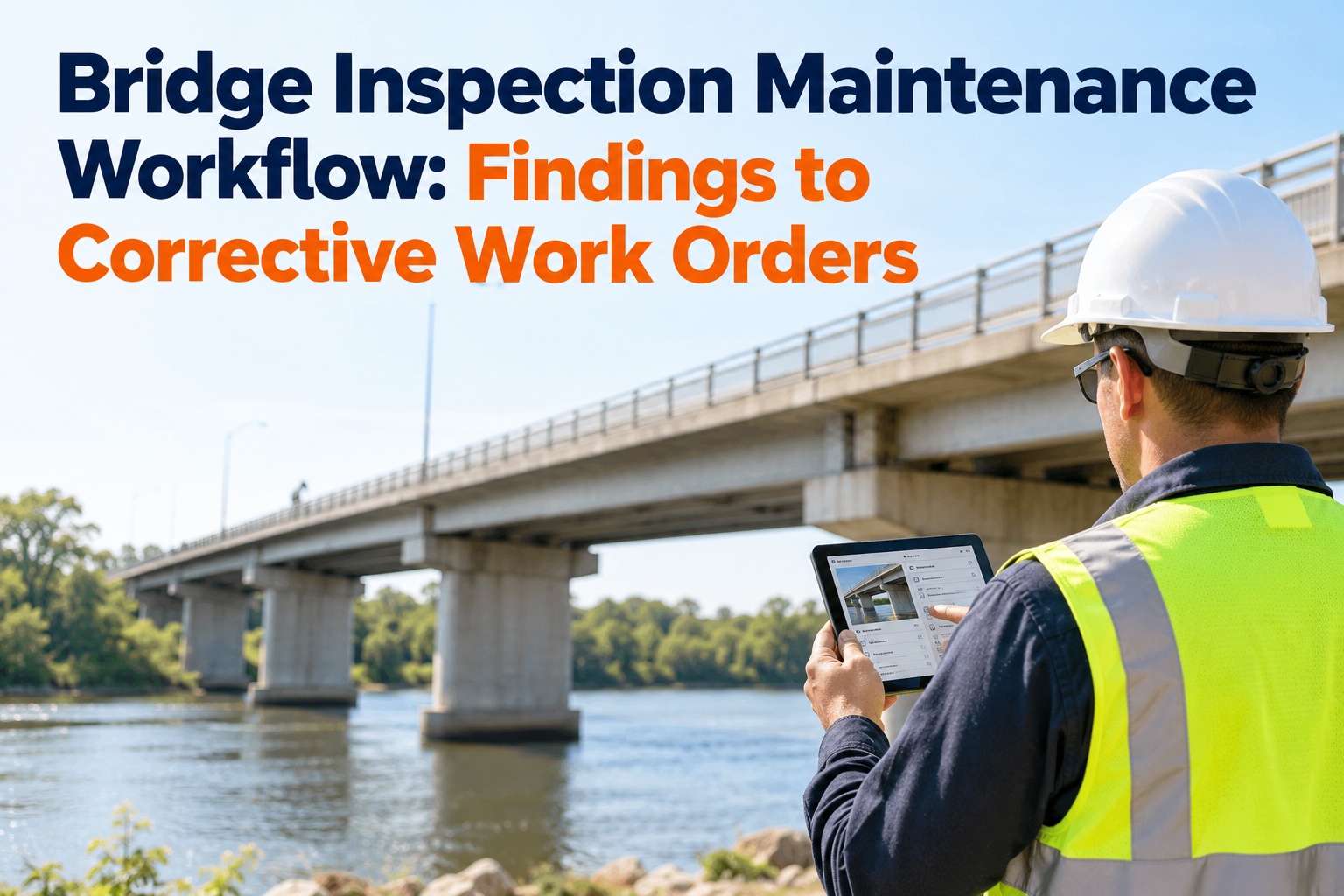
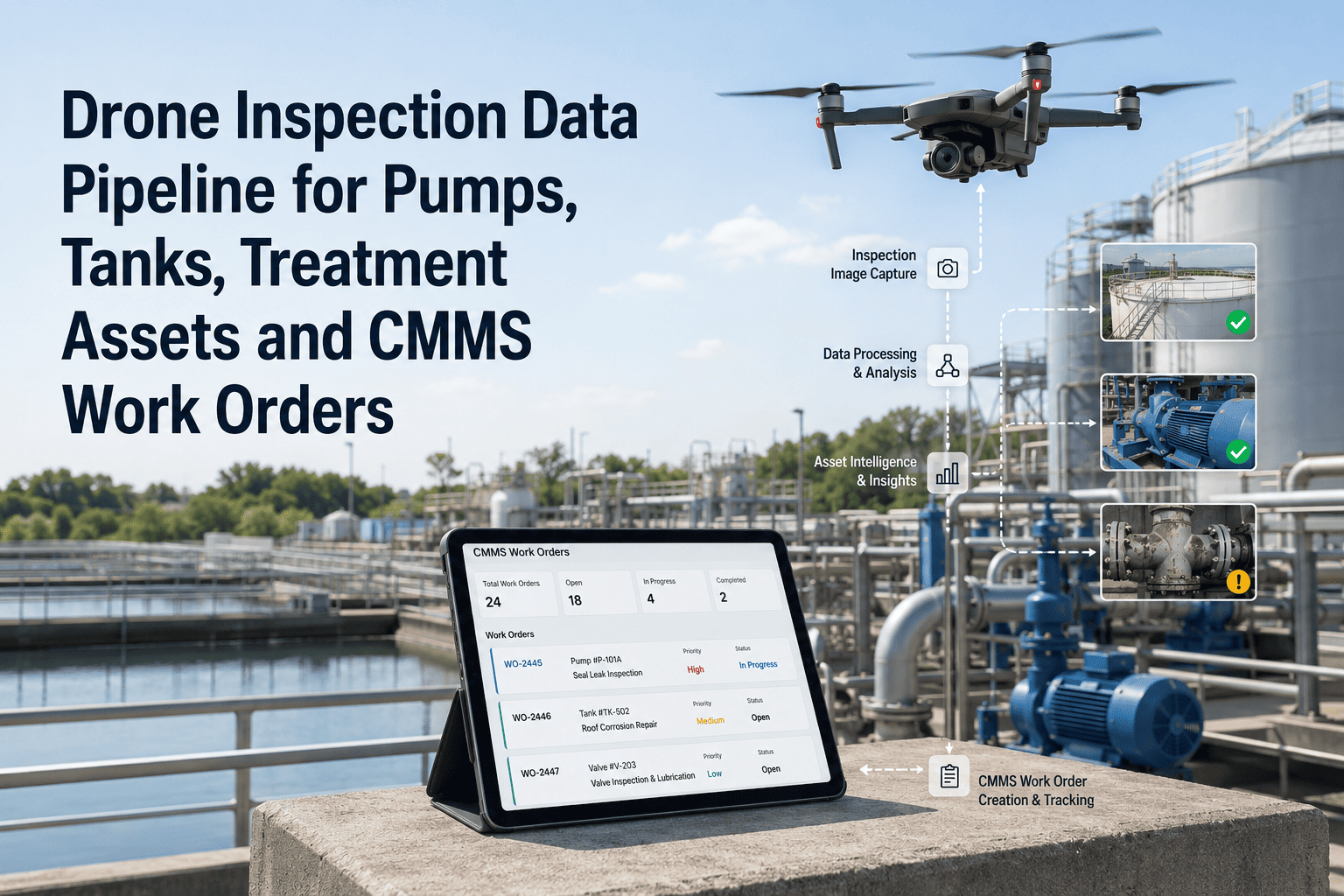
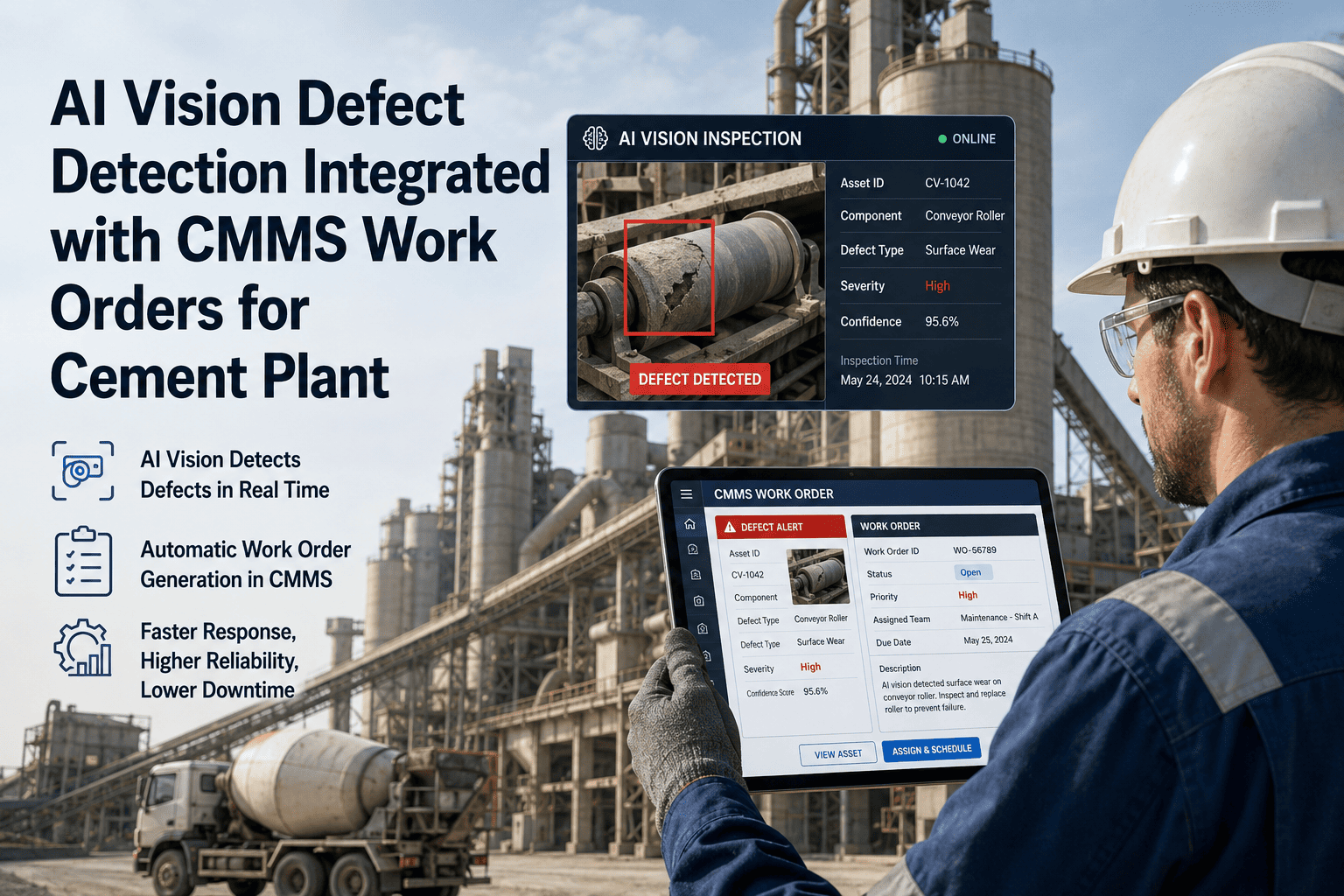
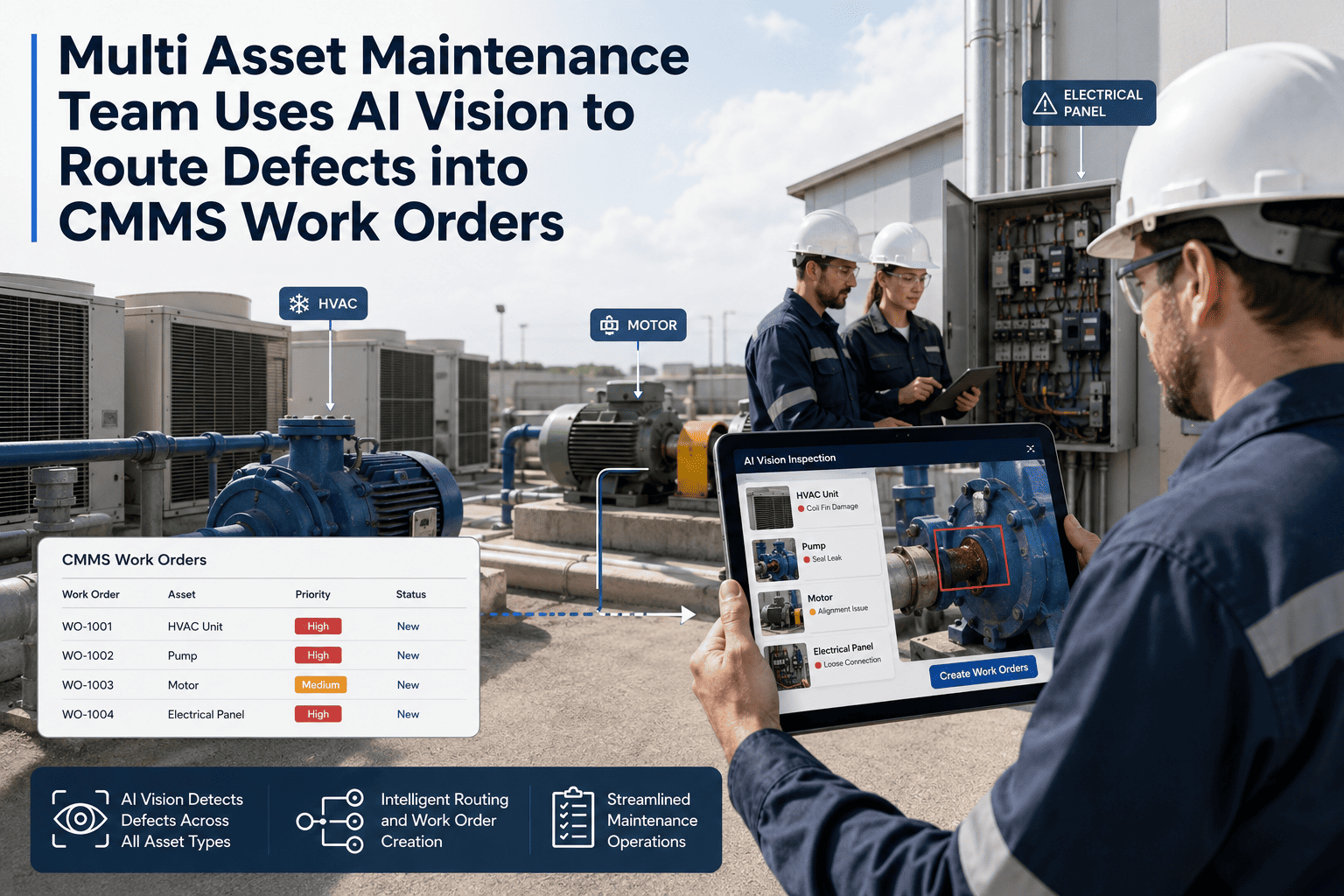
Most maintenance teams have already invested in cameras, sensors, or inspection tools — yet defects still slip through untracked, and work orders still get created manually hours after a visual catch. The gap is not hardware. The gap is the missing bridge between what AI sees and what your CMMS acts on. This buyer guide to AI inspection data connected with CMMS work orders walks you through what that connection looks like in practice, what to demand from any platform before you sign, and how teams across industries are turning visual evidence into resolved work orders in under 60 seconds — without a single manual entry. If you manage assets across multiple sites, shifts, or teams, start your free OxMaint trial to see how AI inspection feeds directly into structured work orders, or book a live demo to walk through a detection-to-dispatch workflow on your asset types.
Buyer Guide · AI Vision Evidence Automation
AI Inspection Data Connected with CMMS Work Orders
What every maintenance buyer must verify before choosing a platform — and the exact data flow that turns a detected defect into a closed work order.
99%+
AI defect detection accuracy vs. 80% for human inspectors
<60s
detection-to-work-order dispatch with native CMMS integration
374%
three-year ROI documented in AI vision + CMMS deployments
Why the AI-to-CMMS Gap Is Where Maintenance Value Disappears
A camera that spots a crack and a CMMS that can't see it are not a system — they are two separate silos with a human running between them. Every hour that gap stays open, that defect progresses, parts aren't pre-ordered, and the work order competes for priority with everything else that arrived manually. The integration is not a feature. It is the ROI.
01
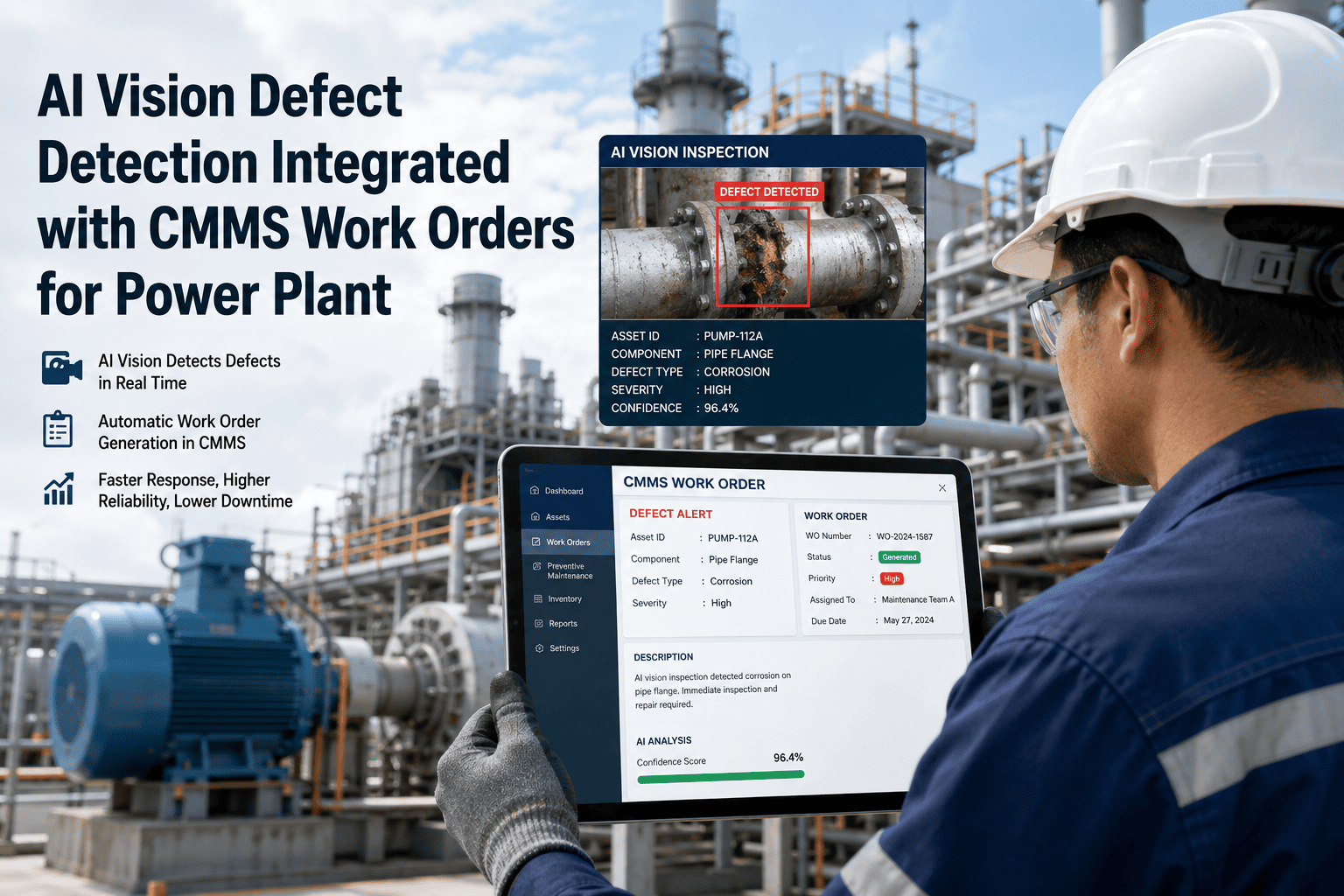
AI Camera Detects Defect
Computer vision model identifies anomaly — crack, corrosion, misalignment, leakage — with annotated photo and confidence score
→
02
Evidence Package Built
Asset ID, location, defect type, severity, annotated image, and repair recommendation assembled automatically
→
03
Work Order Auto-Generated
CMMS creates structured work order — pre-populated, prioritized, and routed to the right crew — zero manual entry
→
04
Parts and History Checked
CMMS cross-references spare parts inventory and asset repair history before the technician leaves the shop floor
→
05
Work Order Closed and Logged
Completion photo, technician notes, and failure code logged — feeding the AI model's future accuracy
The Buyer's Verification Checklist: 8 Questions to Ask Every Vendor
Before any platform demonstration, send these eight questions. The answers reveal whether you are buying a connected maintenance system or two products duct-taped together.
1
How fast does a detected defect become a work order — and what triggers it?
The answer should be under 60 seconds, triggered automatically by the AI detection event without any human approval step for standard severity levels.
2
Does the work order include the annotated photo evidence from the AI detection?
The technician must open a work order that shows exactly what the AI flagged — not a text description of it. No annotated image means no evidence chain.
3
How is priority assigned — manually by a supervisor, or automatically by defect severity and asset criticality?
Automatic priority routing based on pre-defined criticality rules eliminates the triage bottleneck that delays response to high-consequence defects.
4
Does the system check spare parts inventory when the work order fires?
Best-in-class platforms trigger a purchase order automatically when required parts are below threshold — before the technician arrives at the asset.
5
Can we map the AI inspection feed to our existing asset hierarchy without custom development?
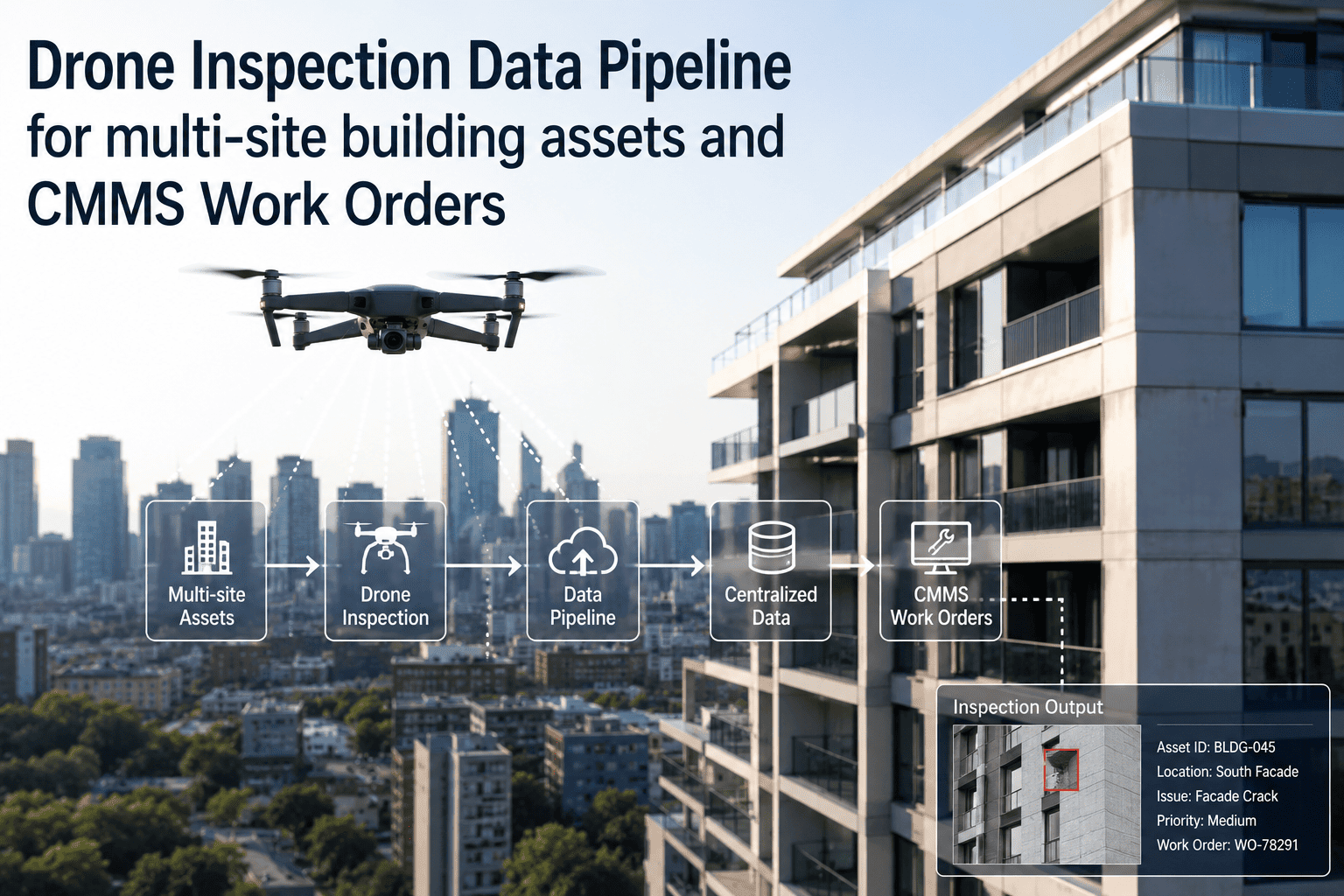
Native asset mapping means each detection belongs to a specific asset tag, building repair history automatically — not a flat data stream with no context.
6
When work orders close, does that feedback improve the AI detection model over time?
Closed-loop learning — where technician findings teach the AI which alerts were real — is what separates a maturing system from a static one with growing false alarm rates.
7
What APIs or protocols does the integration use — and is audit evidence automatically generated?
REST, OPC-UA, or MQTT integrations should create immutable timestamped records that satisfy OSHA, ISO 55000, and internal compliance requirements without manual documentation.
8
Can we see a live detection-to-dispatch demonstration on our specific asset type before we commit?
Any vendor confident in their integration will show it live. If the demo only shows the AI and the CMMS separately, the connection between them is not as seamless as claimed.
See the complete detection-to-work-order pipeline live in OxMaint.
OxMaint connects AI inspection feeds to structured CMMS work orders with annotated photo evidence, automatic priority routing, and closed-loop learning — all without custom development.
Platform Capability Comparison: What to Look for Across 6 Critical Dimensions
| Capability |
Basic Integration |
Mid-Tier Platform |
OxMaint + AI Vision |
| Detection-to-work-order speed |
Manual (hours) |
Semi-auto (minutes) |
Automatic (<60 seconds) |
| Annotated photo in work order |
Link only |
Attachment |
Inline with severity overlay |
| Asset hierarchy mapping |
Flat asset list |
Manual mapping |
Native, multi-level hierarchy |
| Auto parts inventory check |
No |
Alert only |
Auto PO generation |
| Closed-loop AI learning |
No |
Manual retraining |
Continuous from failure codes |
| Audit-ready compliance log |
CSV export |
Report module |
Immutable timestamped chain |
ROI Benchmarks: What Connected Teams Report After 12 Months
▶
37%
Reduction in defect escape rate
Automotive and electronics manufacturers after AI vision + CMMS integration
▶
85%
Fewer customer complaints
Reported by manufacturers with automated defect-to-work-order pipelines
▶
6–12 mo
Average payback period
Across AI vision inspection deployments with CMMS auto-work-order generation
▶
34%
Higher productivity gains
Teams integrating inspection data across their full digital ecosystem vs. siloed deployments
Expert Review
RM
Rahul Mehta
Industrial AI Systems Architect, 14 years in CMMS integration
The single most common mistake I see in AI inspection procurement is evaluating the vision system and the CMMS as separate line items. They should be evaluated as one connected pipeline — because the ROI lives entirely in the handoff speed. A vision system with a 24-hour manual work order process delivers about 20% of the value of one with a 60-second automated handoff. Ask for the integration demo first, not the detection demo. The detection is the easy part.
Frequently Asked Questions
Do we need to replace our existing CMMS to connect AI inspection data?
Not necessarily. OxMaint can ingest AI inspection feeds and manage the work order lifecycle independently, or integrate with your existing CMMS via REST APIs. Most teams find that centralizing both in OxMaint eliminates the integration overhead entirely.
Book a demo to review your current stack and identify the cleanest connection path.
What types of AI cameras and vision systems does OxMaint support?
OxMaint connects to AI vision feeds via standard REST APIs, webhooks, and MQTT event streams. Any camera system that outputs structured detection events — including confidence scores and annotated images — can feed OxMaint's work order engine directly. RTSP and ONVIF-compatible systems are supported out of the box.
Start a free trial to test the connection with your existing hardware.
How does AI inspection data improve audit readiness compared to manual inspection logs?
AI-generated inspection records include timestamped annotated images, detection confidence scores, and an unbroken chain from detection to work order to resolution — all immutably logged. Manual logs have gaps at every handoff. For ISO 55000, OSHA, and sector-specific compliance requirements, the AI-to-CMMS chain satisfies audit evidence requirements that paper logs cannot.
Book a demo to see the compliance report output.
What is the minimum viable setup to start connecting AI inspection to CMMS work orders?
You need three things: an AI vision system producing structured detection events, an asset hierarchy in your CMMS to map detections to specific equipment, and a webhook or API connection between them. OxMaint provides templates for all three and can have a test pipeline running within one week of initial setup — no custom development required.
Start free and run a pilot on one production line or asset group first.
How long before the AI model improves after connecting work order feedback?
Most teams see measurable false-alarm reduction within 60 to 90 days of consistent failure-code feedback from closed work orders. The AI learns which detection signatures preceded confirmed failures versus false positives — progressively raising the signal-to-noise ratio without requiring manual model retraining.
Book a demo to see the feedback loop in action.
Your AI camera is already seeing failures your CMMS doesn't know about yet.
OxMaint closes the gap — turning every detected defect into a structured, evidence-backed, prioritized work order in under 60 seconds. No manual entry. No lost detections. No compliance gaps.