The average maintenance operation uses 4.7 software tools — CMMS, ERP, BI platforms, IoT sensor networks, building automation systems, and accounting software. Without an API connecting them, each tool is an island. Data enters one system and must be manually re-entered into the next. A sensor detects a vibration anomaly, but the work order has to be created by hand. A work order closes, but the cost does not appear in the financial system until someone keys it in. 47% of maintenance teams report spending more time managing data between systems than actually managing maintenance. The solution is not another middleware product with its own licensing fees and implementation timeline — it is a CMMS with a documented, open API that lets your existing tools talk to it directly. REST endpoints for work orders and assets. Webhooks that fire when a PM completes or a sensor threshold triggers. GraphQL for flexible queries that return exactly the data your BI dashboard needs. OxMaint provides all three — documented, free, and ready to use. If you are building integrations or evaluating CMMS platforms for connectivity, start a free trial and access the API documentation immediately or book a demo to walk through integration architecture with our team.
CMMS API · REST · GraphQL · Webhooks · Integration
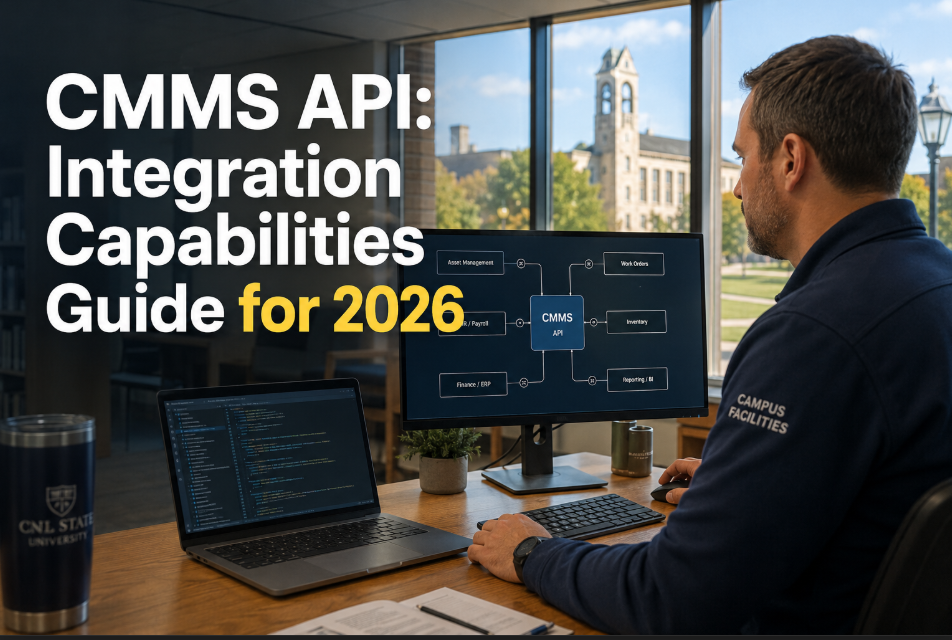
CMMS API: Integration Capabilities Guide for 2026
47% of maintenance teams spend more time managing data between systems than managing maintenance. A CMMS with REST, GraphQL, and webhooks — documented and free — eliminates the data silos that make your operation slower, not smarter.
4.7
average number of software tools per maintenance operation
47%
of teams spend more time on data management than maintenance
73%
of CMMS buyers rank API availability as critical
$0
OxMaint API access cost — documented, free, unlimited
Definition
What Is a CMMS API and Why Does It Matter?
A CMMS API (Application Programming Interface) is the set of documented endpoints, protocols, and data formats that allow external software systems to read from, write to, and interact with a maintenance management platform programmatically. Instead of a human logging into CMMS to create a work order, an API allows an IoT sensor, an ERP system, or a building automation controller to create that work order automatically — with zero human intervention and zero delay.
APIs come in three primary flavors for CMMS: REST (the most common, using standard HTTP requests), GraphQL (allowing flexible queries that return exactly the fields requested), and webhooks (event-driven notifications that fire when something changes in CMMS). The most capable CMMS platforms offer all three. Many offer none — or charge separately for API access, or provide undocumented endpoints that break without warning. OxMaint provides REST, GraphQL, and webhooks — all documented publicly and included at no additional cost. 73% of CMMS buyers in 2026 rank API availability as a critical evaluation criterion, yet only 31% of CMMS platforms offer fully documented APIs. Want to see the API documentation before committing, start a free trial and access the full developer docs from day one.
API Types Explained
REST vs GraphQL vs Webhooks: Which API Type Solves What Problem
Not all API types serve the same purpose. Understanding when to use each one determines whether your integrations are efficient or wasteful with bandwidth and development time.
R
REST API
Standard HTTP endpoints (GET, POST, PUT, DELETE) for CRUD operations on CMMS resources — work orders, assets, PMs, parts, users. Best for: ERP integration, batch data sync, mobile app backends, and any system that needs to create, read, update, or delete CMMS records. OxMaint REST API covers 100% of platform functionality.
G
GraphQL API
Query language that lets you request exactly the data fields you need — no more, no less. Best for: BI dashboards, custom reporting interfaces, and front-end applications where bandwidth efficiency matters. Request 50 asset records with only name, condition score, and last PM date — instead of receiving every field on every asset.
W
Webhooks
Event-driven HTTP callbacks that fire when something changes in CMMS — work order created, PM completed, asset condition changed, threshold breached. Best for: real-time IoT response, notification systems, and event-driven architectures. No polling required — your system is notified the instant something happens.
Your Sensors, ERP, and BI Tools Should Connect to CMMS Without Middleware Fees
OxMaint provides REST, GraphQL, and webhooks — fully documented and free with every plan. No per-call charges. No API access tiers. No surprise invoices. See the developer experience in a 30-minute demo.
Use Cases
6 High-Impact CMMS API Integration Scenarios
APIs are not theoretical — they solve specific, expensive problems. Here are six integration scenarios that maintenance teams deploy most frequently and the measurable impact of each.
IoT Sensor to Work Order
A vibration sensor on a pump motor detects abnormal frequency. The sensor platform calls the OxMaint REST API to create a corrective work order with sensor data attached. The technician receives an assignment with the diagnosis included — no manual interpretation, no delay. Average response time improvement: 82%.
ERP Purchase Order Sync
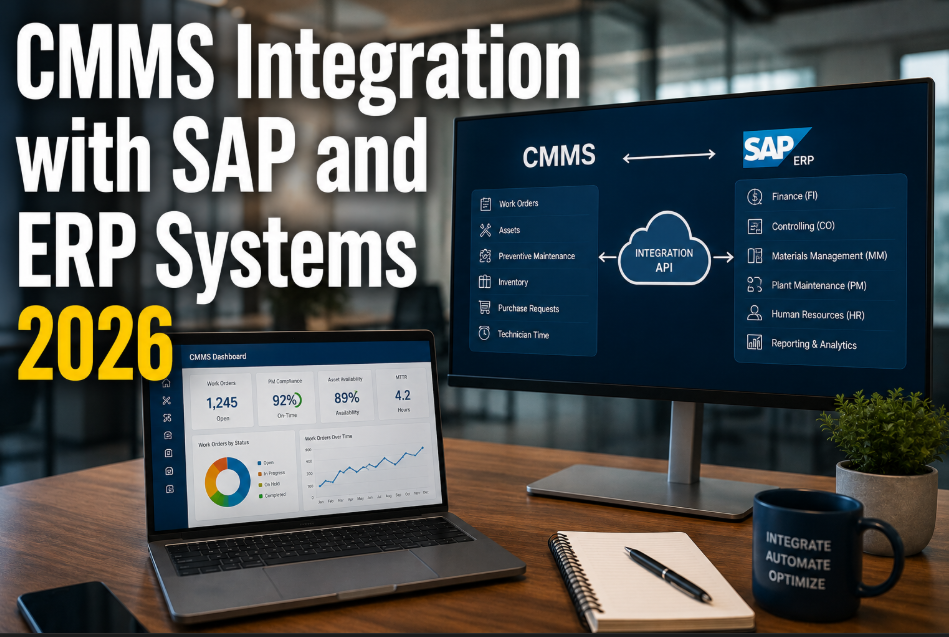
When a technician requests parts in CMMS, the API creates a purchase requisition in SAP, Oracle, or NetSuite. When the PO is approved and the part ships, ERP calls back to update the CMMS work order with expected delivery date. Eliminates 92% of manual procurement data entry.
BI Dashboard Data Feed
Power BI or Tableau queries OxMaint's GraphQL API to pull exactly the KPI data needed — PM compliance, MTTR, cost per asset, work order volume — refreshing automatically on schedule. No CSV exports, no manual data preparation. Dashboard always shows current data.
BAS/BMS Alert Integration
Building automation system detects an HVAC compressor running outside normal parameters. The BMS sends an alert via webhook to OxMaint, which creates a prioritized work order and assigns it to the nearest available HVAC technician. Response time drops from hours to minutes.
Tenant/Occupant Request Portal
A tenant submits a maintenance request through a property management portal. The portal calls the OxMaint API to create a work order, assigns it based on category and location, and returns a tracking number to the tenant. No email forwarding, no phone tag, no lost requests.
Fleet Telematics Integration
Telematics devices report engine hours, fault codes, and mileage milestones. When a vehicle hits a PM threshold — 5,000 miles, 250 engine hours, or a DTC fault code — the telematics platform triggers a work order in OxMaint via API. PM scheduling becomes condition-driven, not calendar-driven.
Platform Comparison
CMMS API Capabilities: What Each Platform Actually Offers
| API Capability |
Basic CMMS |
Enterprise CMMS |
OxMaint |
| REST API |
Not available or undocumented |
Available — limited endpoints |
Full coverage — all resources |
| GraphQL API |
Not available |
Not available |
Full GraphQL with schema explorer |
| Webhooks |
Not available |
Limited event types |
All events — configurable filters |
| Documentation quality |
Minimal or none |
Developer portal — paywalled |
Public, interactive, with examples |
| API access cost |
Add-on fee |
Included at enterprise tier only |
Free with every plan |
| Rate limits |
Restrictive — 100 calls/hour |
Moderate — 1,000 calls/hour |
Generous limits — scalable on request |
| Authentication |
Basic auth |
OAuth 2.0 |
OAuth 2.0 + API keys + service accounts |
| Sandbox/test environment |
Not available |
Available — limited |
Full sandbox with test data |
Common Problems
Why Most CMMS API Experiences Frustrate Developers and IT Teams
Documentation Gap
Undocumented or Outdated API Endpoints
69% of developers report encountering CMMS APIs with missing documentation, deprecated endpoints that still appear in docs, or examples that no longer work. Every undocumented endpoint adds hours of trial-and-error development time — and creates fragile integrations that break without warning.
OxMaint API docs are version-controlled, interactive, and updated with every release
Paywall
API Access Requires Enterprise Licensing
Many CMMS vendors lock API access behind their highest-priced tier — or charge per API call. A mid-size organization sending 10,000 API calls per day for IoT sensor integration can face $2,000-$5,000 per month in API fees alone, on top of the CMMS subscription.
OxMaint API access is free with every plan — no per-call charges, no tier restrictions
Limited Coverage
API Does Not Cover All CMMS Functions
Some CMMS APIs expose work orders and assets but not PM schedules, not parts inventory, not inspection forms, and not reporting data. You can create a work order via API but cannot check PM compliance programmatically — forcing manual workarounds for exactly the data your BI team needs most.
OxMaint REST API covers 100% of platform functionality — every resource, every action
No Webhooks
Polling Required for Real-Time Data
Without webhooks, your IoT platform or BMS has to poll the CMMS every few seconds to check for changes — consuming API rate limits, adding latency, and creating unnecessary server load. Webhooks push data the instant an event occurs, eliminating polling entirely and reducing integration complexity by 60%.
OxMaint webhooks support all event types with configurable filters and retry logic
Measurable Impact
What API-Connected Maintenance Operations Achieve
82%
faster response to sensor alerts
IoT-to-CMMS API integration vs manual work order creation from sensor dashboards
92%
less manual data entry
Bidirectional ERP-CMMS API sync eliminates duplicate keying across systems
60%
reduction in integration complexity
Webhooks eliminate polling loops, reducing code and infrastructure requirements
$0
OxMaint API access fee
REST, GraphQL, and webhooks included free — no per-call charges at any plan level
Every API call that automates a manual step in your maintenance workflow saves time, reduces errors, and accelerates response. The compounding effect across thousands of daily interactions is transformative. If your current CMMS charges for API access or does not offer one at all, the cost is not just the fee — it is every manual workaround your team performs because systems cannot talk to each other. Want to see the developer experience firsthand, start a free trial and access the API sandbox today or book a demo to discuss your specific integration architecture.
FAQs
CMMS API Integration — Common Questions
Does OxMaint charge extra for API access?
Can I connect IoT sensors directly to OxMaint without middleware?
Yes — if your sensor platform can make HTTP requests (which virtually all modern platforms can), it can call OxMaint's REST API directly to create work orders, update asset readings, or trigger PM schedules. For sensor platforms that support MQTT or OPC-UA, OxMaint provides protocol adapters. No third-party middleware is required for standard integrations.
What happens if a webhook delivery fails?
OxMaint implements automatic retry logic with exponential backoff for failed webhook deliveries. If the receiving endpoint is temporarily unavailable, the system retries delivery according to a configurable schedule. Failed deliveries are logged and visible in the API dashboard, with the option to manually replay failed events.
Book a demo to see the webhook management interface.
Is there a sandbox environment for testing integrations?
Yes. Every OxMaint account includes access to a sandbox environment with test data. Developers can build, test, and validate integrations without affecting production data. The sandbox mirrors the production API exactly — same endpoints, same authentication, same response formats. When the integration is validated, switching from sandbox to production requires only changing the base URL.
Your CMMS API Should Be Documented, Free, and Ready to Use Today
OxMaint delivers REST, GraphQL, and webhooks — fully documented, free with every plan, and covering 100% of platform functionality. Access the sandbox, review the docs, and build your first integration in a free trial.