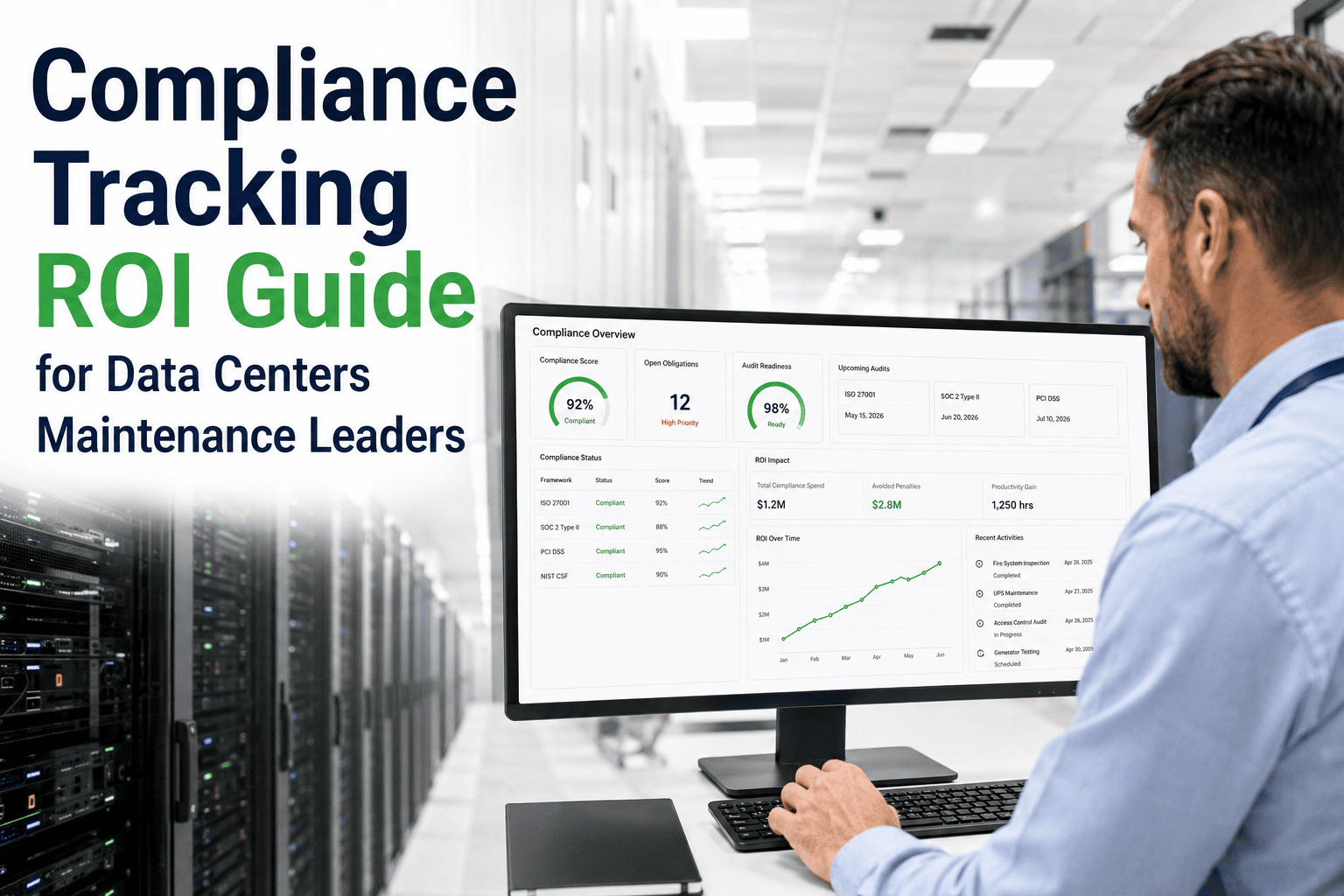
Every data center maintenance leader who has sat across the table from a SOC 2 or ISO 27001 auditor knows the moment the conversation shifts from policy review to evidence request — and how often the honest answer is a scramble through email threads, shared drives, and a fire suppression contractor's invoice from eleven months ago. Compliance frameworks rarely fail on intent; they fail on documentation, and a missed UPS load test, an undated generator inspection, or a fire suppression checklist with no technician sign-off is exactly the kind of gap that turns a routine audit into a qualified finding or a lost colocation contract. The stakes are real: per Uptime Institute's annual operator survey, the large majority of impactful facility outages are later judged preventable through better process discipline — the same discipline an auditor is checking for when they ask to see your inspection history. Oxmaint's compliance tracking module turns every inspection, test, and certification renewal into a scheduled, evidence-backed record that is audit-ready the moment a regulator or client assessor walks in, instead of three weeks after they ask for it. This guide breaks down exactly where data center compliance programs leak time and audit risk, what that leak costs in hours and findings, and how a structured CMMS-based compliance calendar closes it. If your last audit preparation took longer than the audit itself, book a 30-minute walkthrough and see how the conversion works against your own asset list.
Audits Are Not Won With Better Equipment. They Are Won With Better Records.
A SOC 2, ISO 27001, or NFPA assessor does not test whether your UPS works. They test whether you can prove, on demand, that it was tested, on schedule, by a qualified person, with the result on file.
Where Audit-Prep Hours Actually Go
Ask a facilities compliance lead how long audit prep takes and you will hear "a few weeks." Ask where those hours actually go and the answer is rarely the inspections themselves — it is everything built around proving they happened.
The Three Documentation Gaps That Fail Audits
None of these gaps are about whether the maintenance happened. They are about whether you can prove it happened, to someone who was not in the room.
Manual Tracking vs Oxmaint Compliance Tracking
The work itself rarely changes. What changes is whether the proof survives the months between when it happened and when someone finally asks for it.
| Compliance Task | Manual Tracking | Oxmaint Compliance Tracking |
|---|---|---|
| Evidence retrieval before an audit | Hours of searching email, spreadsheets, and vendor PDFs | One filtered export, organized by framework and asset |
| UPS and generator load test records | Logged in notebooks or shared drives, separate from the asset | Auto-logged to the asset with timestamp, technician, and result |
| Fire suppression inspection cadence | Tracked against a paper or spreadsheet calendar | Auto-scheduled by required interval, with overdue alerts |
| Visibility into upcoming lapses | Discovered after a certificate has already expired | Dashboard flags renewals 30, 60, and 90 days ahead |
| Framework mapping for SOC 2, ISO 27001, NFPA | Manually cross-referenced for every audit cycle | Each task pre-tagged to the control it satisfies |
Your Next Audit Should Take Hours to Prepare For, Not Weeks
Oxmaint's compliance tracking module turns every inspection, test, and renewal into a scheduled work order with built-in evidence capture — mapped to the framework it satisfies, ready before the assessor asks.
A Compliance Calendar That Runs Itself
Data center compliance is not one annual event. It is a stack of recurring obligations running at different speeds, and most programs only track the loudest one.
The Financial Case for Automated Compliance Tracking
Facilities teams that move from spreadsheet tracking to a scheduled, evidence-capturing compliance calendar typically see the change show up in three places.
Expert Review
In every failed audit I have reviewed, the equipment was rarely the problem. The generator had been tested. The UPS batteries had been checked. The fire suppression system was charged and within tolerance. What was missing was proof — a dated record tying the work to the asset, the technician, and the required interval. Facilities teams keep investing in better infrastructure and treating documentation as paperwork instead of as the actual deliverable an auditor is buying. A CMMS that schedules the task and captures the evidence in the same motion is not a nice-to-have for a data center; it is the difference between an audit that takes an afternoon and one that puts your SOC 2 status, your colocation contracts, and your insurance terms at risk.
Frequently Asked Questions
The Best Audit Is the One Where Nobody Has to Scramble
Oxmaint's compliance tracking module schedules the work, captures the evidence, and maps every record to the framework it satisfies — so your data center's audit-readiness stops depending on one engineer's memory.