Most manufacturing plants still run a calendar-based preventive maintenance program that changes parts on a fixed schedule whether they need it or not, while a smaller set of critical assets already stream live sensor data into a condition-based workflow that triggers work only when a threshold drifts. The practical answer is rarely one or the other — reliability engineers blend both across the asset register, weighting each machine's criticality, failure pattern, and monitoring cost. OxMaint lets you tier assets, assign time-based PMs to non-critical equipment, and wire condition-based triggers into the same work-order pipeline so nothing falls through. The fastest way to see how it fits your plant is to Start Free Trial and map your first 50 assets this afternoon.
CBM vs PM Decision Framework
Stop guessing which assets deserve sensors and which just need a calendar.
Time-Based PM Alone
- 42% of PM work orders change parts that still have useful life
- Labor spent on 1,200+ calendar triggers per quarter, regardless of asset state
- Critical failures still occur between fixed intervals
Tiered CBM + PM Mix
- 18–30% labor reduction by converting low-value PMs to condition triggers
- Critical assets monitored 24/7 — work orders fire on threshold breach
- One CMMS program, one audit trail, both strategies coexisting
The Core Difference
Two strategies, two trigger mechanisms, one program.
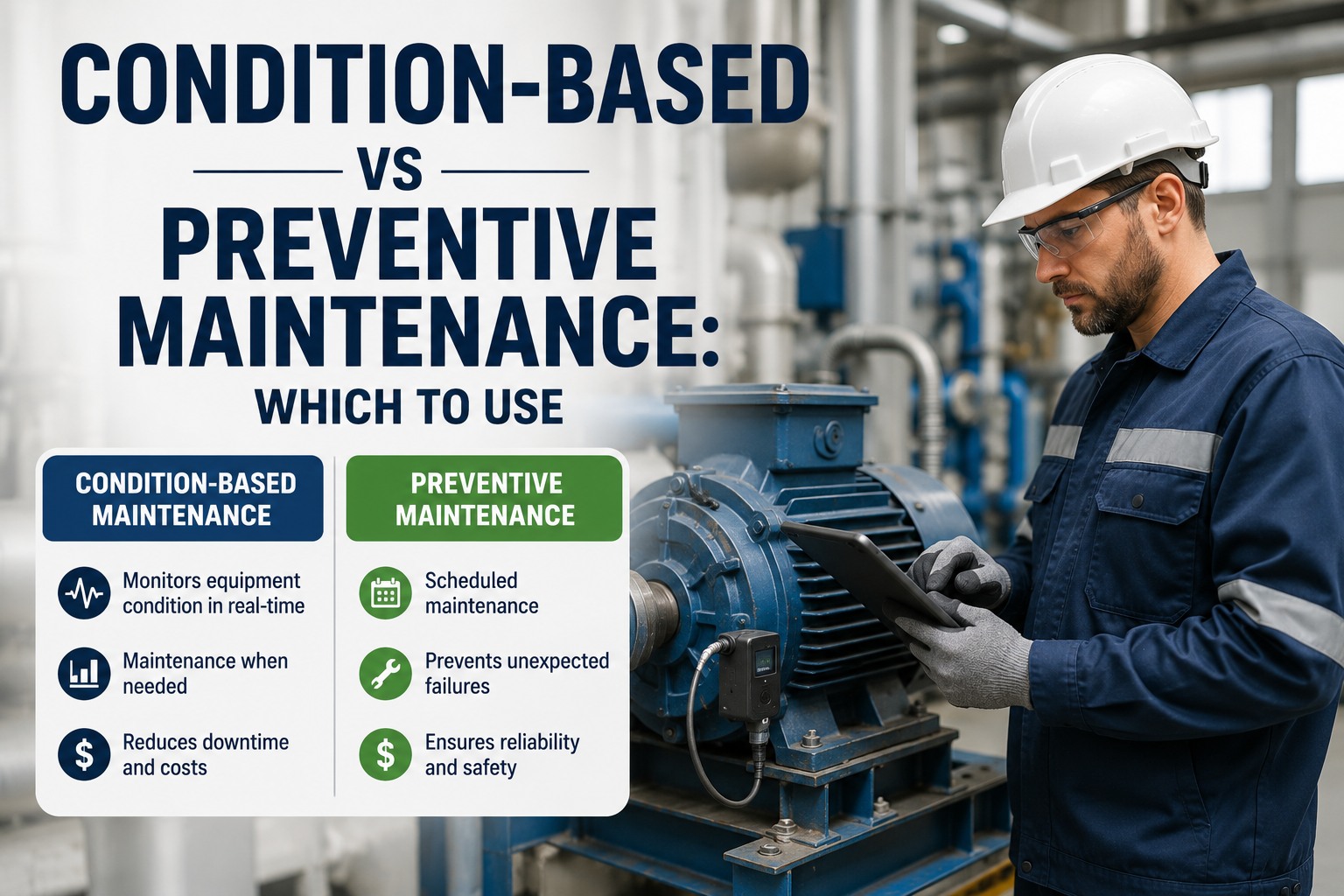
Preventive maintenance fires on a clock; condition-based maintenance fires on a signal. The decision is not philosophical — it is economic, and it varies asset by asset.
Preventive (Time-Based)
Work is scheduled at fixed intervals — every 90 days, 500 cycles, or 2,000 operating hours — regardless of the asset's actual condition. Best for assets with predictable, age-related failure patterns and low monitoring cost.
Condition-Based
Work is triggered when a monitored parameter — vibration, temperature, oil quality, pressure, ultrasonic emission — crosses a threshold. Best for critical assets where failure mode is detectable and downtime cost is high.
Side-by-Side Comparison
Where PM and CBM win, cost, and break down.
Use this matrix as the first-pass filter before you assign either strategy to an asset in the OxMaint register.
| Dimension | Preventive (PM) | Condition-Based (CBM) |
|---|---|---|
| Trigger mechanism | Calendar, runtime hours, or cycle count | Live sensor threshold or inspection reading |
| Upfront cost | Low — labor + parts only | Medium–high — sensors, gateways, analytics |
| Ongoing labor | High — 1,200+ PMs/quarter on a 180-asset plant | Low — only fires on deviation |
| Failure mode fit | Age-related, wear-out patterns (bathtub curve) | Random, degradation-signature failures |
| Unplanned downtime cut | 15–25% vs reactive | 35–55% vs reactive |
| Data requirement | OEM manual, historical MTBF | Baseline signature + continuous stream |
| Best asset tier | Non-critical, redundant, low-value | Critical, single-point-of-failure, high-impact |
| Audit trail | PM compliance % in CMMS | Threshold breach log + work order chain |
Myth vs Reality
Five beliefs that keep plants from the right mix.
Myth
CBM replaces PM entirely once you install sensors.
Reality
Even sensor-monitored assets need lubrication, filter swaps, and calibration PMs. The mix shifts, it does not invert.
Myth
Time-based PM is obsolete and wasteful.
Reality
For assets with clear age-related failure patterns, PM is cheaper than instrumenting them. The waste is applying PM blindly to every asset.
Myth
Condition monitoring requires a data science team.
Reality
Modern CMMS platforms like OxMaint ship with pre-built threshold rules for vibration, temperature, and oil — no ML pipeline required to start.
Myth
You must instrument 100% of assets before CBM pays off.
Reality
Instrumenting the top 15–20% of assets by criticality typically captures 70–80% of avoidable downtime.
Worked Example
A 180-asset plant spending $42K/yr on PM labor.
This is a composite drawn from mid-tier discrete manufacturing clients — the math generalizes to food, packaging, and CNC machining shops.
Before: 100% time-based PM
180 assets, all on 30/90/180-day PM cycles. The reliability team generates roughly 1,240 PM work orders per quarter. A spot audit of 200 completed PMs found that 38% of replaced parts — filters, bearings, seals — had remaining useful life beyond the next interval. Annual PM labor: $42,000. Unplanned downtime: 184 hours/year, concentrated on 12 critical assets that failed between intervals.
Tiered PM + CBM mix in OxMaint
Assets tiered by criticality: 28 critical assets (Tier A) received vibration and temperature sensors with condition-based triggers; 62 assets (Tier B) stayed on extended PM intervals (90→180 days where wear data supported it); 90 assets (Tier C) remained on standard PM. Quarterly PM count dropped from 1,240 to 760. Annual PM labor fell to $28,400. Unplanned downtime on Tier A assets dropped 61% in the first 9 months. Sensor + gateway CapEx: $18,200, payback inside 8 months.
$13.6K
Annual labor saved
61%
Downtime cut on Tier A
8 mo
Payback on sensor CapEx
Five-Step Decision Framework
How to assign each asset the right strategy.
Run every asset through this sequence. Most plants complete the first pass in a single afternoon inside OxMaint's criticality matrix.
Rank every asset by downtime impact
Score on a 1–10 scale for production loss, safety exposure, and lead time to replace. Anything scoring 8+ is a Tier A candidate for condition monitoring.
Classify the dominant failure mode
Pull 24 months of work-order history. If failures cluster around a predictable age, PM fits. If they are random with a detectable degradation signature, CBM fits.
Estimate sensor + integration cost per asset
A vibration sensor + gateway + CMMS integration typically runs $600–$1,400 per asset. Compare that to one year of avoided downtime on that machine.
Tier assets: A (CBM), B (extended PM), C (standard PM)
Most plants land on a 15/35/50 split. OxMaint's criticality matrix auto-suggests a tier once you enter downtime cost and failure history.
Re-tier quarterly using actual work-order data
Assets move tiers as failure patterns emerge. OxMaint flags any Tier C asset that racks up three unplanned work orders in 90 days — a signal to consider CBM.
Tier Your Assets Today
See your PM-to-CBM mix in under 15 minutes.
Import your asset register, run the criticality matrix, and OxMaint will draft a recommended PM + CBM strategy for every machine — free for 14 days.
Frequently Asked Questions
PM and CBM, answered straight.
Is condition-based maintenance always more expensive than preventive?
No. CBM has higher upfront cost — sensors, gateways, integration — but lower ongoing labor because work orders fire only on threshold breach. For a critical asset with high downtime cost, CBM is usually cheaper within 6–12 months. For a $4,000 ancillary pump with a spare on the shelf, PM remains cheaper indefinitely. You can model both paths in a free OxMaint workspace — Start Free Trial and run the numbers on your own assets.
Can I run both strategies in the same CMMS without duplicating work orders?
Yes. OxMaint treats PM triggers and CBM triggers as two input types into one work-order pipeline. A calendar trigger and a vibration threshold breach both generate the same work-order object, route through the same approval flow, and land in the same technician queue — no parallel systems.
How do I know which assets to instrument first for condition monitoring?
Start with the top 15–20% of assets ranked by downtime cost and failure frequency. OxMaint's criticality matrix surfaces these automatically once you import work-order history. Most plants find that instrumenting this slice captures 70–80% of avoidable downtime for a fraction of full-register sensor spend.
What sensors do I need for condition-based maintenance?
The big four are vibration (accelerometers for rotating equipment), temperature (RTD or thermocouple for motors and bearings), oil quality (dielectric or particle count for gearboxes), and pressure (for hydraulic and pneumatic lines). OxMaint integrates with all major sensor vendors over MQTT and OPC-UA — book a demo to walk through your specific stack.
Does moving to CBM mean I can drop my preventive maintenance schedule?
Never entirely. Even sensor-monitored assets need periodic lubrication, filter changes, and calibration checks that no sensor will trigger. The goal is a tiered program — CBM for degradation-driven failures, PM for age-driven wear — not a wholesale swap. Plants that abandon PM entirely usually see a spike in failures within 12–18 months.
Build Your Mixed Strategy
One CMMS for time-based PM and condition-based triggers.
OxMaint gives you the criticality matrix, the PM scheduler, the sensor integration, and the work-order pipeline — in one program. Start free, or let us walk you through a 30-minute demo on your asset register.
Free 14-day trial · No credit card