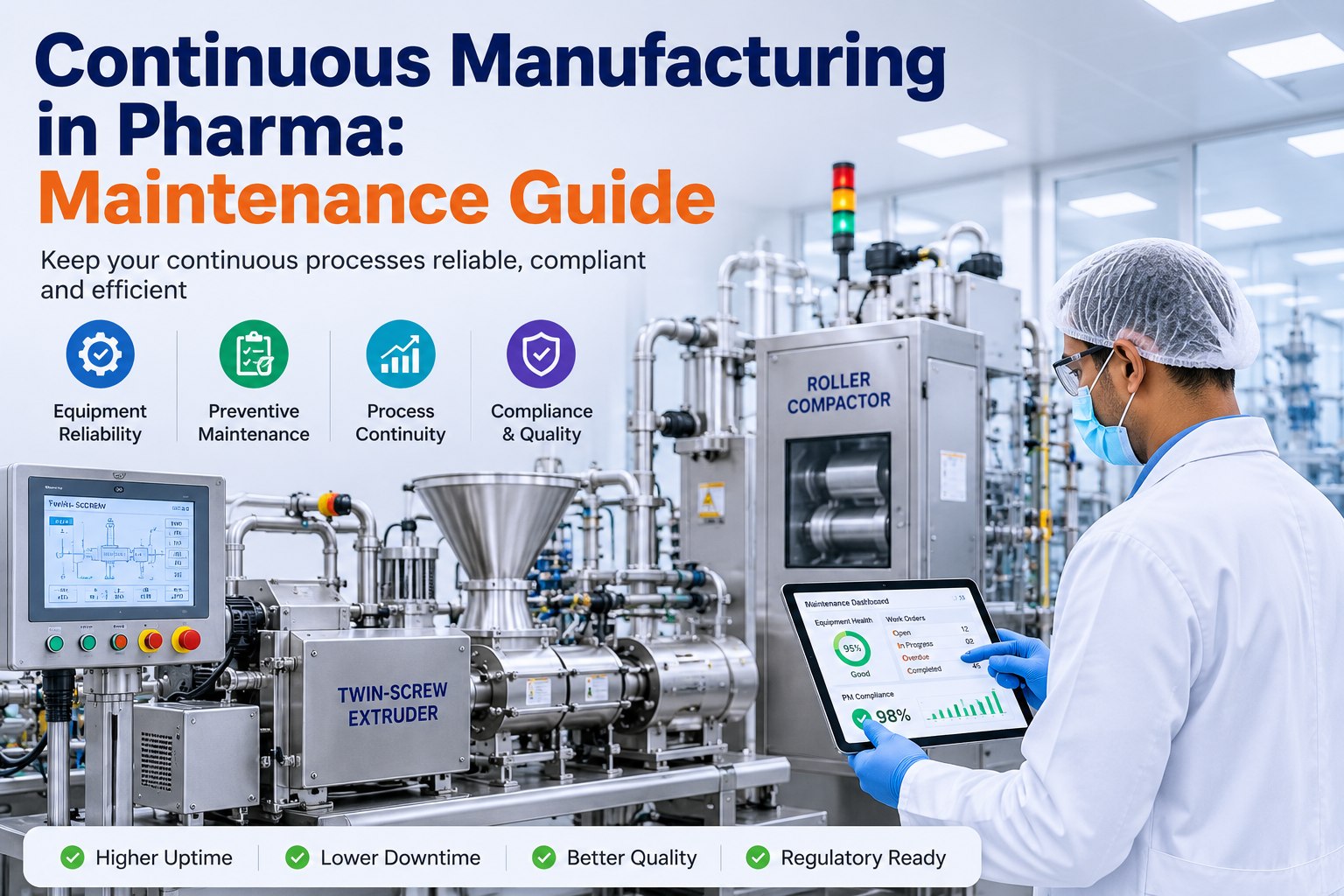
Continuous manufacturing is the most consequential process transformation the pharmaceutical industry has undertaken since the introduction of automated tablet presses. A batch process that historically took 60 to 180 days to convert raw API into packaged tablets — moving through wet granulation, drying, milling, blending, compression, and coating with dwell days between every step — can be executed on a continuous manufacturing line in 3 to 5 days of integrated flow, with better product quality, tighter process control, real-time release testing, and a plant footprint 40-60% smaller than the equivalent batch operation. Since the FDA's active encouragement of CM began in the mid-2010s and accelerated with ICH Q13 in 2023, more than a dozen commercial products have received approval for CM production, and virtually every major pharmaceutical manufacturer now operates or is building CM capability. But the transition changes the plant manager's job at a fundamental level. Traditional pharma maintenance is organized around batch cycles — clean between batches, service equipment during the changeover window, replace wear parts on batch counts. CM has no such windows. The line runs for days, sometimes weeks. Every hour of unplanned downtime translates directly into lost commercial supply of a life-critical product. This guide walks through the economics that make CM compelling, the process train architecture that maintenance must support, the twin-screw extruder wear discipline that determines reliability, the critical wear component cadence that separates a working CM line from a stalled one, and the PAT sensor maintenance framework that keeps real-time release testing functional. OxMaint gives pharma plant managers the CMMS platform that operationalizes CM-specific maintenance discipline. Book a free demo to see continuous manufacturing maintenance inside OxMaint.
Traditional Batch Process
Granulate
15 d
Dry
10 d
Mill
7 d
Blend
14 d
Compress
21 d
Coat
Total cycle: 60-180 days · discrete equipment · large footprint
Continuous Manufacturing
Feed
Granulate
Dry
Blend
Compress
Coat
Total cycle: 3-5 days · integrated train · 40-60% smaller footprint
Compressed timeline · integrated flow · but zero dwell time between operations · every hour of downtime cascades through the entire train
3-5 Days
continuous manufacturing production cycle · compared to 60-180 days for equivalent batch manufacturing
ICH Q13
the 2023 international guideline on continuous manufacturing · defines the regulatory framework every CM operation must satisfy
40-60%
reduction in plant footprint versus batch · higher throughput per square meter · lower capital cost per unit produced
The Continuous Manufacturing Process Train
A CM line for solid oral dosage is not a set of independent unit operations — it is an integrated train where each stage feeds the next in continuous flow. The reliability of the train is limited by the least-reliable stage. A twin-screw extruder that stops for a torque overload takes the entire line down. A loss-in-weight feeder that loses accuracy for four minutes disrupts the material ratio downstream for the duration of the process residence time. Understanding the train architecture is the foundation of CM maintenance planning — every asset must be reliable enough to sustain continuous operation, and every failure mode must be preventable through the CMMS. OxMaint stores each stage as a linked asset in the process train with its criticality tier and PM cadence flowing from its position in the flow. Start a free trial to model your CM process train inside OxMaint.
CM Process Train · Integrated Continuous Flow
01
LIW Feeders
API + excipient dosing · ±0.5% accuracy required
PAT: NIR content
02
Twin-Screw Granulator
Wet or dry granulation · continuous mixing
PAT: Torque · FBRM
03
Continuous Dryer
Fluid bed · residence-controlled · moisture target
PAT: NIR moisture
04
Continuous Blender
Homogenization · lubricant addition
PAT: NIR blend uniformity
05
Rotary Tablet Press
Compression · weight, hardness, thickness control
PAT: force · Raman
06
Continuous Coater
Film coating · spray dynamics · residence control
PAT: NIR coating weight
Each stage stored in OxMaint with its position in the train · train-level view shows which stage's PM window drives line-level scheduling
Twin-Screw Extruder — The Reliability Bottleneck
The twin-screw extruder is the mechanical heart of most continuous manufacturing lines, and its reliability tends to determine the overall reliability of the CM operation. Unlike batch equipment that sees intermittent operation with cleaning between batches, a CM twin-screw extruder can run continuously for days or weeks, with segmented screws experiencing high torque, thermal cycling in the multi-zone barrel, and progressive wear on the kneading blocks that do the actual granulation work. Understanding the anatomy — and the specific wear discipline each component requires — is the foundation of CM extruder maintenance. OxMaint holds every extruder as a multi-component asset with per-element wear tracking. Book a demo to see twin-screw extruder tracking inside OxMaint.
Twin-Screw Extruder Anatomy · Zones & Elements
Z3
Kneading Block A
160°F
Z4
Kneading Block B
180°F
Z5
Devolatilization
160°F
Z8
Die / Discharge
Product
Conveying elements · low wear · standard PM
Kneading blocks · highest wear · torque monitoring critical
Die / discharge · product-contact · CIP critical
Wear Component Discipline — What Fails and When
Continuous manufacturing exposes wear components to sustained operational stress that batch equipment never sees. A twin-screw extruder kneading block that would run for years on a batch line might need replacement every 3-6 months on a CM line running around the clock. A roller compactor roll surface degrades with every kilogram of material processed. A loss-in-weight feeder screw wears at a rate proportional to material abrasiveness and throughput. The wear cadence framework below reflects the discipline mature CM programs maintain — with condition-based replacement triggered by torque signature, particle size distribution shift, or accuracy drift rather than pure calendar cycles. OxMaint tracks every wear component against its usage counter and warning-sign triggers. Start a free trial to configure condition-based replacement inside OxMaint.
Critical Wear Components · Replacement Intervals & Warning Signs
TSE Kneading Blocks
3-6 months
Torque signature shift · granule size distribution change · vibration signature
TSE Conveying Elements
12-18 months
Barrel wall clearance measurement · reduced throughput at same RPM
Roller Compactor Roll Surface
4-8 months
Ribbon density variance · force required for target ribbon · visible surface pitting
LIW Feeder Screws
2-4 months
Accuracy drift beyond ±0.5% · higher screw RPM required for target rate
Tablet Press Tooling
50-150M tablets
Weight variance · thickness drift · visual defect rate · coating adherence
PAT NIR Probe Windows
Continuous cleaning · 6-mo replacement
Baseline drift · fouling signal · calibration deviation from reference
Every part logged against its usage counter · every warning-sign threshold monitored · condition-based replacement rather than pure calendar cadence
Every Element · Every Zone · Every Sensor — One Platform
OxMaint holds every wear component with its usage counter, warning-sign thresholds, and replacement history · CM reliability discipline captured as tracked operational data.
PAT Sensor Integration — Real-Time Release Testing Depends on This
Process Analytical Technology sensors are what make Real-Time Release Testing possible — and RTRT is what makes CM economics possible. NIR probes measuring content uniformity every second, Raman spectroscopy verifying API polymorph form, force sensors tracking every tablet compression, FBRM monitoring particle size distribution — collectively these instruments generate the continuous quality data that replaces batch-end laboratory testing. But every one of them requires disciplined maintenance to remain reliable: probes foul, calibrations drift, reference standards degrade, and window materials scratch. The framework below reflects the PAT maintenance discipline mature CM programs execute. OxMaint captures every calibration, verification, and cleaning as a work order against the specific instrument. Book a demo to see PAT sensor discipline inside OxMaint.
PAT Sensor Maintenance Framework
NIR Spectroscopy
Content uniformity · moisture · blend homogeneity
Daily verification · weekly calibration check · 6-month window replace
Raman Spectroscopy
API polymorph · impurity screening · reaction monitoring
Daily wavelength calibration · weekly reference verify · annual major PM
FBRM · Particle Size
Real-time particle size · granulation endpoint
Daily focus verify · weekly probe clean · monthly full calibration
Torque & Force Sensors
Extruder torque · tablet press force · compaction monitoring
Weekly zero-point · quarterly load-cell verify · annual full recalibration
Weight & Flow
LIW feeder accuracy · line-flow monitoring · mass balance
Daily test-weight check · weekly calibration · quarterly full verification
Temperature & Humidity
Barrel zones · dryer conditions · coater environment
Quarterly PT100 verification · annual reference cross-check
Every calibration event captured in OxMaint · every drift trend visible · RTRT audit response is a report export, not a manual reconstruction
Plant Manager Perspective · Why Reliability Discipline Changes Everything
Moving from batch to continuous manufacturing is not primarily a technology decision. It is a reliability discipline decision. When we ran batch, every product cycle had built-in windows for maintenance, changeover cleaning, and equipment attention — the process itself created dwell times we could exploit for reliability work. Continuous manufacturing has none of that. The line runs for three to five days, and every hour of unplanned downtime translates into commercial supply impact for a product that patients are actively depending on. What that meant for our reliability program was a complete reorganization of how we thought about maintenance. Every wear component on the line had to have a defined replacement trigger. Every PAT sensor had to have a defined calibration cadence. Every barrel zone had to have a defined temperature verification schedule. And every one of those disciplines had to be tracked as operational data because the FDA under ICH Q13 expects to see the reliability program as continuous evidence, not annual reconstruction. When we moved to OxMaint, that operational transformation happened cleanly. Every wear component now has its usage counter and its replacement trigger. Every PAT sensor has its calibration schedule and its drift trend visible. Every barrel zone has its temperature verification history. Our first ICH Q13 audit response was a report export. That is what CM maintenance actually looks like when the reliability program is operationalized in a modern CMMS.
Condition-Based Replacement
OxMaint captures usage counters and warning-sign triggers for every wear component · replacements execute when the equipment says so.
Every Calibration Tracked
PAT instrument calibration history captured per probe · drift trends visible for RTRT continuity.
ICH Q13 Audit-Ready
Regulatory response produced from tracked operational data · not reconstructed from binders when the FDA arrives.
Make Your CM Line Reliable Enough for Commercial Supply
If your continuous manufacturing reliability program still runs on batch-era spreadsheets, calendar-triggered PMs, and manual calibration binders, you are carrying preventable supply-continuity risk into every product campaign. See what OxMaint — a CMMS built for continuous pharmaceutical manufacturing — looks like against your line.
Frequently Asked Questions
How does continuous manufacturing change maintenance?
Fundamentally. Batch manufacturing creates built-in maintenance windows between batches — equipment sits idle during cleaning, changeover, and holding periods, giving reliability teams natural intervention windows. CM runs continuously for 3-5 days at a stretch, with no dwell time between operations. Every wear component must have condition-based replacement triggers rather than calendar cycles, every PAT sensor requires disciplined calibration cadence, and every hour of unplanned downtime cascades through the entire integrated train.
What is ICH Q13 and why does it matter?
ICH Q13 is the 2023 international guideline on Continuous Manufacturing for Drug Substances and Drug Products, adopted by regulatory authorities in the US, EU, Japan, and other ICH regions. It provides the regulatory framework every CM operation must satisfy — covering process design, control strategy, equipment reliability, PAT integration, and Real-Time Release Testing. FDA inspectors examine CM operations against Q13 expectations, and reliability program documentation is a specific focus area during inspection.
Why does the twin-screw extruder drive CM reliability?
Because it typically has the highest wear rate on the CM line and the tightest process control requirements. Segmented screws with kneading blocks experience high torque and thermal cycling; wear on kneading elements shifts granulation performance in ways that appear as PAT drift downstream; and unplanned torque overloads take the entire line down. Extruder reliability commonly determines overall CM line reliability, which is why mature programs treat every screw element as a separately-tracked wear component with condition-based replacement triggers.
How are LIW feeders maintained on a CM line?
Loss-in-weight feeders require ±0.5% accuracy at continuous operation, which is a demanding specification that degrades progressively with screw wear and material abrasion. Standard practice: daily test-weight verification against a calibrated reference; weekly full calibration; feeder-screw replacement every 2-4 months depending on material and throughput; refill dynamics validated during any commissioning; accuracy drift beyond ±0.5% triggers immediate investigation. OxMaint tracks accuracy trend per feeder so drift patterns are visible before they become process excursions.
What PAT sensors are used on a typical CM line?
Six primary categories: NIR spectroscopy (content uniformity, moisture, blend homogeneity); Raman spectroscopy (API polymorph verification); FBRM particle size analyzers (granulation endpoint); torque and force sensors (extruder torque, tablet press force); weight and flow sensors (LIW feeder accuracy, mass balance); temperature and humidity sensors (barrel zones, dryer, coater). Each requires its own maintenance cadence — daily verification, weekly calibration checks, and periodic full recalibration on defined schedules.
Can a batch CMMS support continuous manufacturing?
Generic batch CMMS platforms miss the specific operational disciplines CM requires: per-element wear tracking on segmented extruder screws; condition-based replacement triggers driven by PAT signal drift; usage counters that continue accumulating across days-long production runs; RTRT-supporting calibration histories per instrument; and ICH Q13-ready audit response formats. OxMaint's CM configuration handles all of this as native operational discipline rather than workarounds against batch-oriented data structures.