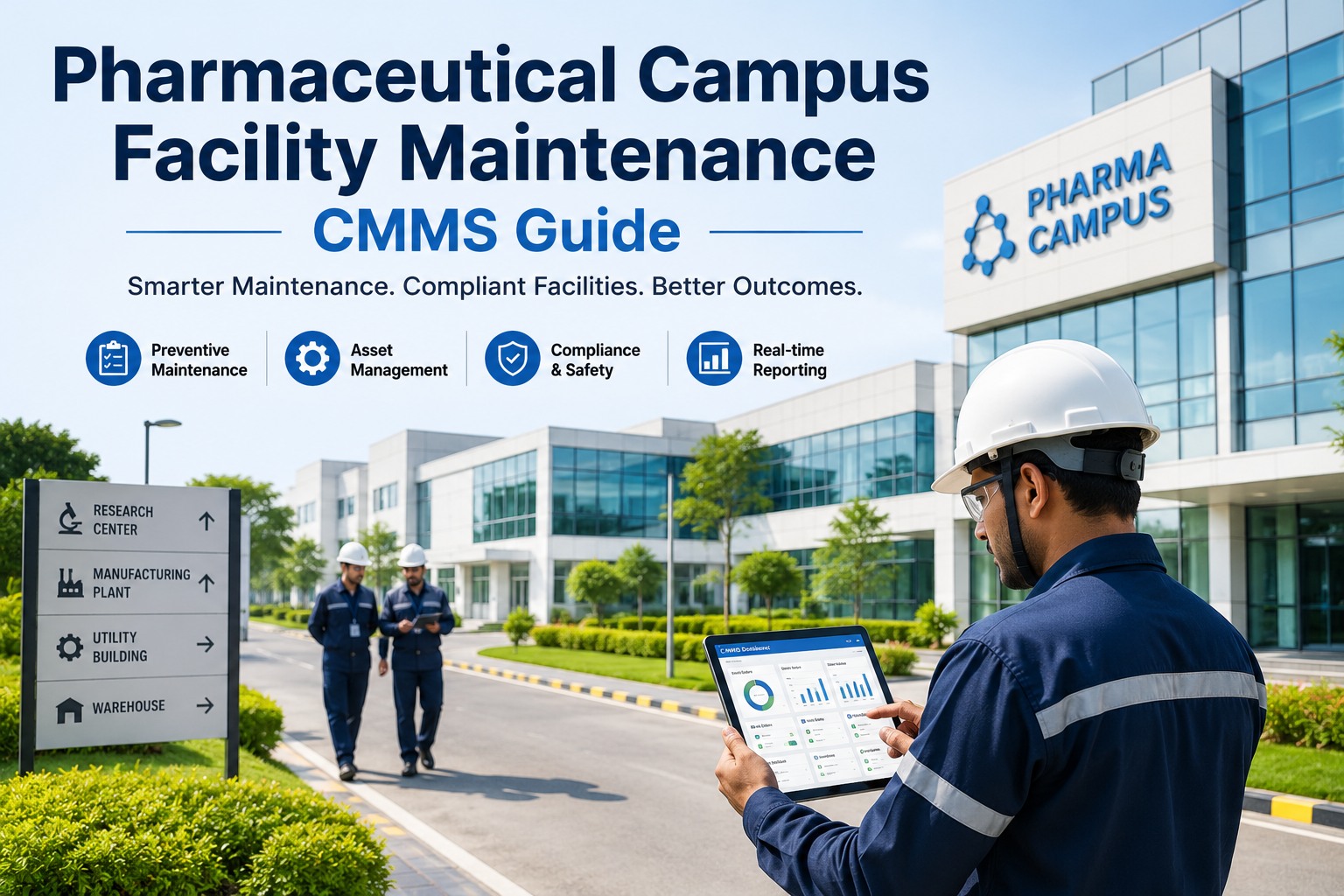
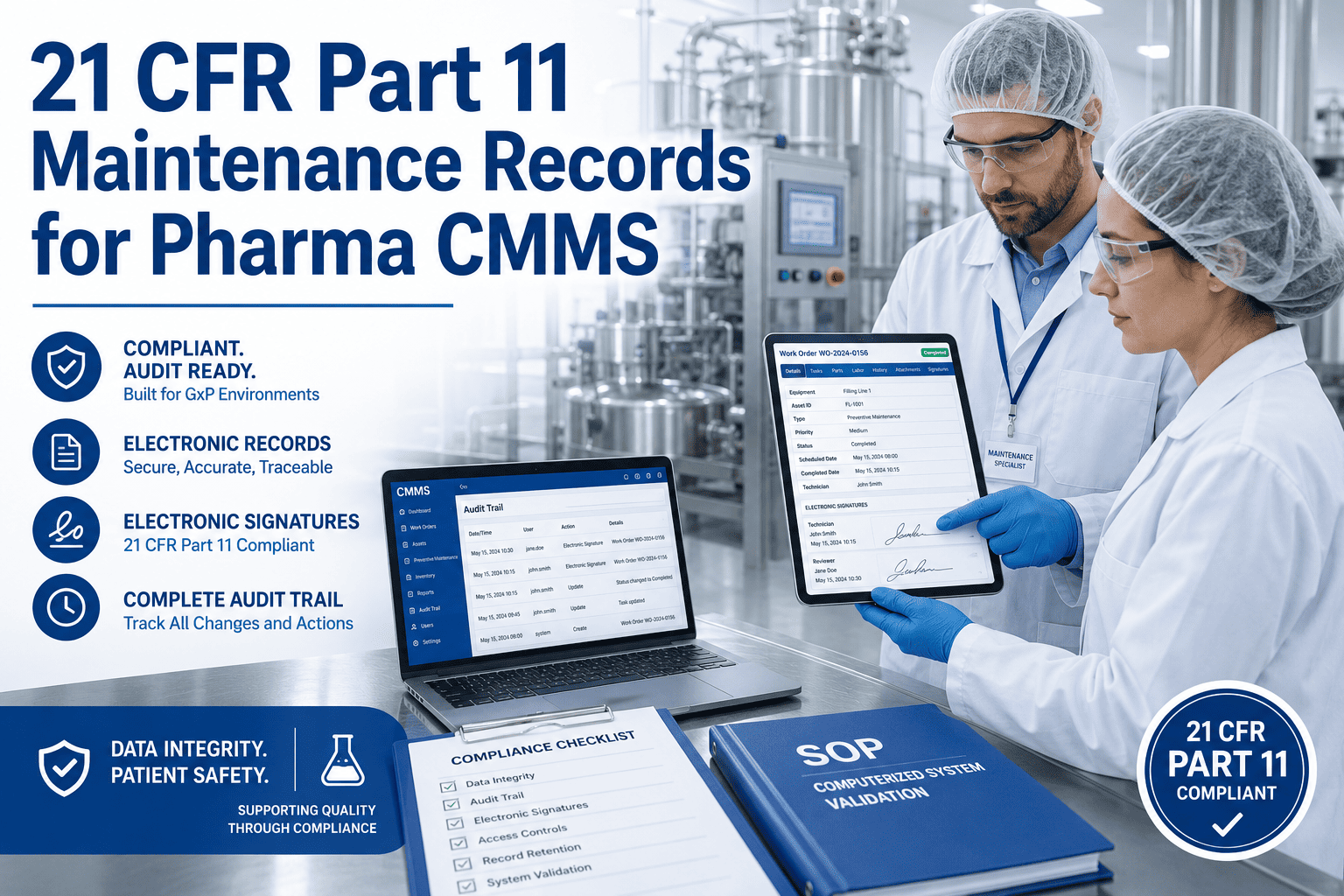
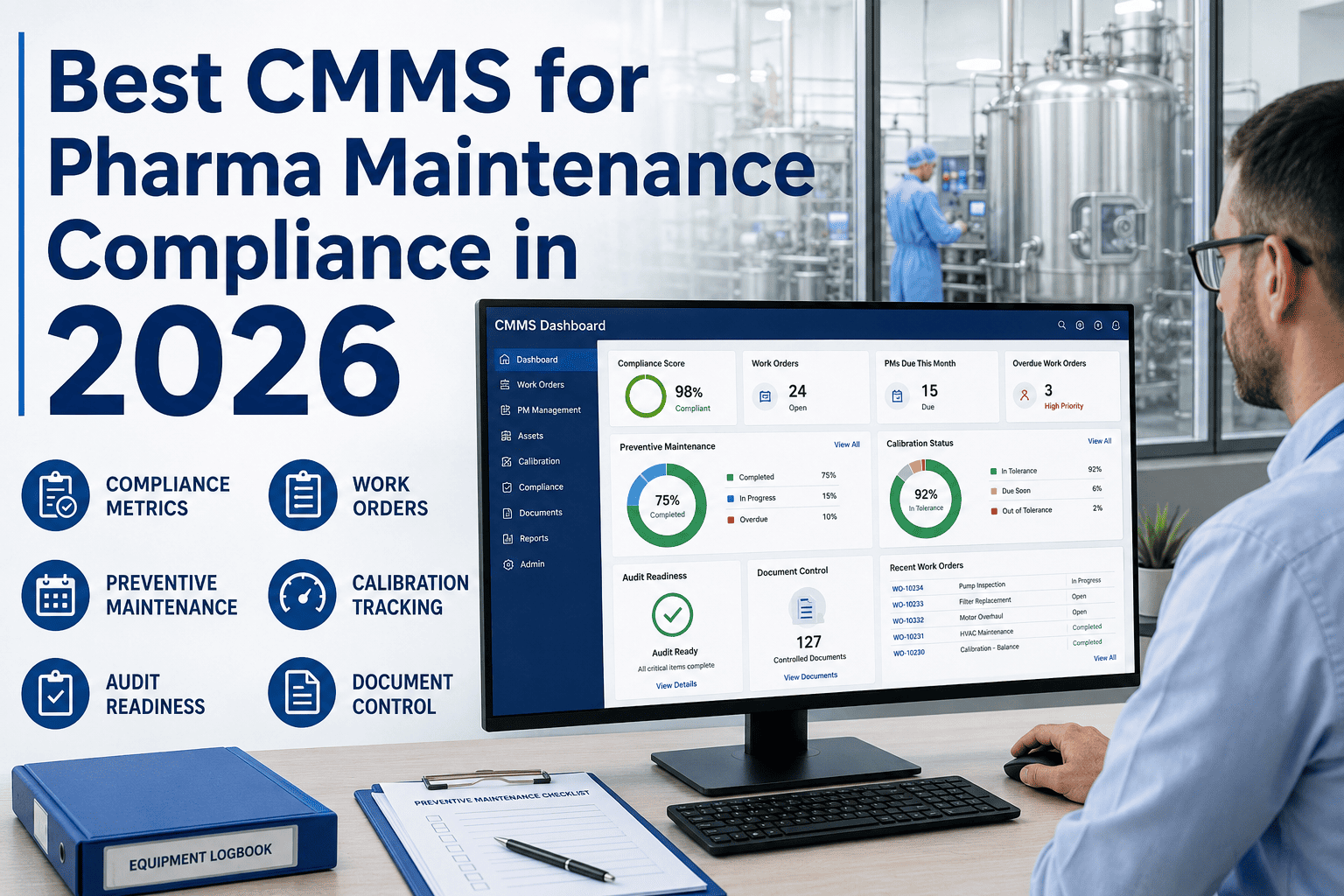
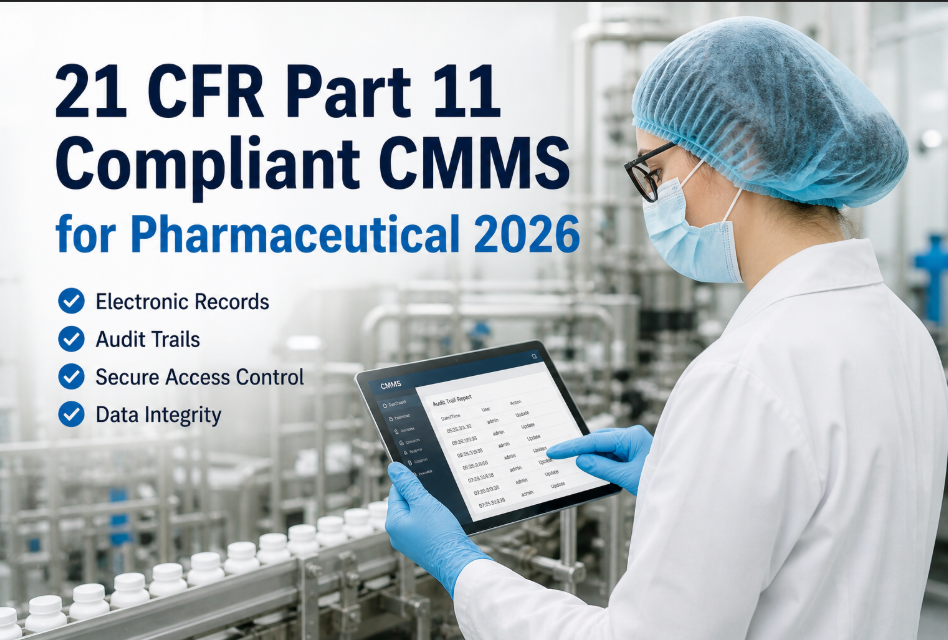
In pharmaceutical manufacturing, maintenance is inseparable from quality. A missed HEPA differential pressure check, an undocumented calibration, or a work order closed without proper sign-off can trigger batch holds, investigation workload, and audit observations that cost far more than the repair itself. Modern pharma teams are expected to prove control: who did what, when, why, and under which approved procedure — with complete, tamper-evident records. That is why “best CMMS for pharmaceutical manufacturing” in 2026 means more than work orders and PMs; it means 21 CFR Part 11-ready electronic records, GMP-aligned inspections, validated workflows, and audit-first reporting. If you want to see how a single platform can standardize GMP maintenance execution and documentation across your facility, you can start a free trial or book a demo.
Pharma CMMS · GMP Maintenance · 21 CFR Part 11 · Audit-Ready Documentation
Best CMMS for Pharmaceutical Manufacturing 2026
A pharma CMMS must control documentation as tightly as it controls work. In 2026, the best platforms combine GMP-ready inspections, electronic signatures, tamper-evident audit trails, and validation support — while still delivering fast work order execution and preventive maintenance performance.
4.8x
Emergency repairs cost more than planned work
Higher spend + higher compliance risk during unplanned events
90%+
PM compliance target in regulated plants
Below 85% typically drives repeat deviations and repeat failures
24–48h
Typical internal SLA for critical utility fixes
Compressed timelines demand mobile-first execution
21 CFR
Electronic records expectations
Audit trail + controlled access + e-signature readiness
Want to see our business, get a free trial for 30 days and book a demo.
If your team is chasing calibration records, paper checklists, and spreadsheet PM trackers, you are carrying avoidable audit risk. See how Oxmaint centralizes GMP documentation, inspections, and work order execution — start a free trial or book a demo.
Definition
What Is a Pharmaceutical CMMS?
Operational Definition
A CMMS that supports GMP execution, not just maintenance tracking
A pharmaceutical CMMS is a maintenance and asset management platform designed to run preventive maintenance, calibrations, inspections, and corrective work in a way that supports regulated documentation. It must maintain technician history, link tasks to specific assets and procedures, and provide audit-ready evidence (timestamps, approvals, attachments, and controlled changes).
Teams moving from reactive to planned work reduce emergency spend by up to 4.8x per event
Compliance Reality
In pharma, “done” means documented, reviewable, and traceable
In regulated facilities, the risk is not only equipment failure — it is missing proof. The best CMMS platforms in 2026 make documentation unavoidable: required fields, inspection checklists, attachments, signatures, and an audit trail that supports internal QA review and external audits.
Best-in-class regulated teams target 90%+ on-time PM completion to reduce repeat deviations
Evaluation Framework
The 8 Must-Have Capabilities in the Best Pharma CMMS (2026 Checklist)
Use this as your CMMS selection scorecard. In pharma, missing any one of these creates either audit exposure, downtime exposure, or both.
01
Electronic Signatures & Audit Trail
Every status change and approval is time-stamped and attributable. Essential for controlled records and review workflows.
Targets: 100% traceability for critical tasks
02
GMP Inspection Checklists
Digital inspections with required steps, pass/fail logic, and attachment capture (photos, readings, certificates).
Cuts missing-field closures by 60%+
03
Calibration & Certification Tracking
Schedule calibrations, store certificates, and link evidence to each asset and work order for fast retrieval.
Audit retrieval time drops from hours to minutes
04
Asset Hierarchy & Criticality
Model utilities, systems, and equipment with consistent naming and criticality scoring to prioritize work correctly.
Improves planning accuracy by 20–30%
05
Change Control Support
Control changes to procedures, PM templates, and inspection forms with versioning and approvals.
Reduces “procedure drift” across shifts
06
Spare Parts + MRO Procurement
Track parts usage to prevent delays; link parts to assets; prevent line stoppages due to stockouts.
Stockout-driven downtime can drop 15–25%
07
Mobile-First Execution
Technicians capture readings, attach evidence, and close tasks correctly in the field without end-of-shift paperwork.
Cuts closeout lag by 30–50%
08
Reporting for QA, Ops, and Leadership
Dashboards for PM compliance, deviations, backlog, and asset condition. Different views for different stakeholders.
Faster decisions with weekly KPI cadence
Where Pharma Plants Feel It
Pharmaceutical Maintenance Pain Points (and the Data They Create)
Documentation Risk
Work done, but not provable
Paper checklists and manual sign-offs create gaps: missing fields, missing dates, missing attachments, and hard-to-verify edits.
Goal: 0 missing-required-field closures on GMP-critical tasks
Batch Impact
Utilities failures become production holds
Compressed air, purified water, HVAC, and critical chillers drive environmental control; failures can trigger investigations and downtime.
Emergency work averages 4.8x the cost of planned work
Calibration Burden
Certificates scattered across drives
When certs live in email threads and shared folders, audit retrieval becomes a scramble and evidence completeness becomes uncertain.
Target: retrieval in under 5 minutes per asset
Shift-to-Shift Drift
Procedures change, execution does not
Without template governance, PMs vary by technician and shift. That inconsistency shows up as repeat failures and audit questions.
Target: 90%+ on-time PM compliance across lines
How Oxmaint Fits
How Oxmaint Supports GMP Execution + 21 CFR Part 11 Expectations
Oxmaint is a modern CMMS and asset management platform designed for commercial and industrial operations. For pharmaceutical environments, the focus is controlled maintenance execution, inspection evidence, and audit-ready documentation.
A
Digital inspections with GMP alignment
Build inspection flows tied to assets, enforce required fields, and capture readings and attachments at the point of work.
Improves completeness on critical inspections
B
Audit-ready documentation + signatures
Track technician history, timestamps, approvals, and sign-offs so closure evidence is consistent across teams.
Reduces audit prep time per audit cycle
C
Preventive maintenance scheduling tied to assets
PMs live on the asset record. History, failures, parts usage, and inspection outcomes stay connected for traceability.
Goal: sustain 90%+ on-time PM rate
D
Condition scoring + lifecycle tracking
Condition-based lifecycle tracking improves replacement timing and reduces “surprise failures” on critical utilities.
Supports 5–10 year CapEx planning
E
Parts inventory + MRO workflows
Reduce stockouts, track MRO consumption, and tie parts usage to work orders for cost and traceability.
Cuts downtime caused by parts delays
F
Mobile-first multi-team execution
Technicians complete tasks, capture evidence, and close work immediately in the field—reducing end-of-shift closeout debt.
Cuts closeout lag by 30–50%
If your CMMS is strong on work orders but weak on controlled documentation, the gap shows up during audits and investigations. To see how Oxmaint supports pharma-grade execution and documentation, book a demo or start a free trial.
Before vs After
Reactive vs Planned Maintenance in Pharma (What Changes Fast)
| Dimension |
Reactive / Paper-Heavy |
Planned / Audit-Ready with Oxmaint |
| PM execution |
PMs missed or closed late; manual follow-up required |
Asset-based PM scheduling with compliance dashboards |
| Evidence capture |
Attachments and readings stored outside the work order |
Digital inspections + attachments tied to the asset record |
| Approvals and signatures |
Inconsistent sign-offs; hard to prove closure control |
Audit-ready documentation with digital signature workflows |
| Deviations and repeat failures |
Hard to identify systemic failure patterns quickly |
Technician history + work order analytics highlight repeat issues |
| Parts readiness |
Expedites and stockouts drive downtime |
Inventory + MRO procurement prevents avoidable delays |
| CapEx planning |
Replacement timing based on age or anecdotes |
Condition scoring + lifecycle tracking for 5–10 year forecasts |
| Audit prep |
Days of searching and printing |
Fast retrieval from asset-centric maintenance history |
| Cost of unplanned work |
Emergency repairs at 4.8x planned costs |
Higher planned ratio reduces emergencies and stabilizes spend |
ROI Strip
ROI and Results Maintenance Leaders Track After CMMS Upgrade
30–50%
faster work order closeout
Mobile-first completion reduces end-of-shift backlog
90%+
PM on-time rate
Sustained compliance reduces repeat failures and deviations
15–25%
less parts-driven downtime
Inventory visibility + reorder discipline reduces stockouts
5–10 yr
CapEx forecast horizon
Condition-based lifecycle tracking supports planning
Shortlist
How to Shortlist the “Best” CMMS for Pharma Without a 6-Month Evaluation
Step 1 (Week 1)
Define your regulated work categories
List the work types that require strict evidence: calibrations, GMP inspections, utilities checks, environmental monitoring support tasks, safety critical PMs. Build a “must-have evidence” requirement list per category.
Target: identify top 20% of tasks driving 80% of audit questions
Step 2 (Week 2)
Score platforms against documentation control
Ask: Can you enforce required fields? Attach evidence at point of work? Maintain technician history? Produce audit-ready exports quickly? If not, it is not a pharma-grade CMMS.
Goal: reduce audit prep time by 50% per cycle
Step 3 (Week 3)
Validate mobile execution in the field
If technicians cannot complete tasks correctly on mobile, you will recreate paperwork. Test closure steps, attachments, checklists, and approvals on real assets.
Target: 30–50% closeout speed improvement
Step 4 (Week 4)
Prove reporting for QA + Ops
QA wants evidence completeness and audit trails. Ops wants uptime, backlog, and response times. Leadership wants costs, CapEx, and risk. Your CMMS must support all three perspectives.
Target: weekly KPI review with under 10 minutes of prep
If you want a faster path, see how Oxmaint is structured for industrial maintenance with audit-ready documentation. You can start a free trial or book a demo and map your asset hierarchy and GMP workflows in one session.
FAQs
Best CMMS for Pharmaceutical Manufacturing — Common Questions
What makes a CMMS “pharma-ready” compared to a general CMMS?
Pharma-ready CMMS platforms prioritize controlled documentation: structured inspections, enforceable completion fields, traceable technician history, and audit-oriented reporting. General CMMS tools often track work orders but struggle with consistent evidence capture at closure. If your operation targets 90%+ PM compliance, the CMMS must make the correct workflow the easiest workflow.
How does a CMMS reduce audit prep time?
Audit prep shrinks when evidence is attached directly to each work order and tied to the asset record: readings, checklists, certificates, and sign-offs in one place. Instead of searching folders and emails, teams filter by asset, date, and task type. If you want to see what “fast retrieval” looks like in practice,
book a demo.
Can we run PMs by production triggers instead of calendar scheduling?
Yes. Production-based maintenance triggers (units, cycles, hours) reduce both over-maintenance and under-maintenance. This matters in pharma where changeovers and run hours can vary widely. To test production-based PM triggers in your environment, you can
start a free trial.
How does Oxmaint support multi-area plants (utilities, packaging, process, warehouses)?
Oxmaint’s asset hierarchy (Portfolio > Property > System > Asset > Component) makes it easier to segment utilities, process equipment, packaging lines, and facilities while keeping reporting consistent. That structure enables site leaders to see portfolio rollups while supervisors focus on their area-level backlogs and PM compliance.
Choose a CMMS That Helps You Pass Audits and Hit Uptime Targets
Oxmaint combines modern CMMS execution with audit-ready documentation, digital inspections, and lifecycle reporting. Want to see our business, get a free trial for 30 days and book a demo. You can start a free trial or book a demo.