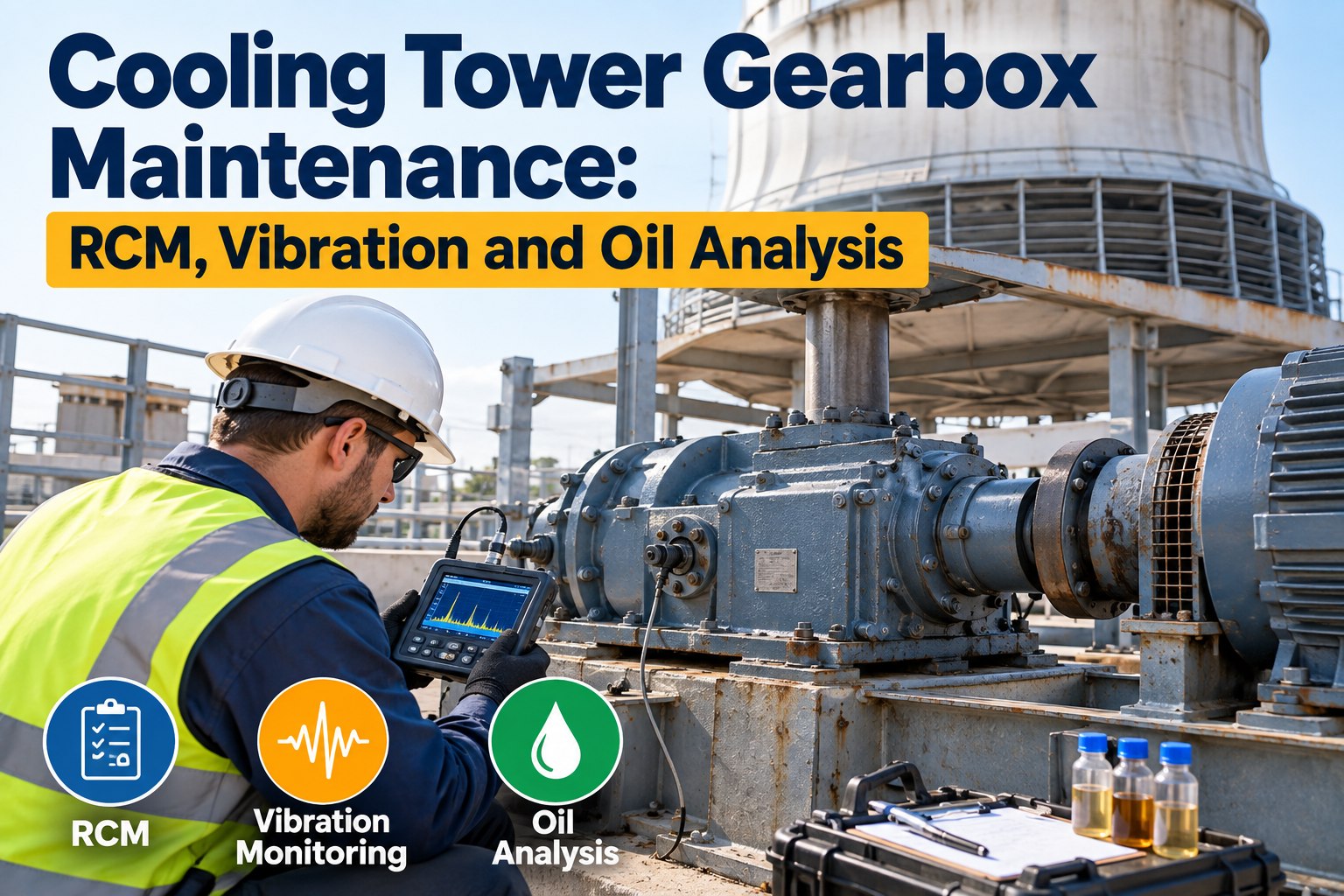
A cooling tower gearbox rarely waits for daylight to announce a problem. On night shift, the first warning may be rising fan-deck vibration, hot oil odor, a drive alarm, or a cell that cannot hold process-water temperature. Effective cooling tower gearbox maintenance depends on determining whether the source is internal gear damage, bearing distress, fan imbalance, alignment error, structural looseness, contamination — or simply a bad sensor. Oxmaint AI connects vibration, oil analysis, inspection findings, operating load, weather context, and maintenance history, giving operators, reliability teams, and planners a traceable path from an abnormal signal to a ranked failure hypothesis and a planner-ready work order in Maximo, SAP, or the site CMMS.
Cooling Tower · RCM Overlay · Gearbox PdM · 2026
Cooling Tower Gearbox Maintenance: Signal to Work Order
Oxmaint AI is an AI RCM overlay on Maximo, SAP, or your site CMMS — it fuses vibration, oil, inspection, load, and weather evidence into a ranked failure hypothesis, then drafts a planner-ready work order. Not a second system of record.
1 Timeline
vibration, oil, inspection, load, weather & EAM aligned
6 Modes
failure-mode groups drive the planner queue
5 Domains
evidence classes fused per diagnosis
90 Days
pilot the workflow without replacing systems
Maintenance Built Around Operating Context
Right-angle spiral-bevel and helical stages beneath the fan face humidity, aggressive air, difficult access, water intrusion, and long drive-shaft alignment. A generic alarm threshold can't cover every configuration — oil grade, backlash, allowable vibration, and alignment tolerance must come from the installed manual, nameplate, and site standard. Start free on your current stack — no rip-and-replace.
Generic Alarm Threshold
The Way It Fails
✕ One alarm turned into a diagnosis
✕ No account for oil grade, backlash or geometry
✕ Vibration, oil & inspection live apart
✕ Gear damage confused with fan imbalance
✕ Fine-iron results miss spalling debris
✕ P-F interval consumed by diagnosis & access
✕ More alerts, not more actionable ones
Oxmaint AI Overlay
The Way It Works
✓ Competing hypotheses ranked, not one alarm trusted
✓ Limits read from manual, nameplate & drawings
✓ One traceable, time-aligned timeline
✓ Speed-referenced measurements separate the causes
✓ PQ, ferrous density & ferrography catch what fine-iron misses
✓ Actionable deterioration flagged before P-F is spent
✓ Ranked WO drafts pushed into Maximo/SAP
The Required Functions an RCM Program Protects
The objective is not more alerts, but actionable deterioration caught before the P-F interval is consumed by diagnosis, access, and parts. An RCM program should protect the gearbox's required functions. Book a demo to map these functions to your cells.
01
Deliver enough fan torque and speed to meet cooling demand
02
Maintain the specified reduction ratio and direction
03
Support shafts within approved alignment, endplay & clearance limits
04
Maintain an adequate lubricant film while controlling contamination & temperature
05
Contain oil and exclude water, dust & chemical contaminants
06
Withstand fan thrust, torque transients, structural vibration & aerodynamic loading
07
Provide reliable condition evidence early enough to plan intervention
08
Oxmaint AI is an AI RCM overlay — Maximo, SAP, or another CMMS remains the system of record for asset hierarchy, approvals, labor, materials, execution & closeout
What This Looks Like in Oxmaint AI
Oxmaint AI is an AI RCM overlay — not a second CMMS. Every item stays traceable to its source, timestamp, operating state, and asset ID. Three panes carry the workflow from evidence to a released work order. Sign up free and see the three panes on your assets.
Pane 1
Timeline
Aligns route vibration, online sensor data, oil lab results, operator observations, process load, weather, lubricant additions & Maximo/SAP work history — e.g. mesh sidebands up after the last fan/coupling outage, rising ferrous density while fine iron stays flat, and no matching rise on the adjacent cell.
Pane 2
Signal→Confidence
Ranks competing failure hypotheses instead of turning a single alarm into a diagnosis. Confidence rises when vibration, oil, temperature, inspection & maintenance-event evidence agree; it falls when speed reference, sampling quality, sensor health, or operating context is missing.
Pane 3
Suggested WO
Prepares a planner-ready draft with the problem statement, ranked causes, attached evidence, access requirements, task sequence, parts hints, operating limits & post-work acceptance criteria. The planner reviews before releasing through Draft WO → Maximo or SAP.
Confidence
74% Fusion Example
Repeatable impacts, mesh modulation & rising ferrous mass support gear/bearing distress; elevated fan-speed order plus recent blade work support external forcing; portable measurements argue against sensor failure; an open gap remains as backlash and indexed borescope checks are incomplete. Triage output — not an OEM limit or root cause.
Overlay Positioning — Not a Second CMMS.
Asset masters, cost centers, inventory, and settlements stay in your EAM. Oxmaint AI owns living failure-mode history, JA1011-style task selection, and ranked WO drafts that push into Maximo or SAP. Maximo, SAP, or the site CMMS remains the authoritative work-order system.
Cooling Tower Gearbox Failure Modes
These modes often resemble one another. Fan imbalance is dominated by one-times running speed; gear damage produces mesh harmonics, sidebands, and debris; looseness creates running-speed harmonics with unstable phase; a bearing defect tracks repeatable impacts. Book a demo to map these six modes to your queue.
Oil evidence also requires care. Elemental spectroscopy can under-report large particles from a spalling or cracked gear. PQ, ferrous density, patch microscopy, magnetic-plug inspection, or analytical ferrography may identify deterioration that fine-iron results miss.
RCM Task Intervals — Use P-F Evidence, Not a Generic Calendar
Continuous monitoring is justified where consequences are high and access is difficult. On portable routes, an accelerating trend or agreement between independent evidence streams should trigger immediate confirmation, not the next scheduled route. Sign up free and configure intervals against your P-F evidence.
Signals That Support a Defensible Diagnosis
Oxmaint AI fuses five evidence domains using site-configured logic. These are illustrative weights, not universal limits. Overall vibration alone isn't enough — analysis may need enveloping, order tracking, synchronous averaging, phase, and reliable speed references. Book a demo to see the weighting on your evidence.
30%
Vibration spectrum, waveform, phase & speed-order evidence
25%
Oil condition, ferrous mass & particle morphology
20%
Visual, borescope, leakage, alignment & structural inspection
15%
Temperature, load, speed & process context
10%
Maintenance history, event timing & sensor-quality checks
Likewise, cooling tower gearbox oil analysis should document lubricant identity, sample location, oil temperature, additions, operating hours, and sampling method.
From Abnormal Signal to Maximo or SAP Work Order
The overlay flow preserves both engineering judgment and CMMS governance. Priority reflects consequence and evidence, and safety planning must cover lockout/tagout, automatic starts, fan windmilling, work at height, and mechanical restraint. Sign up free and run the flow on one cell.
01
Connect Evidence
Aligns condition data, process context, inspections, alarms & maintenance events by asset and operating state.
02
Rank Hypotheses
Internal gear or bearing distress is compared with fan imbalance, misalignment, structural looseness, contamination & sensor error.
03
Define Evidence Gaps
Identifies missing speed references, oil tests, phase readings, borescope images, alignment data or sensor validation.
04
Prepare Suggested WO
The draft includes the asset, operating condition, measurements, ranked cause hypothesis, failure codes, recommended tasks, parts hints & priority.
05
Planner Review & Release
Maximo, SAP, or the installed CMMS remains the authoritative work-order system.
A Practical 90-Day Pilot
A 90-day pilot validates the workflow without replacing existing systems or claiming unsupported savings. No universal cost or ROI band is assumed — labor, crane access, parts, and process loss should come from site contracts and CMMS history. Sign up free and start with selected cooling tower assets.
Days 1–30 · Establish Context
Select representative cells; confirm gearbox model, ratio, lubricant, shaft arrangement, sensor points & CMMS asset IDs.
Days 1–30 · Baseline & Limits
Import relevant Maximo/SAP history; capture baseline vibration, oil, temperature, leakage, fan & process data; define site limits & escalation ownership.
Days 31–60 · Test Diagnosis
Run Timeline and Signal→Confidence reviews on active findings; compare internal gearbox hypotheses against fan, alignment, structure & instrumentation causes.
Days 31–60 · Test Dispatch
Evaluate data quality and close critical evidence gaps; draft Suggested WOs without bypassing planner approval.
Days 61–90 · Standardize
Review whether findings were actionable and traceable; refine routes, sampling practices, failure codes & acceptance criteria.
Days 61–90 · Confirm & Expand
Confirm the Maximo/SAP handoff and closeout process; set expansion criteria based on site evidence, workload & reliability priorities.
"
On night shift, the first warning may be rising fan-deck vibration, hot oil odor, a drive alarm, or a cell that cannot hold process-water temperature. What we needed was a traceable path from that abnormal signal to a ranked failure hypothesis and a planner-ready work order — with every item traceable to its source, timestamp, operating state, sensor location, and asset ID. That is the difference between one more alarm and actionable deterioration caught before the P-F interval is consumed by diagnosis and access planning.
Reliability Planner · Cooling Tower Operations
Frequently Asked Questions
How often should cooling tower gearbox vibration be checked?
There is no universal interval. Begin within OEM and site requirements, then use no more than one-half of the shortest demonstrated P-F interval for the applicable failure mode. Access, consequence, duty, trend rate, and online monitoring availability should influence the route.
How do technicians separate gearbox damage from fan imbalance?
Use speed-referenced measurements across the fan, shaft, motor, gearbox, and structure. Fan imbalance is normally dominated by one-times fan speed. Gear damage is more likely to produce gear-mesh harmonics, sidebands, tooth events, ferrous debris, abnormal backlash, or borescope evidence.
Should a leaking gearbox seal simply be replaced?
Not before checking overfill, blocked breathers, foaming, shaft runout, misalignment, housing distortion, journal wear, and temperature. Otherwise, leakage is likely to recur.
Can Oxmaint AI replace Maximo or SAP?
No. Oxmaint AI is an AI RCM overlay that fuses evidence, ranks hypotheses, and drafts planner-ready work. Maximo, SAP, or the site CMMS remains the system of record.
Connect Field Evidence to Executable Work.
Build a cooling tower gearbox maintenance process that turns abnormal signals into ranked hypotheses and planner-ready work orders. Start free with selected cooling tower assets — without replacing your CMMS.