Facilities that digitised their maintenance operations in the past five years are not just managing assets better — they are operating with a fundamentally different cost structure. Work orders that once sat in paper queues for days are now auto-generated within minutes of an anomaly being detected. Breakdowns that once blindsided operations teams are now flagged weeks in advance. If your maintenance program is still running on spreadsheets, clipboards, and tribal knowledge, Oxmaint's digital platform closes that gap faster than any approach available today.
Digital Platform · Industry 4.0
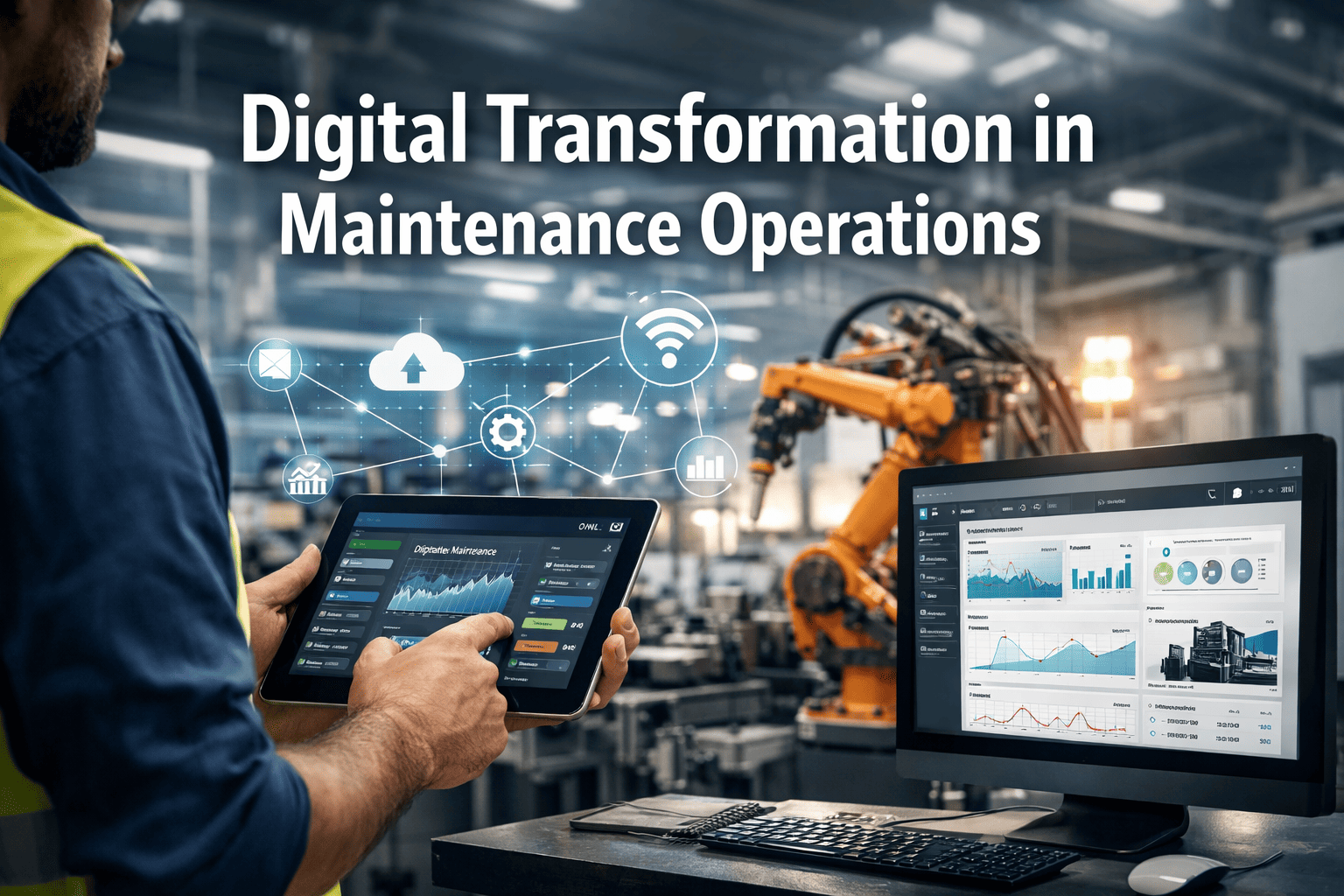
Digital Transformation in
Maintenance Operations
AI, IoT, and CMMS technology have converged to make connected, intelligent maintenance operations the new baseline for competitive facilities. This guide covers what digital transformation in maintenance actually means, how to sequence it, and how Oxmaint delivers each capability in a single deployable platform.
Fewer unplanned downtime events with digital maintenance
Industry Average
35%
Operating cost reduction achievable through CMMS digitisation
McKinsey Research
10x
ROI from predictive maintenance programmes
US Dept. of Energy
3–6mo
Typical platform payback period for Oxmaint customers
Oxmaint Data
$50B
Lost annually to unplanned equipment downtime in manufacturing
Deloitte
40%
Of PM tasks performed on assets still in healthy operating condition
Industry Survey
73%
Of equipment failures show detectable signals 30–60 days before breakdown
Verified Case Data
25%
Lower maintenance costs with predictive vs. reactive strategy
Deloitte Analysis
6 Core Capabilities
What Digital Transformation Actually Means for Maintenance
Digital transformation in maintenance is not a software project — it is a shift in how your operation generates, captures, and acts on asset data. These six capabilities define what a fully digitised maintenance operation looks like.
Predictive Analytics
AI models trained on sensor data detect equipment degradation weeks before failure, replacing calendar-based PM with condition-driven work orders that are generated automatically. Start with Oxmaint's predictive module.
85% less unplanned downtime
Connected IIoT Sensors
Wireless vibration, thermal, current, and pressure sensors create continuous data streams from every critical asset — feeding real-time condition data into your CMMS without manual data entry or inspection rounds.
60%+ sensor cost drop since 2020
Automated Work Orders
When sensor anomalies or PM triggers fire, work orders are generated, classified, and routed automatically. Emergency repairs cost 3–5× more than planned work — automation eliminates the gap between detection and response. See automated work orders in Oxmaint.
3–5× lower emergency repair cost
Real-Time Analytics Dashboard
Live MTBF trends, asset health scores, work order backlog aging, and technician utilisation replace end-of-week reports. Decisions are made on current data, not last week's snapshot.
73% of failures visible 30–60 days early
Inventory and Parts Intelligence
Digital parts management links every spare to the assets that consume it, tracks actual usage rates, and auto-generates purchase orders at optimised reorder points — cutting carrying costs by 20–30% and eliminating $2,000+ emergency procurement runs.
20–30% lower inventory carrying cost
Automated Compliance Documentation
Every inspection, work order, and repair generates timestamped, audit-ready records automatically — eliminating manual report compilation that consumes 40–60 hours per compliance cycle and satisfying OSHA, ISO 45001, and internal audit requirements. Book a demo to see compliance logging.
40–60 hrs/cycle saved on compliance
Key Insight
$1.5M
Saved in Year One — Without New Equipment
A steel manufacturer deploying vibration sensors on critical rotating assets and connecting alerts to automated work orders in Oxmaint saved $1.5 million in year one — from avoided emergency repairs alone. No new machinery was purchased. No production was disrupted. The savings came entirely from responding to failures before they happened rather than after.
Most Oxmaint customers report full platform payback within 3–6 months. Start your free account and begin capturing those savings immediately.
90-Day Journey
How Digital Transformation Unfolds in Practice
The most successful programmes do not attempt to transform everything at once. A sequenced approach delivers measurable wins from week one while building toward full digital maturity.
Days 1–30
Foundation — Digitise Work Orders and Asset Records
Import your asset register and current PM schedule into Oxmaint. Replace paper and spreadsheet work orders with automated digital tasks. Most facilities identify $50,000–$100,000 in immediate waste — from missed PM tasks, duplicate labour, and untracked repair costs — within the first 30 days of structured data capture. Sign up free to begin with no implementation delay.
PM compliance improves from 60% to 90%+ within weeks
Days 31–60
Intelligence — Connect Sensors and Activate Live Analytics
Deploy IIoT sensors on your 10–15 highest-value rotating assets. Activate Oxmaint's live analytics dashboard — MTBF trends, technician utilisation, work order cost history, and asset health scores update in real time. Spare parts tracking goes live with auto-reorder triggers, eliminating emergency procurement runs. AI baseline models begin learning normal asset signatures.
First anomaly alerts surface within 4–8 weeks of sensor deployment
Days 61–90
Optimisation — AI-Driven PM Intervals and Predictive Coverage
With 60–90 days of work order history and sensor data combined, Oxmaint's AI recommends optimised PM intervals per asset — typically reducing unnecessary PM labour by 25–30%. Predictive failure alerts begin catching real degradation events before they become breakdowns. Energy monitoring dashboards flag inefficient operations and off-peak scheduling opportunities. Book a demo to see this stage in a live environment.
Maintenance cost reduction becomes measurable and compounding
Day 90 and Beyond
Scale — Full-Plant Coverage and Cross-Site Benchmarking
Expand sensor coverage and CMMS tracking to all plant assets. For multi-site operations, Oxmaint's cross-facility benchmarking surfaces which plants are outperforming and which processes drive that advantage. Advanced predictive models mature with each work order outcome logged, continuously improving prediction accuracy specific to your equipment and operating conditions.
Full 35% cost reduction target achievable within 18–24 months
Maturity Model
Before and After: The Digital Transformation Gap
Where your facility sits on this spectrum determines your cost structure, competitive position, and resilience to equipment failures.
Dimension
Paper-Based (Legacy)
Partially Digital
Fully Digitised (Oxmaint)
Work Order Process
Manual, paper forms
Spreadsheet-tracked
Auto-generated, routed
Asset Visibility
None between failures
Scheduled snapshots
Real-time health scores
Failure Warning
Breakdown is the warning
None between PM windows
Weeks of advance notice
PM Strategy
Reactive only
Fixed-interval calendar
AI-optimised, condition-based
Parts Management
Manual stockroom counts
Basic spreadsheet tracking
Auto-reorder, usage analytics
Compliance Records
Paper logs, inconsistent
Manual digital entry
Automated, audit-ready
Maintenance Cost
Highest — reactive scramble
Moderate — over-serviced
Lowest — service when needed
Based on Oxmaint customer transformation data and industry maturity frameworks. Most facilities reach full digitisation within 6–12 months.
Swipe horizontally on mobile
See Oxmaint's Digital Platform in Action
Work orders, sensor integration, predictive alerts, and live analytics — all in a single platform deployable in days.
Every Capability of Digital Maintenance in One Platform
Oxmaint is built to deliver the full stack of digital transformation — from your first digitised work order to full AI-predictive coverage across every asset.
AI Anomaly Detection
Sensor streams feed machine learning models trained on your asset's specific baseline. Deviations auto-generate work orders classified by failure mode and severity. The model improves continuously as outcomes are logged.
VibrationThermalAuto Work Orders
AI-Optimised PM Scheduling
Usage patterns, load profiles, and failure history drive interval recommendations per asset — cutting unnecessary PM labour 25–30%. Activate optimisation now.
Interval OptimisationCondition-Based PM
Real-Time Analytics Dashboard
MTBF, MTTR, asset health scores, PM compliance, and cost-per-asset — updated continuously, not weekly. Multi-site benchmarking surfaces which plants are outperforming and why. Book a demo.
Live KPIsMulti-Site
Full IIoT and System Integration
OPC-UA, REST APIs, MQTT, MES, SCADA, and ERP connections — Oxmaint fits into your existing technology stack rather than replacing it. All sensor data and operational context flows into a single unified platform.
OPC-UAMES IntegrationERP Connect
"The biggest myth in manufacturing is that you need massive capital investment to cut costs significantly. Most of your waste is invisible — hidden in reactive maintenance, excess inventory, and manual processes. A good CMMS makes it visible, and once you can see it, you can eliminate it."
Where do we start if our maintenance records are mostly paper-based?
Start with Oxmaint's asset import and work order digitisation — no hardware or sensors required in the first phase. Most teams import their asset register and existing PM schedules within days and begin capturing structured maintenance history immediately. That data foundation is what every subsequent AI and analytics capability is built on. Sign up free and your team can be live within 48 hours.
How long does a full digital transformation take with Oxmaint?
Most facilities reach meaningful improvement within 30 days of deployment. PM compliance typically improves from 60–70% to 90%+ within the first month from automated scheduling alone. Predictive coverage on critical assets is operational within 60–90 days of sensor deployment. Full transformation — including AI-optimised intervals, cross-site benchmarking, and complete digital compliance records — typically takes 6–12 months depending on facility size and scope.
Do we need to replace our existing ERP or SCADA systems?
No. Oxmaint integrates with existing MES, ERP, SCADA, and historian systems via OPC-UA, REST APIs, MQTT, and direct database connections. The platform is designed to complement your existing technology investments rather than displace them — adding the AI analytics, predictive alerting, and connected work order layer that these systems typically lack. Book a demo to see how integrations are configured for your stack.
What is a realistic cost reduction expectation from digitising maintenance?
Facilities with minimal digital infrastructure typically see 15–20% savings in the first year from eliminating reactive maintenance, optimising PM schedules, and improving parts management alone. The full 25–35% reduction is usually achieved within 18–24 months as predictive analytics mature and energy management is added. The US Department of Energy has documented 10x returns on predictive maintenance investments, and most Oxmaint customers report full platform payback within 3–6 months.
How does Oxmaint handle compliance documentation automatically?
Every work order completion, inspection, and sensor reading is timestamped and stored in Oxmaint's audit-ready records system automatically — without manual data entry. Compliance reports that previously required 40–60 hours of manual compilation per reporting cycle are generated on demand. The documentation satisfies OSHA general industry standards and ISO 45001 occupational health requirements. Create a free account to explore the compliance dashboard.
Your Digital Maintenance Programme Starts Today
Every week operating on paper-based work orders and reactive maintenance is a week of avoidable cost, undetected failures, and compliance risk. Oxmaint delivers the complete digital platform — work orders, IIoT integration, AI prediction, and live analytics — in a single system your team can deploy in days.
.png)


