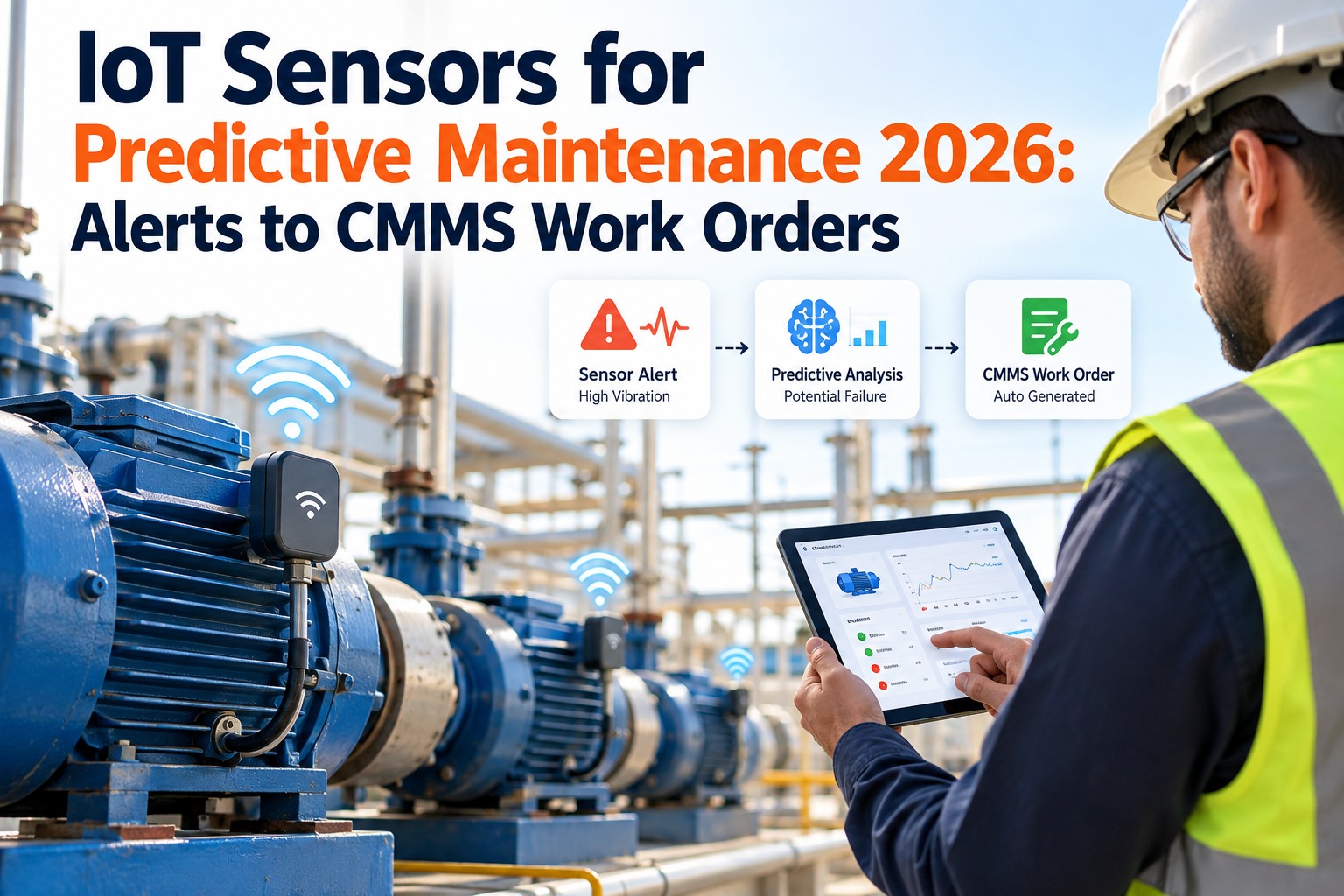
Industrial plants are generating more operational data than ever before — vibration sensors, thermal cameras, motor current signatures, pressure transducers, and environmental monitors running continuously across hundreds of assets. The bottleneck is no longer data collection. It is what happens between data collection and the maintenance decision. When every sensor reading must travel to a cloud server, be processed, and return an alert, the latency is measured in seconds to minutes. For a bearing running at 3,600 RPM approaching failure, that latency is the difference between a planned bearing replacement and a catastrophic shaft seizure. Edge computing eliminates that gap by processing maintenance intelligence directly on-premise — at the machine, in the control room, or at the facility gateway — with real-time decisions that do not depend on internet connectivity. Facilities using edge-based maintenance analytics alongside platforms like OxMaint report 41% faster anomaly detection response times and 28% fewer cloud-dependent failures in maintenance workflows. This guide covers what edge computing actually means for maintenance operations, how to deploy it, and why the latency argument is only part of the story.
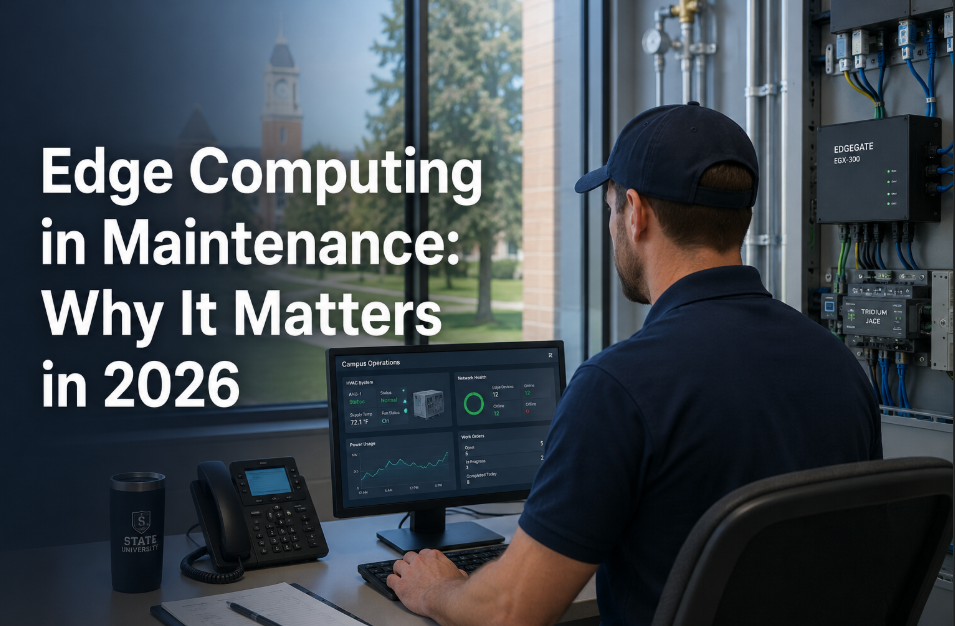
Edge Computing in Maintenance: Why It Matters in 2026
A practical implementation guide for maintenance and plant managers deploying edge analytics, on-premise AI anomaly detection, and low-latency maintenance workflows — without cloud dependency.
What Is Edge Computing in a Maintenance Context?
Edge computing places data processing capability at or near the source of data generation — at the machine, on the production floor, or at a facility gateway — rather than sending raw data to a centralized cloud server for analysis. In maintenance operations, this means anomaly detection algorithms, vibration signature analysis, thermal pattern recognition, and work order triggers all execute locally, with results available in milliseconds rather than seconds or minutes.
Processing occurs directly on smart sensors, PLCs, or embedded controllers at the asset. Vibration FFT analysis, temperature threshold alerts, and current signature monitoring happen in firmware with zero network dependency. Response time under 1ms.
An industrial edge gateway aggregates data from multiple assets, runs ML inference models for anomaly detection, and generates maintenance work order triggers. This is where most maintenance-relevant edge AI runs. Response time 5–50ms.
A local server handles more complex analytics — remaining useful life modeling, multi-asset correlation analysis, and CMMS integration. Synchronizes with cloud for long-term trend storage and portfolio-level reporting. Response time 50–200ms.
Historical analysis, model training on aggregated data, cross-site benchmarking, and executive dashboards. Not used for real-time decisions. Synchronizes with edge nodes when connectivity is available. Response time 800ms–2s+.
Understanding where each type of analysis belongs in the architecture determines how your maintenance platform integrates with edge infrastructure. OxMaint is designed to receive work order triggers from edge systems and manage the resulting maintenance workflows — bridging on-premise intelligence and operational execution. Start a free trial and book a demo to see the integration architecture.
Why Cloud-Only Maintenance Analytics Fails Industrial Operations
Cloud-first maintenance analytics made sense when sensor costs were high and facilities had limited connectivity options. In 2026, those constraints have flipped — sensors are cheap, edge hardware is affordable, and the failure modes of cloud-dependent maintenance are increasingly visible.
A cloud round-trip takes 800ms to 2 seconds. A compressor running at 6,000 RPM can complete 100+ revolutions in that window. Critical fault progression events — bearing spalling, rotor imbalance onset, oil film collapse — are missed entirely because the alert arrives after the damage threshold is crossed.
Industrial facilities in mining, offshore, remote manufacturing, and utilities routinely operate with intermittent or zero internet connectivity. Cloud-dependent maintenance systems go blind during outages — creating exactly the maintenance gap that edge computing eliminates.
Sending real-time production data to third-party cloud servers raises data sovereignty concerns in regulated industries — pharmaceuticals, defense manufacturing, nuclear facilities. Edge processing keeps sensitive operational data on-premise, addressing security requirements that block cloud adoption.
A single vibration sensor sampling at 25.6kHz generates 50MB of data per hour. A facility with 200 monitored assets generates 10GB per hour of raw sensor data. Transmitting this volume continuously to cloud storage is cost-prohibitive — edge pre-processing reduces transmission volume by 95%.
Edge Hub Deployment: A 4-Phase Implementation Roadmap
Deploying edge analytics for maintenance is not an all-or-nothing project. The most successful implementations follow a phased approach that delivers value at each stage without requiring full infrastructure replacement before results appear.
Install vibration, temperature, and current sensors on your top 20 highest-criticality assets. Use wireless IIoT sensors (LoRaWAN or IEEE 802.15.4e) where wiring is impractical. Connect sensors to a facility-level edge gateway. Configure alert thresholds based on OEM specifications and historical failure data. OxMaint begins receiving alert events within 7 days.
Train baseline ML models on 4–8 weeks of normal operating data collected in Phase 1. Deploy trained models to the edge gateway for inference. Models run locally — no cloud dependency for anomaly scoring. Begin receiving anomaly confidence scores with each sensor reading, enabling severity-ranked alert queues rather than binary threshold alerts.
Connect edge gateway API to OxMaint via webhook or REST API. Configure automated work order creation from anomaly events above defined confidence thresholds. Link edge asset IDs to OxMaint asset registry. Enable bidirectional sync — work order completion in OxMaint updates the edge system's maintenance history for model retraining.
Feed edge anomaly trend data into OxMaint's remaining useful life models. Components with accelerating degradation signatures automatically update their replacement timeline in the 5–10 year CapEx forecast. Portfolio managers and asset owners see capital replacement needs driven by actual condition data — not calendar estimates.
Cloud-Only vs Edge-Integrated Maintenance: Head-to-Head
| Capability | Cloud-Only System | Edge-Integrated with OxMaint |
|---|---|---|
| Anomaly detection latency | 800ms – 2,000ms | 5 – 50ms |
| Operation during outages | Blind — no alerts | Full local operation continues |
| Data sovereignty | Data leaves facility | Sensitive data stays on-premise |
| Bandwidth requirement | High — raw data streams | Low — processed summaries only |
| Work order creation speed | Manual or delayed trigger | Automated within seconds of anomaly |
| CapEx forecast accuracy | Calendar-based estimates | Condition-based, real-time updated |
| Model retraining capability | Requires cloud connectivity | On-premise retraining available |
| Fault-to-maintenance timeline | Hours to days | Minutes to hours |
How OxMaint Integrates with Edge Infrastructure
OxMaint is designed as the maintenance execution layer in an edge architecture — receiving condition signals from edge systems and converting them into structured maintenance workflows with full asset context, technician assignment, parts availability, and compliance documentation.
OxMaint accepts webhook and REST API triggers from edge gateways, SCADA systems, and IIoT platforms. When an edge anomaly event fires above a configured threshold, OxMaint creates a prioritized work order with the asset's full maintenance history, last inspection record, and parts inventory attached — automatically.
OxMaint maintains a full asset registry with condition scoring that updates as edge sensor data flows in. Each sensor reading contributes to the asset's live condition score, visible in the OxMaint dashboard alongside PM history, work order backlog, and component replacement status.
Edge systems report actual machine cycles, runtime hours, and production units to OxMaint. PM schedules trigger based on real usage — not calendar intervals. A press completing 1 million cycles fires its die inspection work order regardless of what day it is.
Technicians on the plant floor complete work orders on OxMaint mobile even without connectivity. Completed records sync when the device reconnects — maintaining the integrity of the maintenance record even in environments where connectivity is intermittent.
The bridge between edge intelligence and maintenance execution is where OxMaint delivers its highest value in industrial environments. Ready to see your edge architecture connected to a maintenance platform? Start a free trial or book a demo and see the integration live.
Frequently Asked Questions
What hardware is needed to run edge AI for maintenance analytics?
How does edge ML model accuracy compare to cloud-trained models?
Can OxMaint receive data from edge systems that are already installed?
What is the ROI timeline for edge maintenance analytics?
Your Plant Floor Is Generating the Answers. Edge Makes Them Actionable.
OxMaint is built to be the maintenance execution layer in your edge architecture — receiving real-time condition signals and converting them into structured work orders, CapEx forecasts, and compliance records. See how the integration works for your specific asset types and facility configuration.