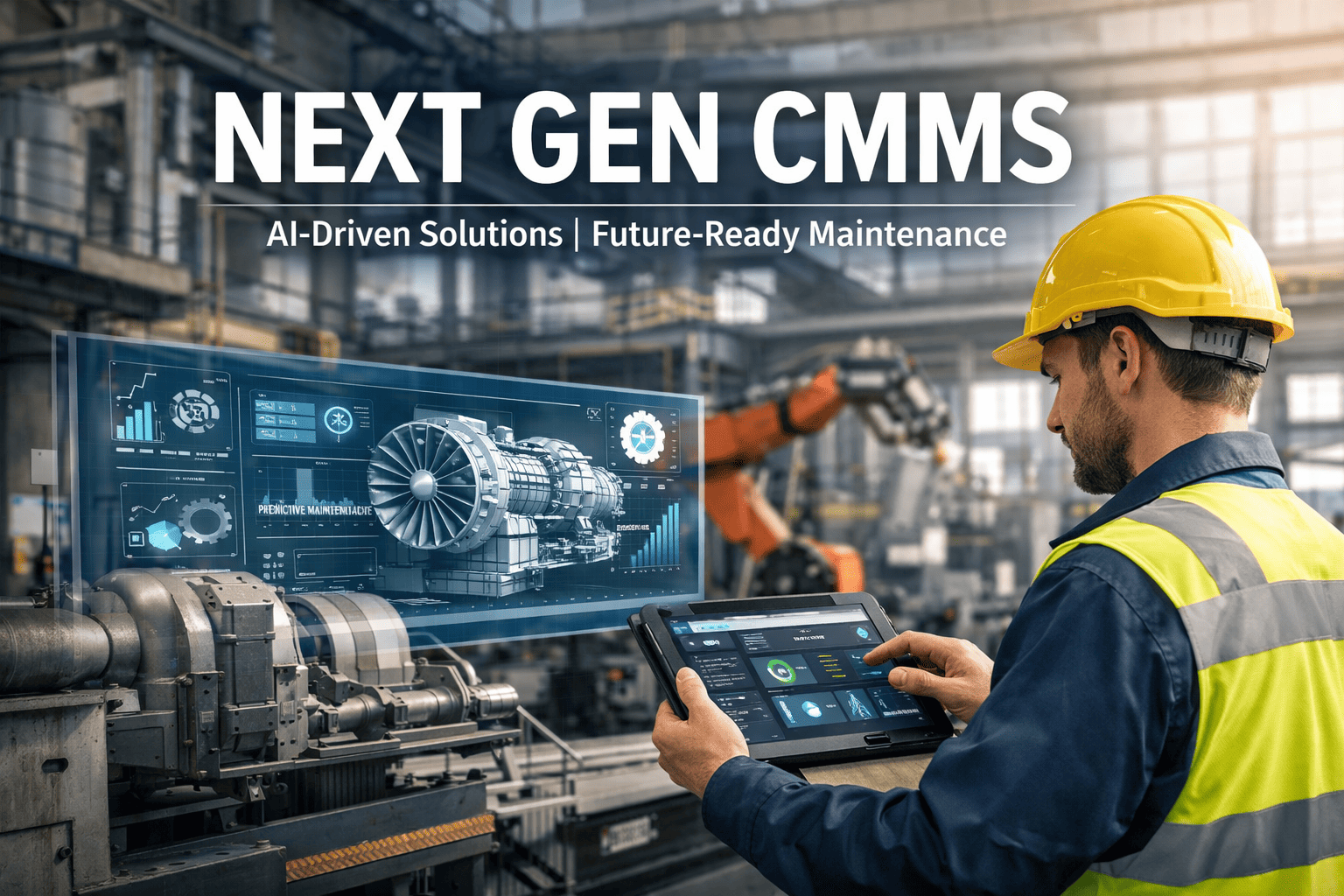
The CMMS software market is undergoing the most significant transformation in its 40-year history. What began as digital work order logs in the 1980s evolved into multi-site asset management platforms by the 2010s — and is now accelerating toward something fundamentally different: systems that do not just record maintenance activity, but autonomously predict, schedule, and in some cases execute it. By 2030, the global CMMS market is projected to reach $2.1 billion, growing at 10.8% CAGR, driven by AI integration, IoT proliferation, and ESG reporting mandates that are turning maintenance data into boardroom currency. The facilities and plant managers who understand where CMMS is heading will build operations that are structurally cheaper, more reliable, and more compliant than those still treating software as a digital filing cabinet. OxMaint is already building toward this autonomous maintenance future — start a free trial or book a demo to see the roadmap in action.
The Future of CMMS Software: What 2026–2030 Looks Like for Maintenance Operations
Autonomous scheduling, generative AI diagnostics, prescriptive analytics, and self-healing asset networks — here is the definitive outlook on where CMMS is heading and how to position your operations ahead of it.
The CMMS Evolution Timeline: From Logbooks to Autonomous Systems
Understanding where CMMS is going requires understanding where it has been. Each decade brought a structural shift — and the 2026–2030 window represents the most disruptive transition yet.
First-generation CMMS replaced paper logbooks with basic digital records. Core function: store what happened, when, and who did it. No analytics, no scheduling intelligence, no asset hierarchy.
CMMS added calendar-based PM scheduling tied to asset records. Reactive maintenance began shifting toward planned maintenance. ERP integrations emerged for procurement and financial reporting.
Cloud deployment democratized CMMS. Mobile apps put work orders in technicians' hands. Multi-site portfolio management emerged. IoT sensor integration began connecting physical assets to digital records for the first time.
Machine learning models began predicting failures before they occurred. Condition-based maintenance triggers replaced fixed-interval PMs. CapEx forecasting and ESG reporting were added as core modules. OxMaint represents this generation.
CMMS will schedule, dispatch, and in some cases execute maintenance without human initiation. Generative AI will diagnose faults from sensor patterns, prescriptive analytics will optimize entire fleet maintenance strategies, and digital twins will simulate failure scenarios before they occur in the physical world.
6 Technology Trends Reshaping CMMS by 2030
These are not speculative — each trend is already in early deployment in leading industrial and commercial operations. The question is not whether they will arrive, but how fast they will become standard.
Large language models trained on maintenance history, OEM manuals, and sensor data will diagnose faults and recommend repair procedures in natural language. Technicians will describe a symptom — "the motor hums at startup but shuts off after 3 minutes" — and receive a ranked list of probable causes with parts requirements and step-by-step repair guides.
AI scheduling engines will replace fixed-interval PM calendars entirely. Maintenance will be triggered by actual asset condition — vibration signatures, temperature trends, runtime hours, and production cycles — and scheduled automatically around production commitments without dispatcher involvement.
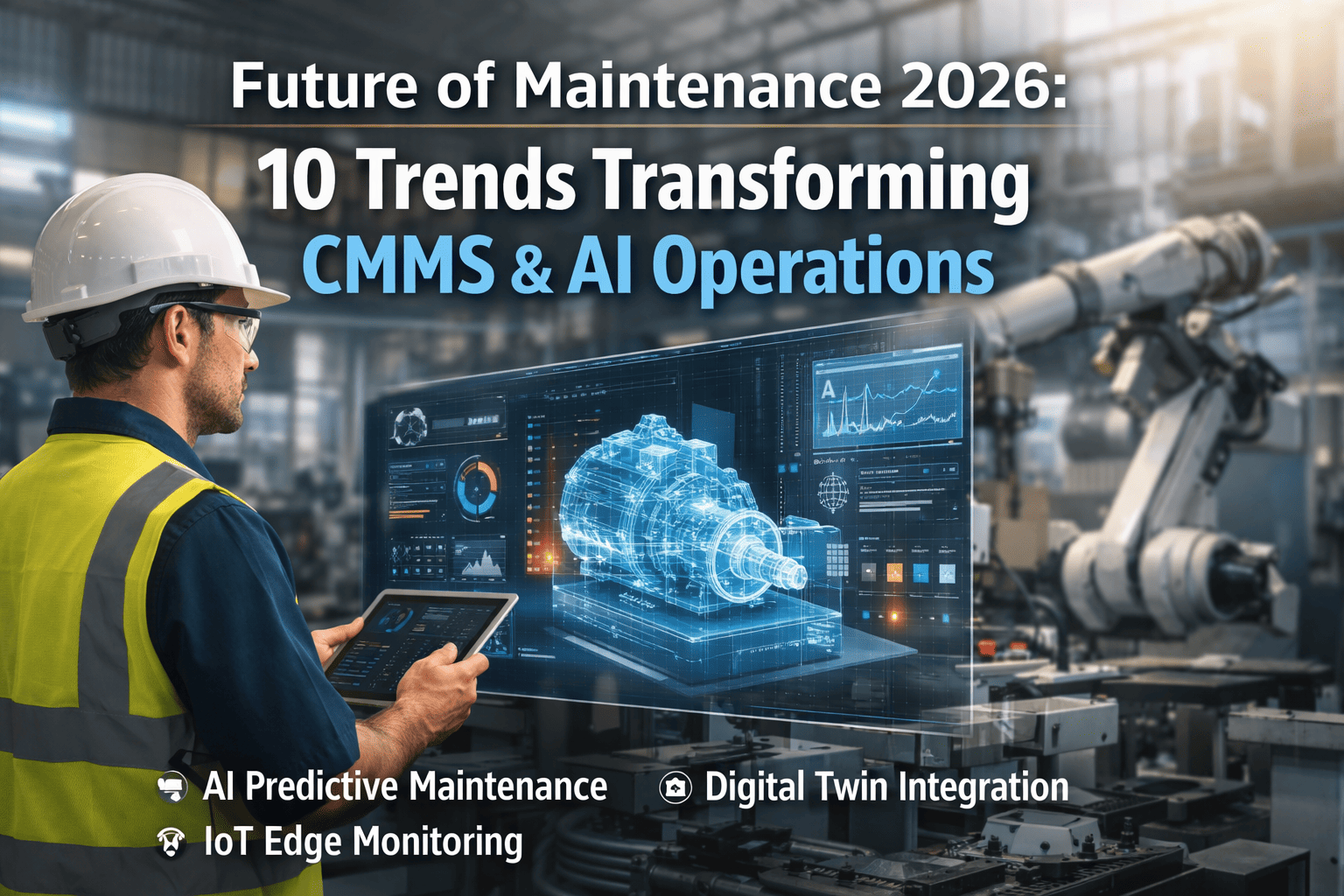
CMMS platforms will connect to digital twin models of critical assets — virtual replicas that mirror real-world behavior in real time. Maintenance scenarios will be simulated in the twin before being executed on the physical asset, eliminating trial-and-error diagnostics and reducing repair time by an estimated 35%.
Moving beyond predictive (what will fail) to prescriptive (what to do about it, in what order, at what cost). CMMS will model the financial and operational impact of every maintenance decision — repair now vs. defer, replace vs. refurbish — and present ranked recommendations with ROI projections before the manager acts.
Technicians will create and update work orders by speaking or typing conversationally — no forms, no dropdowns. AI will parse intent, extract structured data, link to the correct asset, and assign appropriate priority automatically. This removes the single largest adoption barrier for field crews.
CMMS will automatically generate Scope 1, 2, and 3 emissions data from maintenance activity records — energy consumed per asset, refrigerant usage, waste generated during repairs — formatted for GRI, SASB, and SEC climate disclosure frameworks without manual data assembly.
CMMS Generations: Then vs Now vs 2030
The capability gap between today's leading CMMS platforms and 2030's autonomous systems is substantial — but the platforms being deployed today are the foundation that 2030 capabilities will be built on.
| Capability | Legacy CMMS (Pre-2020) | Current CMMS (2024–2026) | Autonomous CMMS (2028–2030) |
|---|---|---|---|
| PM Scheduling | Calendar-based, fixed intervals | Condition-based, usage-triggered | Fully autonomous AI scheduling |
| Fault Diagnosis | Technician knowledge only | Historical pattern matching | Generative AI natural language diagnosis |
| Work Order Creation | Manual form entry | Mobile-optimized forms | Voice/text conversational input with AI parsing |
| CapEx Forecasting | Not available | 5–10 year rolling models | Real-time prescriptive replacement recommendations |
| ESG Reporting | Not available | Energy dashboards, basic emissions | Auto-generated GRI/SEC-formatted disclosure reports |
| Asset Intelligence | Static asset register | Condition scoring + lifecycle tracking | Digital twin integration with simulation |
| Technician Interface | Desktop forms | Mobile-first with offline mode | AR overlays + voice assistance in the field |
Are You Ready for the Autonomous Maintenance Era?
Autonomous CMMS requires a data foundation that most facilities have not yet built. The organizations that will benefit most from 2030-era AI maintenance are the ones building clean, structured asset data today. Here is what readiness actually requires.
AI scheduling needs to know what assets exist, where they are, what systems they belong to, and what their current condition is. Partial or fragmented asset registers produce unreliable AI recommendations. OxMaint structures assets in a Portfolio — Property — System — Asset — Component hierarchy designed for AI consumption.
Machine learning models for fault prediction need 12–24 months of structured work order history per asset class — repair type, parts used, technician time, failure mode, and resolution. Facilities still on paper or spreadsheets have no usable ML training data. Every digital work order logged today is a data point that autonomous systems will learn from tomorrow.
Autonomous condition-based scheduling requires real-time sensor data. Vibration, temperature, current draw, and runtime sensors on critical assets are the inputs that trigger autonomous work orders. Facilities without sensor coverage are limited to calendar-based scheduling regardless of how advanced their CMMS is.
Autonomous CMMS systems need to communicate with ERP for procurement, BMS for building data, telematics for fleet assets, and ESG reporting platforms for sustainability outputs. Facilities with open API infrastructure accelerate time-to-value significantly. OxMaint offers API-first integration with all major enterprise systems.
The window to build this foundation is now — not 2028. Facilities that start structured asset data collection and condition monitoring in 2026 will have 2–3 years of training data ready when autonomous CMMS capabilities become mainstream. Those starting in 2028 will spend their first two years catching up. Start a free trial or book a demo to see how OxMaint structures your asset data for the autonomous maintenance era.
How OxMaint Is Building Toward Autonomous Maintenance
OxMaint's development roadmap is built around the six pillars of autonomous maintenance. Every current feature is a building block toward the fully autonomous system that will be the standard by 2030.
PMs triggered by units produced, cycles completed, and runtime hours — not calendar dates. The first step toward condition-based autonomous scheduling.
Real-time sensor data feeds directly into OxMaint, triggering work orders when asset parameters exceed defined thresholds. No human intervention required for work order creation.
Asset condition scoring and lifecycle data drive automated capital expenditure projections — the foundation of prescriptive replacement analytics.
Line-level Overall Equipment Effectiveness tracking connects production performance to asset maintenance history — enabling data-driven PM interval optimization.
Machine learning ranking of open work orders by criticality, failure probability, and production impact — automatically surfacing the highest-value tasks for each technician's shift.
Natural language fault description input produces AI-generated diagnostic recommendations, parts lists, and repair procedures — drawing from OEM data, work order history, and failure pattern libraries.
The Business Case for Building Your CMMS Foundation Now
Frequently Asked Questions
Will autonomous CMMS replace maintenance technicians?
How much historical data does AI maintenance scheduling actually need?
What is the difference between predictive and prescriptive maintenance?
Is OxMaint compatible with the IoT sensors and data infrastructure needed for autonomous maintenance?
The Autonomous Maintenance Era Starts With the Data You Build Today
Every work order logged, every asset condition scored, every PM completed in OxMaint becomes training data for the AI systems that will define 2028–2030 operations. The facilities winning in 2030 are the ones that started building clean, structured asset data in 2026. Start your foundation now — no implementation fees, guided onboarding, and a roadmap built for the autonomous maintenance era.