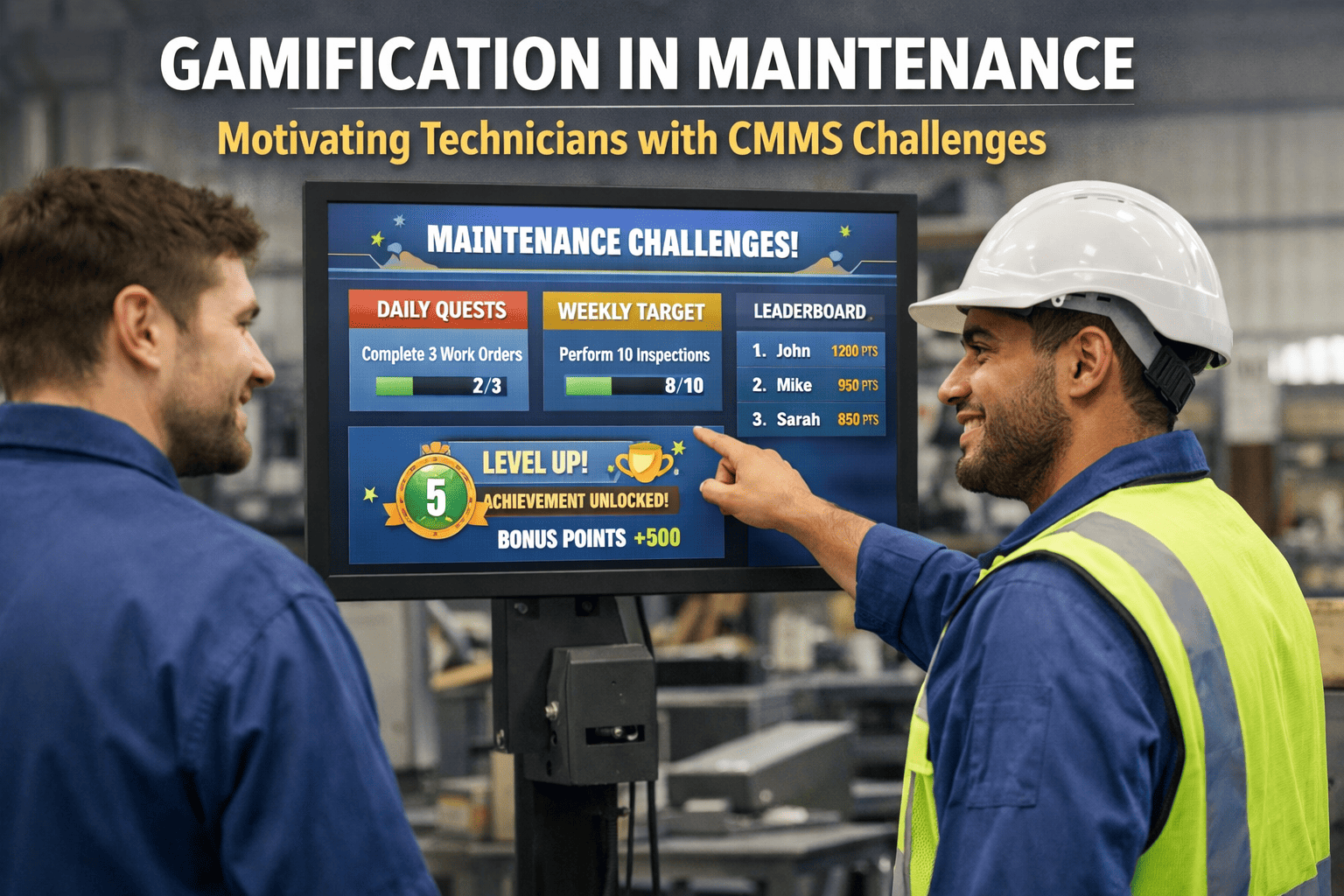
Maintenance technicians complete an average of 8–12 work orders per shift, troubleshoot equipment under pressure, and keep critical assets running — yet 60–70% of organizations still treat maintenance as an invisible function where effort goes unrecognized. The result is predictable: high turnover, inconsistent data entry, skipped preventive maintenance tasks, and a growing gap between what your CMMS tracks and what actually happens on the floor. Research shows that 85% of employees become more engaged and 90% more productive when gamification is applied to their work. In maintenance operations, where CMMS adoption directly impacts reliability, this is not a nice-to-have — it is a force multiplier. Oxmaint's CMMS platform provides the data foundation that makes gamification measurable, transparent, and tied to real operational outcomes — transforming routine maintenance tasks into visible achievements that technicians actually care about.
Why Maintenance Needs Gamification More Than Any Other Function
Maintenance work is physically demanding, often thankless, and increasingly hard to staff. A skilled labor shortage affects 73% of businesses trying to hire maintenance technicians. The technicians who do show up face repetitive work orders, unpredictable schedules, and systems that feel like bureaucratic overhead rather than helpful tools. Without visible recognition or clear feedback loops, even dedicated technicians gradually disengage — and disengagement in maintenance does not just affect morale, it directly degrades asset reliability, safety compliance, and operational uptime.
Invisible Effort Problem
Technicians complete complex repairs, prevent failures, and maintain safety — but their contributions are invisible until something breaks. Gamification makes every completed task visible, quantified, and recognized in real time.
CMMS Adoption Barrier
Many technicians view CMMS as administrative overhead — something that slows them down rather than helps. Gamified elements transform data entry from a chore into a scored activity where completeness earns points and thoroughness unlocks achievements.
Data Quality Crisis
Incomplete work orders, missing failure codes, and skipped inspection fields are symptoms of disengagement, not laziness. When completing fields thoroughly earns points and incomplete submissions cost streak bonuses, data quality improves organically.
Retention & Turnover
69% of employees stay 3+ years at companies using gamification. In an industry with chronic skilled labor shortages, retaining experienced technicians is worth more than any single technology investment. Gamification creates the recognition culture that makes people want to stay.
The gamification market is projected to reach $48.72 billion by 2029, growing at a CAGR well above 20%. Maintenance operations that adopt gamification now will gain a structural advantage in technician engagement, data quality, and retention. Book a demo with Oxmaint to see how the platform's data infrastructure supports gamified maintenance workflows out of the box.
Core Game Mechanics That Work in Maintenance
Effective maintenance gamification is not about slapping badges on a dashboard. It is about applying proven behavioral psychology — specifically Self-Determination Theory (autonomy, competence, relatedness) — through game mechanics that align individual motivation with organizational maintenance goals. The mechanics below are ranked by impact on maintenance-specific outcomes.
Points & XP System
Assign point values to every CMMS action — work order completion, inspection thoroughness, PM schedule adherence, failure code accuracy, photo documentation. Higher-priority and more complex tasks earn more points. Points accumulate into experience levels that track career growth, not just daily output.
Leaderboards & Rankings
Real-time visibility into individual and team performance drives healthy competition. Weekly leaderboards reset to give everyone a fresh start. Monthly boards track sustained excellence. Team-based leaderboards promote collaboration instead of individual competition — critical in maintenance where teamwork drives outcomes.
Achievement Badges & Milestones
Visual symbols of accomplishment that recognize specific skills, consistency, and exceptional performance. Badges should represent meaningful achievements — not participation trophies. A "Zero Rework" badge earned after 50 consecutive first-time fixes carries real weight among peers.
Challenges & Quests
Time-bound objectives that focus team energy on specific maintenance priorities. A "Zero Backlog Week" challenge rallies the entire crew around clearing overdue work orders. "Safety Sprint" challenges incentivize completing all outstanding safety inspections within 48 hours. Challenges create urgency without management pressure.
Streaks & Progress Bars
Consecutive-day tracking creates momentum that technicians do not want to break. A 15-day streak of complete, on-time work order submissions becomes a point of personal pride. Progress bars showing advancement toward the next level or badge tap into the same completion psychology that makes mobile games addictive.
Achievement Unlocked: Smarter Maintenance
Oxmaint provides the real-time data, work order tracking, and performance analytics that power gamified maintenance programs — no custom development required.
The Gamification Playbook: Implementation in 5 Levels
Launching gamification in maintenance requires a structured approach — rushing to install a leaderboard without building the data foundation first leads to disengagement rather than motivation. Follow this level-based progression to build a sustainable gamification program that improves over time.
Establish the Data Foundation
Gamification requires accurate, real-time CMMS data. Before launching any game elements, ensure that work order completion, PM schedules, inspection fields, and failure codes are being captured consistently. Clean your asset hierarchy, standardize workflows, and verify that every technician has mobile access. Without reliable data, points and leaderboards are meaningless.
Design the Point Economy
Map every scoreable CMMS action to a point value. Weight points to incentivize behaviors you want to see more of — thorough failure code entry, photo documentation, root cause notes, on-time PM completion. Ensure the scoring system is transparent and published so technicians understand exactly how points are earned. Avoid making points easy to game through low-value repetitive actions.
Launch Leaderboards & Badges
Start with weekly leaderboards (individual and team) and 5–8 core achievement badges. Display leaderboards on break room screens and within the CMMS mobile app. Keep the initial badge set achievable but meaningful — early wins build momentum. Announce the program with energy: this is a cultural shift, not a software update.
Introduce Challenges & Rewards
Launch time-bound team challenges tied to real maintenance priorities — backlog reduction, PM completion rates, safety inspection blitzes. Connect top performance to tangible rewards: gift cards, extra PTO, tool vouchers, or team events. The reward does not need to be expensive; recognition in front of peers is often more motivating than monetary incentives.
Optimize & Evolve
Analyze gamification data monthly — which mechanics drive the most engagement, which badges are never earned (too hard), which are earned by everyone (too easy). Adjust point values, introduce seasonal challenges, and add advanced badges for mentorship, cross-training, and innovation. The best gamification programs evolve continuously based on data, not assumptions.
Leaderboard Design: What to Rank and How
Leaderboards are the most visible gamification element — and the easiest to get wrong. A poorly designed leaderboard that only rewards speed creates shortcuts and quality problems. An effective maintenance leaderboard balances multiple dimensions to incentivize the complete picture of excellent technician performance.
The critical design principle: never let speed alone determine ranking. A technician who completes 20 work orders with missing failure codes should rank below a technician who completes 15 with full documentation. This is how gamification improves data quality rather than degrading it. Sign up for Oxmaint to access the work order analytics that power this kind of multi-dimensional performance tracking.
Badge System: Designing Achievements That Technicians Value
The difference between a badge system that drives engagement and one that gets ignored comes down to perceived value. Badges must represent accomplishments that technicians themselves consider meaningful — tied to craft skill, consistency, and real impact, not just system usage.
Gamification Pitfalls: What Kills Engagement
Gamification programs fail when they feel manipulative, unfair, or disconnected from real work. Understanding common pitfalls before launch prevents the cynicism that kills adoption faster than any technical limitation. Organizations that get this right — using CMMS platforms like Oxmaint as the data backbone — build sustainable engagement programs that improve year over year.
Rewarding Speed Over Quality
If leaderboards rank by volume alone, technicians rush through work orders with incomplete data. Within weeks, your CMMS data quality degrades rather than improves. Always weight quality metrics (field completeness, failure codes, photos) higher than speed metrics.
Static Systems That Never Change
A leaderboard that shows the same top performers every week demoralizes everyone else. Weekly resets, team-based challenges, skill-specific categories, and rotating recognition ensure fresh competition and opportunities for different people to shine.
Ignoring Intrinsic Motivation
Points and badges are extrinsic motivators. If they become the only reason technicians perform, you have built a fragile system that collapses when rewards stop. Effective gamification amplifies existing pride in craft, team camaraderie, and professional growth — it does not replace them.
Management Surveillance Perception
If technicians feel gamification is a disguised tracking system designed to punish underperformers, engagement collapses immediately. Position gamification as recognition and development, not monitoring. Let technicians control their own dashboard visibility and opt into competitive elements voluntarily.
Measuring Gamification Impact: The Scoreboard That Matters
Gamification is only valuable if it moves real maintenance KPIs — not just engagement scores. Track these metrics before, during, and after implementing gamification to quantify its actual impact on operational performance.
Companies using gamification are 7x more profitable than those that do not. In maintenance, this profitability flows from reduced downtime, lower turnover costs, better data-driven decisions, and extended asset lifespans. Book a personalized demo to see how Oxmaint's analytics dashboard provides the real-time performance data that powers effective gamification programs.
Level Up Your Maintenance Operations
Oxmaint gives your team the mobile-first CMMS, real-time work order data, and performance analytics needed to launch a gamification program that actually moves KPIs — not just engagement scores.