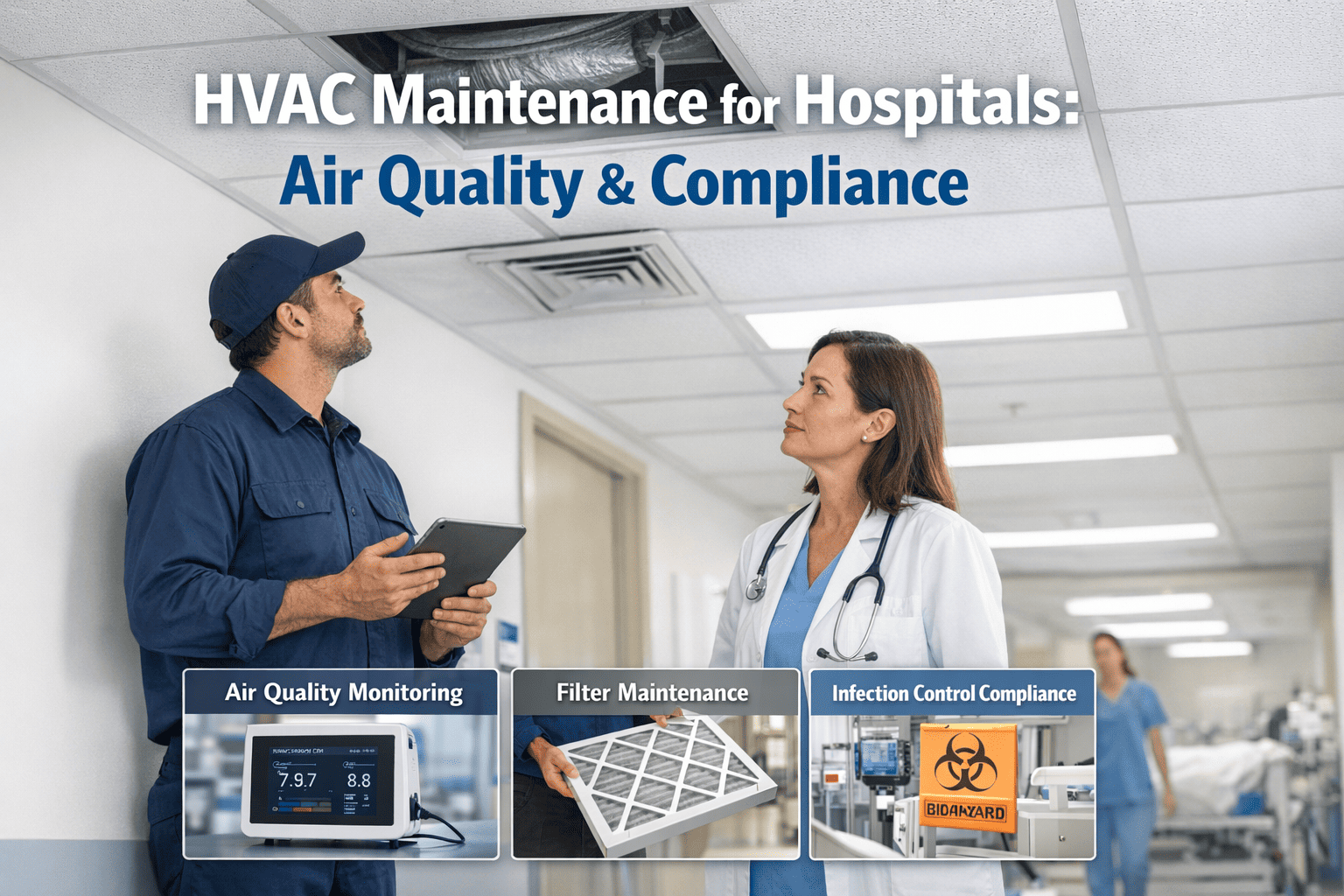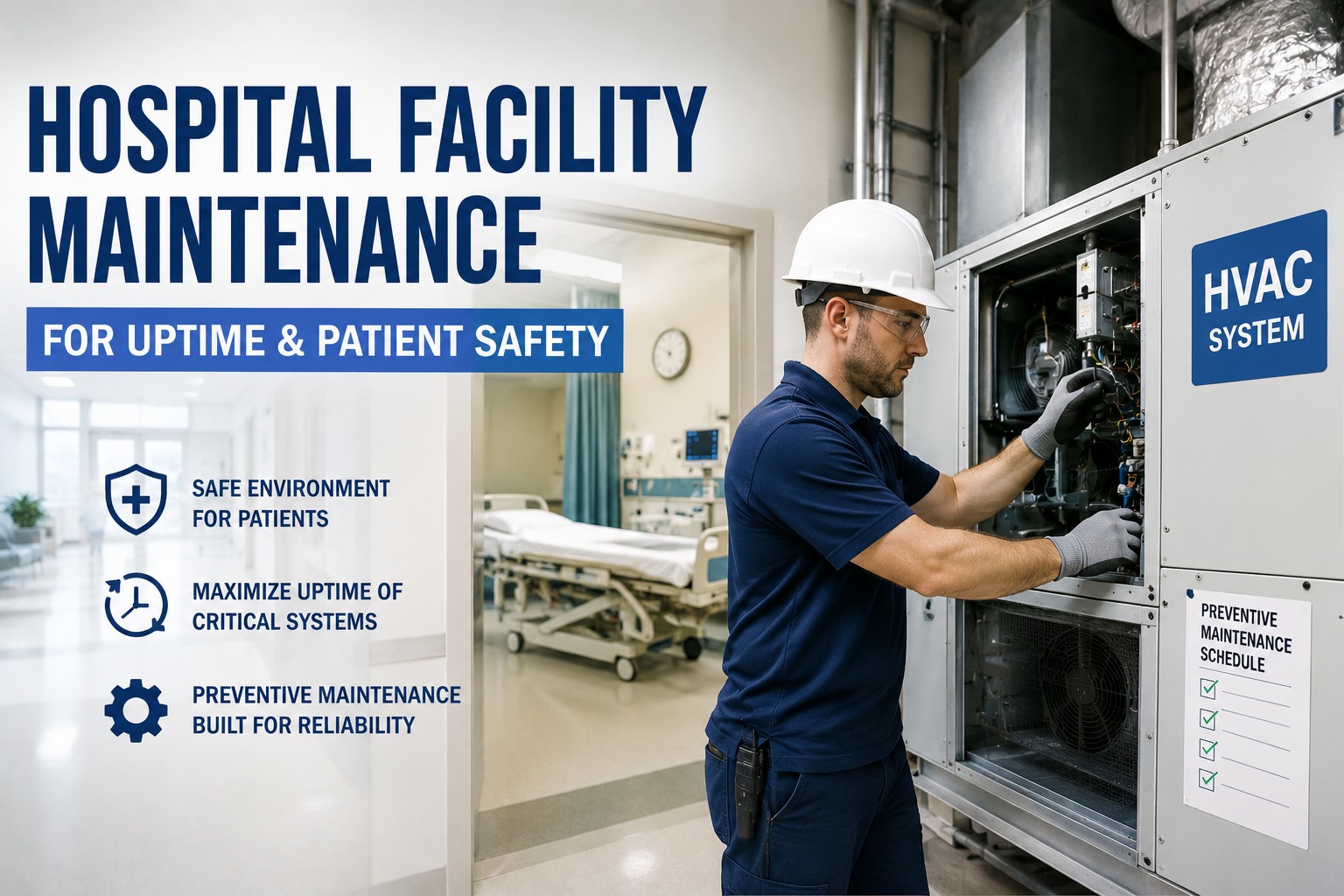
A hospital is the most maintenance-critical building in the industrial or commercial world. When a chiller fails in an office tower, tenants get uncomfortable. When a chiller fails in a hospital surgical suite, the OR shuts down mid-procedure, positive-pressure integrity is lost, and infection control is compromised across the whole department. When the emergency generator does not start on a real utility failure, the essential electrical system carrying every OR light, every ICU ventilator, and every life-support device sits offline until it does. That is the reality behind NFPA 99, NFPA 110, ASHRAE 170, and the Joint Commission Environment of Care survey — and it is why a hospital Facilities Director and the Biomedical Engineering team run the most tightly-scheduled, most heavily-documented, most-audited maintenance program in the built environment. The Joint Commission's sentinel event data consistently identifies environment-of-care failures — power interruptions, ventilation failures, and fire suppression malfunctions — as contributing factors in serious adverse events. A missed monthly generator load test or a skipped quarterly ATS inspection is not paperwork. It is a gap in the system that protects every patient in the building. Oxmaint is the CMMS built for hospital facility maintenance — NFPA 99 aligned, ASHRAE 170 pressure relationship tracking, NFPA 110 emergency power testing cadence, and Joint Commission EC-ready documentation on one platform. Start a free Oxmaint trial to run hospital facility maintenance on the CMMS, or book a demo to see the CMMS mapped to your hospital's critical systems.
Healthcare · Hospital · Facilities Director & Biomedical CMMS
Hospital Facility Maintenance for Uptime & Patient Safety — The 2026 Guide
Emergency power, medical gas, ventilation, water systems, fire safety, and refrigeration — with NFPA 99, NFPA 110, ASHRAE 170, and Joint Commission EC-ready documentation on one CMMS.
-
4 Categories
NFPA 99 risk tiers — from patient life-support (Cat 1) to no-impact (Cat 4)
-
96 Hours
Joint Commission EM.02.02.09 requires hospitals plan for 96-hour self-sufficient operation
-
Monthly
NFPA 110 required generator load test — non-negotiable, no matter how well the unit reads
-
24 / 7
continuous operations — no maintenance window, every service planned around clinical activity
Why Hospital Maintenance Is a Different Discipline
Four Conditions That Make Hospitals the Most Maintenance-Critical Buildings
Every building has utilities. Hospitals are different because those utilities directly support patient life. A ventilator running on a critical branch circuit does not tolerate power interruption. An OR under positive pressure does not tolerate air balance loss. A pharmacy compounding room does not tolerate humidity excursion. Four conditions define the discipline — and understanding all four is the starting point for a Joint Commission-ready program.
-
01
Life-Critical Systems
Emergency power, medical gas, ventilation pressure, water quality. Every one directly supports patient care. Failure is not inconvenience — it is a sentinel event category.
-
02
Regulatory Density
NFPA 99, NFPA 110, NFPA 101, ASHRAE 170, ASHRAE 188, EPA, OSHA, CMS Appendix A, Joint Commission EC. Multiple parallel audit cycles on the same equipment.
-
03
24/7 Continuous Operations
No planned downtime window. Every PM scheduled around clinical activity. Redundancy required so systems can be isolated for service without shutting down care delivery.
-
04
Documented Everything
Every test, every inspection, every calibration. Joint Commission surveyors ask for logs. CMS ties Medicare funding to accreditation. Missing records read as missing maintenance.
The NFPA 99 Risk Framework
Four Risk Categories That Drive Every System Requirement
NFPA 99 classifies every hospital space and every system into one of four risk categories based on the consequence of failure. This classification drives the Essential Electrical System type, the medical gas requirements, the ventilation obligation, and the testing cadence. Oxmaint holds the category as a required field on every hospital asset and space record.
Life Support
Failure likely to cause major injury or death. Operating rooms, ICUs, ventilator-dependent care, critical care units. Requires Type 1 Essential Electrical System.
EES Type: Type 1 (three-branch)
Patient Care
Failure impacts care but not immediately life-threatening. General patient care, non-critical procedures. Requires Type 2 Essential Electrical System.
EES Type: Type 2 (life safety + equipment)
Basic Care
Failure not likely to cause injury. Outpatient waiting areas, administrative offices. Standard commercial electrical requirements apply.
EES Type: Not required
No Impact
No impact on patient care in the event of failure. Non-clinical support functions. Baseline commercial standards apply.
EES Type: Not required
The Six Life-Critical Systems
Every Hospital Program Runs Six Life-Critical System Groups
The critical maintenance surface in a hospital resolves to six discrete system groups — each with its own code framework, its own testing cadence, and its own consequence of failure. Oxmaint holds each as a discrete asset group with the appropriate compliance template attached per system.
-
S1
Emergency Electrical Power
Generators, automatic transfer switches, Essential Electrical System branches (Life Safety, Critical, Equipment). Every OR light, every ICU ventilator depends on it.
NFPA 99 Ch 6, NFPA 110
-
S2
Medical Gas Systems
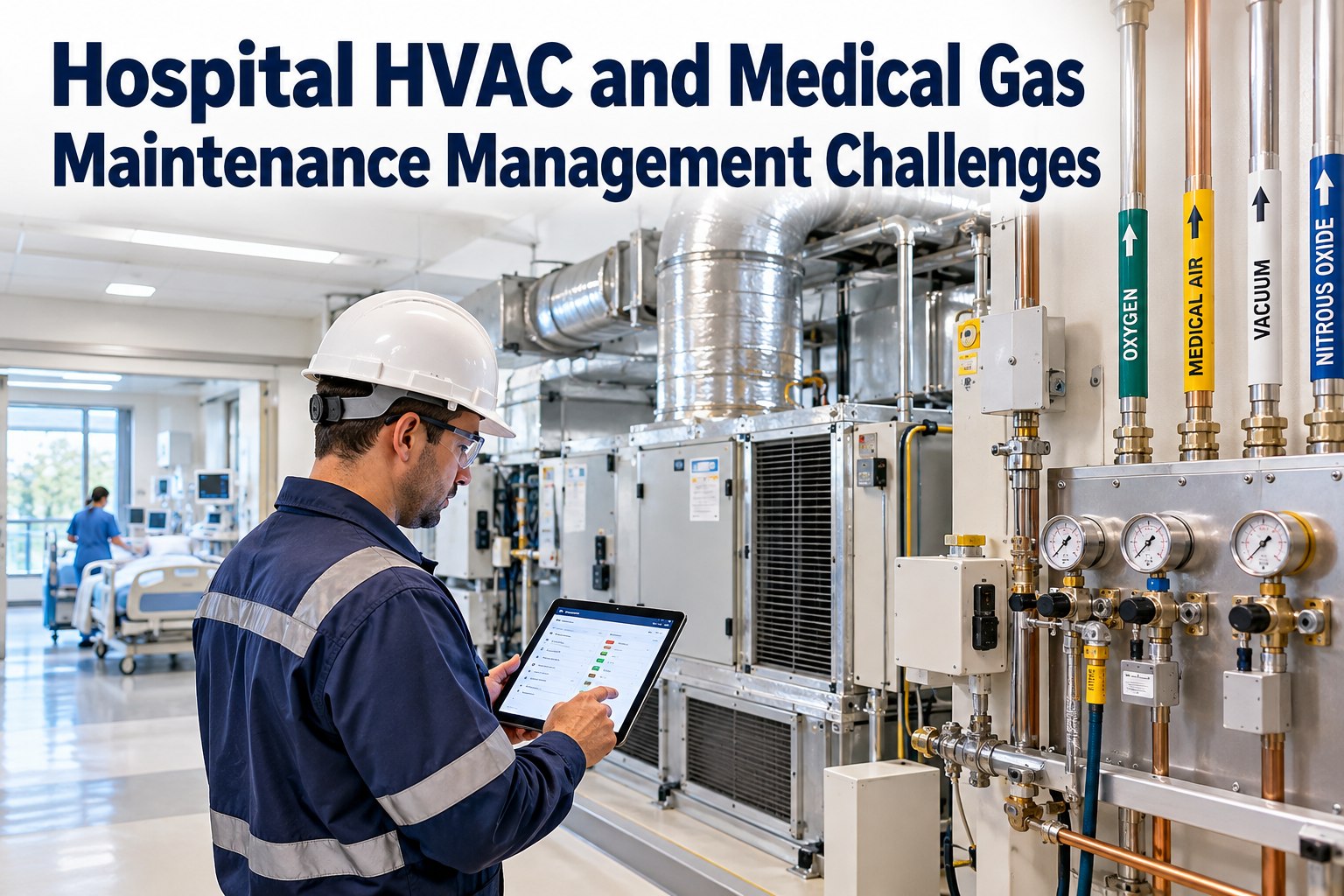
Oxygen, medical air, vacuum, nitrous oxide, nitrogen. Manifolds, pumps, compressors, distribution. Zone valves, alarms, outlets tested against usage load.
NFPA 99 Ch 5
-
S3
Ventilation & Pressure
AHUs, terminal units, HEPA filters, exhaust, pressure controls. Room pressure relationships fundamental to infection control across every clinical space.
ASHRAE 170, NFPA 99 Ch 9
-
S4
Water Systems
Domestic hot water (Legionella), reverse osmosis for dialysis, medical steam, DI water for sterile processing, kitchen and laundry supply.
ASHRAE 188, AAMI TIR34
-
S5
Fire & Life Safety
Fire alarm, sprinklers, smoke control, egress lighting, fire doors, medical gas alarms. Non-negotiable across every hospital regardless of category.
NFPA 101, NFPA 72
-
S6
Refrigeration & Cold Storage
Blood bank, pharmacy, laboratory, morgue, kitchen. Temperature-monitored 24/7 with alarming. Product loss on excursion carries immediate patient impact.
USP 797, Joint Commission MM
HVAC Pressure Relationships
The Three Pressure Regimes That Define Hospital Infection Control
Hospital ventilation is not primarily about temperature or humidity — it is about infection control through room pressure. ASHRAE 170 specifies which spaces run positive, negative, or balanced pressure, and continuous verification is a Joint Commission survey line item. Loss of design pressure relationship in a single room is a documented patient-safety event.
Air Flows Out of Room
Keeps contaminants out of clean spaces. Higher room pressure than corridor. Airflow moves outward every time the door opens.
Spaces: Operating rooms, protective environment (immunocompromised, transplant, oncology), sterile supply, procedure rooms, pharmacy compounding
Air Flows Into Room
Contains contaminants inside contaminated spaces. Lower room pressure than corridor. Airflow moves inward every time the door opens.
Spaces: Airborne isolation (AIIR) for TB, COVID, measles, bronchoscopy, autopsy, decontamination, soiled utility, waste holding
Neutral Pressure
Default state for spaces with no specific infection control requirement. Supply and exhaust balanced. Pressure differential minimal.
Spaces: General patient rooms, exam rooms, corridors, waiting areas, most administrative and non-clinical spaces
The Documentation Reality
Joint Commission Sentinel Event Data Consistently Names EC Failures — Power, Ventilation, Fire Safety
Every serious adverse event review that traces back to a facility issue found the same thing: the failure was preventable, the PM was scheduled, and the record was either missing or the task deferred. Missed monthly generator load tests. Skipped quarterly ATS inspections. Failed pressure verification on an isolation room. Oxmaint holds every task on the correct cadence and produces the audit-ready package the surveyor asks for.
Emergency Power Testing Cadence
NFPA 110 Testing Frequencies — Non-Negotiable Under Joint Commission Survey
The emergency power system is the single most heavily-tested hospital utility. NFPA 110 specifies exact intervals with defined scope and documentation. Below is the working test matrix Oxmaint fires against every generator, ATS, and EES asset — and holds the log against the equipment record for direct surveyor access.
| Interval | Test | Scope | Code |
|---|---|---|---|
| Weekly | Generator inspection | Visual, fluid levels, battery state, block heater | NFPA 110 |
| Monthly | Load test under load | 30-minute minimum, transfer to emergency, 30% nameplate or exhaust temp | NFPA 110 |
| Monthly | ATS inspection | Automatic transfer switch operation, timing, indicator status | NFPA 110 |
| Annual | 4-hour load bank | Full-load continuous test simulating extended outage | NFPA 110 |
| Annual | Fuel quality test | Water content, particulates, microbial growth, cetane index | NFPA 110 |
| 3-Year | Full system audit | Complete EES branch functional test, protective relays, transfer times | NFPA 99 |
Joint Commission EC Documentation
Five Environment of Care Areas the Surveyor Will Ask For
A Joint Commission survey traverses five Environment of Care standards areas that touch the facilities program. Every one requires documented evidence of program design, execution, and effectiveness — evidence that lives in the CMMS or does not exist at survey time.
-
EC 02.03
Fire Safety
Fire alarm testing, sprinkler inspection, fire door annual verification, smoke damper cycling, fire drill records. Non-negotiable line item on every survey.
-
EC 02.04
Medical Equipment
Biomedical inventory, PM completion rate, incoming inspection, high-risk equipment identification. Shared surface between Facilities and Clinical Engineering.
-
EC 02.05
Utility Systems
Emergency power testing per NFPA 110, medical gas alarm verification, HVAC pressure relationship confirmation, water system Legionella management.
-
EC 02.06
Environment Interior
Surface condition, cleaning verification, physical hazards, temperature and humidity in critical care areas, IAQ in the occupied spaces.
-
EM 02.02.09
96-Hour Resilience
Emergency management plan for 96 hours of self-sufficient operation. Fuel, water, medical supply, and utility resilience plans documented.
Where Manual Programs Break
Four Failure Modes Every Joint Commission Survey Finds
-
01
Missing Generator Load Test Records
Weekly and monthly generator tests were done. Records are in a binder in the plant office. Some months missing. Surveyor asks. Facility cannot prove compliance.
-
02
Pressure Relationships Not Verified
Isolation room pressure differential last checked at commissioning. No routine verification. Loss of design pressure discovered only when infection control audits reveal it.
-
03
Medical Gas Alarm Testing Fragmented
Zone valve alarms, master alarms, area alarms. Each tested by a different technician on a different schedule. Records scattered. NFPA 99 gaps discovered at survey.
-
04
Legionella WMP Records Off-System
ASHRAE 188 Water Management Plan records live with the water treatment vendor. Building can't produce them under EC 02.05 survey inquiry. Compliance failure.
Built for Hospital Facilities
How Oxmaint Runs the Full Hospital Facility Program
-
Risk-Categorized Assets
Every Asset Tagged With NFPA 99 Category
Category 1 life support, 2 patient care, 3 basic, 4 no impact. PM cadence, testing frequency, and documentation standard inherit from category automatically.
-
EES Branch Tracking
Life Safety, Critical, Equipment Branches Distinct
Every powered asset assigned to the correct EES branch. Testing scope per branch. NFPA 110 monthly load, annual load bank, 3-year full audit fire automatically.
-
Pressure Verification
Room Pressure Relationships Tracked Continuously
ORs, isolation rooms, protective environment, pharmacy. Continuous BAS integration where available; scheduled manual verification otherwise. Deviations create work orders.
-
Medical Gas Program
NFPA 99 Ch 5 Full Compliance Template
Manifolds, sources, zone valves, area alarms, master alarms, outlets. Testing cadence per NFPA 99 held per asset. Certified verifier sign-off captured.
-
Water Management Plan
ASHRAE 188 Records Inside the CMMS
Domestic hot water testing, cooling tower dosing, Legionella risk assessment — all held against the water system record. Water treatment vendor uploads directly.
-
EC Survey Package
Joint Commission Documentation Exports on Demand
EC 02.03 fire, 02.04 medical equipment, 02.05 utility, 02.06 environment, EM 02.02.09 resilience. Every documentation package one export away.
Measured Outcomes
What Hospitals Gain With Oxmaint Running the Facility Program
-
Zero
Missed Regulatory Tests
NFPA 110 generator cadence, NFPA 99 medical gas testing, ASHRAE 170 pressure verification — all fired automatically on the correct interval.
-
Continuous
Survey Readiness
Every EC standard package exportable on demand. No scramble in the weeks before a Joint Commission survey — the documentation is ready always.
-
Live
Pressure Verification
Isolation rooms, ORs, and protective environments monitored continuously. Deviation from design pressure raises a work order automatically.
-
Unified
Facilities & Biomed
Facilities Director and Biomedical Engineering team on the same platform for the shared EC 02.04 and EC 02.05 documentation and work order flow.
Frequently Asked
Hospital Facility Maintenance & CMMS Questions
What is the NFPA 110 generator monthly load test requirement?
A minimum 30-minute test under load — transferring to emergency, running under either 30% of nameplate kW rating or a specified exhaust temperature threshold. The test must be documented with start and end time, load level, and observations. Missing or incomplete monthly load tests are a common Joint Commission survey finding under EC 02.05. Oxmaint schedules the test, prompts for the load data, and holds the record against the generator asset. Sign up for Oxmaint to run NFPA 110 cadence on every generator.
Which hospital spaces require positive versus negative pressure?
ASHRAE 170 specifies. Positive pressure protects clean spaces from contamination — operating rooms, protective environment rooms for immunocompromised patients, sterile supply, pharmacy compounding, procedure rooms. Negative pressure contains contamination — airborne isolation rooms for TB and COVID, bronchoscopy, autopsy, decontamination, soiled utility. General patient rooms and most non-clinical spaces run balanced. Continuous verification is a Joint Commission line item.
Does Oxmaint support both Facilities and Biomedical Engineering?
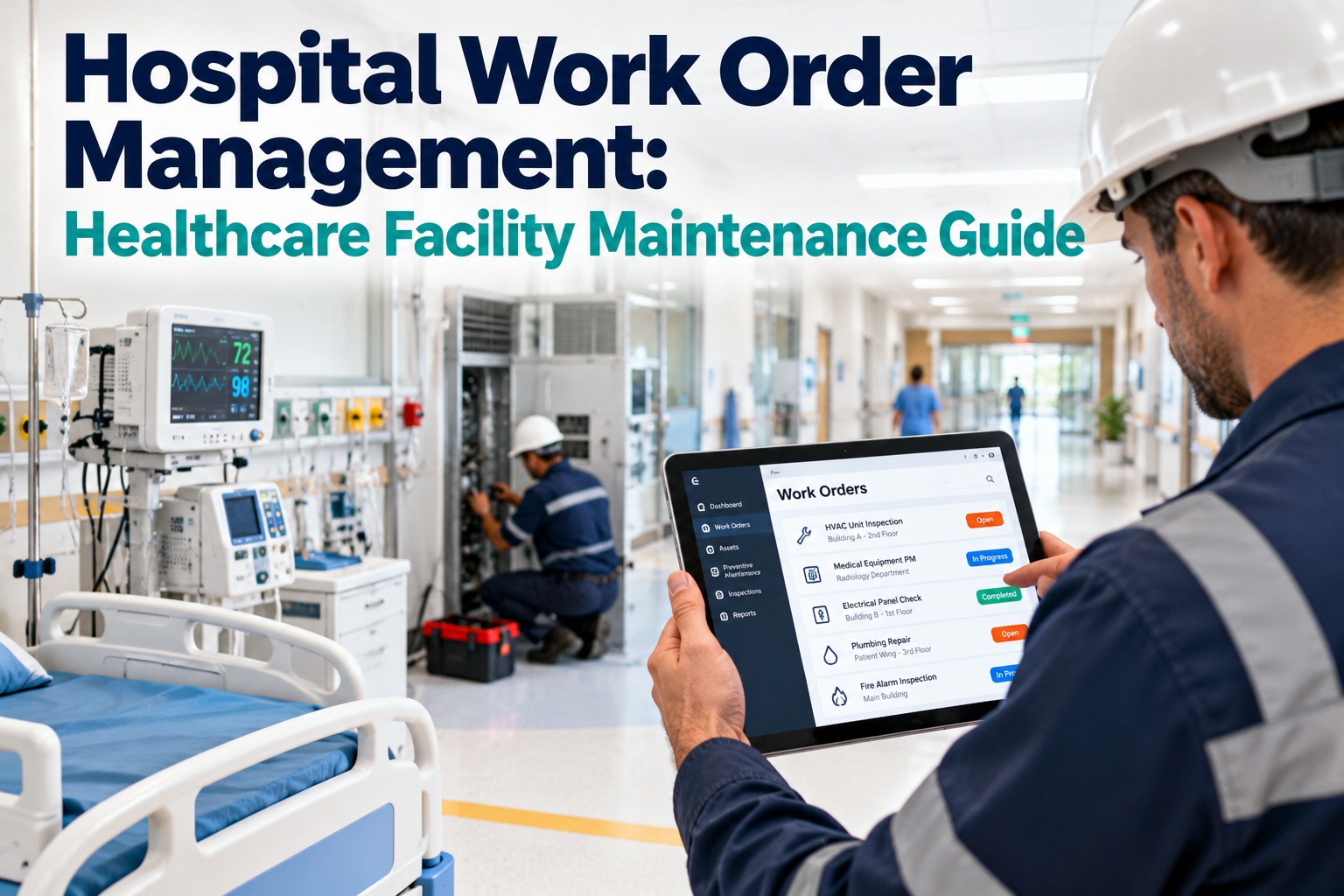
Yes. Facilities manages the plant, utilities, and environmental systems under EC 02.05 and 02.06. Biomedical Engineering manages the medical equipment inventory under EC 02.04. Both live inside the same Oxmaint platform, so work orders, PMs, and documentation share one system. The interface between the two disciplines — for example, a bed frame issue on the electrical Critical Branch — routes cleanly instead of falling in the gap. Book a demo to see the shared Facilities-Biomed workflow inside Oxmaint.
How does the software prepare for a Joint Commission survey?
Every EC standard maps to a documentation package inside Oxmaint. EC 02.03 fire safety, 02.04 medical equipment, 02.05 utility systems, 02.06 environment interior, and EM 02.02.09 96-hour resilience — each exportable on demand. Survey readiness is continuous, not a scramble in the weeks before. Every work order carries its associated standard reference. Sign up for Oxmaint to run Joint Commission survey-ready documentation on every EC standard.
Comply · Sustain · Protect
Every Sentinel Event Traced to a Facility Failure Had a PM That Should Have Fired Before It
The generator that did not start. The pressure differential that had slipped. The medical gas alarm that had gone unnoticed. The Legionella count that had drifted upward. Every one preventable — and every one caught by a CMMS that runs NFPA 99, NFPA 110, ASHRAE 170, and Joint Commission EC on the calendar the codes actually require. Oxmaint is the maintenance software built for hospital Facilities Directors and Biomedical Engineering teams protecting patient safety and continuous uptime.


.png)