A technician who arrives without the right part doesn't fix anything — they just rearrange the timeline of the failure. First-time fix rate (FTFR) is the single clearest measure of how well a maintenance team prepares for the work it dispatches. Industry data shows that high-performing organizations achieve an 88% FTFR while low-performers sit at 63% — and the gap almost always comes down to parts readiness before dispatch, not technician skill. This guide explains what drives that gap and how to close it using OxMaint's parts and inventory management tools.
Why Technicians Fail on the First Visit
IBM's field service research identifies four consistent root causes behind missed first-time fixes. Three of them are directly solvable before the technician ever leaves the depot.
The most common cause. The technician arrives with generic stock instead of the asset-specific parts required. Without a CMMS linking work orders to asset BOM, this happens on every unfamiliar job.
A technician dispatched blind — without knowing what failed last time, which parts were used, or what the failure symptom was — will spend 40% of visit time diagnosing what is already documented.
Sending a general technician to a job that requires specialist knowledge means a second dispatch. CMMS-driven skill matching at the work order stage eliminates avoidable skill gaps before dispatch.
Without a structured job plan, technicians improvise — which leads to missed steps, incomplete repairs, and callbacks within days. Digital job plans built into work orders remove this risk entirely.
The 5-Step Parts Readiness Check Before Every Dispatch
Every asset in OxMaint carries a linked parts list. Before dispatch, verify that every part on the BOM for the reported fault type is in stock and available. Parts with zero stock trigger an automatic reorder alert.
Repeat failures follow patterns. If the same component failed twice in the past six months, the technician needs to know before arriving — and should carry the component as a precaution even if it is not the primary fault reported.
Match the assigned technician's skill certifications against the work order's required skills in OxMaint before confirming dispatch. A mismatch at this stage costs one visit; discovering it on site costs two.
Digital job plans define every step, measurement, and acceptance criterion for the repair. Technicians accessing these on the OxMaint mobile app before starting work complete jobs 23% faster and with fewer callbacks.
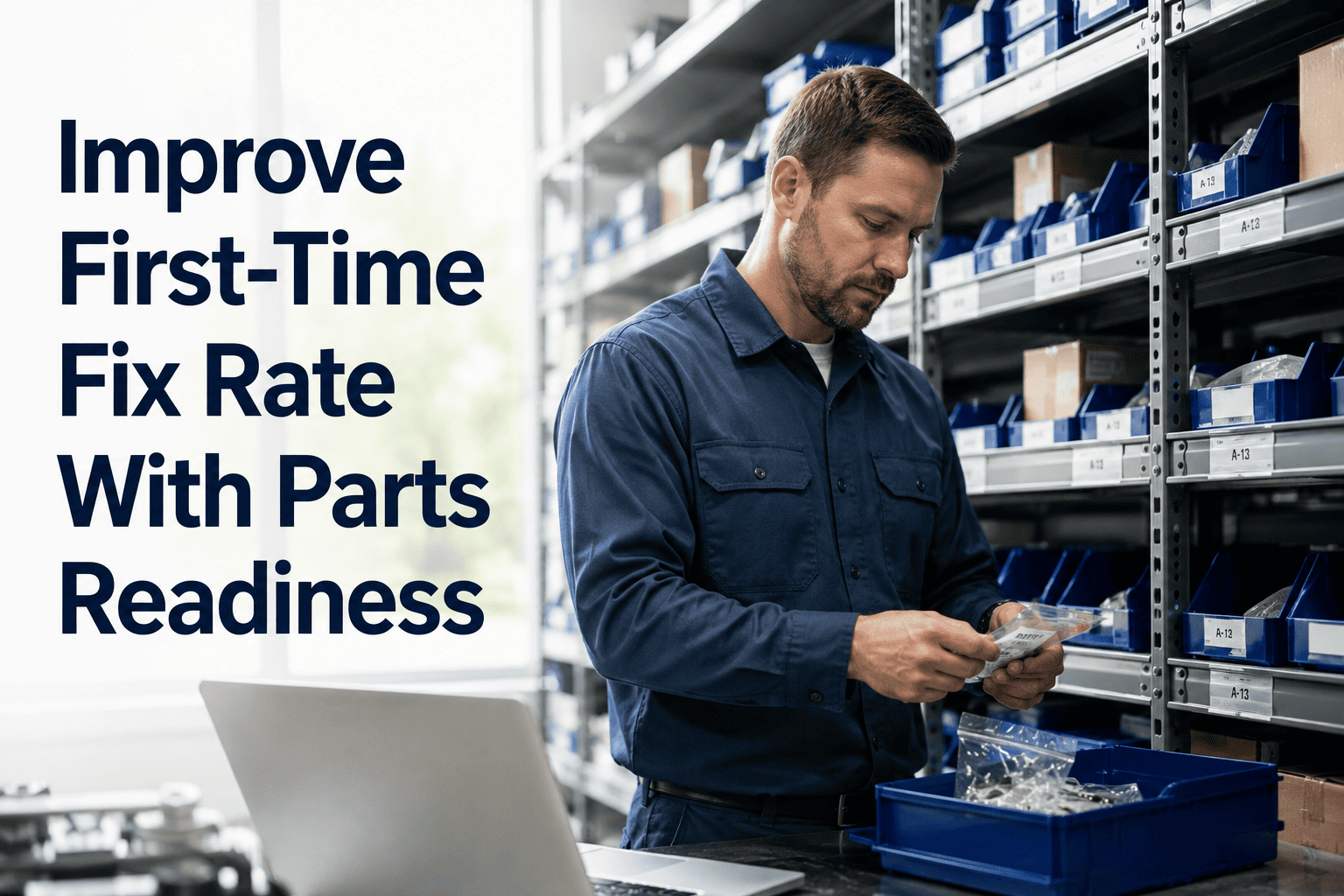
A part being "in stock" and a part being "in the technician's kit bag" are not the same thing. Parts readiness is only complete when the inventory is reserved and physically staged against the work order in the storeroom.
See How OxMaint Links Parts Inventory to Every Work Order
OxMaint connects your parts storeroom to work order dispatch — automatically surfacing BOM requirements, stock levels, and asset history so your team can prepare before they leave, not after they arrive.
What Moves the FTFR Needle Most
| Action Taken Before Dispatch | Typical FTFR Impact | Difficulty to Implement |
|---|---|---|
| Link asset BOM to work orders | +8 to 12 percentage points | Low — configure once per asset type |
| Show asset history to technician before dispatch | +5 to 8 percentage points | Low — automatic with CMMS |
| Skill-match technician to work order requirements | +3 to 6 percentage points | Medium — requires skill tagging in system |
| Attach digital job plans to all recurring tasks | +4 to 7 percentage points | Medium — one-time plan creation effort |
| Physical parts staging before technician departs | +6 to 10 percentage points | Low — process change at storeroom level |
The FTFR problem is almost always a preparation problem, not a skill problem. In every audit I have conducted where FTFR was below 75%, the root cause was a technician leaving the depot without confirmed parts availability or confirmed access to the asset's repair history. The moment you make parts confirmation mandatory before dispatch — not optional, mandatory — FTFR climbs within two weeks. The data is consistent across industries: preparation is worth more than any training programme you can run.
Frequently Asked Questions
What is a realistic first-time fix rate target for a manufacturing plant?
For manufacturing environments, a realistic starting target is 75 to 80 percent, with a stretch goal of 85 to 88 percent for mature operations. Best-in-class organizations with well-established parts readiness processes and CMMS-driven dispatch achieve above 88 percent consistently. Getting from 65 percent to 80 percent is largely a process improvement project — it requires parts linking, history access, and dispatch checklists. Moving from 80 percent to 88 percent requires deeper investment in job plans and technician skill management. OxMaint tracks FTFR automatically so you always know where you stand against your target.
How does parts readiness differ from parts availability?
Parts availability means the part exists somewhere in your inventory system. Parts readiness means the correct part has been identified for the specific work order, confirmed in stock, reserved against that job, and physically staged for the technician to collect before departure. The gap between these two definitions is where most FTFR failures happen. A part showing as available in a CMMS but not reserved or staged can be allocated to a different job, misplaced in the storeroom, or discovered to be damaged — all after the technician has already traveled to the asset. True parts readiness closes this gap at the work order planning stage, not at the storeroom counter.
Can FTFR be tracked automatically inside a CMMS?
Yes, and it should be. Manual FTFR tracking — asking technicians to self-report whether a job was completed on the first visit — is unreliable and time-consuming. A modern CMMS like OxMaint tracks FTFR automatically by detecting when a second work order is opened on the same asset within a defined window after a prior work order was closed as complete. This gives you an accurate, auditable FTFR figure by technician, by asset type, and by location — without any manual data entry or subjective self-reporting from the field team.
Your FTFR Is a Preparation Score — Start Preparing Better
OxMaint links parts inventory, asset history, technician skills, and job plans to every work order automatically. Book a 30-minute demo to see how teams go from 68% to 85% FTFR within a quarter.