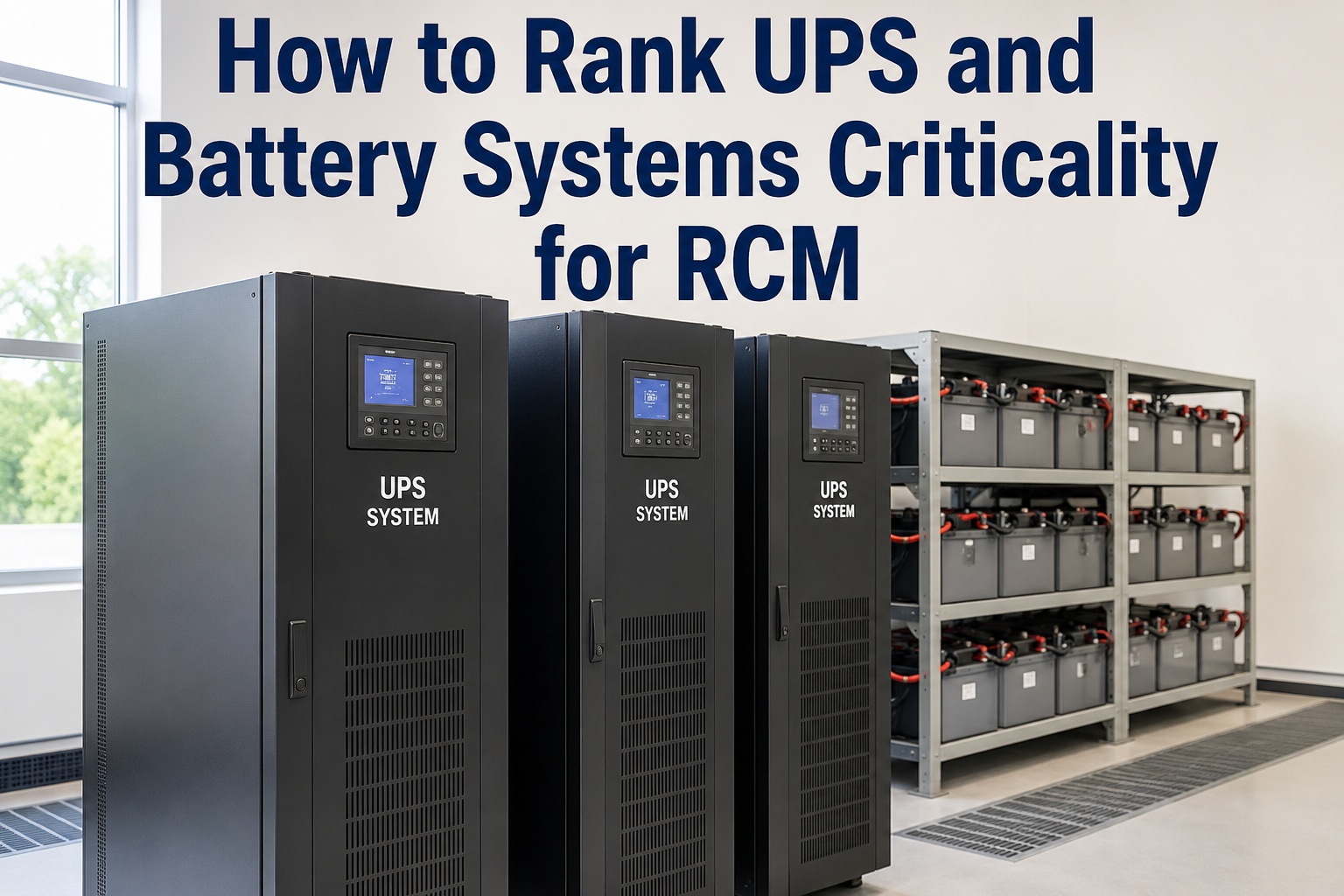
Criticality analysis for UPS and battery systems is the process of scoring your backup power assets by consequence of failure so you can deploy the right maintenance strategy—predictive, preventive, or run-to-failure—where it matters most. For maintenance and reliability teams, an unranked UPS fleet means treating a life-safety data center battery the same as a backup unit in a low-impact utility closet, which inevitably wastes budget while leaving critical operations exposed to unplanned outages. By applying a structured risk matrix and tier ranking to UPS and battery systems reliability, facilities can isolate high-impact assets, mitigate battery aging and capacitor wear before they cause downtime, and shift from a reactive firefighting stance to controlled reliability. OxMaint's AI-powered CMMS and EAM platform is built to operationalize this exact transition, giving you the asset hierarchies, PM automation, and risk-based work order workflows needed to act on your analysis. Start Free Trial to map your asset priority today and turn your maintenance data into defensible decisions.
UPS & Battery Criticality Ranking Guide
Can your UPS battery failure take down a $2M production line in under 8 milliseconds?
Without a formal UPS and battery systems risk assessment, maintenance teams fly blind—over-maintaining low-impact assets while critical battery strings degrade silently. Score your assets by consequence of failure and deploy maintenance resources where they actually protect uptime, safety, and compliance.
Why Criticality Scoring Matters
The High Cost of Skipping UPS & Battery Systems Consequence Analysis
When a maintenance team operates without a formalized UPS and battery systems criticality ranking, every work order feels equally urgent. The result is a reactive maintenance culture where technicians chase breakdowns instead of preventing them. In modern manufacturing, healthcare, and data center environments, a single UPS failure can halt production, corrupt critical data, or trigger regulatory penalties. By establishing a defensible consequence-of-failure scoring system, reliability teams can justify maintenance budgets, optimize labor allocation, and ensure compliance with ISO 55000 asset management standards.
Risk Assessment Framework
Building a UPS & Battery Systems Risk Matrix
A robust risk matrix evaluates two dimensions: the probability of failure (driven by battery aging, thermal stress, and capacitor wear) and the consequence of failure (safety, production loss, environmental impact, and regulatory exposure). By plotting your assets on this matrix, you assign a priority score that dictates whether an asset requires predictive maintenance technologies like impedance testing, standard preventive maintenance, or a run-to-failure strategy. This consequence analysis ensures your highest-risk assets receive the most rigorous attention.
| Risk Matrix Zone | RPN Range | Asset Example | Required Maintenance Strategy |
|---|---|---|---|
| Extreme Risk (Tier 1) | 150 – 1000 | Life-safety UPS in a hospital ICU | Predictive (continuous monitoring) + PM |
| High Risk (Tier 2) | 80 – 149 | Primary data center UPS battery string | Preventive (quarterly testing & impedance) |
| Moderate Risk (Tier 3) | 40 – 79 | Plant floor backup UPS for non-critical HMI | Preventive (annual inspection & load test) |
| Low Risk (Tier 4) | Below 40 | Office lighting backup UPS | Run-to-failure (corrective on breakdown) |
Implementation Timeline
Step-by-Step Guide to UPS & Battery Systems Tier Ranking
Transitioning from a flat maintenance schedule to a tiered, risk-based approach requires a systematic rollout. Here is a proven 4-month timeline to establish your UPS and battery systems priority scoring and integrate it into daily maintenance workflows.
Asset Inventory & Data Capture
Compile a complete registry of all UPS units, battery strings, and associated capacitors. Capture install dates, load profiles, and environmental conditions. OxMaint's asset hierarchy builder allows you to map parent-child relationships between UPS cabinets and individual battery cells in minutes.
Consequence Analysis & Scoring
Evaluate the operational, safety, and financial impact of each asset failing. Apply the Risk Priority Number formula to assign scores. Use OxMaint's custom asset priority fields to tag each UPS with its calculated tier rank, ensuring visibility across all work orders.
Strategy Assignment & PM Automation
Map maintenance strategies to each tier. Automate quarterly impedance tests for Tier 1 assets and annual load tests for Tier 3. OxMaint automatically generates and routes these preventive maintenance work orders based on your predefined tier-based triggers.
Review & Predictive Integration
Analyze initial PM data to identify failure trends, such as accelerated battery aging in high-temperature zones. Adjust your criticality criteria and integrate sensor data to move high-risk assets into predictive maintenance workflows.
Stop Guessing Where to Deploy Maintenance Technicians
See how OxMaint's asset priority scoring and automated PM workflows eliminate reactive firefighting and cut downtime by up to 40%.
Worked Example
Real-World Scenario: 180-Asset Plant UPS Fleet Prioritization
Consider a 180-asset manufacturing plant spending $42K annually on reactive UPS battery maintenance. Before implementing a criticality ranking, technicians replaced batteries ad-hoc, often over-servicing low-impact units while a critical production-line UPS suffered a string failure that halted operations for 6 hours, costing $310K in lost throughput. By applying consequence-of-failure scoring, the plant reclassified 22 assets as Tier 1 (Extreme Risk) and shifted them to predictive maintenance with continuous impedance monitoring.
Within the first year, the plant reallocated $18K in maintenance budget from low-risk to high-risk assets, caught 4 failing battery strings before they caused downtime, and achieved a 35% reduction in overall unplanned UPS outages. The transition from spreadsheets to OxMaint's CMMS provided the audit trail needed for ISO 55000 compliance and proved the ROI of reliability-centered maintenance to executive leadership.
How OxMaint Helps
Operationalizing UPS & Battery Systems Criticality with OxMaint
Calculating criticality is only the first step; sustaining it requires a system that enforces your strategy every day. OxMaint transforms your static risk matrix into a dynamic maintenance engine, ensuring your highest-tier assets never miss a predictive or preventive intervention.
Dynamic Asset Priority Tracking
Assign and visualize tier rankings directly in the asset registry. Filter work queues by criticality to ensure Tier 1 UPS systems are serviced first, eliminating the risk of high-impact assets slipping through the cracks.
Automated PM & Predictive Triggers
Configure tier-based PM schedules—like quarterly impedance tests for Tier 1 and bi-annual thermal scans for Tier 2. OxMaint auto-generates work orders, ensuring battery aging and capacitor wear are tracked before failure.
Mobile Technician Execution
Equip technicians with mobile work orders that include the asset's criticality score, historical failure data, and specific testing procedures. Ensure consistent execution and real-time data capture from the UPS cabinet floor.
Audit-Ready Compliance Reporting
Generate one-click reports proving your preventive maintenance strategy aligns with your risk matrix. Perfect for ISO 55000 audits, insurance reviews, and executive ROI presentations, saving reliability engineers weeks of manual data compilation.
Frequently Asked Questions
UPS & Battery Systems Criticality Analysis FAQs
What is criticality analysis for UPS and battery systems?
Criticality analysis is a structured method of ranking UPS and battery assets based on the consequence of their failure. By evaluating safety, production loss, and financial impact, maintenance teams assign a priority score that dictates whether an asset requires predictive maintenance, standard preventive maintenance, or a run-to-failure approach, ensuring resources are focused on the most critical equipment.
How often should UPS battery systems be inspected?
Highly critical (Tier 1) UPS battery systems should undergo quarterly visual and impedance testing, with continuous monitoring where possible. Lower-tier assets may only require semi-annual or annual preventive maintenance inspections. OxMaint allows you to automate these inspection schedules based on your asset's specific criticality ranking. Start Free Trial to automate your inspection cycles today.
What are the main causes of UPS and battery systems failure?
The leading causes of failure include battery aging (where VRLA batteries drop below 80% capacity after 3–5 years), thermal stress that accelerates degradation, and capacitor wear in the UPS electronics. A robust UPS and battery systems risk assessment identifies these factors early, allowing reliability teams to implement predictive maintenance and replace components before an unplanned outage occurs.
How do you calculate a risk priority number for battery systems?
The Risk Priority Number (RPN) is calculated by multiplying the Probability of Failure (1–10), the Consequence Severity (1–10), and the Detectability Factor (1–10). An RPN above 125 typically indicates a high-risk asset that requires immediate inclusion in a predictive maintenance program. Book a Demo to see how OxMaint automates this scoring.
Why should we use a CMMS for UPS maintenance priority scoring?
A CMMS like OxMaint turns your static criticality matrix into an active maintenance engine. It ensures that work orders, PM schedules, and spare parts inventory are automatically aligned with each asset's tier ranking, eliminating the guesswork and manual tracking of spreadsheets while providing audit-ready compliance data for ISO 55000 and internal reviews.
Turn Your Risk Matrix Into Automated Maintenance Action
Join the reliability teams using OxMaint to prioritize work orders, predict battery failures, and eliminate unplanned downtime.
Free 14-day trial · No credit card required