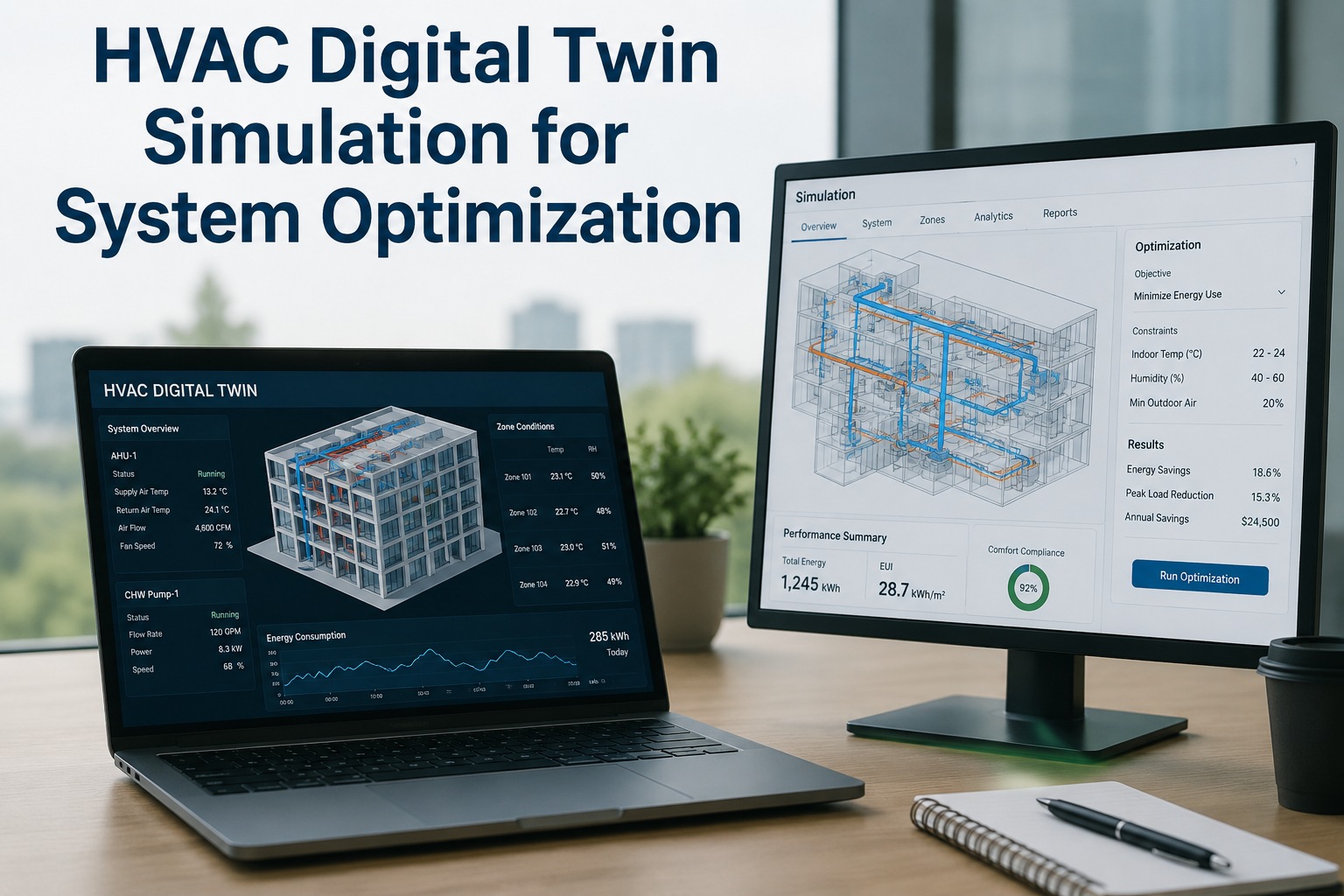
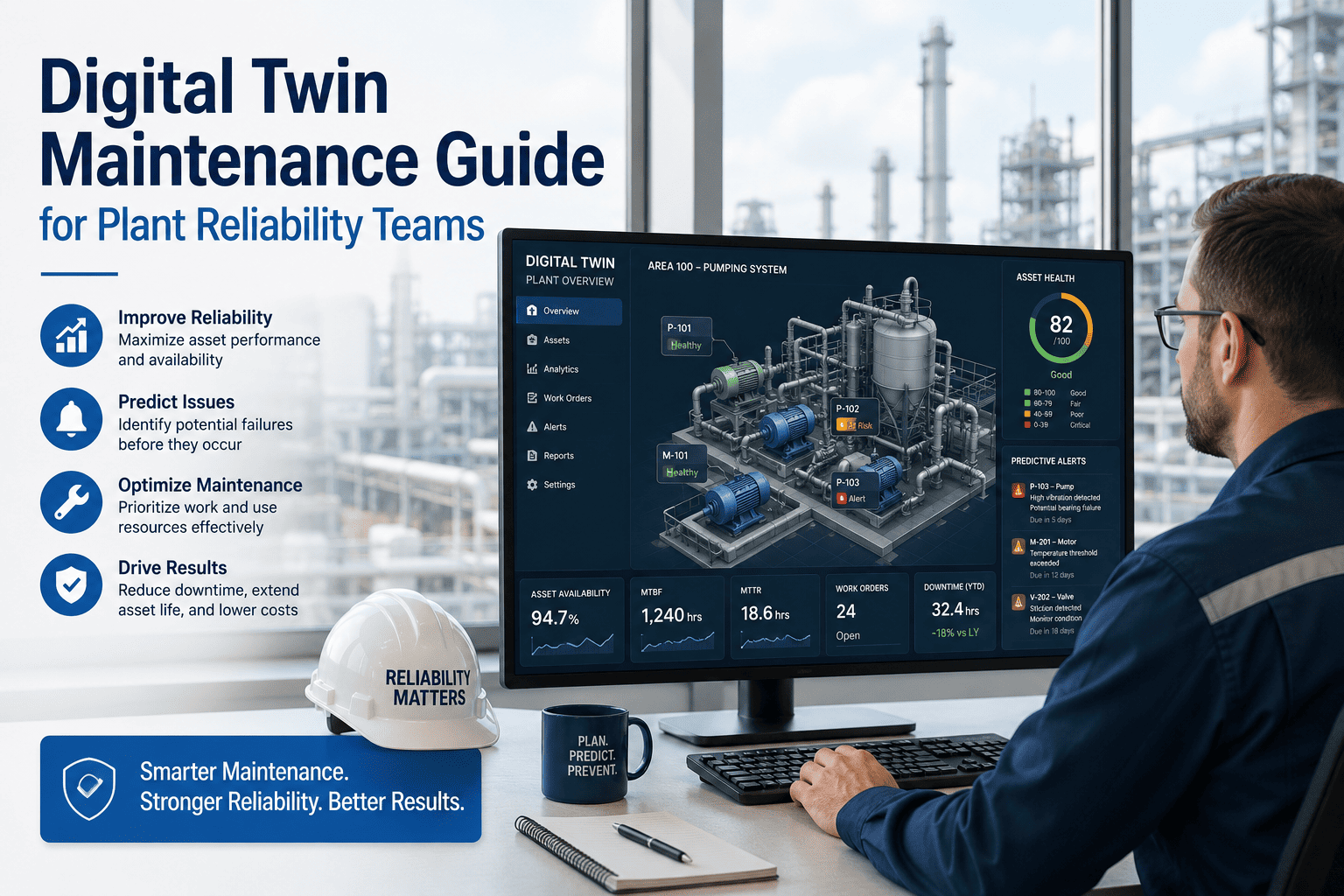
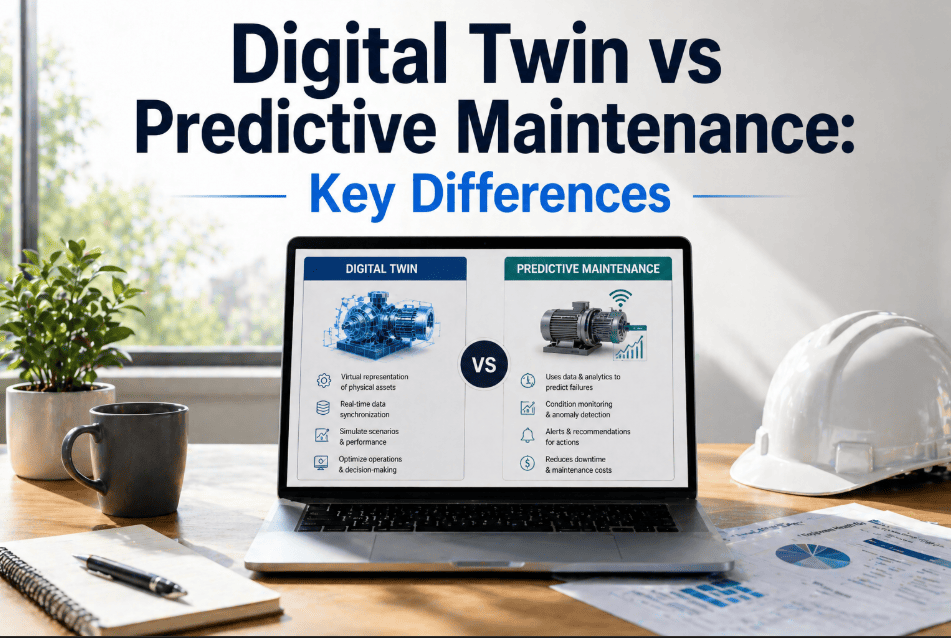
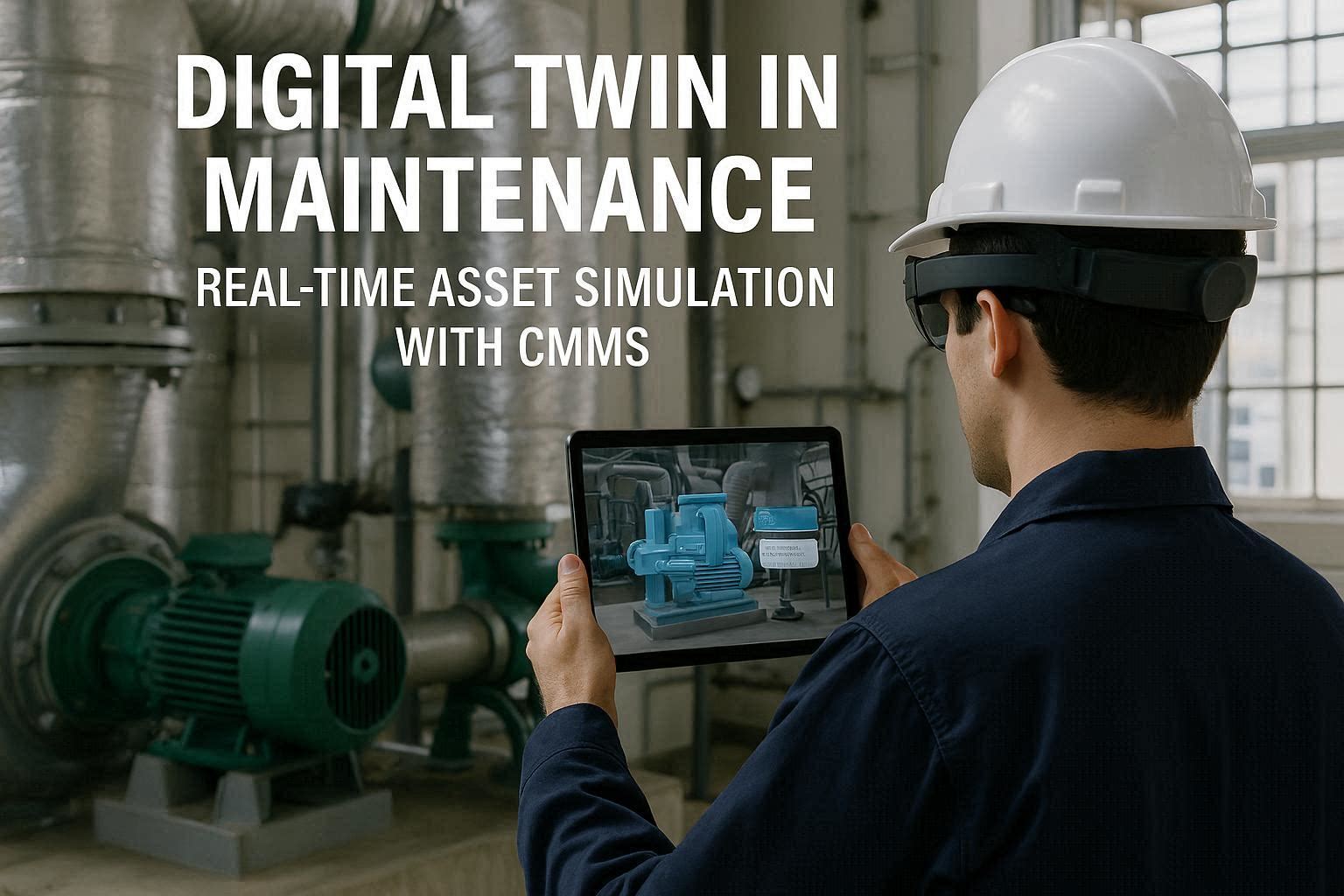
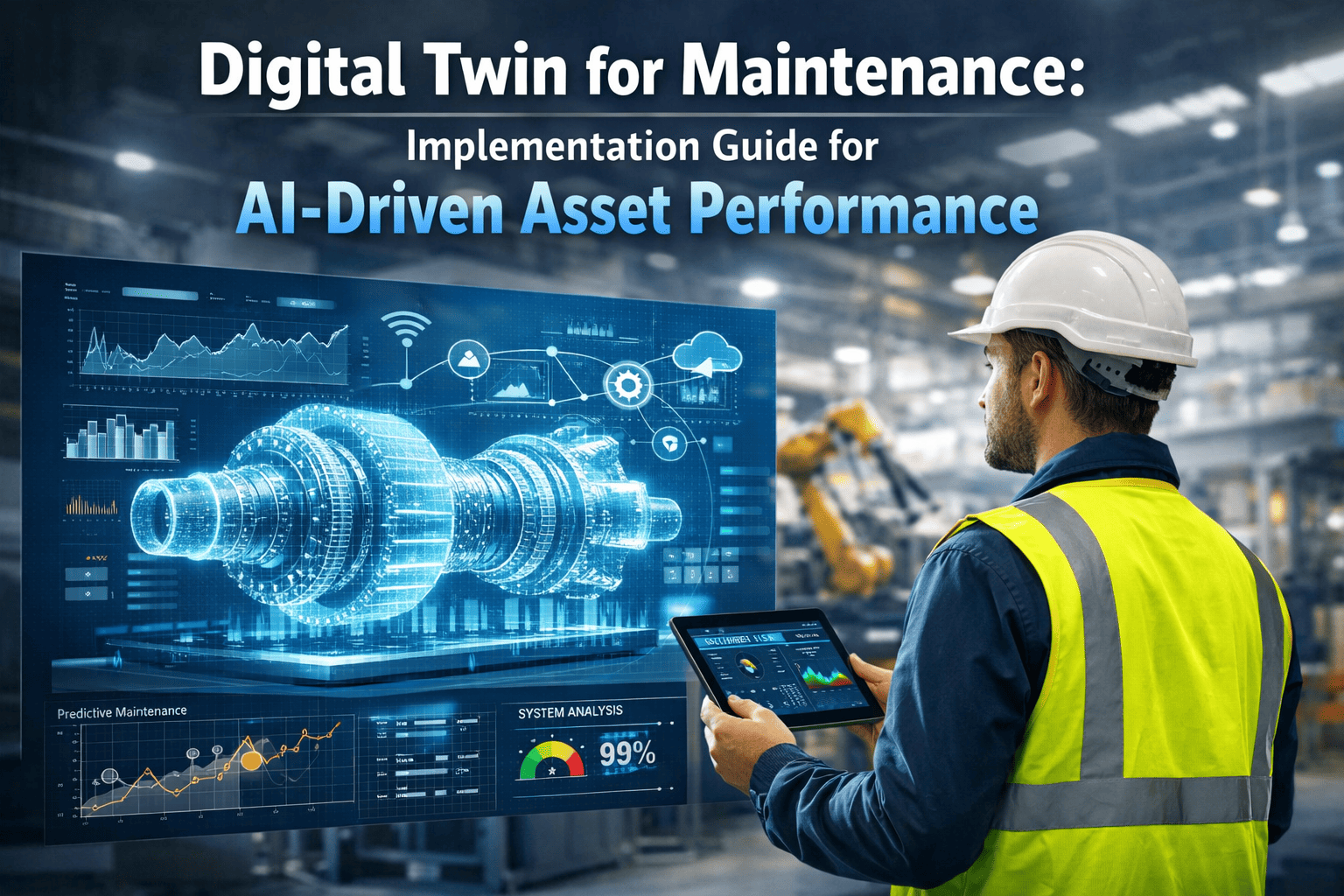
An HVAC digital twin lets you test control changes, staging strategies, and retrofits in simulation before touching the real system — turning "we think this will save energy" into a proven number. This guide covers physics-based vs data-driven vs hybrid models, the 4-layer architecture, ROI-positive applications, and where twins actually deliver versus stay vendor demos. Start free on OxMaint to begin twin data collection, or book a demo.
HVAC Digital Twins · Simulate Before You Change the Real System
Physics · data-driven · hybrid — chosen by what the question asks.
12%
HVAC's share of global energy consumption — the target every twin project ultimately measures against
9–14%
Documented HVAC energy savings from calibrated DT + predictive control in published case studies
R²=0.98
Calibration target — with CVRMSE ≤ 15% to satisfy ASHRAE Guideline 14 acceptance
12–18 mo
Typical compounded ROI window from a phased twin deployment tied to CMMS execution
BMS vs Digital Twin · The One-Line Distinction
Every twin conversation starts with the same clarification. A Building Management System dashboard tells you what's happening right now. A digital twin tells you what should be happening under those same conditions if the system were working as designed — and quantifies the gap.
BMS
Real-Time State Dashboard
Sensor values, setpoints, alarms, historical trends. Answers "what is the chilled-water supply temp right now?" — reactively.
Digital Twin
Simulated Counterfactual
Model of the same system that computes what supply temp SHOULD be at the current outdoor conditions and load. The gap is the fault, drift, or opportunity.
The 3 Model Types · Physics-Based, Data-Driven, Hybrid
Every HVAC digital twin sits in one of three model families, and the choice is not stylistic — it's driven by what question the twin needs to answer, what data is available, and how much the accuracy needs to survive extrapolation beyond historical operating ranges.
Type 01 · White-Box
Physics-Based
Built withFirst-principles equations · heat transfer, mass balance, thermodynamics · Modelica + Buildings Library, EnergyPlus, TRNSYS
Best whenTesting scenarios outside historical operating range · new equipment sizing · greenfield or major retrofit
Data needFull equipment specs, geometry, control logic, weather — modest sensor data for calibration
LimitsModeling effort is high · legacy systems with incomplete documentation are hard to represent accurately
Type 02 · Black-Box
Data-Driven
Built withMachine learning · regression / neural nets / gradient boosting trained on historical sensor + BMS data
Best whenRich sensor history exists · short-horizon prediction (1-hour to 24-hour ahead) · fault pattern detection
Data need6–12 months minimum high-resolution BMS + submeter + weather data covering all seasons
LimitsPoor extrapolation outside training range · limited interpretability · retraining required after major changes
Type 03 · Grey-Box
Hybrid — Emerging Standard
Built withPhysics-based core wrapped in ML surrogate · calibrated against sensor data · aligned to ISO 23247 hybrid DT architecture
Best whenMulti-zone systems, non-linear interactions, portfolio-scale optimization, real-time MPC applications
Data needPhysics inputs + sensor history · ML surrogate speeds physics model for real-time use
LimitsHighest build complexity · requires cross-functional team (controls, data science, HVAC engineering)
The 4-Layer Digital Twin Architecture · Where the Data Actually Flows
Every credible HVAC digital twin runs on the same four-layer architecture. Missing or under-scoping any layer is what makes a twin project stall at pilot — the vendor demo runs, but nothing operationalizes.
L1
Data Acquisition
BMS points, submeters, IoT sensors, weather data, occupancy signals — the raw inputs from the physical asset.
↓
L2
Transmission
Interface layer moving data between physical, model, and application layers — BACnet, MQTT, REST APIs, secure gateways.
↓
L3
Model Integration
Physics model, ML surrogate, or hybrid — the "brain" that turns data into predictions, anomaly detections, or optimization outputs.
↓
L4
Application & Visualization
Dashboards, alerts, MPC control outputs, and — critically — auto-generated work orders in the CMMS when the twin flags a fault or drift.
ROI-Positive Applications · Where Twins Actually Deliver
Digital twin projects live or die on picking the right use case. The six applications below have documented ROI in published case studies and represent the field-standard shortlist for a first HVAC twin deployment.
Use case 01
Chiller Staging Optimization
Multi-chiller plants where staging decisions across weather + occupancy patterns are non-linear. Twin explores staging combinations offline; best strategy pushed to BMS.
Use case 02
Model Predictive Control (MPC)
Twin forecasts 1–24 hr ahead using weather + occupancy predictions; controller pre-cools or pre-heats to minimize peak-load energy. 9–14% documented savings.
Use case 03
Fault Detection & Diagnostics
Twin computes expected behavior; live delta above tolerance auto-generates a diagnostic work order. Catches fouling, sensor drift, damper stuck weeks before BMS alarm.
Use case 04
Refrigerant Leak Probability
Vibration-temperature correlations feed leak-probability model. Predicted-leak-risk work order fires before charge loss becomes performance degradation.
Use case 05
Capital Planning "What-If"
Simulate the ROI of chiller replacement, VRF conversion, or heat-pump retrofit against 12 months of actual operating data. Finance-defensible without touching real equipment.
Use case 06
Testing, Adjusting & Balancing (TAB) Verification
Post-commissioning or post-retrofit, twin verifies that measured airflows, water flows, and setpoints match design intent — catches installation drift the day-of.
Start the Digital-Twin Data Foundation on OxMaint — Free Forever
Sign up on OxMaint's free forever plan and begin capturing the BMS, submeter, weather, and work-order data your twin will need. Even before the twin is live, the same foundation drives condition-based PMs and MTBF trending. No card, no time limit.
Why Twins Stall · The 5 Vendor-Demo Failure Modes
The academic literature notes a consistent pattern: strong physics-based cooling models get built, then never make the step from validated model to actionable optimization. Below are the five reasons DT projects stall at pilot.
Failure 01
No Integration Path to CMMS
Twin detects a fault; nothing generates a work order. Insight dies in the dashboard.
Failure 02
Wrong Model Type for the Question
Black-box ML deployed on a capital-planning question requiring extrapolation. Poor generalization = untrusted outputs.
Failure 03
Data Foundation Not Ready
Submetering sparse; BMS points not tagged; weather data absent. Model calibration fails or drifts fast.
Failure 04
No Clear ROI Target
"Deploy a digital twin" as the goal instead of "reduce chilled-water pumping energy 10%." No goal = no verification.
Failure 05
Ignoring the Feedback Loop
Twin ships v1 and never gets recalibrated. Real system drifts; twin becomes unreliable within 6–12 months.
Failure 06
No CMVP-Style Verification
Twin-claimed savings not verified against IPMVP / ASHRAE Guideline 14. Finance doesn't accept the ROI story.
Phased Adoption Roadmap · Rule-Based → Physics → AI-Hybrid
Successful DT rollouts don't try to instrument every unit on day one. They follow a tiered progression matched to asset criticality — quick wins early on distributed terminal equipment, physics-based twins on central plants where the money is, AI-hybrid twins on portfolio-scale optimization.
Phase 01 · Months 0–3
Rule-Based Twins on Terminal Units
VAV boxes, fan-coil units, RTUs — simple threshold rules from BMS points. Fast to deploy, catches obvious drift, builds team confidence.
Phase 02 · Months 3–9
Physics-Based Twins on Central Plants
Chillers, boilers, cooling towers — Modelica or equivalent physics models calibrated against 6–12 months of BMS + submeter data. Enables staging optimization + capital planning.
Phase 03 · Months 9–18
AI-Hybrid Twins on Whole-Building / Portfolio
Hybrid grey-box models with ML surrogates for real-time MPC and portfolio-scale optimization. Highest ROI, requires the earlier phases as prerequisites.
How OxMaint Runs the HVAC Digital Twin Program
The data acquisition, model integration, application layer, and CMMS work-order routing all run on one platform — physics or hybrid models fed by BMS + submeter + weather data, calibration tracked against ASHRAE Guideline 14 targets, and twin-detected faults auto-generating diagnostic work orders that the field team actually receives.
Foundation
BMS + Submeter + Weather Data
Continuous ingestion of BMS points, submeter readings, NOAA weather, and work-order history — the calibration and training foundation for any twin type.
Model
Physics · Data-Driven · Hybrid Supported
Tiered support — rule-based twins for terminal units, physics-based for central plants, AI-hybrid for portfolio optimization. Match the model to the question.
Calibrate
Guideline 14 Acceptance Targets
Model accuracy tracked against R² and CVRMSE targets. Recalibration triggered automatically when drift crosses threshold.
Detect
Twin Delta → Auto Work Order
Live gap between actual and twin-predicted behavior above tolerance auto-generates a diagnostic work order with the delta captured.
Simulate
What-If for Capital Planning
Run retrofit, replacement, or control-strategy scenarios against 12 months of actual operating data — finance-defensible ROI without touching real equipment.
Verify
IPMVP-Aligned Savings Reporting
Twin-claimed savings verified through weather-normalized post-retrofit measurement per IPMVP + ASHRAE Guideline 14. Finance accepts the number.
Move Your HVAC Program From Reactive to Simulated-First
Free forever plan — no card, no time limit. Start the data foundation your twin will need; the same data drives condition-based PMs and MTBF trending from day one. Or book 30 minutes and we'll walk your central plant twin path end-to-end on the platform.
Frequently Asked Questions
What's the difference between a BMS and an HVAC digital twin?
A Building Management System dashboard shows you what's happening right now — sensor values, setpoints, alarms, historical trends. A digital twin runs a model of the same system that computes what SHOULD be happening under those exact current conditions if the equipment were working as designed. The gap between actual and twin-predicted behavior is the fault, the drift, or the energy-optimization opportunity — the number that turns reactive maintenance into predictive maintenance and turns "we should probably do something about that chiller" into a work order with a specific delta on it.
Physics-based, data-driven, or hybrid — how do you choose?
Match the model to the question. Physics-based (white-box, built with Modelica / EnergyPlus / TRNSYS) is right when you need to test scenarios outside the historical operating range — capital planning, new equipment sizing, retrofit ROI. Data-driven (black-box ML) is right when you have 6–12 months of rich sensor history and need short-horizon prediction or fault-pattern detection. Hybrid (grey-box, aligned to ISO 23247) combines both — physics core wrapped in ML surrogates for real-time speed — and is the emerging standard for multi-zone systems, non-linear interactions, and portfolio-scale MPC applications.
What energy savings does the published research actually document?
Peer-reviewed case studies land in a 9–14% HVAC energy savings range from calibrated digital twin combined with predictive control. A semiconductor FAB study documented approximately 9.4% savings from a DT + AI predictive control framework replacing static control (R² = 0.98, CVRMSE = 1.22%, comfortably within ASHRAE Guideline 14 acceptance). A hybrid-ventilated office study documented 14% HVAC energy reduction plus 22% productivity improvement versus rule-based benchmark. Both required disciplined calibration and integration with the control layer to realize.
Why do digital twin projects stall at pilot?
Six recurring failure modes. No integration path to CMMS — twin detects the fault, nothing generates the work order. Wrong model type for the question — black-box ML deployed where physics extrapolation is needed. Data foundation not ready — sparse submetering, untagged BMS points. No clear ROI target — "deploy a digital twin" instead of "reduce pumping energy 10%." Feedback loop ignored — twin ships v1 and drifts within 6–12 months. And no CMVP-style savings verification per IPMVP or Guideline 14 — so finance never accepts the ROI story. Each is avoidable at plan time.
Book a demo to see the CMMS integration path.
Do we need to replace our existing BMS to deploy a digital twin?
No. A digital twin sits alongside the BMS — it reads BMS points via BACnet, MQTT, or REST APIs, adds submeter and weather data, runs the model, and writes back through the control layer or through the CMMS as auto-generated work orders. The BMS remains the real-time control system; the twin becomes the "what-should-be" comparison layer plus the offline what-if simulation environment. Phased deployment starts on the existing BMS foundation, with the CMMS integration providing the operational loop that turns twin insight into technician action.
Sign up free to start on your existing BMS today.