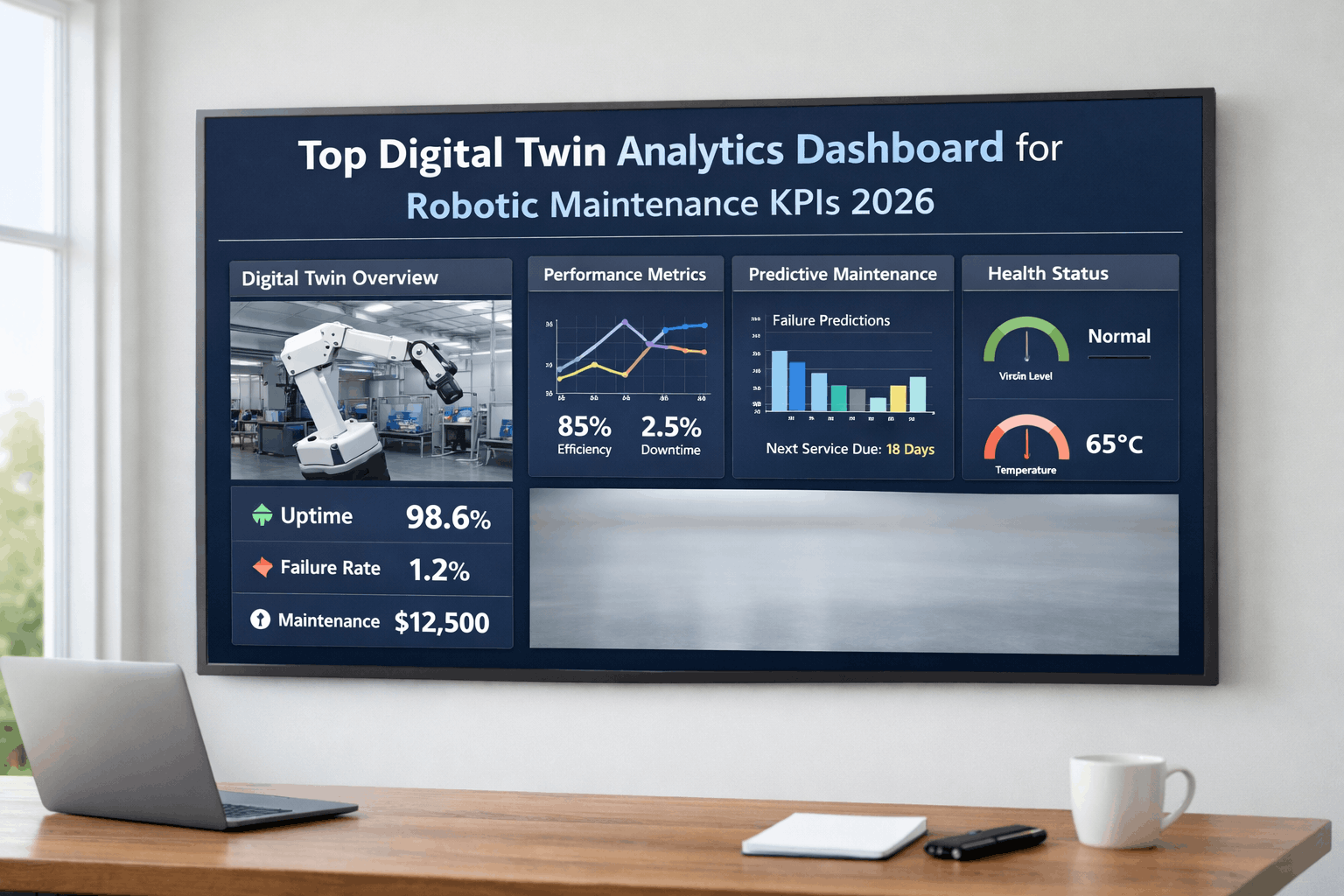
Top Open-Source Digital Twin Tools for Robotic Maintenance 2026
When your reliability engineer discovers that the €200,000 digital twin platform you licensed last year requires a six-figure renewal, locks your robot data inside a proprietary format, and still cannot connect natively to your CMMS—the true cost of closed-source digital twin technology becomes painfully clear. Meanwhile, a competitor running Eclipse Ditto on their own infrastructure, feeding twin state into an open CMMS via standard APIs, achieved 85% failure prediction accuracy at one-tenth of the licensing cost. In 2026, the open-source digital twin ecosystem has matured to the point where manufacturing teams can build production-grade predictive maintenance systems for robotic fleets without vendor lock-in, without per-robot licensing fees, and without surrendering control of their operational data.
This guide provides reliability engineers, automation architects, and maintenance directors with a comprehensive evaluation of the best open-source digital twin tools compatible with CMMS platforms for robotic maintenance in 2026. We cover Eclipse Ditto, NVIDIA Isaac, Azure Digital Twins (open SDK), ROS2-based twins, and emerging community frameworks—comparing capabilities, integration patterns, and total cost of ownership. Teams ready to build open, vendor-neutral predictive maintenance can start their free Oxmaint trial today.
Industry Reality
Why Open-Source Digital Twins Are Winning in 2026
70%
of manufacturers cite vendor lock-in as the top barrier to scaling digital twin deployments beyond pilot stage
80%
cost reduction achievable by replacing per-robot proprietary licences with open-source twin frameworks and open CMMS APIs
85%
failure prediction accuracy when combining open-source twins with CMMS-integrated automated repair workflows
Open-source digital twin tools have reached a critical maturity threshold. Eclipse Ditto manages twin state at enterprise scale, NVIDIA Isaac delivers GPU-accelerated physics simulation for robots, Azure Digital Twins provides an open DTDL modelling standard with portable SDKs, and ROS2 bridges live robot telemetry into any twin engine. The missing piece was never the technology—it was the integration architecture that converts twin predictions into automated CMMS actions. This guide provides that architecture.
The Open-Source Twin Deployment Lifecycle
Deploying open-source digital twins follows a structured lifecycle—just like proprietary platforms, but with fundamentally different economics and data ownership. Each phase requires specific tooling decisions, data pipeline architecture, and CMMS integration validation. The advantage: every component is replaceable, auditable, and owned by your team rather than a vendor.
Open-Source Digital Twin Deployment Framework
From open tooling selection to CMMS-integrated predictive intelligence
01
Select & Stack
Choose open-source components: Eclipse Ditto for state management, NVIDIA Isaac or Gazebo for simulation, ROS2 for robot connectivity
02
Connect & Ingest
Stream robot telemetry via MQTT/OPC-UA into twin state engine. Map sensor channels to digital twin properties with open schema definitions
03
Simulate & Predict
Run degradation models using open ML frameworks (PyTorch, scikit-learn). Compute RUL predictions from twin state without proprietary lock-in
04
Act via CMMS
Push predictions to Oxmaint via REST API for auto work order generation, parts forecasting, and production-aligned repair scheduling
The open-source approach gives maintenance teams full ownership of their data pipeline, model training, and integration logic. When predictions trigger CMMS work orders through standard APIs, your team can swap any component—twin engine, ML framework, or visualisation layer—without disrupting the maintenance workflow that your technicians rely on daily. Book a Demo.
Proprietary vs. Open-Source: The Architecture Decision
The choice between proprietary and open-source digital twin platforms is not merely a technology decision—it is a business architecture decision that affects data ownership, scaling costs, CMMS flexibility, and long-term vendor independence. Proprietary platforms offer faster initial setup but create dependency that compounds with every robot added. Open-source requires more upfront engineering but delivers accelerating advantages as your fleet grows.
Architecture Comparison: Proprietary vs. Open-Source
1
Proprietary / Closed Platform
Per-robot licensing fees that scale linearly with fleet size
Robot telemetry locked in vendor-specific cloud and formats
CMMS integration limited to vendor-approved connectors only
Model training restricted to vendor's proprietary analytics engine
Upgrade cycle controlled by vendor roadmap and pricing tiers
Multi-year contracts with significant switching costs
Single-vendor dependency for support, innovation, and data access
Locked-In & Expensive at Scale
2
Open-Source / Open Standards
Zero per-robot licensing—cost scales with infrastructure only
Data stored in open formats on your own infrastructure
CMMS integration via standard REST/MQTT APIs to any platform
ML models trained in any framework (PyTorch, TensorFlow, ONNX)
Upgrade on your timeline with community-driven releases
No vendor contracts—swap any component without disruption
Community + commercial support options for every layer
Owned, Flexible & Scalable
Choosing open-source does not mean choosing unsupported. Eclipse Ditto has enterprise backing from Bosch, NVIDIA Isaac offers commercial support tiers, Azure Digital Twins provides cloud-managed infrastructure with open DTDL ontologies, and CMMS platforms like Oxmaint provide API-first integration that works with any twin engine—open or proprietary.
Open-Source Twin Impact Metrics
Measured improvements from open-source twin deployments with CMMS integration
80%
Licence Cost Reduction
vs. Proprietary Platforms
85%
Prediction Accuracy
Open ML + Twin State
40%
Downtime Reduction
Predictive vs. Reactive
5–8x
ROI Return
Within 18 Months
Top Open-Source Tools: The Evaluation Matrix
Not all open-source digital twin tools serve the same purpose. Some manage twin state, others provide physics simulation, and others bridge robot telemetry. Building a production-grade system requires selecting the right tool for each layer and ensuring they integrate cleanly with your CMMS for automated work order generation. Below is the definitive evaluation for 2026. Book a Demo.
Best Open-Source Digital Twin Tools for Robotic Maintenance
Eclipse Ditto
IoT digital twin state management. Stores and exposes twin state via HTTP/WebSocket APIs. Handles thousands of twins at scale. Best for: CMMS integration layer and state synchronisation.
NVIDIA Isaac Sim
GPU-accelerated physics simulation for robots. Photorealistic rendering and accurate contact dynamics. Best for: degradation simulation, RUL modelling, and what-if scenario analysis.
Azure DT (Open SDK)
DTDL-based modelling with open SDK and portable ontology definitions. Cloud-managed with open client libraries. Best for: enterprises needing managed infrastructure with open data models.
ROS2 + Gazebo
Robot telemetry bridge and physics simulator. Native connectivity to any ROS2-compatible robot via open topics. Best for: real-time data ingestion and simulation validation.
The Economics: Open-Source vs. Proprietary TCO
The financial case for open-source digital twins becomes overwhelming at fleet scale. While proprietary platforms charge per-robot licences that multiply linearly, open-source costs are dominated by one-time engineering and fixed infrastructure—making every additional robot nearly free to twin. The comparison below illustrates real-world economics for a 50-robot manufacturing facility over 24 months.
TCO Calculator: Open-Source vs. Proprietary Digital Twin
Based on a 50-robot manufacturing facility over 24 months
Proprietary Platform
Platform licence (50 robots × $2K/yr)$200,000
Cloud compute & data storage$60,000
CMMS connector licence & middleware$35,000
Professional services & customisation$80,000
24-Month Cost: $375,000
VS
Open-Source Stack + CMMS
Open-source licences (Eclipse Ditto, ROS2)$0
Infrastructure (self-hosted / cloud VM)$30,000
Engineering & integration labour$55,000
Oxmaint CMMS subscription$18,000
24-Month Cost: $103,000
Beyond direct cost savings, open-source deployments deliver strategic advantages: data portability ensures you never lose access to your operational history, community-driven innovation keeps tools current without vendor-gated upgrades, and open APIs mean your CMMS integration works with any future twin engine you choose.
Connect Open-Source Twins to Automated Maintenance
Oxmaint's open API ingests twin state from Eclipse Ditto, NVIDIA Isaac, ROS2, or any custom twin engine—automatically generating prioritised work orders, scheduling repairs during production windows, and tracking every robot component's remaining useful life without vendor lock-in.
Deploying open-source digital twins for robotic maintenance is a maturity journey—just like proprietary deployments, but with full transparency and control at every stage. Start with state management and sensor connectivity, progress to predictive modelling with community-trained ML frameworks, and scale to fleet-wide autonomous scheduling with CMMS-integrated automation.
Open-Source Twin Maturity Model
Level 1
Foundation — Connect & Mirror (Months 1-3)
Eclipse Ditto DeploymentMQTT Telemetry PipelineTwin State Schema DesignAsset Registry in CMMS
Level 2
Predictive — Model & Forecast (Months 4-9)
PyTorch / scikit-learn RUL ModelsNVIDIA Isaac SimulationAuto CMMS Work OrdersOpen Parts Forecasting
Level 3
Autonomous — Optimise & Scale (Months 10+)
Fleet-Wide Twin SyncSelf-Learning Open ModelsProduction-Aligned SchedulingCommunity Model Sharing
Start by deploying Eclipse Ditto for twin state management and MQTT pipelines for sensor ingestion. Build baseline operating signatures during the first 90 days. As your open-source models accumulate confirmed failure data, introduce community-trained ML models for RUL prediction and connect predictions directly to Oxmaint CMMS for automated work order generation and spare parts forecasting.
Open-Source Twin Compatibility Across Robot Types
Open-source digital twin tools work across the full spectrum of industrial robotics—from articulated arms and SCARA robots to collaborative cobots and AGV/AMR fleets. Because the tooling uses open protocols (ROS2, MQTT, OPC-UA), any robot that exposes telemetry data can be twinned without OEM-specific connectors or proprietary middleware.
Vendor-Neutral Twin Coverage Across Robot Types
Open-source predictive maintenance for every automation platform
Articulated Arms
SCARA Robots
Delta / Parallel
Collaborative Cobots
AGV / AMR Fleets
Gantry Systems
Welding Robots
Palletizing Cells
Open Protocol Connectivity
ROS2, MQTT, OPC-UA, and REST APIs connect any robot OEM—FANUC, ABB, KUKA, Yaskawa, UR—without proprietary drivers or vendor-specific middleware.
Community-Trained Models
Leverage pre-trained failure prediction models shared by the open-source community for common components—bearings, servos, harmonic drives—reducing model development time by 60%.
Zero Licence Cost per Robot
Scale from 5 robots to 500 without per-unit licensing fees. Cost scales with infrastructure compute, not fleet size—making fleet expansion financially trivial.
Build vendor-neutral predictive maintenance across your entire fleetGet Started →
By standardising on open protocols and community-supported tooling, manufacturers gain true fleet-level visibility without vendor dependency. This enables smarter capital planning, competitive spare parts sourcing, and the freedom to benchmark and switch any component of the twin stack as better tools emerge. Book a Demo.
Build Your Open-Source Robot Twin System
Join forward-thinking manufacturers using open-source digital twins with Oxmaint CMMS to turn predictions into automated maintenance actions. Own your data, control your models, and eliminate vendor lock-in while maximising robot uptime and fleet reliability.
What is Eclipse Ditto and how does it work for robotic maintenance?
Eclipse Ditto is an open-source framework for managing digital twin state at scale. It stores a virtual representation of each physical robot—including current sensor readings, component health status, and operational parameters—and exposes this state via HTTP and WebSocket APIs. For robotic maintenance, Ditto acts as the central twin state engine: sensor data from robots streams in via MQTT, Ditto maintains the current state of every component, and downstream systems (CMMS, analytics, dashboards) query Ditto's API to retrieve real-time twin status. It handles thousands of twins simultaneously, making it ideal for large robotic fleets.
Can open-source tools match proprietary platform prediction accuracy?
Yes. Prediction accuracy depends on data quality, model architecture, and training data—not on whether the platform is open-source or proprietary. Teams using open ML frameworks like PyTorch or scikit-learn with properly curated failure data routinely achieve 80-90% prediction accuracy for common robotic failure modes (bearing wear, servo degradation, harmonic drive fatigue). The key advantage of open-source is that your data scientists can choose the best model architecture for each failure mode, rather than being constrained to a vendor's pre-built analytics engine. Sign up free to see how open twin predictions flow into CMMS work orders.
How does NVIDIA Isaac fit into an open-source twin stack?
NVIDIA Isaac Sim provides GPU-accelerated physics simulation for robots—accurate contact dynamics, kinematics, and thermal modelling. In an open-source twin stack, Isaac serves as the simulation layer: it runs accelerated degradation scenarios to predict how components will wear under specific load profiles. Isaac's simulation outputs (predicted wear rates, stress distributions, thermal profiles) feed into the twin state engine (Eclipse Ditto) and ML prediction models, which then trigger CMMS work orders when RUL thresholds are crossed. Isaac is free for individual use and has commercial tiers for enterprise deployment.
How do open-source twins integrate with a CMMS like Oxmaint?
Integration follows a clean API pattern. The twin state engine (Eclipse Ditto) or your ML prediction service monitors component RUL values. When a component's predicted remaining life crosses a configurable threshold (e.g., 21 days), it sends a structured alert payload to Oxmaint's REST API containing: component ID, predicted failure date, failure mode, confidence score, and recommended repair action. Oxmaint auto-generates a prioritised work order with all evidence attached, schedules it against production calendars, and tracks repair execution. Confirmed outcomes feed back into the ML models for continuous improvement. Book a demo to see the integration pipeline in action.
What is the typical timeline and cost for an open-source twin deployment?
A pilot deployment on 5-10 robots typically takes 10-14 weeks: 3 weeks for Ditto setup and telemetry pipeline, 4 weeks for baseline data collection and twin schema design, and 3-4 weeks for initial ML model training and CMMS integration. Infrastructure costs are minimal—a single cloud VM or on-premise server handles 50+ twins. The primary investment is engineering labour ($40K-$70K for the pilot phase). Scaling to full production adds incremental infrastructure cost but near-zero per-robot licensing. Most teams achieve ROI within 6-8 months from avoided unplanned downtime and optimised maintenance scheduling alone.