The cost of industrial IoT sensor hardware has dropped 85% since 2019. A vibration monitoring node that cost $600 per point in 2019 now costs under $50 in 2026 — crossing the threshold where predictive maintenance via sensor-based condition monitoring delivers positive ROI on assets valued at $5,000 or more. This price collapse is why IoT-based predictive maintenance has moved from a large-enterprise differentiator to a mainstream operational tool for mid-size manufacturing plants, commercial facilities, and multi-site industrial portfolios. But the technology selection, deployment sequence, and integration architecture still separate operations that get results from those that buy hardware and produce dashboards nobody acts on. This guide covers every sensor type, deployment decision, cost benchmark, and integration consideration your team needs to build an IoT predictive maintenance program that actually reduces downtime — not just generates data. For teams ready to connect sensor data to automated work order generation, start a free trial with OxMaint or book a demo to see the IoT edge hub in action.
IoT Maintenance Guide 2026 Sensor Selection and Deployment Complete Reference
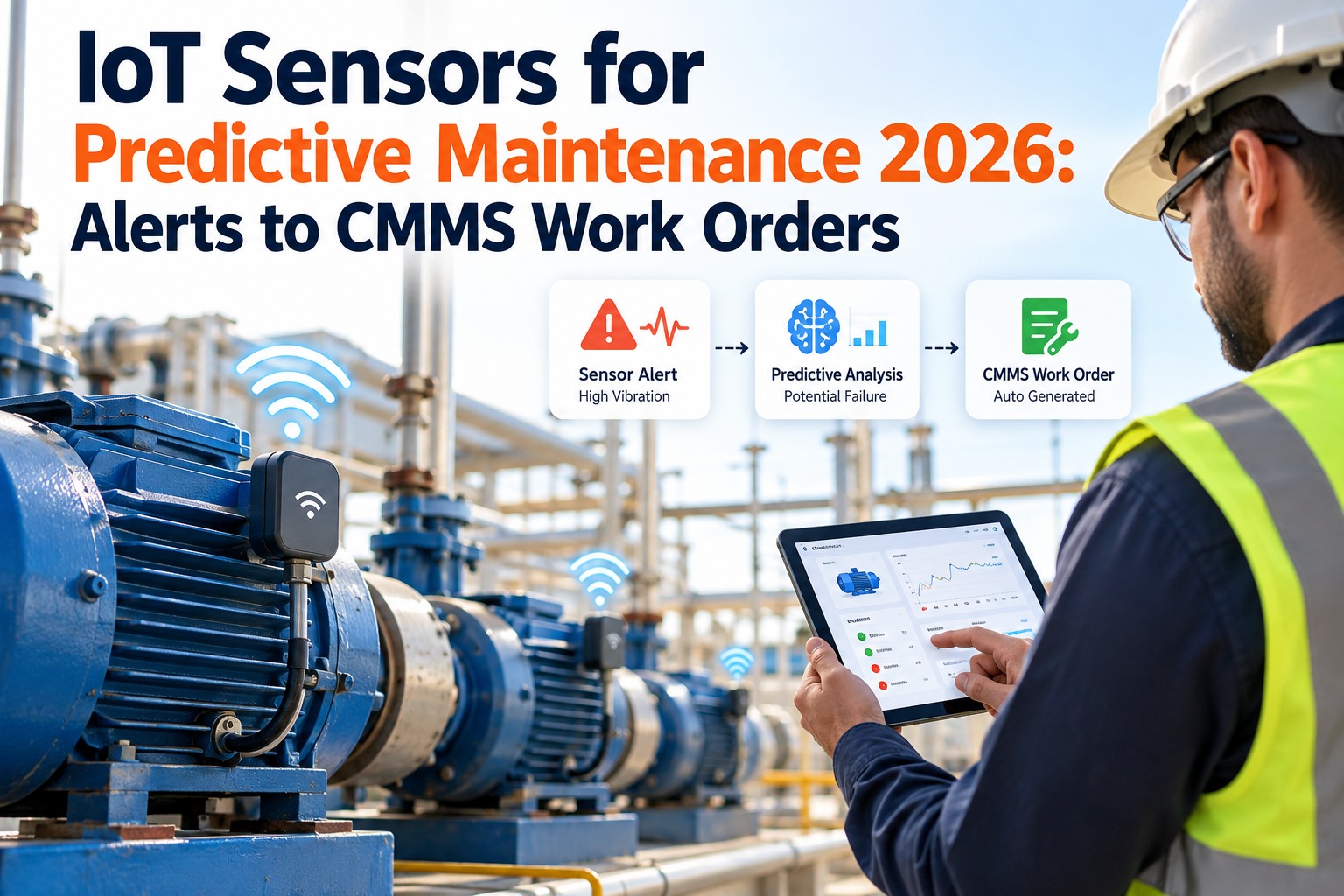
IoT Sensors for Predictive Maintenance: The Complete 2026 Deployment Guide
Sensor types, cost benchmarks, deployment sequence, protocol selection, and integration architecture — everything needed to build an IoT predictive maintenance program that delivers measurable downtime reduction, not just data.
$47
Average 2026 cost per wireless vibration monitoring node
85%
IoT sensor hardware cost reduction since 2019
43%
Of industrial breakdowns caught by vibration monitoring alone
2.3x
Average ROI within 12 months on a 20-node sensor deployment
OxMaint IoT Edge Hub — Under $50 Per Node, Connected to AI Work Order Generation
OxMaint's IoT edge hub supports sub-$50/node wireless sensors out of the box. Sensor alerts automatically generate prioritized work orders. No additional analytics platform required. Free for 30 days.
The Six IoT Sensor Types That Cover 90% of Industrial Failure Modes
No single sensor type catches every failure mode. Industrial predictive maintenance programs that deliver 50%+ downtime reduction use a portfolio of sensor types matched to the specific failure modes of each asset class. These six sensors address 90%+ of industrial breakdown scenarios — and in 2026, all six are available at costs that deliver positive ROI on assets valued above $5,000. The key is matching the right sensor to the right asset based on its dominant failure mode, not deploying every sensor type on every machine. Teams ready to build their sensor portfolio can start a free trial or book a demo to map sensor types to their specific asset inventory.
Catches: Bearing wear, shaft misalignment, mechanical imbalance, looseness, gear tooth damage
Best for: Motors, pumps, fans, compressors, gearboxes, conveyor drives — any rotating equipment
Fault lead time: 4–12 weeks before failure on most bearing defects
Catches 43% of all industrial equipment failures — highest single-sensor coverage of any type
Catches: Bearing thermal degradation, motor winding overheating, electrical hotspots, lubrication failure, cooling system faults
Best for: Motors, electrical panels, transformers, bearings, heat exchangers, process piping
Fault lead time: 2–8 weeks for thermal anomalies that precede mechanical failure
Detects 28% of industrial failures — second most effective single-sensor type after vibration
Catches: Motor degradation, load imbalance, winding faults, efficiency decline, soft foot conditions
Best for: Electric motors — provides condition monitoring without physical contact with rotating parts
Fault lead time: 2–6 weeks — excellent non-intrusive option for hazardous or inaccessible installations
Motor current signature analysis (MCSA) detects 70%+ of motor winding faults before thermal runaway
Catches: Pump cavitation, filter plugging, seal degradation, valve erosion, pipe blockage, hydraulic system faults
Best for: Hydraulic systems, pneumatic circuits, process pumps, filter housings, compressed air systems
Fault lead time: 1–4 weeks — pressure deviations often precede catastrophic pump or valve failure
Differential pressure monitoring on filters reduces unexpected filter failure events by 65%
Catches: Compressed air and gas leaks, steam trap failures, early bearing defects (earlier than vibration), electrical arcing, partial discharge
Best for: Compressed air systems, steam distribution, electrical switchgear, bearings in early defect stage (Stage 1)
Fault lead time: 6–16 weeks — catches bearing defects earlier than vibration sensors alone
Ultrasonic leak detection in compressed air systems saves $8,000–$25,000 per year in energy per facility
Catches: Lubricant contamination, wear particle generation (early gear and bearing failure), coolant degradation, hydraulic fluid moisture ingress
Best for: Gearboxes, hydraulic systems, large rotating machinery — wherever lubricant quality directly affects component life
Fault lead time: 4–20 weeks — wear particle count increases measurably long before physical failure
Online oil quality monitoring reduces gearbox failure rate by 35% vs. scheduled oil change programs
Sensor-to-Asset Matching Matrix — Which Sensor for Which Equipment
Deploying the wrong sensor type on an asset wastes budget and generates data with limited predictive value. This matching matrix reflects industry-validated deployment patterns for common industrial and commercial equipment types across manufacturing, facilities, and process operations.
| Asset Type | Vibration | Temperature | Current | Pressure | Ultrasonic | Oil Quality |
| Electric Motors | Primary | Primary | Primary | Rarely | Secondary | Rarely |
| Centrifugal Pumps | Primary | Secondary | Secondary | Primary | Secondary | Rarely |
| Gearboxes | Primary | Primary | Rarely | Rarely | Secondary | Primary |
| Compressors | Primary | Primary | Primary | Primary | Secondary | Secondary |
| HVAC Air Handlers | Primary | Primary | Secondary | Primary | Rarely | Rarely |
| Hydraulic Systems | Secondary | Secondary | Rarely | Primary | Secondary | Primary |
| Electrical Panels | Rarely | Primary | Primary | Rarely | Primary | Rarely |
| Conveyor Systems | Primary | Secondary | Secondary | Rarely | Secondary | Rarely |
IoT Pain Points — Why Sensor Programs Fail Without the Right Platform
The technology barrier for IoT sensors has been overcome. The implementation barrier has not. These four failure patterns account for the majority of IoT predictive maintenance programs that generate data but do not reduce downtime.
01
Data Without Action — The Dashboard Graveyard
Sensor data streams into a monitoring platform that generates charts. Nobody has defined what action to take when a threshold is crossed. Alerts get ignored because they are not connected to the work order system. 60% of sensor alerts in disconnected deployments never generate a maintenance action.
Fix: Connect sensor alerts directly to automated CMMS work order generation
02
Alert Fatigue From Poorly Calibrated Thresholds
Static threshold alerts (temperature above 80°C = alert) generate false positives constantly during normal production variation. Technicians stop trusting the system within 60 days. AI-based anomaly detection that learns normal operational patterns reduces false positives by 92% compared to static thresholds.
Fix: Use AI anomaly detection, not static thresholds, for alert generation
03
Wrong Sensor on the Wrong Asset
Deploying vibration sensors on hydraulic systems or pressure sensors on rotating equipment produces data with limited predictive value for the failure modes that actually affect those assets. Budget gets consumed on monitoring that does not catch the failures causing downtime.
Fix: Use failure mode analysis to select sensor type before purchasing hardware
04
Network and Connectivity Gaps Interrupting Data Streams
Wireless sensor deployments in metal-dense industrial environments experience signal interference and coverage gaps. Data streams drop. Gaps in time-series data corrupt ML model training and produce false alerts when data resumes. Edge computing on the sensor node itself mitigates this — data is processed locally and synchronized when connectivity restores.
Fix: Deploy edge-processing sensors with local data buffering for connectivity resilience
How OxMaint's IoT Edge Hub Solves the Integration Problem
The gap between sensor hardware and actionable maintenance intelligence is where most IoT predictive maintenance programs stall. OxMaint closes this gap with an IoT edge hub that connects sub-$50 wireless sensor nodes to AI anomaly detection and automated work order generation — in a single platform without middleware or additional analytics tools. Teams managing the integration gap firsthand can start a free trial or book a demo to see the complete data-to-work-order flow.
Protocol
Multi-Protocol Support Out of the Box
Modbus TCP/RTU, MQTT, OPC-UA, BACnet, and REST API supported natively. Connect wireless sensor nodes, existing SCADA systems, PLCs, and BMS simultaneously. No middleware or custom integration required.
Average integration time: 4–8 hours for standard industrial protocols
Edge AI
On-Device Anomaly Detection
AI anomaly detection runs at the edge hub — not in the cloud. Sensor data is processed locally with sub-100ms latency. No connectivity dependency for alert generation. Data is synchronized to the cloud when available, with full buffering during outages.
Under 4% false positive rate after 30-day baseline learning period
Auto-Generate
Sensor Alert to Work Order in Zero Minutes
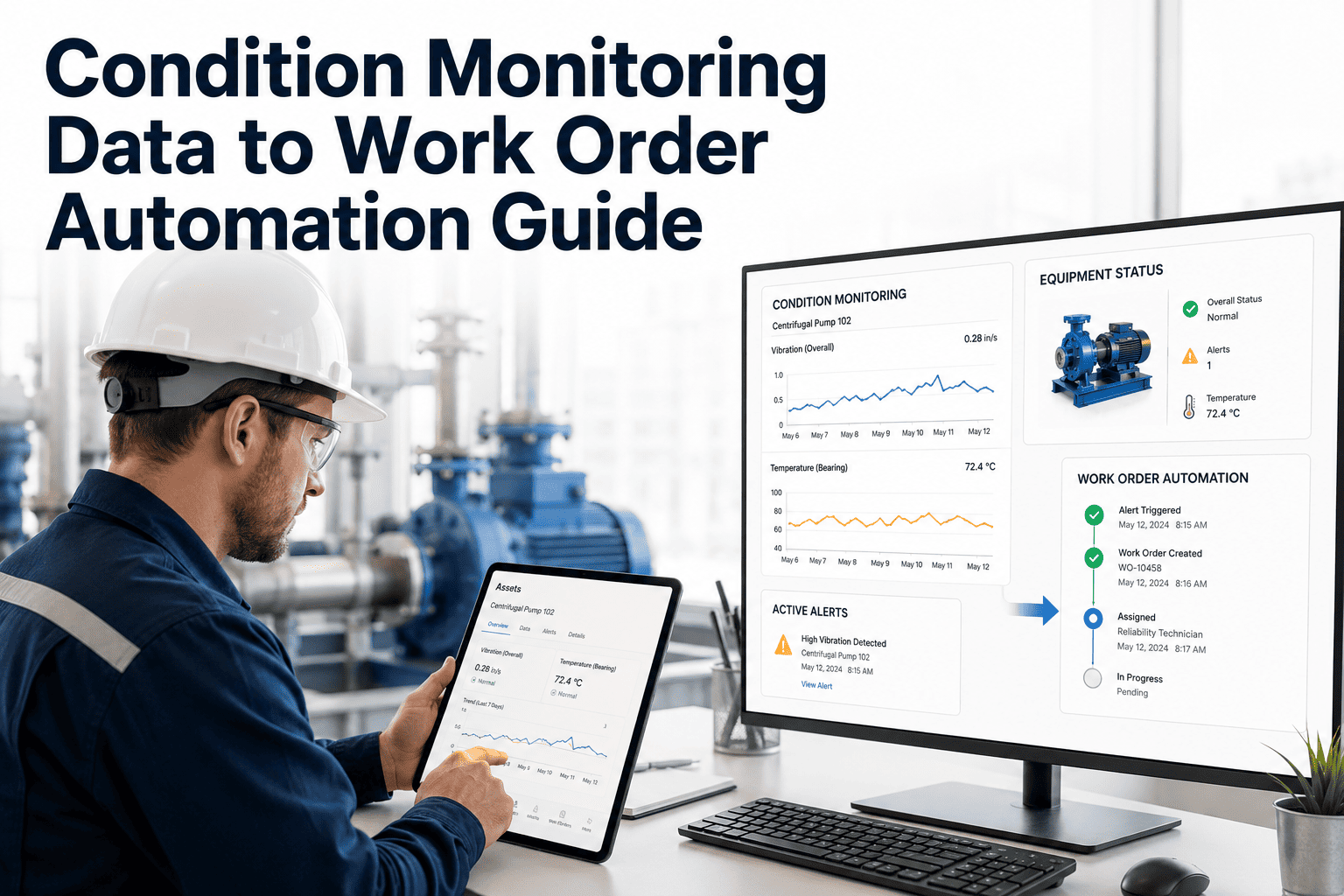
When edge AI detects an anomaly, OxMaint automatically generates a CMMS work order with fault diagnosis, asset context, recommended action, parts list, and technician assignment. No human intervention required in the alert-to-action path.
80% reduction in time between fault detection and technician dispatch
Sub-$50
Validated Low-Cost Sensor Node Support
OxMaint's IoT hub is validated with the leading sub-$50 wireless vibration and temperature sensor nodes — including SKF Enlight Collect IMx-1, Samsara CM32, and compatible MEMS accelerometer nodes. Deployment guides and configuration templates included.
20-asset deployment hardware cost under $8,000 with validated sensor recommendations
Deployment Phases — Building a 20-Asset IoT PdM Program in 90 Days
The most effective IoT predictive maintenance deployments follow a phased approach that prioritizes high-criticality assets, validates ROI early, and expands based on demonstrated results — rather than attempting full-site sensor coverage from day one.
Rank all assets by criticality: downtime cost per hour, failure frequency, and lead time to source replacement parts
Select your 20 highest-criticality assets — these become Phase 1 monitoring targets
Map failure modes for each asset using FMEA or maintenance history — determine which sensor type matches each failure mode
Specify hardware: sensor type, quantity, wireless protocol, and mounting requirements per asset
Budget baseline: 20-asset deployment with vibration + temperature sensors typically $6,000–$12,000 hardware cost
Install sensor nodes — wireless vibration and temperature sensors mount in under 20 minutes per asset point
Connect to OxMaint IoT edge hub — configure data streams and asset associations in CMMS
AI baseline learning period: 14–30 days of normal operational data to establish asset-specific behavioral baselines
Configure alert escalation paths and work order generation rules per asset criticality tier
Train technicians on mobile alert acknowledgment and work order completion with sensor context
AI anomaly detection active — alerts generating with fault context and severity scoring
Track first validated fault detections — document avoided breakdown cost per event
Measure false positive rate — target under 4% after 30 days of learning
Calculate 90-day ROI: avoided breakdown cost versus sensor hardware and platform cost
Identify next expansion tier: which additional assets justify sensor investment based on Phase 1 results
IoT PdM ROI Benchmarks — The Numbers That Build Business Cases
$47
Average Node Cost
Wireless vibration + temperature — 2026 market benchmark
$8K
20-Asset Deployment Hardware
Complete vibration + thermal monitoring, mid-size facility
2.3x
12-Month ROI
Average across manufacturing and commercial facility deployments
50%
Downtime Reduction
On assets with active sensor monitoring vs. calendar PM baseline
Frequently Asked Questions
How many sensors does a typical 50,000 sq ft manufacturing facility need?+
A 50,000 sq ft manufacturing facility with 40–80 significant mechanical assets typically deploys 60–120 sensor monitoring points across Phase 1 and Phase 2. The 80/20 rule applies — start with 20–30 sensor points on your 10–15 highest-criticality assets. This covers the assets responsible for 80%+ of downtime cost. At $47 per node average, a 20-point deployment runs $940 in hardware — an investment that pays back from a single avoided emergency repair event.
Book a demo for a specific sensor count estimate based on your asset inventory.
What wireless protocol should we use for industrial sensor networks?+
For most industrial environments, the 2026 recommendation is LoRaWAN for long-range, low-power sensor networks in large facilities — coverage up to 2km in industrial settings, 10-year battery life on vibration nodes, and strong performance in metal-dense environments. For facilities with existing Wi-Fi infrastructure and shorter distances, Wi-Fi 6 (802.11ax) sensor nodes provide higher data bandwidth for high-frequency vibration sampling (10kHz+). Bluetooth 5.0 mesh is a cost-effective option for compact facilities. OxMaint's edge hub supports all three protocols simultaneously.
Can IoT sensors work on legacy equipment without OEM digital interfaces?+
Yes — this is the most common deployment scenario. Wireless vibration and temperature sensors mount externally to any mechanical asset using magnetic or adhesive mounts. They measure the asset's external condition signals — vibration signature, bearing housing temperature, surface temperature — without any integration with the machine's internal controls or OEM software. Legacy equipment from the 1980s and 1990s is routinely monitored with modern IoT sensors. No OEM involvement or protocol compatibility required.
How does edge computing change the IoT sensor architecture?+
Edge computing processes sensor data at the local hub — on-site — rather than sending raw data streams to a cloud server for analysis. The benefits for maintenance are significant: sub-100ms alert latency versus 2–15 seconds for cloud-only processing; full functionality during internet outages with local data buffering; reduced cloud data transmission costs (edge pre-processes and only sends anomaly events, not raw time-series); and improved data privacy for sensitive production environments. OxMaint's edge hub runs AI anomaly detection models locally — alerts generate even when the facility has no internet connectivity.
IoT PdM with OxMaint
Turn $47 Sensors Into $50,000 Breakdown Prevention.
OxMaint's IoT edge hub connects sub-$50 wireless sensor nodes to AI anomaly detection and automatic work order generation — without additional analytics platforms, middleware, or integration consultants. Deploy a 20-asset monitoring program in 90 days. Measure ROI in 90 days. Expand based on results.
$47
Per-node sensor cost supported
90 Days
To measurable downtime reduction
2.3x
Average 12-month ROI
$0
Platform implementation fees